
Search
Category
- Bollard Light
- Commercial Lighting
- Energy-Efficient Lighting
- LAMPS
- LED Lights
- LED Uplighter
- Light and Colour Theory
- Lighting Design and Facade Lighting
- Lighting Design Consultancy UAE
- lighting design principles
- Lighting Fundamentals and Design Principles
- Lighting Solutions
- Nature of Light in Lighting Design
- Panel Lights vs. Spot Lights
- Portable Lights
- Signage Solutions
- Smart Controllers for Streetlights
- Solar Lights
- Tree Lighter
- Uncategorized
Recent Posts



Commercial Signage Solutions UAE & GCC

Canadian Bespoke Lights
Tags
- Architectural Lighting
- Architectural Lighting Design
- Architectural Lighting Design UAE
- automation
- Best Lighting Design Consultancy in UAE
- COB LED Technology
- COB Spotlights
- Color Temperature in Lighting
- Commercial Lighting Design
- Commercial Lighting Fixtures
- Commercial Lighting Innovations
- Commercial Lighting UAE
- Cylinder COB Lights
- Dialux Lighting Design
- Dialux Lighting Design UAE
- Energy Efficient Lighting
- Energy-Efficient Lighting USA
- Exterior Lighting Solutions
- Facade & Exterior Lighting
- Facade Lighting
- Facade Lighting Design
- Facade Lighting Design UAE
- Facade lighting ideas
- Facade Lighting UAE
- Facade Uplighting
- Green Building Design
- Indoor & Exterior Lighting Solutions
- Interior Lighting Design
- Lamps
- LED Lighting Solutions
- LED lights
- LED Panel
- LED Uplighters
- LED vs Halogen
- Light and Color Theory
- Lighting Basics
- Lighting Consultancy UAE
- Lighting Design
- Lighting Design Consultancy in UAE
- Lighting Design Principles
- Lighting Design UAE
- Lighting Fundamentals Guide
- Lighting Layers
- Lumen Output in Lighting
- Modern Building Lighting Ideas
- Modern Lighting Ideas
- Office Lighting Solutions
- Outdoor Lighting Consultants UAE
- Panel Lights vs. Spot Lights
- Portable Lights
- smart light
- Smart Lighting Systems
- Sustainable Architecture
- Sustainable Lighting UAE
- Villa Lighting UAE
28Apr 2026
- Nature of Light in Lighting Design


Nature of Light in Lighting Design: Complete Technical Guide for Professionals
Introduction to the Nature of Light in Lighting Design
Light is a complex medium with which to work. While light itself is understood by science, how humans perceive it remains not fully understood. Different people react to light in different ways. It is therefore important in Lighting Design to be sensitive to what people like and dislike about certain properties of light—especially in diverse environments such as residential and commercial projects across Dubai, United Arab Emirates, and the United States.
The Nature of Light in Lighting Design focuses only on visual light. Visual light is the emission of energy within a certain bandwidth range known as the visual spectrum.
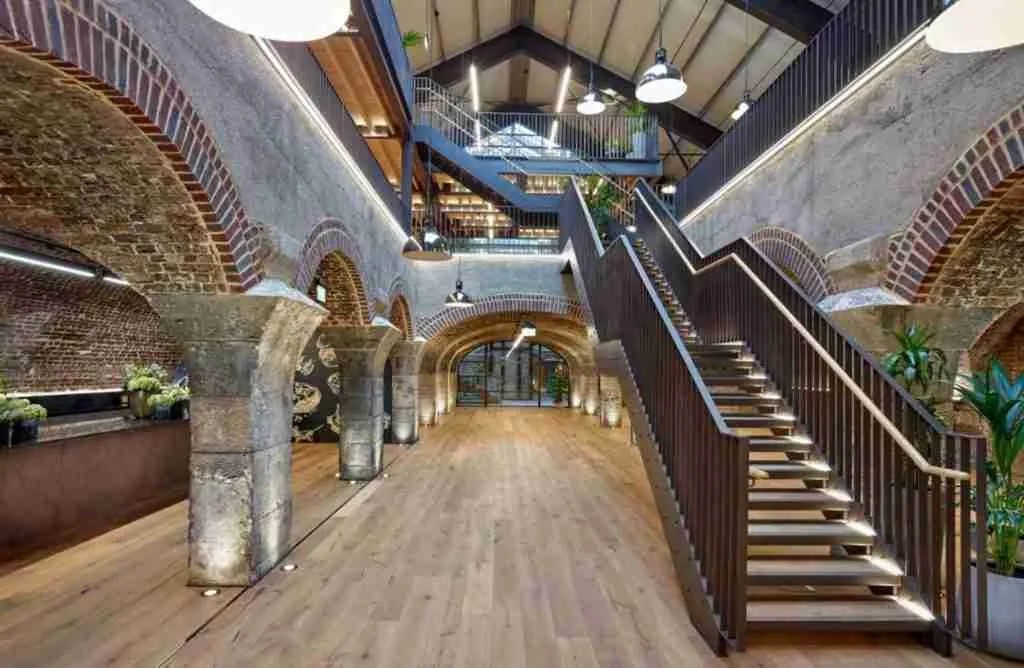
Visual Spectrum (390nm–700nm)
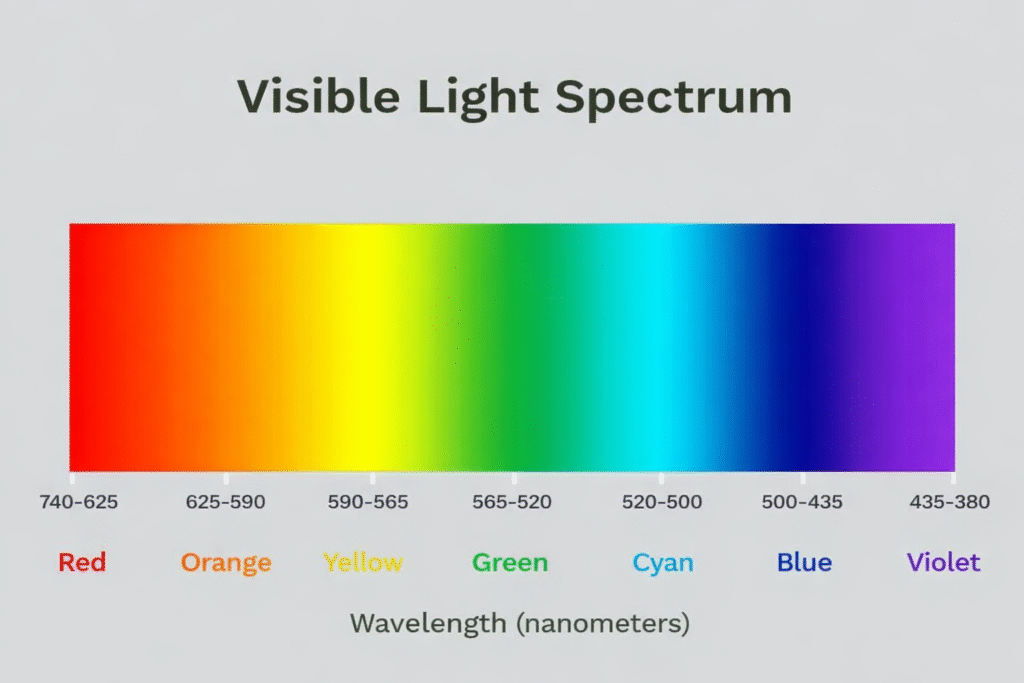
The visible range of light generally lies between 390 nanometers (nm) and 700 nanometers (nm), although this may vary slightly from person to person.
Light can be:
- Received directly from a light source such as a lamp
- Seen as a reflection of other objects
The colour of objects is determined by the light reflected from their surfaces and received by the eye.
How Light Travels in Lighting Design
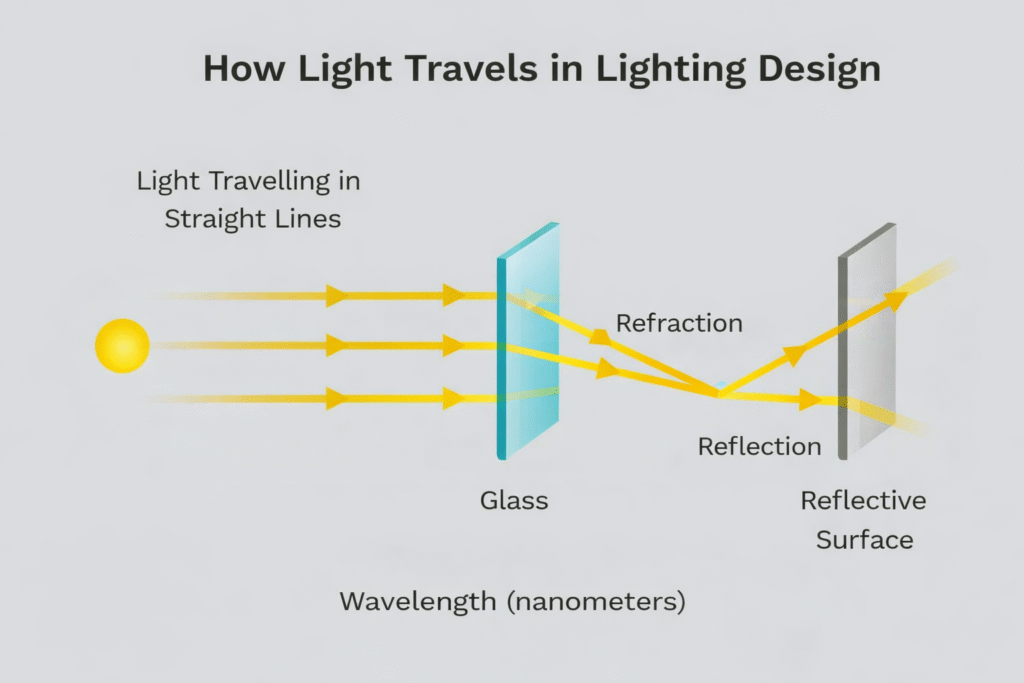
Light travels in straight lines. This makes it possible to predict where light will fall within a room. In professional Lighting Design, standard mathematics can determine:
- Whether a light source will be visible
- Whether glare will occur
- Whether light will fall on a specific surface
These principles are applied consistently in lighting projects worldwide—from modern offices in the United Kingdom to large-scale developments in Saudi Arabia and Kuwait.
Total Internal Reflection
If light contacts glass at a very shallow angle, almost parallel to the surface, it will not penetrate it. Instead, it reflects away similar to a mirror. This is known as total internal reflection.
Properties of Light and Electricity in Lighting Design
Understanding measurable properties is fundamental to accurate Lighting Design.
Luminous Intensity
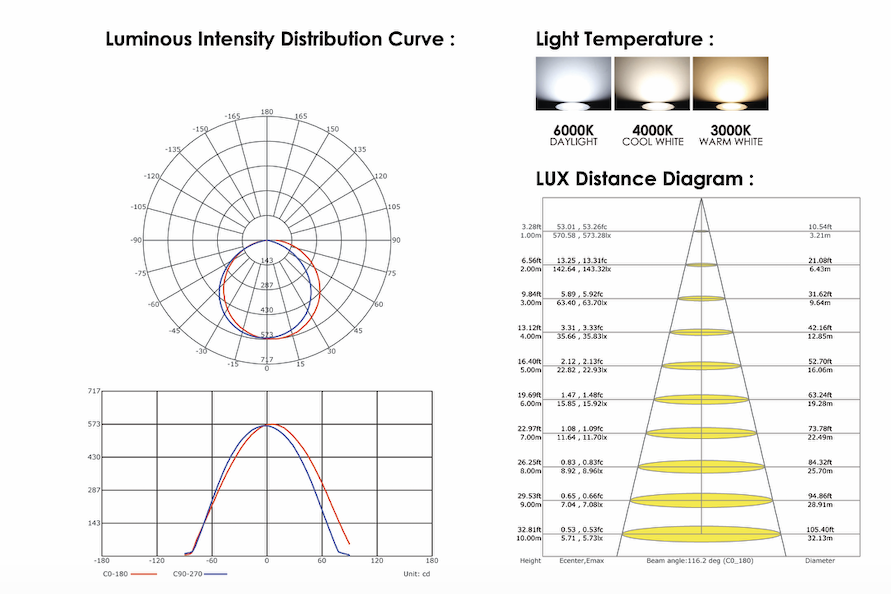
Luminous intensity measures visible light in a particular direction per solid angle.
| Property | Detail |
|---|---|
| Unit | Candela (cd) |
| Measures | Directional light output |
Most lamps with a beam angle (generally up to 60°) will have a peak intensity value. This allows comparison between lamps and indicates maximum light output.
Luminous Flux
Luminous flux measures the total visible light output of a lamp.
| Property | Detail |
|---|---|
| Unit | Lumen (lm) |
| Measures | Light is emitted in all directions |
This value is commonly given for fluorescent tubes and incandescent lamps and allows comparison of brightness between different lamps.
Illuminance
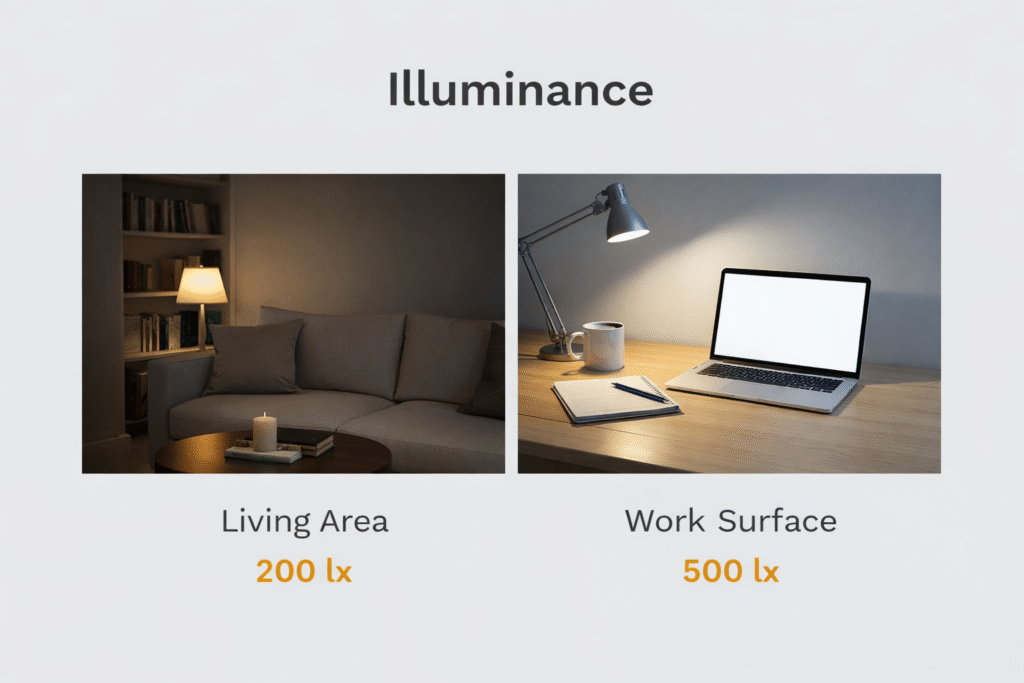
Illuminance is the measure of luminous flux per unit area.
| Property | Detail |
|---|---|
| Unit | Lux (lx) |
| Definition | 1 lux = 1 lumen per square metre |
Typical Residential Illuminance Levels
| Area | Illuminance Level |
|---|---|
| General Living Areas | 100–300 lx |
| Work Surfaces | Up to 500 lx |
A house would not be lit entirely at 500 lx, as this level is typically required only on work surfaces.
Manufacturers often provide light cone diagrams showing peak illuminance at different distances.
Power
Power refers to the electrical power used by lamps.
| Property | Detail |
|---|---|
| Unit | Watt (W) |
Lighting equipment has maximum wattage limits. For example:
-
Many dimmer switches have a maximum rating of 250W.
-
Exceeding this may cause overheating.
It is normally acceptable to have less than the maximum wattage unless using fluorescent or metal halide lamps, which must be correctly matched.
Efficacy
Efficacy relates to the ratio between lumens produced and watts consumed.
| Property | Detail |
|---|---|
| Unit | lm/W |
| Formula | Lumens ÷ Watts |
Some lm/W values consider transformer and ballast losses, as well as light lost within the fitting.
Higher lm/W indicates greater energy efficiency in Lighting Design.
Electric Potential (Voltage)
Electric potential is measured in Volts (V).
| Country | Voltage |
|---|---|
| United Kingdom | 230V AC |
| United States | 120V AC |
When purchasing lighting equipment from other countries, voltage compatibility must be ensured.
Current
Current is the flow of electric charge.
| Property | Detail |
|---|---|
| Unit | Ampere (A) |
Power, Voltage, and Current are related:
Power = Voltage × Current
Some switches specify maximum current (commonly 10A) rather than wattage.
LED Current Requirements
LEDs generally require constant current to emit maximum light output.
Common specifications include:
| LED Type | Current |
|---|---|
| Standard LED | 350mA |
| High Power LED | 700mA |
It is important to obtain an LED driver that matches these requirements to ensure efficiency and prevent damage.
Internal Reference Pages:
LED Lighting Products
Lighting Consultancy Services
Correlated Colour Temperature (CCT)
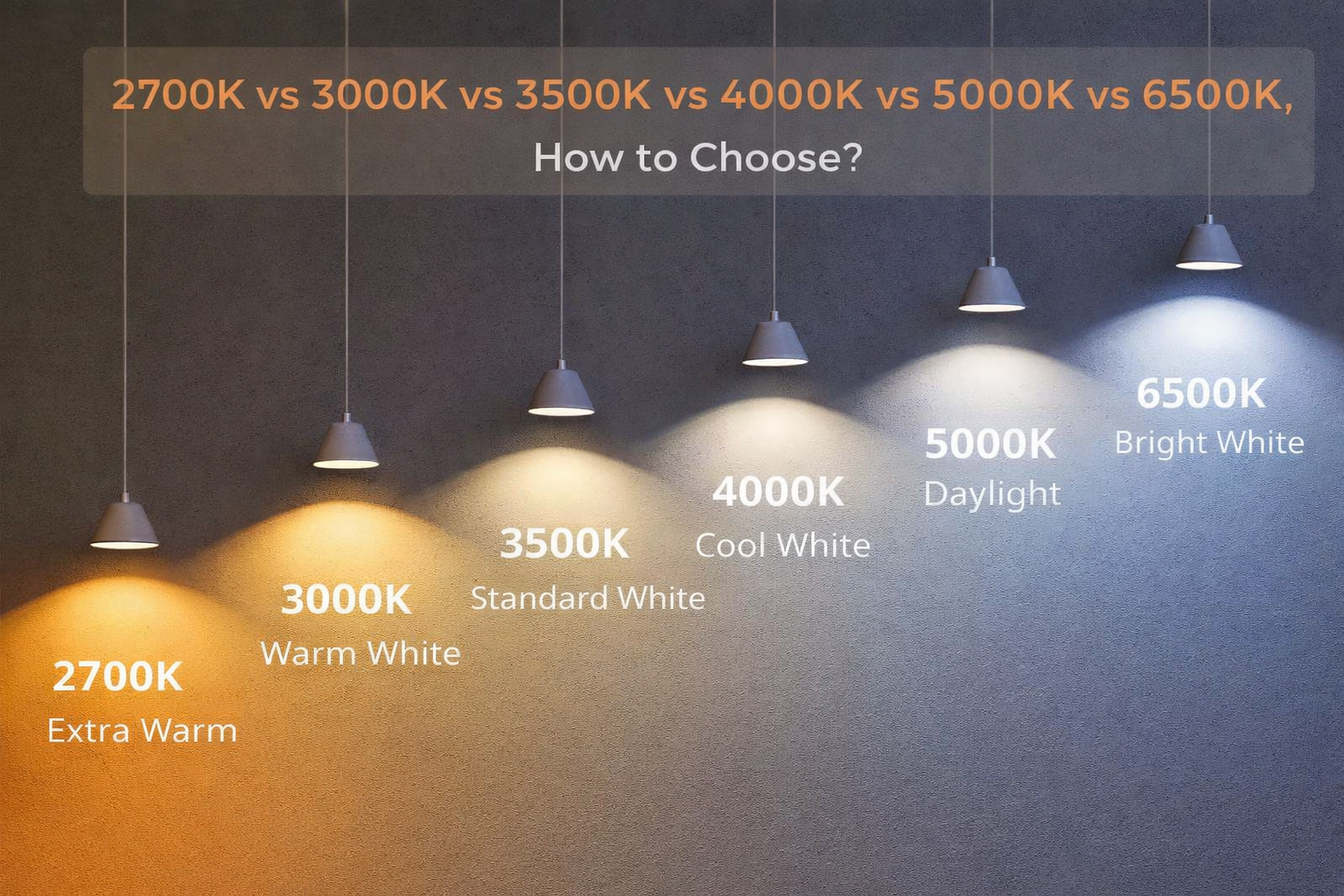
Correlated Colour Temperature measures the warmth of light.
Unit: Kelvin (K)
| CCT | Description |
|---|---|
| 2200K | Orange/White |
| 2700K | Incandescent & mains voltage halogens |
| 3000K | Warm White |
| 3500K | Neutral White |
| 4000K | Cool White |
| 6500K | Daylight |
| 8000K | Blue/White |
If a high level of light is required, cooler temperatures (3500K–4000K) are generally suitable.
If a lower level of light is required, warmer temperatures (2700K–3200K) are preferred.
If two light sources serve the same purpose, such as illuminating a work surface, their colour temperature should match.
Dimming and Colour Behaviour
| Light Type | Behaviour When Dimmed |
|---|---|
| Incandescent | Becomes warmer |
| Halogen | Becomes warmer |
| LED | Maintains same colour temperature |
| Fluorescent | May emit cooler tones |
This must be considered in professional Lighting Design.
Colour Rendering Index (CRI)
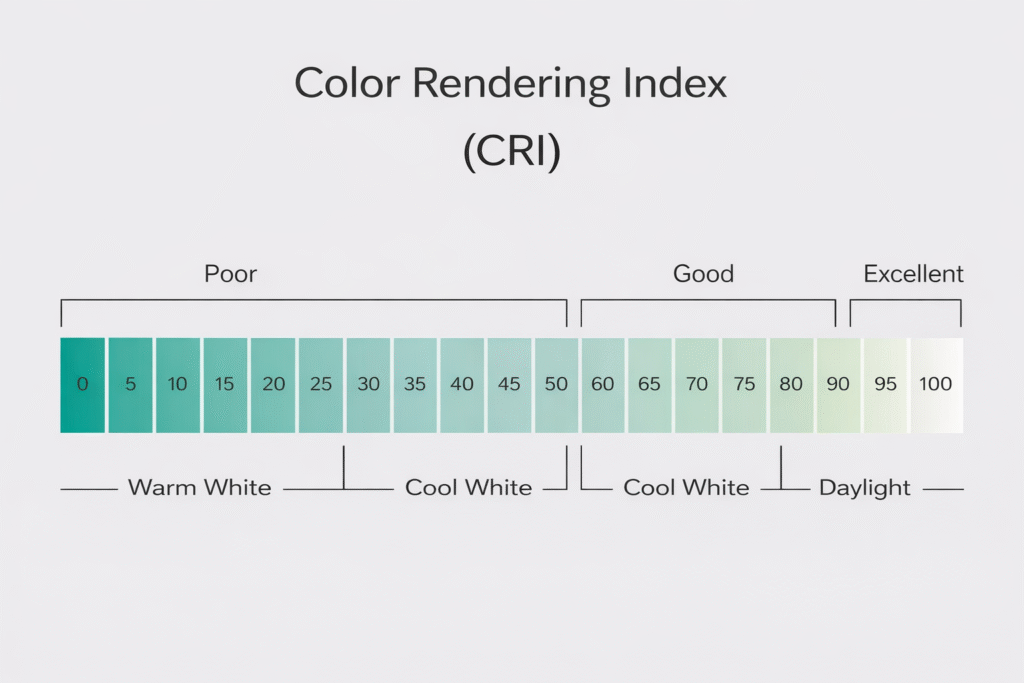
The Colour Rendering Index measures how accurately a light source shows colours compared to a black body radiator standard.
| CRI Value | Quality |
|---|---|
| 100 | Incandescent |
| 90+ | Exceptionally Good |
| 80–89 | Good |
| Below 80 | Not suitable for residential use |
Sodium street lamps have very low CRI, making colour distinction difficult.
CRI is a critical parameter in both residential and commercial Lighting Design applications.
Conclusion
At Luzion Lighting, the Nature of Light in Lighting Design combines visual science, electrical principles, and human perception. From luminous intensity and flux to voltage, CCT, and CRI, each measurable property contributes to accurate and effective lighting design.
A clear understanding of these fundamentals allows Luzion Lighting to ensure correct lamp selection, safe electrical planning, and appropriate visual performance—whether the project is a residential interior, a commercial installation, or a large-scale development.
Related posts
21 Oct 2026
Channel Letter Signage in UAE: Types, Materials and Applications
Channel letter signage is widely used by retail stores, hotels, restaurants, shopping malls and commercial buildings to display business names,…
21 Oct 2026
3D Letter Signage in UAE: Materials, Finishes and Applications
In a competitive commercial environment, signage plays an important role in how customers recognise a brand, locate a business and…
21 Oct 2026
Types of Illuminated Signage: A Guide for UAE & GCC Projects
Illuminated signage plays an important role in how commercial buildings, hotels, retail developments and corporate spaces communicate their identity. In…

17 Oct 2026
Commercial Signage Solutions UAE & GCC
How to Choose Commercial Signage Solutions in the UAE & GCC Commercial signage plays an important role in how people…
02 Oct 2026
Canadian Bespoke Lights
Canadian Bespoke Lighting: Where Design Becomes a Signature Luxury architecture is rarely defined by one element alone. The character of…
subscribe for newsletter

Luzion is a leading manufacturer and exporter of high-quality LED lighting solutions. With a focus on design, research, and innovation, we offer a wide range of products for commercial, industrial, residential, and outdoor spaces.
