

Luxury Landscape Lighting Design Services Across India, UAE, USA, UK & Worldwide
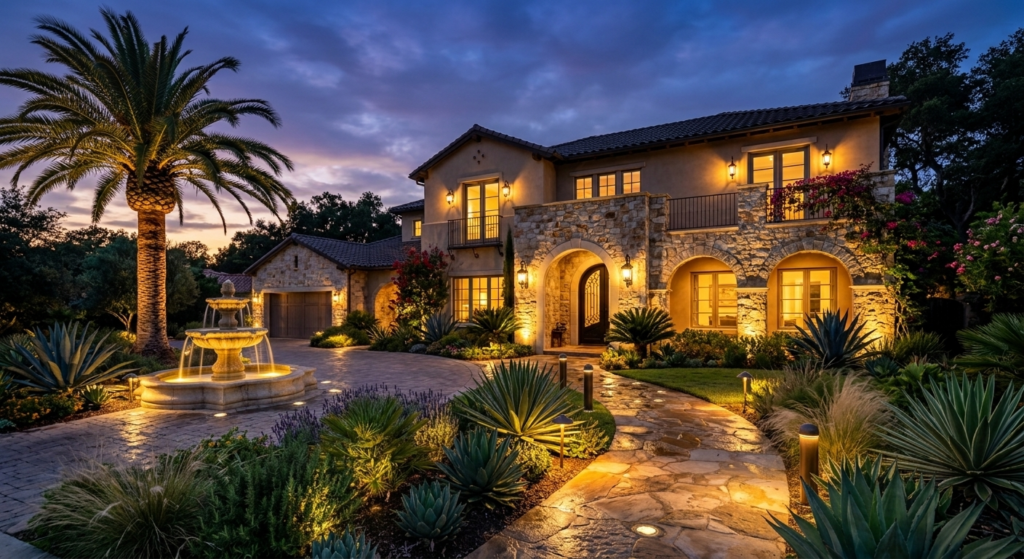 Well-designed outdoor spaces need more than attractive planting, paving and architecture. The right illumination helps define pathways, highlight landscape features, improve nighttime visibility and create a strong visual connection between buildings and their surroundings.
Landscape Lights enhance gardens, pathways, terraces, courtyards, driveways, lawns, trees, water features and other outdoor environments.Unlike basic outdoor fixtures, professionally selected landscape lights consider beam distribution, mounting position, colour temperature, glare, weather resistance and the character of the surrounding landscape.
For residential properties, landscape illumination can make a villa entrance feel more welcoming, create depth around a garden and highlight architectural details after sunset. In hospitality projects, carefully positioned Landscape LED Lights can strengthen the identity of hotels, resorts and restaurants while supporting comfortable movement through outdoor areas.
Commercial developments, public spaces and large estates require a more coordinated approach. Here, Outdoor Landscape Lights may form part of a wider lighting strategy covering pedestrian routes, façades, gardens, parking approaches, recreational areas and architectural elements.
Luzion develops lighting solutions for residential, hospitality, commercial, architectural and landscape applications. Its project approach combines product selection, optical performance, technical coordination and project-specific requirements. Solutions can be considered for projects across India and international markets, including the UAE, Saudi Arabia, UK, USA, Australia, Africa and other global regions.
What Are Landscape Lights?
Landscape lights are outdoor lighting products designed to illuminate and visually enhance natural and built landscape elements.
They can be used to define circulation routes, highlight trees and planting, illuminate steps and level changes, create focal points, or provide controlled illumination around buildings and outdoor gathering areas.
A landscape lighting system can include several fixture types working together rather than relying on one type of luminaire. For example, bollard lights may define a pathway, spike lights may illuminate planting, and inground fixtures may highlight architectural surfaces or trees.
From an engineering perspective, landscape lights should be selected according to the environment in which they will operate. Outdoor exposure makes factors such as IP rating, IK protection, corrosion resistance, thermal management and driver reliability particularly important.
Why Landscape Lights Matter
Landscape lighting affects both the appearance and usability of an outdoor environment. A well-planned installation creates visual hierarchy instead of simply increasing brightness.
The objective is to illuminate the elements that matter while controlling glare and unwanted spill light. This can improve nighttime comfort while giving the landscape greater depth and definition.
Landscape lights can help achieve four important outcomes:
- Safety and visibility: Improve illumination along pathways, stairs, entrances and circulation areas.
- Architectural enhancement: Highlight façades, walls, columns, textures and other outdoor structures.
- Landscape definition: Bring attention to trees, planting, water features and garden elements.
- Nighttime ambience: Create a comfortable visual environment for residential and hospitality spaces.
The final result depends on more than fixture appearance. Beam angle, lumen output, mounting height, aiming direction, CCT and surrounding surfaces all influence how the light is perceived.
Types of Landscape Lights
Different landscape elements require different optical and mounting solutions. Selecting the appropriate fixture helps achieve controlled illumination while maintaining a clean architectural appearance.
| Landscape Light Type | Typical Application | Main Lighting Purpose |
|---|---|---|
| Bollard Lights | Pathways, driveways, gardens | Path and area illumination |
| Spike Lights | Planting beds, trees, shrubs | Directional accent lighting |
| Inground Lights | Paving, walls, landscape features | Recessed architectural illumination |
| Step Lights | Steps, retaining walls, level changes | Safe movement and visual guidance |
| Wall Lights | Boundary walls, terraces, outdoor structures | Functional and decorative illumination |
| Spotlights / Uplights | Trees, columns, sculptures | Accent and feature lighting |
| Linear Lights | Edges, steps, landscape structures | Continuous architectural illumination |
Landscape Bollard Lights
Landscape bollard lights are commonly used along pathways, pedestrian routes, garden edges and driveways. Their mounting height and optical distribution can provide a defined pool of light without requiring high-output illumination across the entire landscape.
For premium residential and hospitality projects, bollards can also contribute to the visual language of the landscape. Their form, finish and spacing should therefore be considered alongside the surrounding architecture.
Landscape Path Lights
Path lights are designed to guide movement through gardens, walkways and outdoor circulation areas. Good path illumination should provide sufficient visibility without producing excessive glare.
The spacing and beam distribution should be determined according to the pathway width, mounting height, surface reflectance and required illumination level.
Landscape Spike Lights
Spike lights provide flexibility because their position and aiming direction can be adjusted during installation or landscape development.
They are frequently used for trees, shrubs, planting beds, sculptures, signage and selected architectural elements. Narrower beams can create a more focused effect, while wider distributions can provide broader coverage.
Landscape Inground Lights
Inground fixtures are installed flush with paving, landscape surfaces or architectural elements. They are particularly useful where the lighting effect is required without creating a visually prominent fixture.
Applications include pathways, steps, walls, tree uplighting and architectural landscape details. Because these products are exposed to outdoor conditions and may experience mechanical loads, IP and IK ratings should be evaluated according to the installation environment.
Residential Landscape Lights
Residential landscapes require a balance between aesthetics, comfort and practical outdoor visibility.
For villas, bungalows, farmhouses and luxury residences, landscape lights can be used across entrances, gardens, pathways, terraces, balconies, driveways, pools and outdoor entertainment areas.
A coordinated residential scheme may combine soft pathway illumination with carefully positioned tree lights, architectural uplighting and subtle façade illumination. This creates layers of light rather than a uniformly bright outdoor environment.
Landscape Lights for Villas
Large villas often contain several landscape zones with different visual and functional requirements. The entrance may need stronger directional illumination, while garden areas can use softer accent lighting.
Villa Landscape Lights can therefore be selected according to the architecture, planting design and outdoor circulation pattern. In luxury properties, concealed or low-visibility fixtures are often preferred where the lighting effect should remain more prominent than the equipment.
Garden Landscape Lights
Garden lighting can bring structure and depth to planting after sunset. Trees, shrubs, flower beds, water features and garden pathways can each become part of the nighttime composition.
Rather than illuminating every element equally, a considered approach establishes focal points and darker areas. This helps preserve contrast and creates a more natural visual experience.
Hospitality Landscape Lights
Hotels, resorts, restaurants and leisure properties often use outdoor spaces as extensions of their interior environments.
Hotel Landscape Lights and Resort Landscape Lights can support arrival areas, gardens, terraces, pools, walkways, courtyards and outdoor dining spaces. The lighting needs to be visually consistent with the property’s architectural identity while also meeting operational and maintenance requirements.
For luxury hospitality projects, lighting can contribute to the guest experience from the moment of arrival. Carefully controlled illumination can draw attention toward entrances, water features, landscape compositions and architectural focal points without creating excessive brightness.
Commercial & Public Landscape Lights
Landscape illumination is also important in commercial developments, corporate campuses, retail environments, public parks and mixed-use projects.
Commercial Landscape Lights may be required for pedestrian circulation, entrance areas, outdoor seating, landscaped zones and architectural features. Larger developments often benefit from coordinated lighting controls and zoning so that different areas can operate according to their schedules and usage.
Public landscape projects require additional consideration of durability, accessibility, maintenance, energy consumption and environmental conditions. Product selection should therefore consider the expected operating hours, exposure, installation conditions and long-term maintenance strategy.
Landscape Lights for Global Projects
Landscape architecture varies significantly between regions because climate, vegetation, architectural styles, regulations and project requirements differ.
Luzion’s landscape light solutions can be considered for projects in India, the UAE and Middle East, Europe, North America, Asia-Pacific, Africa and Latin America.
Key markets and project locations include India and cities such as Ahmedabad, Mumbai, Delhi, Bengaluru, Hyderabad and Pune; the UAE including Dubai and Abu Dhabi; Saudi Arabia including Riyadh, Jeddah and Dammam; the UK including London and Manchester; the USA including California, New York, Texas and Florida; Canada; Australia; Singapore; Malaysia; South Africa and other international markets.
For international projects, product selection should account for environmental exposure, local electrical requirements, installation practices, control systems and project specifications. This makes technical coordination particularly important for architects, landscape designers, consultants, developers and contractors working across different markets.
Luzion Landscape Light Solutions
Luzion approaches landscape projects with a combination of product engineering, manufacturing capability and technical project support.
Solutions can be developed around residential landscapes, luxury villas, hotels, resorts, commercial properties, architectural environments and larger outdoor developments.
The objective is not simply to provide individual fixtures. A complete landscape light solution considers the relationship between the product, optics, installation environment, architecture, planting and the intended nighttime experience.
As the landscape lighting system becomes more technically demanding, factors such as beam angle, CCT, CRI, IP protection, optical control, driver performance and energy efficiency become increasingly important.
The following sections explore these technical considerations in greater detail, along with landscape lighting design principles, smart controls, product selection, customisation and project-specific solutions.
Landscape Lights for Different Outdoor Spaces
Landscape lighting should respond to the character and function of each outdoor space. A garden pathway has different requirements from a large resort landscape, just as a villa entrance differs from a public park.
The most effective approach combines different Landscape Light Fixtures according to the landscape layout, architectural features, planting, circulation routes and desired visual effect.
Rather than using the same fixture throughout a project, designers can combine bollards, spike lights, inground lights, wall lights, spotlights, linear systems and other outdoor luminaires to create layers of illumination.
Garden Landscape Lights
Gardens contain multiple visual elements that can benefit from carefully controlled illumination. Trees, shrubs, flower beds, sculptures, pathways and water features can each become part of the nighttime composition.
Garden Landscape Lights should enhance these elements without making the landscape appear excessively bright. A combination of soft ambient illumination and focused accent lighting can create depth while retaining natural contrast.
For larger gardens, lighting zones can be planned independently. Entrance areas may require practical illumination, while planting zones can use lower-output accent fixtures to create visual focus.
Tree & Plant Lighting
Trees are often strong focal points in residential and hospitality landscapes. Their structure can be highlighted through uplighting, grazing or controlled directional beams.
Landscape Tree Lights should be selected according to tree height, canopy density, trunk diameter and viewing distance. Narrow beams can emphasise trunks and vertical forms, while wider optics can illuminate larger canopies.
The position of the fixture is equally important. Lighting from below, beside or at a distance from the tree can produce significantly different results.
Shrub & Planting Bed Lighting
Planting beds can be illuminated with compact spike lights or other directional fixtures. The objective is generally to reveal texture and form rather than illuminate the entire planting area uniformly.
Fixture placement should account for plant growth. A landscape that changes significantly over time may require adjustable fixtures so that the lighting composition can be repositioned as vegetation develops.
Landscape Pathway Lights
Pathways are among the most common applications for outdoor landscape illumination. The lighting should help users understand direction, changes in level and the boundaries of the walking route.
Landscape Path Lights and bollard fixtures can provide visual guidance while contributing to the overall character of the landscape.
Spacing should not be determined only by fixture wattage. Designers should also consider mounting height, optical distribution, pathway width, surface reflectance and surrounding ambient illumination.
For premium projects, avoiding repetitive bright spots can create a more refined appearance. Alternating or carefully staggered fixture positions may produce a smoother visual rhythm.
Driveway & Entrance Landscape Lights
Driveways and property entrances are important transition areas between public and private space.
Landscape lights can define vehicle routes, pedestrian access and architectural entrances without creating unnecessary glare for drivers or residents.
Landscape Lights for Homes may combine low-level pathway fixtures with directional illumination on trees, boundary walls and architectural elements. The result can improve nighttime orientation while creating a stronger first impression.
For luxury villas, entrance lighting can also be coordinated with façade and architectural lights so that the landscape and building appear as one integrated composition.
Courtyard Landscape Lights
Courtyards often combine architecture, planting and outdoor living areas within a relatively compact space.
Lighting can be integrated into walls, steps, planters, pergolas and landscape structures. This creates opportunities for concealed illumination and subtle architectural effects.
Courtyard Landscape Lights are particularly effective when fixture visibility is controlled. Recessed, concealed or low-profile products can provide illumination while allowing architectural materials and planting to remain visually dominant.
Terrace & Outdoor Living Areas
Modern homes, villas and hospitality properties increasingly use terraces and outdoor spaces as extensions of their interior environments.
These spaces may require a combination of ambient, decorative and functional illumination. The lighting should support dining, seating, circulation and relaxation without producing uncomfortable glare.
Residential Landscape Lights can be coordinated with interior colour temperature and architectural lighting so that the transition between indoor and outdoor areas feels natural.
For restaurants, resorts and luxury residences, dimmable systems can provide greater flexibility as the outdoor space changes from active use to a quieter evening environment.
Pool & Water Feature Lighting
Water can become a major visual feature after sunset when illuminated correctly.
Pool lighting, fountains, ponds and water walls can use carefully selected underwater or adjacent fixtures depending on the application and applicable installation requirements.
Landscape Pool Lights should be selected with particular attention to electrical safety, ingress protection, installation conditions and maintenance access.
Water features can also be illuminated from outside the water. Directional fixtures positioned around planting, walls or surrounding surfaces can create reflections and visual depth without excessive brightness.
Landscape Lights for Villas & Luxury Homes
Luxury residential landscapes often require a highly coordinated lighting strategy because the outdoor environment may include architecture, gardens, pathways, pools, terraces, sculptures and multiple levels.
Luxury Landscape Lights should complement the architectural language of the property rather than compete with it.
A successful villa lighting scheme may combine discreet pathway illumination with focused tree uplighting, wall grazing, step lighting and selected architectural accents.
Villa Entrance Lighting
The entrance is usually one of the most important visual zones of a luxury property.
Villa Landscape Lights can define the driveway, entrance pathway, planting and architectural frontage. Carefully controlled beams can draw attention toward the entrance while maintaining softer illumination elsewhere.
Backyard & Garden Lighting
Backyard areas can be designed around outdoor seating, gardens, pools and entertainment spaces.
Backyard Landscape Lights should support both usability and atmosphere. Different lighting zones can be controlled separately to accommodate dining, socialising, circulation or quiet evening use.
Farmhouse & Estate Lighting
Large farmhouses, estates and private compounds often contain extensive outdoor areas.
Here, Landscape Lights for Large Gardens may require longer cable runs, carefully planned zoning, robust outdoor enclosures and a maintenance strategy suitable for larger sites.
Landscape Lights for Hotels & Resorts
Hospitality landscapes have both functional and experiential requirements. Guests may encounter the landscape at arrival, during evening dining, while walking between facilities or when using recreational areas.
Hospitality Landscape Lighting should therefore be integrated into the property’s architecture, landscape design and operational requirements.
Hotel and resort projects may include:
- Arrival drives and entrance landscapes
- Garden pathways and courtyards
- Pool decks and recreational areas
- Outdoor restaurants and seating areas
The lighting strategy should maintain visual consistency throughout these zones while allowing different areas to operate independently.
Hotel Landscape Lights
Hotel Landscape Lights can be used to define entrances, garden paths, planting beds, architectural features and guest circulation routes.
Hotels may also require lighting systems that can operate for extended periods. LED technology, efficient drivers, appropriate thermal management and suitable outdoor protection can contribute to long-term operational reliability.
Resort Landscape Lights
Resorts typically have larger and more diverse landscapes than conventional commercial properties.
Resort Landscape Lights may be required across gardens, pathways, villas, pools, restaurants, recreational spaces and architectural structures.
A coordinated approach helps prevent isolated lighting effects and creates a consistent nighttime identity across the entire property.
Restaurant & Outdoor Dining Landscape Lights
Outdoor dining requires a careful balance between atmosphere and visibility.
Lighting that is too bright can reduce comfort, while insufficient illumination can affect circulation and usability.
Restaurant Landscape Lights can combine low-level pathway fixtures, wall-mounted illumination, planting accents and decorative elements. Where dining tables require additional light, the design should avoid direct glare into guests’ eyes.
The colour temperature and colour quality of the light should also complement food presentation, furniture, finishes and the surrounding landscape.
Commercial Landscape Lights
Commercial landscapes can include corporate campuses, offices, retail developments, shopping centres, mixed-use projects and business parks.
Commercial Landscape Lights should address pedestrian movement, entrances, outdoor gathering areas and landscape features while considering energy consumption and maintenance.
Larger commercial projects can benefit from lighting controls that allow different zones to operate according to occupancy, operating hours or scheduled scenes.
Corporate Landscape Lights
Corporate campuses often contain landscaped pathways, entrance plazas, courtyards and outdoor meeting areas.
Corporate Landscape Lights can reinforce the architectural identity of the development while providing comfortable nighttime navigation.
A restrained approach is generally effective for corporate environments. Lighting should support the architecture and landscape rather than becoming an independent visual element.
Retail & Shopping Mall Landscape Lights
Retail developments often combine architecture, pedestrian circulation, signage, landscaping and outdoor gathering spaces.
Retail Landscape Lights can help guide customers toward entrances and create visual focus around landscape features.
Shopping malls may also require coordination between landscape illumination, Façade lighting and signage to create a unified nighttime appearance.
Public Spaces, Parks & Urban Landscapes
Public landscapes require a combination of safety, durability, visual quality and operational efficiency.
Applications may include parks, plazas, promenades, public gardens, streetscapes and civic spaces.
Public Landscape Lights should consider pedestrian movement, accessibility, maintenance requirements, vandal resistance and the surrounding urban environment.
For larger developments, lighting controls can help manage operating schedules and reduce unnecessary energy consumption during low-use periods.
Park Landscape Lights
Parks may contain walking routes, trees, seating areas, recreational facilities and open spaces.
Park Landscape Lights should provide orientation while preserving appropriate darkness in areas where excessive illumination is unnecessary.
The design should also consider nearby residential properties, ecological conditions and potential light spill.
Architectural Landscape Lights
Landscape and architecture increasingly overlap in contemporary projects. Walls, columns, façades, retaining structures, pergolas and entrance features can all become part of the outdoor lighting composition.
Architectural Landscape Lights are particularly useful when the objective is to reveal material, geometry or structural form.
Wall grazing can emphasise textured surfaces, while narrow-beam uplighting can highlight columns or vertical architectural elements.
The key is controlled illumination. A carefully positioned low-output fixture can sometimes create a stronger architectural effect than a high-output fixture aimed indiscriminately at a surface.
Landscape Lights for Water, Sculptures & Feature Elements
Outdoor landscapes often contain focal features such as sculptures, fountains, artwork, signage and architectural objects.
Landscape Spotlights and directional fixtures can provide controlled accent illumination for these elements.
Beam selection should reflect the size and distance of the target. A narrow beam may be appropriate for a sculpture, while a wider distribution may be better for a broad water feature or architectural surface.
Lighting intensity should also be considered relative to the surrounding landscape. A feature becomes visually dominant when its luminance contrasts strongly with adjacent areas.
Landscape Lights for Different Project Requirements
| Environmental Factor | Common Mistake | What Actually Happens |
|---|---|---|
| High UV exposure | Using standard (non-UV-stabilized) polycarbonate housings | Housings yellow, crack, and lose impact resistance within 1–2 years |
| Sand and dust | Skipping IP6X-rated sealing on ingress points | Fine dust infiltrates drivers and optics, reducing output and causing early failure |
| Coastal/marina salt air | No salt-spray corrosion testing on housings and hardware | Corrosion sets into fixture bodies and mounting hardware within months |
| High ambient heat | Ignoring thermal management in fixture design | LED lumen depreciation accelerates, and driver lifespan drops sharply |
Landscape Lights & Landscape Architecture
Landscape lighting works best when considered alongside the landscape design rather than added after construction.
Planting density, tree growth, hardscape materials, drainage, irrigation, pathways and maintenance access can all affect fixture placement.
Landscape architects and lighting designers should coordinate fixture locations during the design stage. This can reduce conflicts with irrigation systems, roots, paving and other landscape infrastructure.
For major developments, a coordinated Landscape Lighting Plan can define fixture locations, mounting details, circuits, control zones and lighting effects before installation begins.
Landscape Lighting for Different Climates
Outdoor lighting products operate in environments that can vary significantly from one region to another.
Projects in hot and dry climates such as the UAE and Saudi Arabia may require careful consideration of thermal conditions, dust exposure and long operating periods.
Projects in humid or coastal environments may place greater emphasis on corrosion resistance, ingress protection and material selection.
In colder or wetter regions, drainage, freezing conditions and mechanical protection can become important design considerations.
This is why a product suitable for one environment should not automatically be assumed to be appropriate for every global project.
Global Landscape Light Applications
Luzion supports landscape lighting requirements for different architectural and environmental contexts, with project opportunities across India, the Middle East, Europe, North America, Asia-Pacific, Africa and Latin America.
Regional project considerations can include Landscape Lights UAE and Dubai villa developments, Landscape Lights Saudi Arabia for large residential and hospitality projects, as well as landscape applications across the UK, USA, Australia, Singapore, Canada and other international markets.
Major urban markets such as Dubai, Abu Dhabi, Riyadh, Jeddah, London, New York, Mumbai, Bengaluru, Sydney and Singapore represent different architectural and climatic environments.
Rather than applying one universal lighting formula, project specifications should be adapted to local conditions, architectural requirements, environmental exposure and applicable standards.
The next stage is understanding the technology behind these products — including LED performance, CCT, CRI, beam angles, optics, IP ratings, drivers, controls and energy efficiency.
LED Technology for Landscape Lights
Modern outdoor projects increasingly use LED technology because it provides controllable illumination, high efficiency, compact form factors and long operating life.
Landscape LED Lights can be designed for different outdoor applications, from low-level pathway illumination to high-intensity architectural accent lighting. The correct LED system should be selected according to the required lumen output, optical distribution, operating hours and environmental conditions.
For professional projects, the LED chip is only one part of the system. Driver quality, thermal management, optics, housing materials and installation conditions all influence the long-term performance of the luminaire.
A technically suitable product should therefore be evaluated as a complete lighting system rather than based only on wattage or initial price.
Why Choose Landscape LED Lights?
LED technology offers several advantages for landscape applications when the products are correctly engineered and specified.
The compact size of LED sources allows manufacturers to develop discreet fixtures for gardens, pathways, walls, steps and architectural elements. Directional optics can also provide more controlled illumination compared with conventional broad-output sources.
Key advantages include:
- Energy efficiency: Lower electrical consumption can help reduce operating costs.
- Long operating life: Quality LED systems can support extended service periods when properly thermally managed.
- Optical control: Lenses and reflectors can create narrow, medium or wide distributions.
- Design flexibility: LED sources can be integrated into compact, recessed and architectural luminaires.
The actual performance depends on the LED package, driver, operating temperature, optical system and product construction. Therefore, project specifications should focus on complete luminaire performance rather than LED wattage alone.
Lumen Output & Lighting Performance
Lumens indicate the total quantity of visible light produced by a source or luminaire. However, lumen output alone does not determine whether a landscape light will produce the desired result.
A 1,000-lumen fixture with a narrow beam can create a very different visual effect from a 1,000-lumen fixture with a wide distribution.
For this reason, landscape lighting design should consider lumen output together with beam angle, mounting distance, target size, surface reflectance and required illumination level.
Professional projects may also require photometric files so that lighting performance can be evaluated through lighting calculation software.
Landscape Light CCT
Colour temperature affects how warm or cool the landscape appears at night. It is expressed in Kelvin (K).
Warm CCTs are commonly used in residential gardens, hospitality landscapes and luxury outdoor environments because they can complement natural materials, planting and warm architectural finishes.
Neutral or cooler colour temperatures may be appropriate for specific contemporary, commercial or functional applications where a cleaner visual appearance is required.
| CCT Range | Visual Character | Typical Landscape Application |
|---|---|---|
| 2200–2700K | Very warm | Luxury gardens, hospitality, heritage environments |
| 2700–3000K | Warm | Villas, residential gardens, resorts |
| 3000–3500K | Warm-neutral | Contemporary residential and commercial areas |
| 3500–4000K | Neutral | Functional commercial and public environments |
| 4000K+ | Cool-neutral | Selected architectural or specialised applications |
The correct CCT should be considered alongside surrounding architecture, planting, façade materials and existing outdoor illumination.
CRI & Colour Quality
Colour Rendering Index, or CRI, indicates how accurately a light source reveals colours compared with a reference source.
High colour quality can be particularly important when landscape lighting is used around vegetation, stone, timber, artwork, decorative surfaces and hospitality environments.
Landscape Lights with suitable CRI performance can help preserve the visual character of materials and planting after sunset.
CRI should not be considered in isolation. Designers may also evaluate the consistency of the light source, colour stability, CCT tolerance and the visual requirements of the project.
For premium residential and hospitality environments, colour consistency between different fixture types is especially important. Mixing products with noticeably different colour appearance can make an otherwise carefully designed landscape feel visually inconsistent.
Beam Angle & Optical Performance
Beam angle determines how widely light spreads from the luminaire. It is one of the most important parameters when selecting directional landscape fixtures.
A narrow beam can create a concentrated accent effect on a tree trunk, column or sculpture. Medium distributions can illuminate smaller landscape features, while wider beams may be appropriate for walls, planting areas or larger surfaces.
Landscape Spotlights and uplights often use directional optics because they need to project light toward a defined target.
| Beam Type | Approximate Distribution | Typical Application |
|---|---|---|
| Narrow | 5°–15° | Trees, columns, sculptures, focal elements |
| Medium | 15°–30° | Planting, façades, medium-sized features |
| Wide | 30°–60° | Walls, gardens and broader surfaces |
| Very Wide | 60°+ | General area and soft landscape illumination |
Actual beam classification varies by optical design and manufacturer. Photometric data should therefore be used when precise calculations are required.
Optics, Glare & Light Distribution
Good landscape lighting is not simply about directing light toward a target. It must also control where unwanted light travels.
Poorly aimed fixtures can produce glare for pedestrians, residents, drivers or guests. Excessive upward spill can also reduce visual comfort and affect the nighttime appearance of the surrounding environment.
Optical accessories, shielding, louvres, precise aiming and appropriate mounting positions can help control unwanted light.
Professional Landscape Lights should therefore provide predictable optical performance and allow designers to control the relationship between the light source and the viewer.
Landscape Lights & Glare Control
Glare becomes particularly noticeable when bright light sources are positioned close to eye level.
Pathway fixtures, bollards and wall-mounted luminaires should be positioned and specified carefully to prevent direct views of high-intensity LED sources.
For premium projects, the objective is often to see the illuminated landscape rather than the light source itself.
This can be achieved through recessed fixtures, concealed mounting, shields, indirect illumination, appropriate beam angles and careful aiming.
IP Ratings for Outdoor Landscape Lights
Outdoor luminaires are exposed to rain, moisture, dust and changing environmental conditions. Ingress protection is therefore an important part of product selection.
The IP rating generally indicates protection against the entry of solid particles and water.
| Beam Type | Approximate Distribution | Typical Application |
|---|---|---|
| Narrow | 5°–15° | Trees, columns, sculptures, focal elements |
| Medium | 15°–30° | Planting, façades, medium-sized features |
| Wide | 30°–60° | Walls, gardens and broader surfaces |
| Very Wide | 60°+ | General area and soft landscape illumination |
The appropriate rating depends on the installation environment. Products installed at ground level, near irrigation or in locations exposed to standing water may require different protection from fixtures mounted beneath a roof or sheltered structure.
IK Rating & Mechanical Protection
IP protection addresses ingress, while IK ratings relate to resistance against mechanical impact.
This can become important for landscape fixtures installed in public spaces, pathways, commercial developments or other locations where accidental impact may occur.
For Commercial Landscape Lights and public projects, designers should evaluate the required mechanical protection according to the site’s accessibility and expected operating conditions.
The required IK level should be determined from the project environment rather than selected simply because a higher number appears preferable.
Landscape Light Housing & Material Selection
The housing material affects durability, heat dissipation, corrosion resistance and overall product life.
Aluminium is widely used for outdoor luminaires because it provides a practical combination of structural strength and thermal conductivity. Surface treatments and protective finishes can further support outdoor durability.
For coastal or highly humid environments, corrosion resistance becomes particularly important. Material selection should consider exposure to salt, humidity, chemicals, irrigation water and local environmental conditions.
The finish should also complement the landscape and architecture. Black, dark grey, metallic and custom finishes can be considered depending on the project design.
Thermal Management
LED performance is strongly influenced by operating temperature.
Excessive heat can accelerate component degradation and affect long-term performance. Efficient heat dissipation therefore becomes an important part of outdoor luminaire engineering.
Outdoor Landscape Lights should incorporate an appropriate thermal path from the LED source through the housing or heatsink to the surrounding environment.
Thermal design becomes particularly important in hot climates. Projects in regions such as Dubai, Abu Dhabi, Riyadh and other Middle Eastern locations may experience high ambient temperatures, making product engineering and installation conditions important considerations.
Drivers for Landscape LED Lights
The LED driver converts and regulates electrical power for the LED system. Driver quality can influence reliability, dimming performance, efficiency and system stability.
For professional projects, specifications may include input voltage, output current, power factor, surge protection, efficiency and control compatibility.
Depending on the project, landscape luminaires may support control technologies such as DALI, DMX or other compatible systems.
Driver selection should also consider local electrical conditions and the overall control architecture of the development.
Dimming & Lighting Controls
Dimming provides flexibility by allowing the intensity of landscape illumination to change according to time, occupancy or scene requirements.
For example, a hotel garden may operate at a higher level during evening activity and transition to a lower level later at night.
Landscape Lighting Systems can incorporate control strategies ranging from simple switching to sophisticated digital control networks.
Potential control approaches include:
- Scheduled on/off operation
- Dimming by lighting zone
- Centralised control systems
- Scene-based operation for hospitality and architectural environments
The appropriate control architecture depends on project size, operational requirements and integration with the wider building or site management system.
Smart Landscape Lights
Smart control technology can provide greater flexibility for large residential, hospitality and commercial landscapes.
A smart landscape system may allow different zones to be controlled independently, helping project operators adjust lighting according to time, activity or special events.
Smart Landscape Lights can be particularly useful for villas, resorts, hotels and large commercial properties where outdoor areas have different operating schedules.
Integration should be planned at the design stage because control compatibility can influence driver selection, wiring, commissioning and system architecture.
RGB & RGBW Landscape Lights
Colour-changing systems can be used where landscape illumination forms part of an architectural or experiential lighting concept.
RGB systems combine red, green and blue LED channels to create a broad range of colours. RGBW systems add a dedicated white channel, allowing greater control over white light quality while retaining colour-changing capability.
RGBW Landscape Lights can be considered for water features, hospitality environments, entertainment areas, architectural elements and special-event applications.
These systems should be specified carefully because colour control, driver compatibility, DMX addressing and programming requirements can increase system complexity.
Tunable White Landscape Lights
Tunable white technology allows the colour temperature of a luminaire to be adjusted within a defined range.
This can be useful for projects where the outdoor environment needs to change character throughout the evening or where the landscape lighting must coordinate with dynamic architectural lighting.
The technology is more relevant to advanced projects than standard residential installations and should be evaluated against the project’s actual control requirements.
Energy Efficiency & Operating Cost
Energy efficiency is an important consideration for landscapes that operate for several hours every evening.
LED technology can reduce electrical consumption compared with less efficient traditional sources, but the complete system should be evaluated.
A highly efficient LED fixture can still produce poor project results if excessive quantities or unnecessarily high lumen outputs are specified.
The better approach is to optimise the lighting design first and then select efficient products that provide the required performance.
For large Landscape Lighting Solutions, lifecycle evaluation can include energy consumption, operating hours, maintenance requirements, replacement costs and expected service life.
Surge Protection & Electrical Reliability
Outdoor lighting systems can be exposed to electrical disturbances caused by switching events, grid conditions and lightning-related transients.
Appropriate surge protection can help protect sensitive LED drivers and control equipment.
The required protection level should be determined according to local electrical conditions, project risk and applicable standards.
For international projects, electrical specifications should be coordinated with local requirements rather than assuming that one configuration is suitable for every country.
Landscape Lights & Photometric Data
Photometric data provides information about how a luminaire distributes light.
For professional design work, files such as IES or LDT can be used within lighting calculation software to model fixture performance.
Photometric information may include:
- Lumen output and luminous intensity
- Beam distribution and photometric curves
- CCT and colour characteristics
- Power consumption and efficiency
Accurate photometric data allows lighting consultants and designers to evaluate fixture performance before installation.
DIALux Landscape Lighting Design
DIALux Landscape Lighting Design can help project teams evaluate different fixture positions, beam distributions and illumination levels digitally before construction.
A landscape model can be developed to assess pathways, architectural surfaces, planting zones and other illuminated elements.
This can reduce guesswork during product selection and provide useful documentation for project coordination.
For larger developments, lighting calculations can also help identify areas of over-illumination or insufficient coverage before products are ordered.
Technical Specification Checklist
| Parameter | What to Evaluate | Why It Matters |
|---|---|---|
| LED Performance | Lumens, efficacy, colour consistency | Overall light quality and efficiency |
| CCT | 2200K–4000K+ depending on application | Visual atmosphere and material appearance |
| CRI | Appropriate colour rendering | Accurate appearance of planting and materials |
| Beam Angle | Narrow, medium or wide optics | Controls target coverage and accent effect |
| IP Rating | IP65/IP66/IP67 or application-specific | Outdoor environmental protection |
| IK Rating | Required mechanical protection | Important in exposed/public locations |
| Driver | Efficiency, PF, surge, dimming | Reliability and control compatibility |
| Housing | Aluminium, finish, corrosion resistance | Durability and thermal performance |
| Controls | DALI, DMX or project-specific | Zoning and smart operation |
| Photometry | IES/LDT and measured data | Lighting calculations and design verification |
Landscape Lights: Performance Beyond Wattage
Wattage indicates electrical power consumption, but it does not directly describe the quality of illumination.
Two fixtures with the same wattage can produce different lumen outputs, beam distributions and visual results depending on their LED source and optical system.
For this reason, architects and lighting consultants should compare Landscape Light Fixtures using complete technical specifications rather than selecting products only by wattage or price.
A well-engineered landscape light should balance optical performance, efficiency, thermal management, environmental protection, reliability and visual quality.
This technical foundation becomes particularly important when moving from individual fixture selection to a complete landscape lighting design.
The next section focuses on how these products are combined into a professional design — including layered landscape lighting, pathway illumination, tree uplighting, wall grazing, architectural integration, glare control, zoning and lighting calculations.
Landscape Lighting Design for Outdoor Spaces
A successful landscape lighting design is not created by placing fixtures wherever illumination is required. It is a coordinated process that considers architecture, planting, pathways, outdoor activities, sightlines and the overall character of the property.
The objective is to create a comfortable nighttime environment where important elements are visible and visually connected without making the entire landscape uniformly bright.
Landscape Lighting Design can combine functional illumination with architectural and decorative effects. Pathways may receive low-level guidance, trees can become focal points, and walls or landscape structures can provide depth through carefully controlled illumination.
For residential, hospitality and commercial projects, the design should also consider maintenance access, operating schedules, future landscape growth and coordination with electrical and irrigation systems.
Layered Landscape Lighting
Layering is one of the most effective principles for creating depth in outdoor environments.
Instead of relying on a single type of fixture, designers can combine different levels and directions of illumination. Lower-level pathway lighting provides orientation, while accent lighting draws attention to trees, planting or architectural elements.
A layered approach can include:
- Functional lighting: Pathways, steps, entrances and circulation areas.
- Accent lighting: Trees, sculptures, planting and architectural features.
- Ambient lighting: Soft illumination for gardens, courtyards and outdoor living spaces.
- Decorative lighting: Fixtures or effects that contribute to the visual character of the landscape.
The balance between these layers determines how the landscape is perceived after sunset.
Functional Landscape Lighting
Functional illumination supports movement and everyday use of outdoor spaces.
Pathways, stairs, driveways, entrances and transitions between different levels should be easy to understand visually. The lighting does not necessarily need to be bright; it needs to provide appropriate visibility without creating excessive contrast or glare.
Landscape Lighting Solutions for functional areas should therefore consider pedestrian movement, surface conditions and the relationship between illuminated and darker zones.
Accent Landscape Lighting
Accent lighting creates visual hierarchy by directing attention toward selected landscape elements.
Trees, sculptures, water features, architectural walls and distinctive planting can become focal points through controlled directional illumination.
Landscape Uplights are commonly used for vertical elements such as trees and columns, while spotlights can be aimed at specific objects or landscape features.
The number of fixtures should be determined by the size and form of the target rather than by a fixed fixture-to-area ratio.
Tree Uplighting & Canopy Illumination
Trees can dramatically change the appearance of a landscape at night.
Uplighting from below can reveal trunks and branches, while carefully positioned fixtures can illuminate sections of the canopy. The desired effect depends on tree species, structure, size and surrounding viewing angles.
Landscape Lights for Trees and Plants should be positioned so that the light supports the natural form of the vegetation rather than creating a flat illuminated surface.
Large specimen trees may require multiple fixtures from different positions. Smaller trees can often be treated with a more concentrated approach.
Wall Washing & Wall Grazing
Walls and landscape structures provide useful surfaces for creating visual depth.
Wall washing uses broader illumination to create a relatively even appearance across a surface. Wall grazing positions the light closer to the surface to reveal texture, stonework, masonry or other material characteristics.
Landscape Wall Lights and recessed or directional fixtures can be selected according to the desired effect and architectural detail.
For textured walls, grazing can make surface irregularities more prominent. For smoother surfaces, a softer wash may produce a cleaner appearance.
Landscape Step Lighting
Steps and level changes require careful illumination because shadows and unclear edges can affect nighttime movement.
Landscape Step Lights can be integrated into risers, walls, handrail structures or adjacent landscape elements.
The lighting should clearly reveal the change in level without producing direct glare toward users approaching the steps.
For luxury villas, resorts and hospitality projects, recessed step lighting can also maintain a clean architectural appearance while providing practical illumination.
Pathway Lighting Design
Pathway lighting should establish a clear visual route without creating a repetitive sequence of bright spots.
The spacing, fixture height and optical distribution should respond to the pathway’s width, surface and surroundings.
For narrow residential paths, compact fixtures may be sufficient. Wider hospitality or commercial routes may require a different combination of low-level and architectural illumination.
Outdoor Landscape Lights should also be coordinated with nearby planting so that vegetation growth does not block the intended distribution.
Driveway Lighting Design
Driveways require a different approach because they are used by both pedestrians and vehicles.
Fixtures should help define the route while avoiding uncomfortable glare for drivers. Landscape elements near the entrance can be illuminated separately to create visual focus.
For villas and estates, driveway illumination can be integrated with entrance architecture, boundary walls, trees and gates to create a unified arrival experience.
Landscape Lighting & Architectural Integration
The strongest outdoor lighting designs connect the building with its surrounding landscape.
A façade should not appear visually isolated from a brightly illuminated garden or pathway. Instead, architectural and landscape illumination should work together to create a balanced nighttime composition.
Architectural Landscape Lights can highlight columns, retaining walls, pergolas, entrance structures and other elements that connect landscape architecture with the building.
This approach is especially relevant to contemporary villas, hotels, resorts and mixed-use developments where outdoor spaces form an important part of the architectural experience.
Residential Landscape Lighting Design
Residential projects generally require a more personal and comfortable lighting environment.
A typical villa may contain an entrance, driveway, front garden, backyard, terrace, pool, pathways and outdoor seating areas. Each zone can have a different lighting requirement.
Residential Landscape Lights should therefore be planned around how residents actually use the property.
The front landscape may prioritise arrival and orientation, while the backyard may focus more on relaxation, entertainment and garden features.
Luxury Villa Landscape Lighting
Luxury properties provide opportunities for more detailed lighting compositions.
Luxury Villa Landscape Lights can combine discreet path illumination, tree uplighting, architectural accents, pool lighting, step illumination and garden feature lighting.
The objective is usually controlled sophistication rather than maximum brightness. Fixtures can be concealed where possible so that the landscape and architecture remain the dominant visual elements.
Lighting scenes can also be created for different occasions, such as everyday operation, entertaining, events or reduced nighttime illumination.
Hotel & Resort Landscape Lighting Design
Hospitality environments require a carefully coordinated guest experience from arrival to outdoor recreation.
The landscape may include entrance drives, gardens, pathways, courtyards, pools, restaurants, outdoor lounges and recreational spaces.
Hotel Landscape Lighting should maintain consistency between these areas while allowing different zones to operate according to their individual schedules.
Resorts often require an even more comprehensive approach because of their larger sites. Different accommodation areas, restaurants, pools and landscape zones may need independent control and maintenance strategies.
Landscape Lighting for Commercial Projects
Commercial developments benefit from lighting that supports navigation while reinforcing the identity of the property.
Corporate campuses, retail developments, offices and mixed-use projects may include pedestrian plazas, landscaped entrances, outdoor seating and feature gardens.
Commercial Outdoor Landscape Lights should be planned alongside architecture, signage, parking and pedestrian circulation so that the overall development maintains a coherent nighttime appearance.
Energy consumption and maintenance should also be considered during the design stage, particularly for large sites with extended operating hours.
Landscape Lighting for Public Spaces
Public landscapes require a balance between usability, visual quality, durability and responsible illumination.
Parks, promenades, plazas and civic landscapes may have high pedestrian activity and longer operating periods.
Urban Landscape Lights can help establish pedestrian routes and important public-space features while maintaining appropriate visual comfort.
Designers should also consider surrounding buildings, nearby residential areas, ecological conditions and the potential impact of excessive illumination.
Light & Shadow in Landscape Design
Darkness is an important part of a successful landscape lighting composition.
If every surface is illuminated equally, the landscape can lose depth and visual hierarchy. Areas of lower illumination allow brighter features to become more prominent.
Strategic use of shadow can reveal the shape of planting, create separation between landscape zones and make focal features more visually effective.
This is why a professional lighting design does not aim to eliminate darkness. It uses light and shadow together.
Colour Temperature in Landscape Design
Warm light can create a comfortable atmosphere around timber, stone, planting and residential architecture. More neutral light may be selected for contemporary commercial or functional environments.
The important consideration is consistency.
Different landscape zones should feel visually connected, particularly when they can be viewed together from a terrace, entrance or interior space.
Landscape Lighting & Materials
Materials influence how light is reflected and perceived.
Light-coloured stone can reflect significant amounts of light, while dark surfaces may require more carefully positioned illumination to reveal texture.
Water, glass, polished stone, timber and textured masonry each respond differently to light.
Landscape Lighting Design should therefore consider the actual materials used on the site rather than relying solely on fixture specifications.
A lighting mock-up or sample installation can be useful for important architectural and landscape features where the final visual effect is difficult to predict from drawings alone.
Landscape Lighting & Plant Growth
Unlike architectural surfaces, landscapes change over time.
Trees grow, shrubs become denser and planting layouts can evolve. A fixture that produces the correct effect immediately after installation may produce a different result several years later.
Adjustable Landscape Spotlights and spike-mounted fixtures can provide flexibility for changing planting conditions.
Designers should also coordinate fixture locations with gardening and maintenance activities so that luminaires remain accessible and are not easily damaged.
Landscape Lighting Zoning
Large outdoor environments should not necessarily operate as one lighting circuit.
Zoning allows different areas to operate independently according to use, time and importance.
For example, a villa could have separate zones for the entrance, garden, pool and terrace. A resort may have additional zones for pathways, restaurants, accommodation areas and recreational spaces.
| Zone | Typical Lighting Objective | Possible Control Approach |
|---|---|---|
| Entrance | Arrival and orientation | Scheduled / dimmed |
| Pathways | Pedestrian guidance | Scheduled |
| Garden | Accent and ambience | Dimming / scenes |
| Pool | Recreation and visual focus | Scene control |
| Terrace | Outdoor activity | Occupancy / scene |
| Feature Areas | Architectural emphasis | Individual control |
Zoning also provides flexibility for maintenance because individual areas can be isolated without shutting down the complete landscape.
Landscape Lighting Masterplan
Large projects benefit from a coordinated Landscape Lighting Masterplan.
The masterplan establishes the overall nighttime vision and helps coordinate landscape architecture, architecture, electrical systems and lighting controls.
It can identify key focal points, circulation routes, feature areas, fixture families, control zones and installation requirements.
For developers and project consultants, this approach can reduce inconsistencies between different areas of a large development.
Landscape Lighting Layout
A detailed lighting layout translates the design concept into specific fixture locations.
The layout may show fixture positions, aiming directions, mounting details, circuits, control zones and coordination points with other site services.
For professional projects, the layout should be coordinated with architectural, landscape, electrical and irrigation drawings.
This coordination is particularly important for inground fixtures, step lights and concealed installations where changes during construction can affect the final lighting result.
Landscape Lighting Mock-Ups
Mock-ups can be useful for premium and large-scale projects where visual quality is critical.
A sample installation allows the project team to evaluate fixture positioning, beam spread, colour appearance, glare and the relationship between light and materials.
Mock-ups can also help architects, landscape designers and clients agree on the desired visual character before large quantities of products are installed.
Sustainable Landscape Lighting Design
Sustainability in landscape lighting extends beyond selecting efficient LED products.
A responsible design considers the quantity of light, operating hours, control strategy, maintenance requirements and potential impact on surrounding environments.
Using only the illumination that the space requires can reduce unnecessary energy consumption and help preserve darker areas.
Energy Efficient Landscape Lights combined with appropriate zoning and controls can support lower operating consumption without compromising the intended visual experience.
Landscape Lighting & Light Pollution
Outdoor illumination should remain within the boundaries of the intended application.
Excessive upward light, uncontrolled spill and unnecessarily high output can affect neighbouring properties, views of the night sky and surrounding environments.
Good optical control and thoughtful fixture positioning can reduce unwanted illumination.
For sensitive locations, designers may need to consider surrounding residential properties, ecological areas, water environments and local requirements when developing the lighting strategy.
Professional Landscape Lighting Design Process
A structured design process helps move a project from concept to installation.
| Stage | Key Activity | Project Output |
|---|---|---|
| 1. Site Understanding | Architecture, landscape and usage review | Project requirements |
| 2. Concept Development | Lighting hierarchy and visual direction | Concept design |
| 3. Fixture Selection | Product and optical selection | Preliminary schedule |
| 4. Technical Design | Layout, calculations and coordination | Technical drawings |
| 5. Mock-Up | Review critical lighting effects | Approved lighting approach |
| 6. Installation Support | Coordination and aiming | Site implementation |
| 7. Commissioning | Final adjustment and scene setup | Completed lighting system |
This process can be adapted according to project size and complexity.
Landscape Lighting Design for Global Projects
Different markets require different approaches to landscape design because architecture, climate, regulations and outdoor lifestyles vary.
In the UAE, landscape lighting is frequently associated with villas, hospitality developments, commercial properties and large outdoor environments. Dubai and Abu Dhabi projects may place particular emphasis on architectural integration and performance in hot outdoor conditions.
In Saudi Arabia, cities such as Riyadh and Jeddah present opportunities across luxury residential, hospitality and large-scale development projects.
In India, landscape applications range from private residences and villas to hotels, resorts, commercial campuses and public developments across Ahmedabad, Mumbai, Delhi, Bengaluru, Hyderabad, Pune and other major cities.
European projects can require a more restrained approach to illumination, particularly where heritage architecture, urban context or environmental considerations influence the design.
North American markets, including the USA and Canada, cover residential estates, hospitality properties, commercial developments and public landscapes across cities and regions such as California, New York, Texas, Florida, Toronto and Vancouver.
In Australia, Singapore, Malaysia, Africa and Latin America, landscape lighting requirements can vary significantly according to climate, architecture, vegetation and project type.
Luzion’s approach is therefore based on project-specific requirements rather than applying one standard landscape lighting formula to every market.
Landscape Lighting Design for Architects & Landscape Designers
Architects and landscape designers require lighting that respects the original design intent.
The best results are achieved when lighting is considered during the landscape planning stage rather than after construction has already been completed.
Luzion can support project teams with product selection, technical coordination, photometric information, custom requirements and lighting documentation where required.
This allows the landscape lighting strategy to remain connected with the architecture, planting and outdoor experience.
Landscape Lighting Design for Developers & Contractors
For developers and contractors, product availability, technical documentation, installation practicality and long-term reliability are important considerations.
A coordinated lighting specification can help reduce product substitutions and installation issues during construction.
Early coordination can also identify requirements for conduits, junction boxes, cable routes, mounting details, control systems and access for maintenance.
The result is a more predictable transition from lighting design to project execution.
From Landscape Concept to Lighting Execution
A successful landscape lighting project brings together design intent, product performance and practical installation.
The landscape should look intentional at night, with pathways that are easy to navigate, focal elements that have appropriate emphasis and architectural features that remain connected to their surroundings.
The next stage is selecting the right Landscape Lights for these requirements — comparing fixture types, technical specifications, installation conditions, project budgets, maintenance considerations and long-term value.
How to Choose Landscape Lights
Selecting the right landscape lights requires more than comparing fixture appearance or wattage. The product should suit the landscape element, installation environment, intended visual effect and project requirements.
For a residential garden, compact spike or pathway fixtures may be appropriate. A hotel landscape may require a combination of bollards, inground fixtures, architectural spotlights and controlled lighting systems.
For large commercial and hospitality developments, product selection should also consider consistency across multiple zones, technical documentation, installation requirements, maintenance and long-term availability.
A structured selection process helps architects, designers, consultants, contractors and procurement teams make decisions based on both design and performance.
Landscape Lights Selection Checklist
Before specifying Landscape Light Fixtures, project teams should review the following factors:
- Application: Identify whether the fixture is required for pathways, trees, planting, steps, walls, façades, water features or general outdoor areas.
- Lighting effect: Determine whether the requirement is functional, accent, ambient, decorative or architectural.
- Installation environment: Consider ground installation, exposed locations, irrigation, coastal conditions, heat, humidity and mechanical exposure.
- Project requirements: Review controls, finishes, dimensions, mounting arrangements, documentation, warranty and maintenance expectations.
This approach prevents products from being selected purely because they look attractive or have a low initial price.
Landscape Lights by Lighting Effect
Different lighting effects require different fixture characteristics.
| Lighting Effect | Typical Fixture Types | Common Application |
|---|---|---|
| Path Illumination | Bollard, path lights | Walkways, entrances |
| Tree Uplighting | Spike, spotlight | Trees and large planting |
| Wall Grazing | Inground, wall, linear | Stone and textured walls |
| Architectural Accent | Spotlight, uplight | Columns, structures |
| Step Illumination | Recessed step light | Stairs and level changes |
| Ground Accent | Inground, well light | Paving and landscape features |
| Soft Ambient Light | Bollard, wall light | Gardens and outdoor areas |
| Decorative Effect | Specialised fixtures | Hospitality and luxury landscapes |
The fixture should support the desired effect without introducing unnecessary visual clutter.
Landscape Lights: Product Selection by Project Type
The appropriate fixture mix changes according to the scale and character of the project.
Residential Landscape Lights
Residential projects generally prioritise comfort, appearance and ease of operation.
A villa may require pathway lighting, tree accents, entrance illumination, garden features, step lights and pool-area lighting.
For Landscape Lights for Villas, fixture visibility should be considered carefully. In premium residential projects, compact or concealed products can allow the architecture and planting to remain the focus.
Commercial Landscape Lights
Commercial projects usually require a balance between appearance, usability, energy consumption and long-term maintenance.
Commercial Landscape Lights may be used across entrance plazas, pedestrian routes, gardens, outdoor seating areas and architectural features.
Larger developments can benefit from consistent product families so that the visual language remains coordinated throughout the site.
Hospitality Landscape Lights
Hotels and resorts require lighting that contributes to the guest experience while supporting practical circulation.
Landscape Lights for Hotels and Resorts may be required across arrival areas, gardens, pathways, restaurants, pools, courtyards and recreational spaces.
Products should be selected with the property’s operating hours, maintenance strategy and desired visual identity in mind.
Public & Infrastructure Landscape Lights
Public projects generally place greater emphasis on durability, safety, accessibility and maintenance.
Public Landscape Lighting can be used for parks, plazas, pedestrian routes, civic spaces and urban landscape developments.
Product selection should reflect the level of public access and expected environmental exposure.
Residential vs Commercial Landscape Lights
| Factor | Residential Projects | Commercial / Hospitality Projects |
|---|---|---|
| Primary Objective | Comfort and aesthetics | Experience, function and identity |
| Operating Hours | Generally moderate | Often extended |
| Controls | Simple to advanced | Frequently zoned and centralised |
| Fixture Scale | Compact and discreet | Wider range of sizes |
| Maintenance | Property-based | Planned operational maintenance |
| Customisation | Architectural preferences | Project-wide specification |
The distinction is not absolute. Luxury residences can require systems as sophisticated as commercial projects, while smaller commercial sites may use relatively simple control arrangements.
Premium Landscape Lights vs Conventional Outdoor Fixtures
Not every outdoor fixture is suitable for a professionally designed landscape.
Conventional products may provide basic illumination, but premium projects often require more precise optical control, better integration, consistent colour appearance and stronger technical documentation.
Premium does not simply mean a higher purchase price. The value comes from how well the product performs within the complete lighting design.
Landscape Lights Price & Project Budget
The price of a landscape light should be considered in relation to its complete project value.
A lower-cost fixture may initially appear attractive but can become less economical if it requires frequent replacement, has inconsistent performance or creates installation and maintenance difficulties.
For larger projects, procurement teams should evaluate the total cost of ownership, including product cost, installation, electrical consumption, maintenance and potential replacement.
A more reliable comparison is therefore based on lifecycle value rather than unit price alone.
Landscape Lights & Total Cost of Ownership
Total cost of ownership can include:
- Initial product and installation cost
- Energy consumption over the operating period
- Cleaning and maintenance requirements
- Driver or component replacement
- Accessibility and labour costs
- Expected product service life
The actual calculation will depend on project conditions and operating schedules.
For a large hotel or commercial landscape operating every evening, even relatively small differences in energy consumption and maintenance requirements can become significant over time.
Landscape Lights for Large Projects
Large landscapes require a different procurement approach from individual residential installations.
Projects may involve hundreds or thousands of luminaires across multiple zones. Consistency, product availability and documentation become important because substitutions can affect the lighting design.
A large project may require:
- Coordinated fixture schedules
- Photometric files
- Technical datasheets
- Installation details
- Sample approval
- Finish and colour confirmation
- Control-system compatibility
- Project-specific packaging or labelling
Early coordination between manufacturer, consultant, contractor and procurement team can help reduce delays during installation.
Landscape Lights Specification for Architects
Architects often need products that complement the visual language of the building and landscape.
Product dimensions, finishes, mounting details and fixture visibility can therefore be as important as light output.
Architectural Landscape Lighting should be specified alongside the landscape materials and architectural details rather than treated as a separate procurement category.
For concealed installations, dimensions and access requirements should be confirmed before construction.
Landscape Lights Specification for Landscape Architects
Landscape architects typically work with changing vegetation, paving, irrigation, drainage and site circulation.
The lighting specification should therefore account for the long-term development of the landscape.
Adjustable products can be useful where planting is expected to mature or where final fixture aiming may need to change after installation.
Coordination drawings can also identify potential conflicts between luminaires and irrigation systems, planting beds, roots and hardscape elements.
Landscape Lights for Lighting Consultants
Lighting consultants often require reliable technical information to verify the suitability of products.
A professional Landscape Lighting Supplier should be able to provide relevant product data, photometric information and technical support for specification and calculation.
For projects using DIALux or other lighting calculation platforms, accurate photometric files can help consultants assess fixture distribution before installation.
Landscape Lights for Developers
Developers need to balance design quality, project budget, availability and long-term performance.
For residential developments, hospitality projects and mixed-use environments, standardised product families can simplify procurement and future maintenance.
At the same time, key architectural areas may require custom products or specialised optics to achieve the desired visual effect.
A project-wide specification can help establish where standard products are appropriate and where bespoke solutions add genuine value.
Landscape Lights for Contractors
Contractors need products that can be installed efficiently and coordinated with site infrastructure.
Important considerations include mounting methods, cable connections, junction arrangements, installation depth, access for maintenance and compatibility with the specified control system.
For Landscape Lights for Contractors, clear technical documentation can reduce uncertainty during installation and commissioning.
The product should also be available in the required quantities and delivered according to the project schedule.
Custom Landscape Lights
Standard products do not always satisfy the requirements of architectural landscape projects.
Custom Landscape Lights can be developed when a project requires specific dimensions, finishes, mounting methods, optical distributions or other product characteristics.
Customisation can be useful for luxury villas, hospitality developments, branded commercial environments and large architectural projects where standard fixtures do not fully align with the design intent.
Landscape Lights Manufacturer vs General Supplier
For specification-driven projects, working directly with a manufacturer can provide greater access to product engineering and customisation.
A Landscape Lights Manufacturer can potentially support fixture development, technical modifications, production coordination and quality-control requirements.
A general supplier may be suitable for standard product procurement, but complex architectural projects often benefit from direct technical communication with the manufacturer.
The right sourcing model depends on project size, complexity and required level of customisation.
Landscape LED Lights Manufacturer
A specialist Landscape LED Lights Manufacturer should understand the relationship between LED performance, optics, housing design, thermal management, drivers and outdoor installation.
Manufacturing capability also matters when projects require consistent production across large quantities.
For international projects, manufacturing processes should support repeatability, documentation and quality control throughout production.
Luzion Landscape Light Manufacturing Approach
Luzion combines product development and manufacturing capabilities to support architectural and outdoor lighting requirements.
Its manufacturing environment includes R&D, SMT production, assembly, testing and quality-control processes, allowing products to be developed with both design and engineering considerations in mind.
For project-based requirements, this approach can support standard product selection as well as customised landscape lighting solutions.
Quality Control & Product Testing
Outdoor luminaires need to maintain consistent performance throughout production.
Quality processes can include inspection of components, assembly checks, electrical testing and verification of product performance.
Depending on the product and project requirement, testing may also address ingress protection, electrical safety, thermal performance and other applicable parameters.
For procurement teams, documented testing and quality processes can provide greater confidence when specifying products for large developments.
Landscape Lighting Design for Global Projects
Landscape architecture varies significantly from one market to another, but the fundamental requirement remains consistent: Landscape Lighting Design should complement the architecture, enhance outdoor spaces, improve visibility and create a comfortable visual environment after sunset.
Luzion provides Landscape Lighting Solutions for architects, landscape architects, interior designers, lighting consultants, developers, contractors and project owners working across residential, hospitality, commercial and public projects. The approach can be adapted to luxury villas, private gardens, resorts, hotels, residential communities, commercial developments, parks and large-scale outdoor environments.
From India and the Middle East to Europe, North America, Australia, Southeast Asia, Africa and Latin America, project conditions can differ in climate, terrain, architecture, vegetation, electrical systems and regulatory expectations. Landscape Lights should therefore be selected according to the actual site and lighting objectives rather than applying one specification across every location.
Landscape Lighting Design in India
India’s landscape architecture includes everything from compact urban gardens and apartment developments to luxury villas, farmhouses, resorts and large residential communities.
Landscape Lights India projects often require a balance between energy efficiency, durability, visual comfort and architectural appearance. Different climatic zones can also influence the selection of outdoor fixtures, particularly for gardens, pathways, façades, terraces and water features.
Major cities such as Mumbai, Delhi, Bengaluru, Hyderabad, Chennai, Ahmedabad, Pune and Kolkata have diverse residential and commercial landscapes, creating demand for Outdoor Landscape Lights, pathway illumination, tree uplighting, garden lighting and architectural landscape solutions.
For premium residences and villas, Luxury Landscape Lights India can combine bollard lights, spike lights, inground lights, step lights, wall lights and tree uplights to create a layered outdoor environment.
Hospitality developments across Goa, Rajasthan, Kerala and other tourism-focused regions can also benefit from carefully coordinated Landscape Lighting Design that integrates gardens, pathways, pools, courtyards and outdoor dining areas.
Landscape Lighting Design in the UAE & Middle East
The Middle East has a strong demand for premium villas, private residences, hotels, resorts, commercial developments and large landscaped environments.
Landscape Lights UAE projects often require careful consideration of heat, dust, humidity, outdoor exposure, façade materials and extensive hardscape and landscape areas.
In Dubai and Abu Dhabi, Landscape Lights Dubai and Landscape Lights Abu Dhabi can be used across luxury villas, residential communities, hotels, resorts, commercial properties and high-end outdoor spaces. Landscape lighting concepts may combine architectural uplighting, pathway illumination, garden lighting, façade integration and pool or water-feature illumination.
Across Saudi Arabia, Landscape Lights Saudi Arabia projects are increasingly relevant to luxury residential developments, hospitality destinations and large-scale urban developments. Cities such as Riyadh, Jeddah and Dammam can require solutions adapted to demanding outdoor conditions and large landscape areas.
Large developments associated with emerging destinations such as NEOM may require coordinated Landscape Lighting Solutions for public spaces, hospitality environments, residential communities and architectural landscapes.
Qatar, Kuwait, Oman and Bahrain also offer opportunities for premium Outdoor Landscape Lights, particularly for villas, hotels, resorts, commercial properties and landscaped public areas.
Landscape Lighting Design in Europe
European landscape projects often place strong emphasis on energy efficiency, visual comfort, sustainability, architectural integration and controlled illumination.
Landscape Lighting UK projects can range from private gardens and residential developments to hotels, commercial landscapes, parks and historic properties. London, Manchester, Birmingham and other cities present a mixture of contemporary and traditional architecture, requiring different approaches to landscape illumination.
Across Germany, France, Italy, Spain and the Netherlands, Landscape Lighting Solutions can be integrated with gardens, courtyards, plazas, pedestrian areas and architectural landscapes.
Markets such as Berlin, Munich, Paris, Milan, Madrid and Amsterdam include a wide range of architectural environments. The lighting specification should therefore consider the site’s landscape character, vegetation, materials, pedestrian movement, visual comfort and applicable local requirements.
In Switzerland and other premium European markets, Luxury Landscape Lights may be used to create discreet illumination around high-end residences, hotels, resorts and architectural properties where fixture appearance and light control are particularly important.
Landscape Lighting Design in North America
North American landscape architecture includes private residences, luxury villas, condominiums, hotels, resorts, commercial properties, parks and large residential communities.
Landscape Lights USA projects can require combinations of pathway lights, bollards, spike lights, tree uplights, inground fixtures, wall lights and architectural outdoor products.
Major markets such as New York, Los Angeles, Miami, Chicago, Houston, Dallas, San Francisco, Seattle, Phoenix and Las Vegas have significantly different environmental and architectural conditions.
For example, landscape projects in coastal locations may require greater attention to corrosion resistance, while hotter and drier regions may place greater emphasis on thermal performance, dust exposure and efficient outdoor operation.
Similarly, Landscape Lights Canada can serve residential, hospitality and commercial landscapes in Toronto, Vancouver, Montreal, Calgary and other markets. Seasonal conditions and property-specific requirements should be considered when developing the landscape lighting concept.
Landscape Lighting Design in Australia & New Zealand
Australia offers a broad range of landscape environments, from urban residential gardens and coastal properties to large resorts, commercial developments and expansive outdoor spaces.
Landscape Lights Australia can be used across residential gardens, villas, pathways, terraces, pools, hospitality properties and commercial landscapes.
Cities such as Sydney, Melbourne, Brisbane, Perth, Adelaide and the Gold Coast have different architectural and climatic conditions, making site-specific fixture selection important.
For coastal and outdoor projects, Waterproof Landscape Lights and products with appropriate environmental protection may be required depending on exposure and installation conditions.
In New Zealand, cities such as Auckland, Wellington and Christchurch also offer residential, hospitality and commercial applications for Outdoor Landscape Lights, with landscape concepts often integrating gardens, pathways, terraces and architectural features.
Landscape Lighting Design in Asia-Pacific
Asia-Pacific contains some of the world’s most diverse landscape environments, from high-density urban developments to tropical resorts, luxury residences and large commercial properties.
Landscape Lighting Singapore projects may focus on compact architectural landscapes, residential developments, hospitality properties, gardens and public spaces where glare control and efficient use of space are particularly important.
In Malaysia and Thailand, tropical landscapes can create opportunities for Landscape Garden Lights, tree illumination, pathway lighting, resort lighting and water-feature applications.
Markets such as Kuala Lumpur, Bangkok, Jakarta and Bali can benefit from outdoor lighting systems designed around vegetation, humidity, rainfall and resort-style environments.
Japan and South Korea also have strong architectural traditions where controlled illumination can complement gardens, courtyards, buildings and public spaces. In cities such as Tokyo and Seoul, Architectural Landscape Lights can be integrated into contemporary developments as well as more traditional landscape environments.
Landscape Lighting Design in Africa
Africa offers diverse applications for Landscape Lighting Solutions, ranging from private residences and luxury hotels to resorts, commercial developments, public spaces and large landscaped properties.
South Africa represents an important market for Landscape Lights South Africa, particularly across Johannesburg, Cape Town and Durban. Residential gardens, hospitality properties, outdoor entertainment spaces and commercial landscapes can require combinations of functional and architectural illumination.
In Kenya, Landscape Lights Kenya can support hotels, resorts, residential properties and landscaped commercial developments, particularly in environments where gardens and outdoor spaces form an important part of the visitor experience.
Markets such as Nigeria, Egypt, Ghana, Morocco and Tanzania also present opportunities for Commercial Landscape Lights, hotel landscape lighting, residential outdoor lighting and public-space illumination.
Climate, dust, humidity, coastal exposure, maintenance access and electrical infrastructure should be evaluated when selecting landscape fixtures for these environments.
Landscape Lighting Design in Latin America
Latin American markets combine residential, hospitality, commercial and urban landscape applications.
Landscape Lights Brazil can be used across luxury residences, hotels, resorts, gardens, commercial properties and outdoor entertainment spaces in cities such as São Paulo and Rio de Janeiro.
Mexico, Argentina, Chile, Colombia and Peru also offer opportunities for Landscape Lighting Solutions across residential developments, hospitality projects, public landscapes and commercial environments.
Projects in coastal and tropical regions may require careful consideration of moisture, corrosion and outdoor exposure, while urban developments may place greater emphasis on glare control, pedestrian safety and architectural integration.
For premium properties, Luxury Landscape Lights can create carefully controlled illumination around entrances, gardens, terraces, pools, pathways and architectural features without overwhelming the landscape.
Global Landscape Lighting Design Considerations
International landscape projects require more than simply adding a country or city name to a product specification. The complete site environment should be assessed before the final Landscape Light Design and fixture selection.
Important Project Factors
- Climate & Environment: Temperature, humidity, rainfall, dust, salt exposure and seasonal conditions can influence outdoor product selection.
- Landscape & Vegetation: Trees, shrubs, planting beds, terrain, pathways and water features should be considered when determining fixture placement and light distribution.
- Architecture: Fixture dimensions, mounting methods, finishes and optical characteristics should complement the building and landscape design.
- Electrical & Controls: Voltage, frequency, drivers, dimming systems and smart controls should be compatible with the project infrastructure.
- Standards & Compliance: Products and installations should be evaluated against the applicable requirements of the project location.
This project-specific approach helps maintain consistent performance while allowing the Landscape Lighting Design to respond naturally to local architecture, climate and landscape character.
Landscape Lighting Solutions for International Projects
A global landscape project may involve multiple outdoor environments within the same development. A luxury resort, for example, could include arrival zones, pathways, gardens, pools, restaurants, villas, terraces and architectural features.
Each area can require a different lighting approach while maintaining a consistent visual language across the property.
Luzion can support international projects with Landscape LED Lights, architectural outdoor fixtures, garden lights, pathway solutions, tree lighting, inground products and other Professional Landscape Lights according to project requirements.
From initial fixture selection and technical coordination to product supply and project quantities, the objective is to maintain a clear connection between the landscape concept and the final lighting installation.
Global Markets We Cover
Luzion’s Landscape Lighting Solutions can support project requirements across:
Middle East: UAE, Saudi Arabia, Qatar, Kuwait, Oman and Bahrain
Asia: India, Singapore, Malaysia, Thailand, Indonesia, Japan and South Korea
Europe: UK, Germany, France, Italy, Spain, Netherlands and Switzerland
North America: USA and Canada
Australia & New Zealand: Australia and New Zealand
Africa: South Africa, Kenya, Nigeria, Egypt, Morocco, Ghana and Tanzania
Latin America: Brazil, Mexico, Argentina, Chile, Colombia and Peru
The exact product specification, technical documentation and project requirements can be adapted to the individual market and installation environment.
Landscape Lights for Architects, Landscape Designers & Developers
For architects and landscape designers, the priority is often to preserve the visual hierarchy of the landscape while using light to reveal architecture, vegetation, pathways and outdoor features.
For developers and contractors, considerations may additionally include product consistency, quantities, installation practicality, technical documentation, project schedules and long-term maintenance.
A coordinated Landscape Lighting Plan can bring these requirements together, helping different project stakeholders work from a common lighting strategy.
Whether the project is a private villa in Dubai, a resort in Bali, a residential development in India, a commercial property in London or a hospitality project in the USA, the lighting should respond to the specific architecture and landscape rather than follow a generic formula.
A Project-Specific Approach to Global Landscape Lighting
Successful international landscape lighting depends on understanding the relationship between architecture, landscape, climate, people and light.
The same fixture may perform differently depending on its location, mounting position, surrounding materials and environmental exposure. Similarly, a lighting effect that works effectively in a compact urban garden may require a completely different approach in a large resort or public landscape.
Luzion’s project-focused approach allows Landscape Lights to be considered not simply as individual products, but as part of a complete outdoor lighting system designed around the project’s architectural and landscape objectives.
Landscape Lights Procurement Process
A structured procurement process can help avoid last-minute product substitutions.
| Stage | Procurement Activity |
|---|---|
| 1 | Understand project requirements |
| 2 | Select suitable fixture categories |
| 3 | Review technical specifications |
| 4 | Confirm samples and finishes |
| 5 | Approve drawings and documentation |
| 6 | Confirm quantities and schedule |
| 7 | Manufacture and quality-check products |
| 8 | Deliver according to project requirements |
For large developments, procurement should begin early enough to accommodate samples, approvals, customisation and production lead times.
Landscape Lights: Specification to Installation
The best procurement decisions connect product selection with the original lighting design.
A fixture should not be replaced simply because another product appears similar. Changes in beam distribution, dimensions, output, colour appearance or control compatibility can alter the final lighting result.
This is why communication between the Landscape Lighting Designer, consultant, manufacturer, contractor and procurement team should continue throughout the project.
Complete Landscape Lighting Solutions
A complete solution goes beyond supplying individual products.
It can include fixture selection, technical specifications, photometric information, custom product development, lighting calculations, project coordination and installation support.
For architects, landscape designers, developers and contractors, this integrated approach can simplify the transition from concept to construction.
Luzion supports projects with a combination of Landscape Lighting Solutions, manufacturing capability and technical coordination, helping project teams move from the initial landscape concept toward a coordinated outdoor lighting system.
The final part brings these elements together by examining why to choose Luzion, project support, manufacturing expertise, custom solutions, FAQs and a consultation-focused call to action.
Why Choose Luzion for Landscape Lights?
A successful landscape lighting project requires more than selecting attractive fixtures. It requires the right combination of Landscape Lights, optical performance, durability, installation practicality, architectural integration and long-term reliability.
Luzion brings these requirements together through a project-focused approach to Landscape Light Solutions. From residential gardens and luxury villas to hotels, resorts, commercial developments and large outdoor environments, our solutions are developed around the character, scale and technical requirements of each project.
Our approach combines product engineering, lighting knowledge and manufacturing capabilities to help architects, landscape designers, lighting consultants, developers and contractors move from concept to specification with greater confidence.
Designed for Architectural & Landscape Applications
Landscape Lights should complement the architecture rather than compete with it. Luzion focuses on controlled illumination, appropriate fixture proportions and discreet integration so that the lighting supports the landscape composition.
Whether the requirement is a subtle pathway effect, dramatic tree uplighting, architectural wall grazing or a coordinated outdoor lighting scheme, fixture selection can be aligned with the intended visual result.
Built for Outdoor Project Conditions
Outdoor installations can be exposed to moisture, dust, temperature variations, mechanical impact and demanding operating conditions. Product construction therefore plays an important role in maintaining consistent performance over time.
Luzion’s Outdoor Landscape Lights are developed with attention to housing construction, thermal management, optical performance, electrical components and environmental protection, depending on the application and project specification.
Suitable for Projects of Different Scales
Landscape lighting requirements can range from a few fixtures for a private garden to thousands of luminaires across a hotel, resort, residential development or public landscape.
A project-oriented supply approach allows fixture families, finishes, mounting methods, optical distributions and control requirements to be coordinated across different outdoor areas.
Landscape Light Manufacturing & Product Development
As a lighting manufacturer, Luzion approaches Landscape Light Fixtures from both product and project perspectives. Manufacturing capability allows greater control over product consistency, specifications, finishes and project-specific requirements.
Product development can address different landscape applications, including bollards, spike lights, inground fixtures, step lights, wall-mounted products, spotlights, linear systems and other architectural outdoor luminaires.
The objective is not simply to produce a wide range of fixtures, but to provide lighting products that can be integrated into practical project specifications.
Product Development Focus
Key areas considered during product development include:
- Optical performance and light distribution
- Mechanical construction and outdoor durability
- Thermal management and LED performance
- Driver and control compatibility
- Mounting and installation requirements
- Surface finish and architectural appearance
This approach helps create Professional Landscape Lights that can meet both aesthetic expectations and technical project requirements.
Technical Expertise for Landscape Projects
Landscape projects often involve multiple disciplines. Lighting must work with architecture, landscape elements, electrical infrastructure, irrigation, hardscape materials and outdoor furniture.
Luzion supports this multidisciplinary environment by considering the complete lighting requirement rather than treating every fixture as an isolated product.
Technical documentation can include product specifications, photometric information, dimensions, mounting details, electrical characteristics and other information required during design development, tendering and procurement.
For projects requiring detailed calculations, DIALux Landscape Lighting Design and photometric data can also form part of the technical development process.
The result is a more coordinated transition from design intent to fixture selection and project execution.
Custom Landscape Lights for Unique Projects
Not every architectural landscape can be solved with standard products. Luxury villas, hospitality developments, branded environments and distinctive architectural projects may require customised dimensions, finishes, mounting arrangements or optical characteristics.
Luzion can develop Custom Landscape Lights around defined project requirements where standard products do not provide the desired solution.
| Customisation Area | Possible Project Requirement |
|---|---|
| Dimensions | Custom height, diameter or overall form |
| Finish | Architectural colour or surface finish |
| Mounting | Surface, recessed, spike, wall or custom mounting |
| Optics | Specific beam or distribution requirement |
| Light Output | Project-specific lumen or wattage requirement |
| Controls | Dimming or smart-control compatibility |
| Housing | Application-specific construction and protection |
Customisation is particularly useful when landscape luminaires need to visually integrate with a building, coordinate with a furniture or landscape palette, or achieve a specific lighting effect.
Landscape Lighting Design & Project Support
The strongest landscape lighting solutions begin with a clear understanding of the site.
Luzion can support projects through different stages, from initial product discussions and fixture selection to technical coordination and supply. Depending on the project, this may involve reviewing drawings, understanding lighting objectives, recommending suitable fixture categories and coordinating technical specifications.
From Concept to Project Supply
Concept → Lighting Approach → Fixture Selection → Technical Specification → Approval → Manufacturing → Supply
This structured process helps reduce uncertainty during procurement and keeps the selected Landscape Lighting Solutions aligned with the original design intent.
For architects and designers, the focus can remain on visual composition and architectural integration. For contractors and procurement teams, the emphasis can shift toward specifications, quantities, installation requirements and delivery coordination.
Landscape Lights for Architects, Designers & Consultants
Architects and landscape designers often need products that can disappear into the design while delivering precise illumination.
Luzion supports design professionals with product information and technical options for applications such as:
- Villa gardens and courtyards
- Resort landscapes and hospitality spaces
- Pathways and entrances
- Trees, planting beds and architectural features
- Pools, water features and outdoor terraces
- Commercial and public landscapes
For lighting consultants, technical data and fixture selection can be coordinated with the overall lighting concept, calculations and control strategy.
The objective is to provide Architectural Landscape Lights that support the visual hierarchy of the project without creating unnecessary visual clutter.
Landscape Lights for Developers & Contractors
For developers and contractors, landscape lighting must balance design quality with reliability, procurement efficiency and installation practicality.
Fixture standardisation across repeated areas can simplify procurement, while appropriate product selection can help maintain visual consistency throughout a development.
Large projects may also require coordinated quantities, technical documentation, samples, finish approvals and delivery schedules. A structured manufacturing and supply process becomes particularly important when multiple landscape zones are being developed simultaneously.
Landscape Lights for International Projects
Landscape design varies significantly between regions, but the fundamental requirements of controlled illumination, outdoor durability and architectural integration remain important.
Luzion supports international project requirements across markets including India, the UAE and wider Middle East, the UK, USA, Europe, Asia-Pacific and Africa.
Different regions can introduce different project considerations, such as climate, electrical systems, local procurement practices, architectural styles and regulatory requirements. These factors should be considered during product specification rather than after the fixture has already been selected.
For international projects, technical documentation, product consistency, packaging, project coordination and delivery planning are therefore important parts of the overall supply process.
Quality, Testing & Manufacturing Consistency
Consistency becomes increasingly important when Landscape Lights are specified across large developments.
A fixture used repeatedly across a villa community, hotel landscape or commercial development needs to maintain consistency in appearance, performance and construction.
Manufacturing quality control can involve checks across components, assembly, electrical performance, product construction and final inspection. Depending on the product and project, environmental protection and performance requirements can also be considered during product validation.
For project procurement teams, this helps create a more dependable supply chain from approved sample to final quantity.
Landscape Lights Buying Guide
Before selecting or purchasing landscape fixtures, project teams should evaluate more than wattage or appearance.
| Selection Factor | What to Check | Why It Matters |
|---|---|---|
| Application | Path, tree, wall, step, garden or feature | Determines the appropriate fixture type |
| Light Distribution | Beam, spread and optical control | Defines the intended lighting effect |
| Environment | Exposure to water, dust and impact | Supports appropriate product protection |
| Construction | Housing, finish and thermal design | Influences outdoor durability |
| Electrical | Voltage, driver and controls | Ensures system compatibility |
| Project Scale | Quantity, repetition and replacement needs | Supports procurement and consistency |
| Design Intent | Architectural style and landscape character | Maintains visual harmony |
A good specification should therefore begin with the desired lighting result and site conditions, followed by fixture selection and technical verification.
Why Luzion for Global Landscape Projects?
Luzion combines Landscape Lights manufacturing, product development and project-oriented technical support to serve different outdoor lighting requirements.
For a single luxury residence, the focus may be on discreet fixtures, refined finishes and carefully controlled illumination. For a hotel or resort, the requirement may involve multiple lighting layers, consistent product families and scene-based controls. Large commercial and public projects may place greater emphasis on standardisation, documentation, durability and procurement efficiency.
This flexibility allows the lighting approach to scale with the project.
A Complete Landscape Lighting Approach
Luzion’s role can extend across:
Product Selection
Identify appropriate landscape fixture categories based on the application.
Technical Coordination
Review performance, mounting, electrical and environmental requirements.
Custom Development
Adapt products where project-specific dimensions, finishes or performance are required.
Project Supply
Coordinate manufacturing, quality and delivery for project quantities.
Design Support
Assist in translating the intended landscape lighting effect into suitable product solutions.
Together, these capabilities create a more complete approach to Landscape Lighting Solutions for residential, hospitality, commercial and international projects.
FAQ – About Landscape Lights
What are the best Landscape Lights for a luxury villa?
The right Landscape Lights for Villas depend on the architecture, garden layout and desired lighting effect. A combination of bollards, spike lights, inground fixtures, step lights, wall lights and tree uplights can create a layered result while keeping the overall installation visually discreet.
What should I consider when choosing Landscape LED Lights?
Consider the application, optical distribution, light output, colour quality, environmental exposure, construction, driver compatibility, controls and installation requirements. For larger projects, consistency, photometric data and long-term maintenance should also be included in the specification.
Which Landscape Lights are suitable for gardens, pathways and trees?
Pathways commonly use bollard or path lights, while trees and planting features can use spike lights, spotlights or uplights. Gardens may combine several fixture types to create functional illumination and visual depth without uniformly lighting every area.
What IP rating is suitable for Outdoor Landscape Lights?
The appropriate protection level depends on where the fixture is installed and how much exposure it receives. Exposed outdoor installations commonly require higher protection than sheltered areas, while ground-recessed or potentially water-exposed applications may require products selected specifically for those conditions.
Can Luzion provide Custom Landscape Lights?
Yes. Custom Landscape Lights can be developed for defined project requirements such as dimensions, finishes, mounting arrangements, optical characteristics, output or control compatibility, subject to project feasibility and technical requirements.
Can Luzion support Landscape Lighting Design and DIALux calculations?
For projects requiring detailed lighting development, Luzion can support product selection and technical coordination, including photometric information and DIALux Landscape Lighting Design requirements where applicable.
Where can I source Landscape Lights for international projects?
Specialist manufacturers and project suppliers can provide Landscape Lights with suitable technical documentation, consistent products, project quantities and international coordination. Luzion serves project requirements across India and international markets including the Middle East, UK, USA, Europe, Asia-Pacific and Africa.
Are LED Landscape Lights energy efficient?
LED technology can provide high luminous efficacy, long service life and lower energy consumption compared with many conventional light sources. Actual energy performance depends on the selected output, optics, operating hours, controls and overall lighting design.
Start Your Landscape Lighting Project with Luzion
Great landscape lighting is not simply about adding more light. It involves deciding where to place light, how to distribute it and how it should interact with architecture, landscape and people.
Whether you are developing a luxury villa, hotel, resort, commercial property, residential community or public landscape, Luzion can help translate the lighting concept into a coordinated product and project solution.
Build Your Landscape Lighting Concept
From Design to Delivery
Concept → Product Selection → Technical Specification → Approval → Manufacturing → Project Supply
Bring together Landscape Lights, technical performance and architectural design to create outdoor spaces that remain visually compelling after sunset.
Start Your Landscape Lighting Project with Luzion’s Expert Consultants
Talk to an Expert
Discuss your landscape, architectural and project requirements with our team.
subscribe for newsletter

Luzion is a leading manufacturer and exporter of high-quality LED lighting solutions. With a focus on design, research, and innovation, we offer a wide range of products for commercial, industrial, residential, and outdoor spaces.


