
Signage Solutions in UAE for Architectural & Commercial Projects
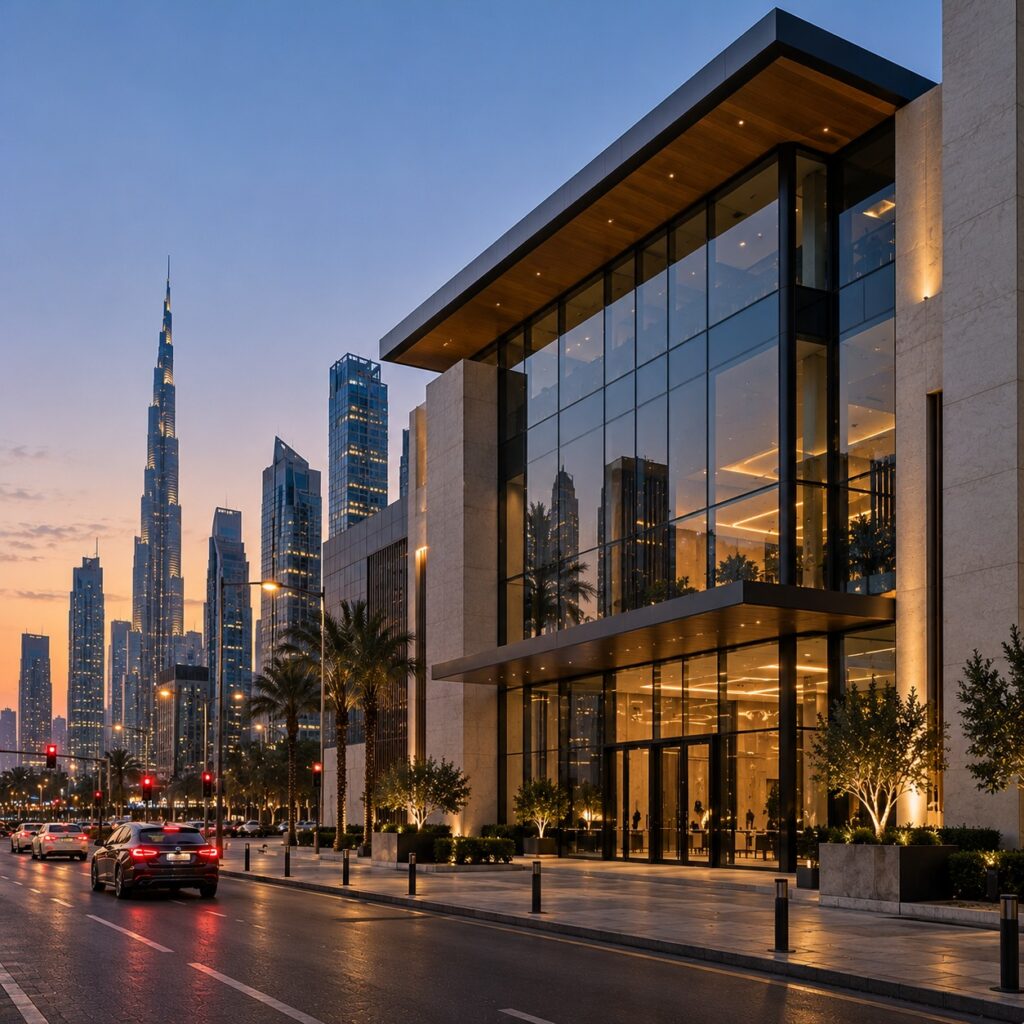
Signage is an essential part of how a building, business, hotel, retail destination or commercial development communicates with people. Well-designed signage does more than display a name or direction—it creates visibility, strengthens brand identity, supports wayfinding and becomes an integral part of the architectural environment.
Luzion provides premium signage solutions in UAE for architects, developers, hospitality groups, commercial property owners, contractors, interior designers and project procurement teams. Our approach combines signage design, architectural detailing, illuminated signage and LED lighting technology to create signage that is functional, visually refined and appropriate for its surrounding architecture.
From a prominent building identity in Dubai to a sophisticated hotel entrance in Abu Dhabi, corporate branding, retail signage, wayfinding systems and illuminated architectural signs, every project requires a balance between visibility, material quality, proportions, lighting and installation conditions.
What Are Signage Solutions?
Signage solutions encompass the planning, design, fabrication, illumination and installation of signs used to identify, inform, direct or communicate within a built environment.
Depending on the project, signage can include:
- Building and architectural signage
- Corporate and business signage
- Hotel and hospitality signage
- Retail and shopping mall signage
- Illuminated signage
- LED signage
- 3D letters and channel letters
- Indoor and outdoor signs
- Wayfinding and directional signage
- Parking and safety signage
- Monument and pylon signage
- Custom branded signage
A successful signage system should be easy to understand from the intended viewing distance while complementing the architectural character of the project. Material selection, typography, dimensions, contrast, illumination and mounting details all influence the final result.
Custom Signage Design for UAE Projects
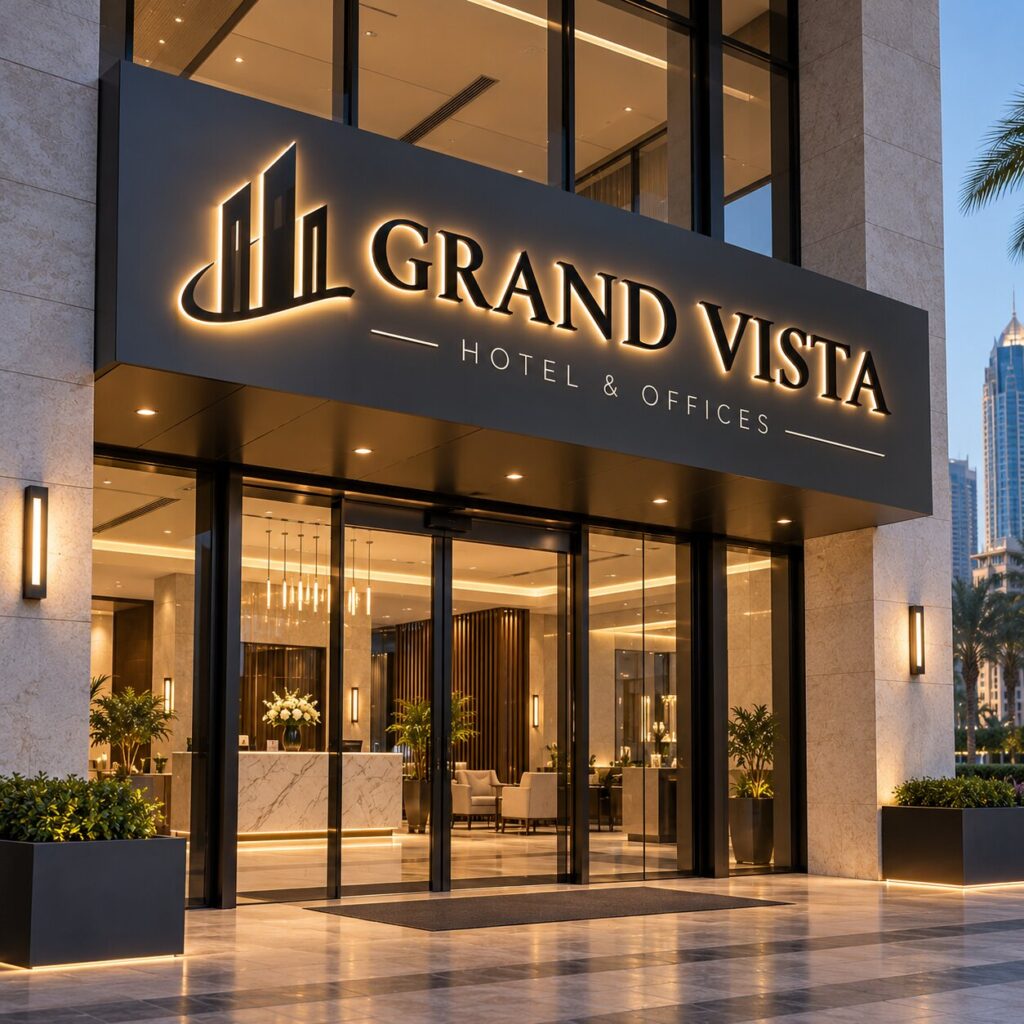 The UAE has a highly diverse built environment, ranging from luxury hotels and high-end retail destinations to corporate towers, residential developments, mixed-use communities and large commercial complexes. Each project therefore requires a signage approach that responds to its architectural identity and operational requirements.
Custom signage design allows the sign to be developed around the project’s specific requirements rather than relying on a standard off-the-shelf format.
Key considerations can include:
- Brand identity and logo proportions
- Building façade and entrance architecture
- Sign dimensions and viewing distance
- Material and surface finish
- Daytime and nighttime visibility
- Illumination requirements
- Mounting and fixing conditions
- Indoor or outdoor application
- Environmental exposure
- Wayfinding requirements
- Maintenance access
- Integration with architectural lighting
For premium developments, these details are particularly important. A sign positioned at a hotel entrance, luxury retail façade or corporate headquarters can become one of the first visual elements visitors associate with the property.
Signage Design That Works With Architecture
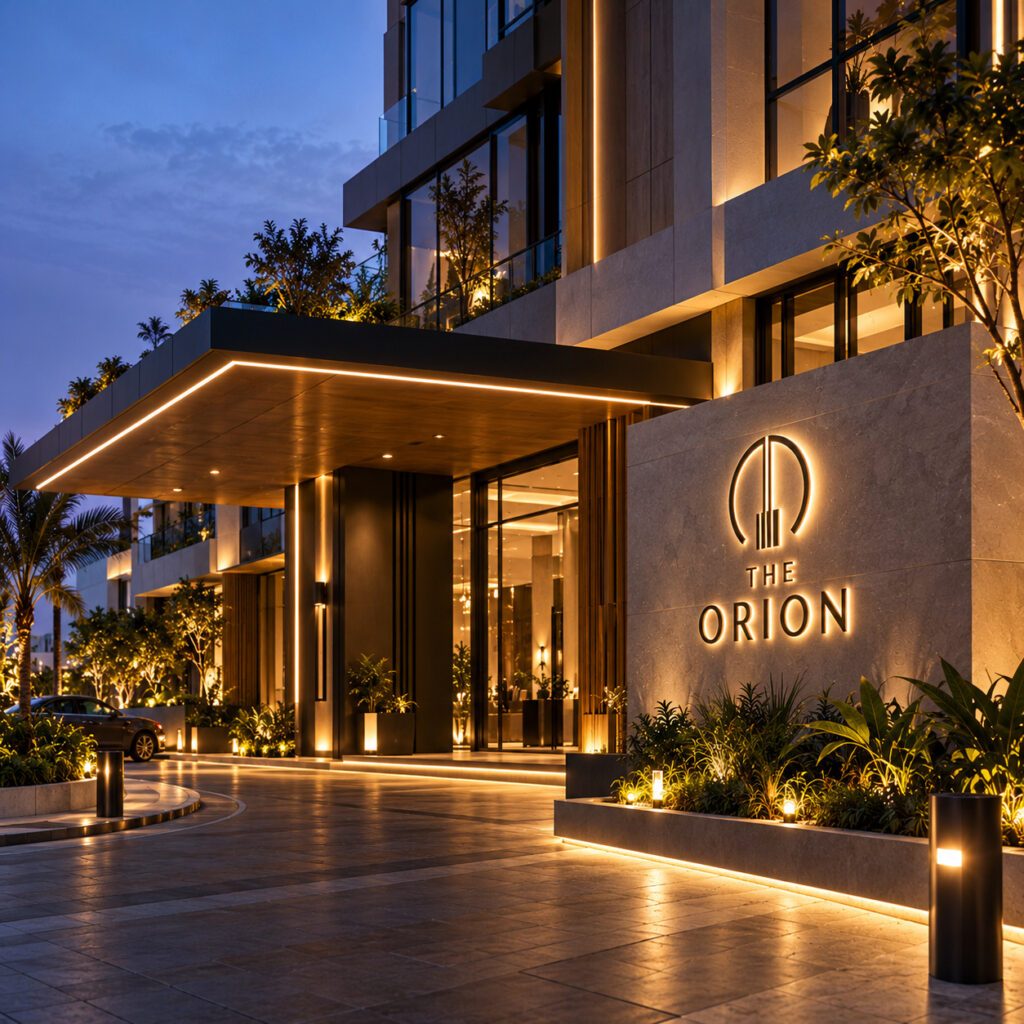 Architectural signage should not appear as an unrelated graphic element added after construction. When planned correctly, signage becomes part of the architectural composition.
The relationship between signage, façade materials, architectural lighting and landscape elements can influence how a building is experienced during both daytime and nighttime.
For example, a hotel entrance may require illuminated brand lettering combined with discreet wayfinding. A corporate building may use dimensional letters integrated into a façade feature, while a retail development may require a coordinated system of storefront identification, directional signs, parking signs and illuminated branding.
This is where architectural expertise becomes valuable. Signage dimensions, letter depth, mounting details, illumination levels, viewing angles and surrounding lighting should be considered together rather than independently.
Illuminated Signage for Day & Night Visibility
Illumination can significantly improve the visibility and visual impact of signage after sunset. Depending on the architectural requirement, different lighting approaches can be considered, including:
- Front-lit signage
- Backlit or halo-lit lettering
- Edge-lit signage
- Internally illuminated letters
- LED lightbox signage
- Illuminated acrylic signs
- LED channel letters
- Custom illuminated architectural signs
The appropriate solution depends on the sign size, material, viewing distance, desired appearance and surrounding ambient light.
For exterior projects in the UAE, lighting performance also needs to be considered alongside environmental exposure, thermal conditions, maintenance access and appropriate ingress protection for outdoor components.
A well-designed illuminated sign should provide sufficient visibility without creating unnecessary glare or overpowering the architecture.
Signage for Commercial & Architectural Environments
Professional signage is required across a wide range of environments. The design language may change from one project type to another, but the underlying requirements remain consistent: clarity, durability, visibility, brand consistency and architectural compatibility.
Hospitality & Hotels
Hotels and resorts often require a coordinated signage system covering entrance identification, reception, restaurants, amenities, guest facilities, parking, directional routes and service areas.
Luxury hospitality projects may also require bespoke illuminated lettering and architectural signage designed to complement premium materials, façade finishes and landscape lighting.
Retail & Shopping Destinations
Retail signage must attract attention while maintaining brand consistency. Applications can include storefront signs, illuminated logos, 3D letters, tenant identification, directory systems, promotional signage and wayfinding.
In shopping malls and premium retail environments, signage also needs to work within established architectural and landlord guidelines.
Corporate Offices
Corporate signage can include building identification, reception branding, lobby signs, floor directories, meeting-room identification, directional systems and external corporate logos.
Material finishes and typography can be selected to communicate the desired corporate character while maintaining a refined architectural appearance.
Commercial & Mixed-Use Developments
Large developments often require multiple signage categories working as one coordinated system. Building identification, retail units, parking, pedestrian routes, entrances and common areas may all need different signage formats.
A unified signage strategy helps visitors navigate the development while maintaining a consistent visual identity.
Signage Solutions Across the UAE
Luzion’s signage approach is suitable for architectural and commercial projects across major UAE markets, including Dubai, Abu Dhabi, Sharjah, Ajman, Ras Al Khaimah, Fujairah and Al Ain.
Project requirements can vary according to the building type, development guidelines, location, installation conditions and authority or landlord requirements. Early coordination between the architect, signage designer, lighting consultant, MEP team, contractor and signage manufacturer can help avoid design conflicts later in the project.
For larger developments, signage should ideally be considered during the design and coordination stage rather than after the architectural package has been finalized.
From Signage Concept to Project Execution
A professional signage project involves more than selecting a sign style. The process may include:
Project Brief → Site & Architectural Review → Signage Concept → Material & Finish Selection → Technical Development → Illumination Design → Fabrication → Quality Inspection → Installation
This integrated approach is particularly valuable for projects where signage forms part of the façade, entrance architecture or overall lighting scheme.
For architects, developers and contractors, early technical coordination can help address mounting structures, electrical requirements, LED accessibility, cable routing, dimensions and maintenance considerations before fabrication begins.
With its architectural lighting expertise, Luzion approaches signage as part of the wider visual environment—bringing together design, materials, illumination and architectural integration for premium commercial projects.
Types of Signage Solutions for UAE Projects
Every architectural or commercial project has different communication, branding and wayfinding requirements. A hotel entrance may require illuminated dimensional lettering, while a shopping destination may need a complete combination of storefront signs, directories and directional systems. Corporate buildings often require discreet architectural branding, whereas retail environments may demand highly visible illuminated signage.
Choosing the right signage type depends on the building architecture, brand identity, viewing distance, location, lighting conditions, material, installation method and operational requirements.
Indoor Signage
Indoor signage helps visitors navigate and identify spaces within commercial and architectural environments. It can also reinforce the visual identity of a brand throughout the interior.
Common applications include:
- Reception and lobby signs
- Room identification signs
- Floor directories
- Directional signs
- Lift and staircase signs
- Meeting-room signs
- Retail identification
- Hotel amenity signs
- Restaurant and café signs
- Washroom and accessibility signage
- Safety and regulatory signs
Indoor signage can be manufactured using materials such as acrylic, aluminium, stainless steel, glass, wood finishes and other project-specific materials. The finish should complement the interior palette rather than compete with it.
Outdoor Signage
Outdoor signage needs to remain visible and durable under changing environmental conditions. It may be installed on building façades, entrances, external walls, landscape areas, parking zones or roadside locations.
Typical outdoor signage includes:
- Building identification signs
- External corporate signs
- Hotel entrance signage
- Retail storefront signage
- Monument signs
- Pylon signs
- Directional signage
- Parking signs
- Safety signage
- Illuminated façade signs
- Wayfinding systems
For UAE projects, outdoor signage design should account for factors such as heat exposure, dust, moisture, UV exposure, wind conditions, mounting method and maintenance access.
Material and component selection therefore plays an important role in long-term performance.
Illuminated Signage
Illuminated signage combines branding or information with integrated lighting to improve visibility during evening and nighttime hours.
Different illumination methods can create very different visual effects.
Front-Lit Signage
Front-lit signs illuminate the face of the letters or logo directly. This format provides strong visibility and is commonly used for commercial buildings, retail stores, corporate offices and hospitality projects.
Backlit & Halo-Lit Signage
Backlit or halo-lit letters produce a controlled glow behind the sign. The result is generally more understated and architectural, making it suitable for premium façades, hotels, corporate environments and luxury developments.
Internally Illuminated Signage
LED sources can be integrated inside dimensional letters, boxes or other fabricated elements to produce an evenly illuminated face.
The internal construction, diffuser, LED placement and depth of the sign influence the uniformity of illumination.
LED Signage
LED technology has become an important part of modern signage because it can provide efficient illumination in compact formats.
LED signage can be used for:
- Channel letters
- Backlit lettering
- Lightboxes
- Illuminated logos
- Building signs
- Retail signs
- Hotel identification
- Corporate branding
- Architectural signage
The selection of LED modules, power supplies, optical distribution and electrical components should be appropriate for the application. For exterior signage, protection against environmental exposure and convenient maintenance access should also be considered.
Where signage is integrated with architectural lighting, the colour temperature, brightness and visual character of the LED system should be coordinated with surrounding lighting.
3D Signage & Dimensional Letters
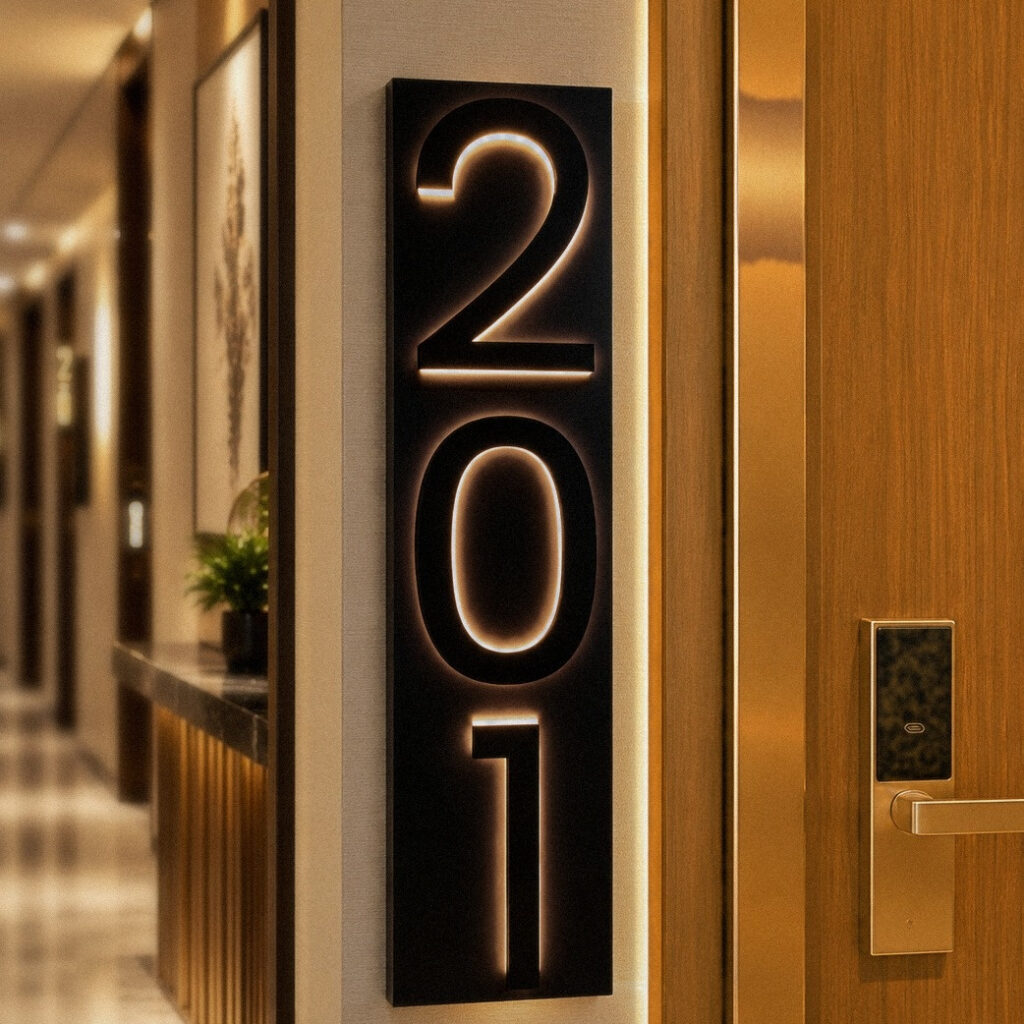 3D signage gives logos, names and individual letters physical depth, creating a stronger visual presence than flat graphics.
Dimensional letters can be produced in different materials and finishes, including:
- Acrylic
- Stainless steel
- Aluminium
- Brass-effect finishes
- Painted metal
- Powder-coated metal
- Acrylic with illumination
- Metal letters with halo lighting
The depth, return, surface finish and mounting method can be customized according to the architectural requirement.
For luxury hotels, corporate headquarters and premium retail environments, dimensional signage can provide a refined alternative to conventional flat signboards.
Channel Letter Signage
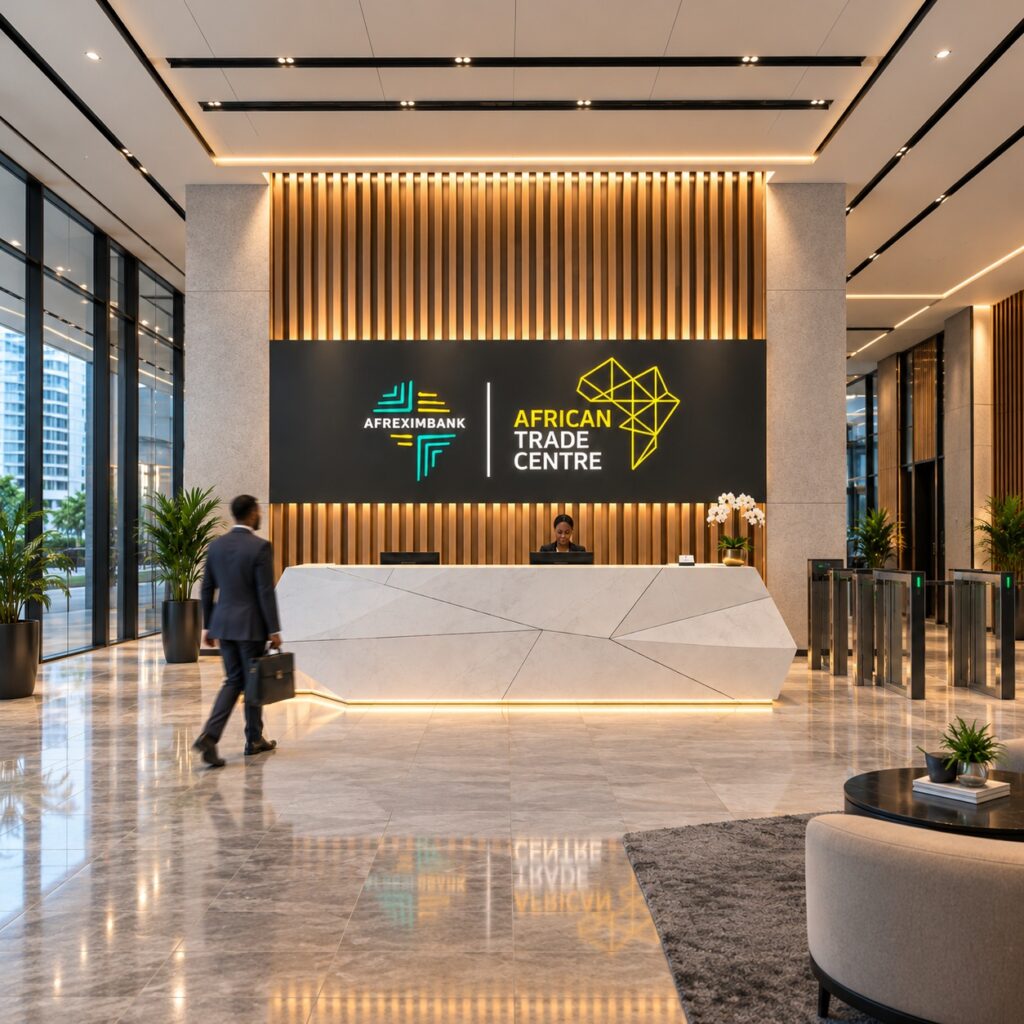 Channel letters are individually fabricated three-dimensional letters that can incorporate internal illumination.
They are widely used for:
- Retail storefronts
- Restaurants
- Hotels
- Corporate buildings
- Shopping centres
- Commercial developments
- Building façades
Channel letters can be front-lit, backlit or designed with different combinations of materials and lighting effects.
Their individual construction allows logos, letters and brand elements to be developed with precise proportions while providing strong nighttime visibility.
Acrylic Signage
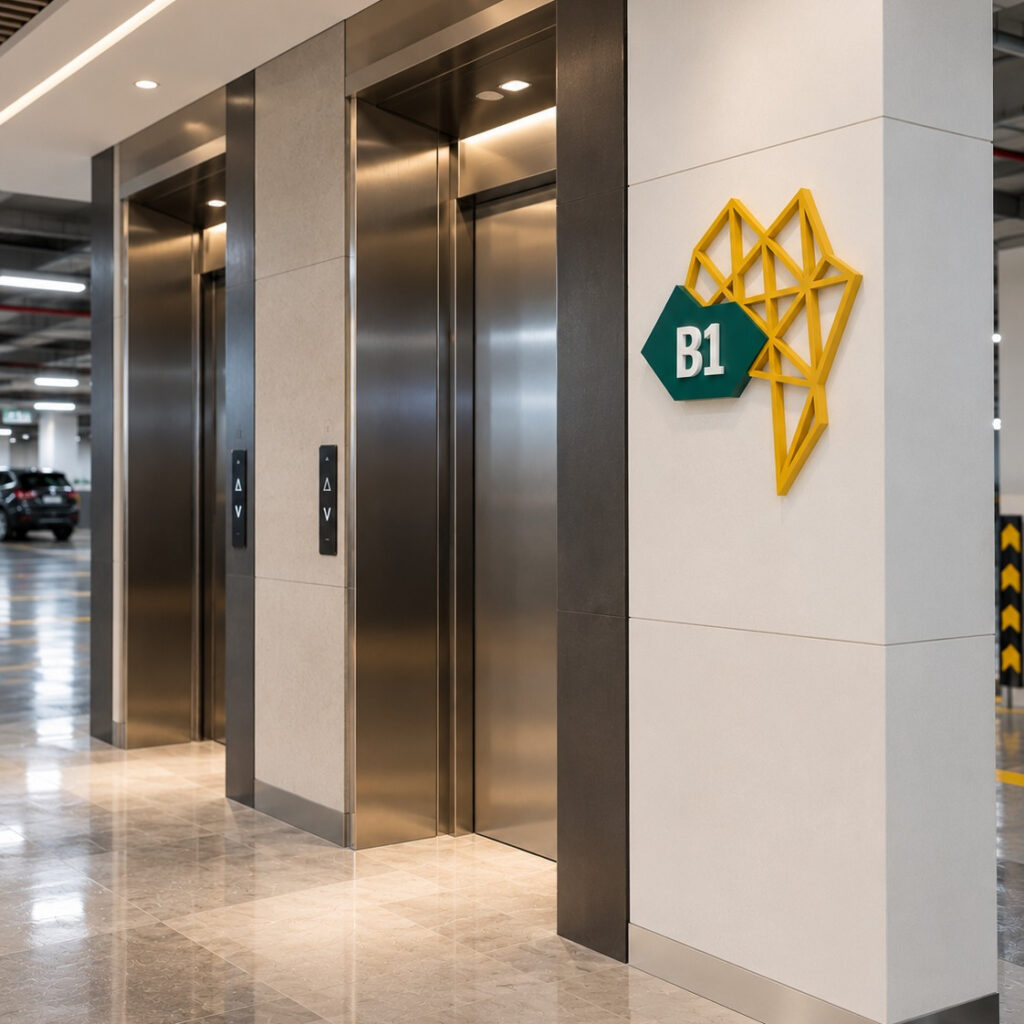 Acrylic is widely used for both illuminated and non-illuminated signage because it offers a clean appearance and can be produced in different colours, transparencies and finishes.
Applications include:
- Reception signage
- Indoor directional signs
- Illuminated letters
- Lightboxes
- Retail signage
- Corporate signs
- Hotel identification
- Wayfinding systems
Transparent, translucent and opaque acrylic can be selected depending on the required appearance and illumination effect.
Metal Signage
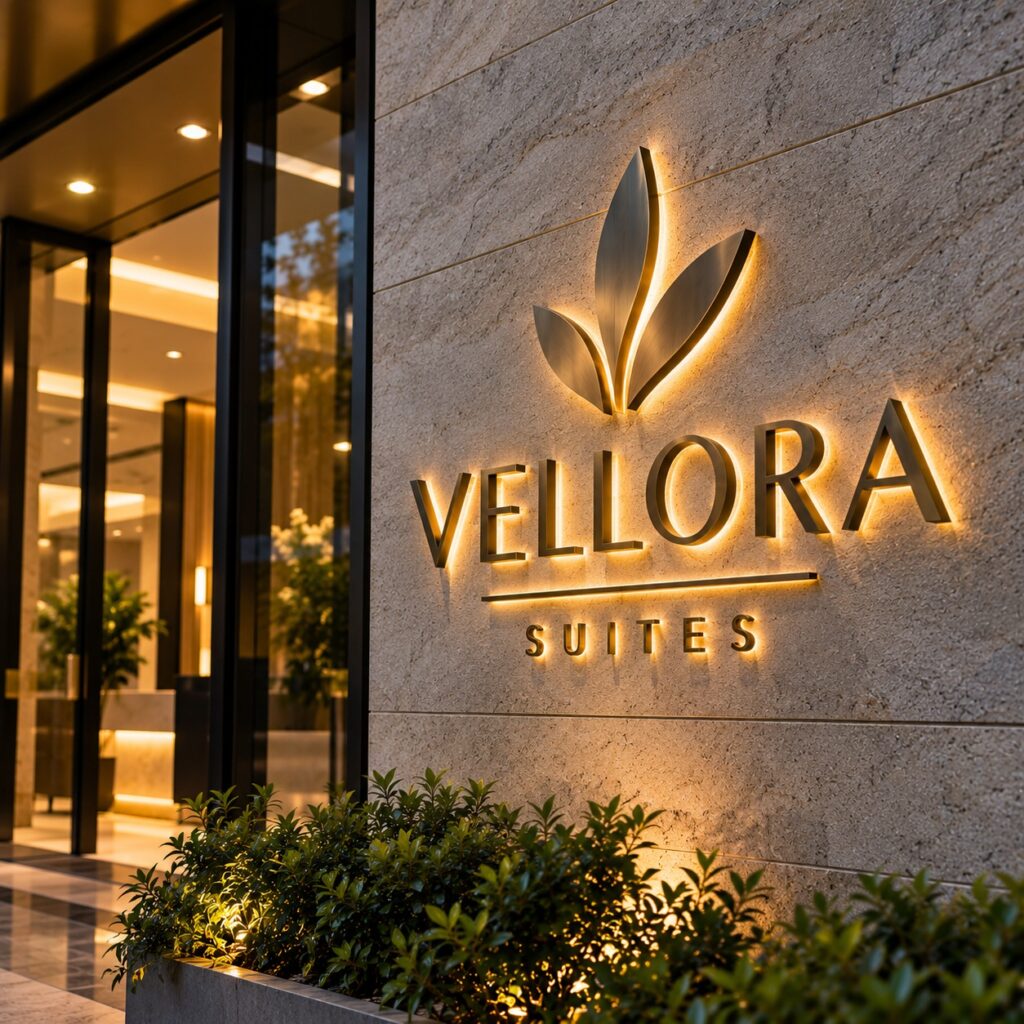 Metal signage is often selected when durability, premium appearance and architectural integration are important.
Common materials and finishes include:
- Aluminium
- Stainless steel
- Brushed metal
- Polished finishes
- Powder-coated finishes
- Painted metal
- Custom decorative finishes
Metal signage works particularly well with contemporary architecture and can be used for building identification, corporate logos, hotel branding, directional signage and external architectural applications.
The selected finish should be evaluated against the surrounding façade or interior material palette.
Lightbox Signage
Lightbox signage uses an illuminated enclosure with a graphic or translucent face. It can provide strong visual communication while maintaining consistent illumination across the sign.
Lightboxes are suitable for:
- Retail environments
- Shopping centres
- Commercial buildings
- Hotels
- Restaurants
- Reception areas
- Promotional applications
- Outdoor commercial signage
The size, depth, diffuser material and LED arrangement should be designed together to achieve even illumination without visible hotspots.
Wayfinding & Directional Signage
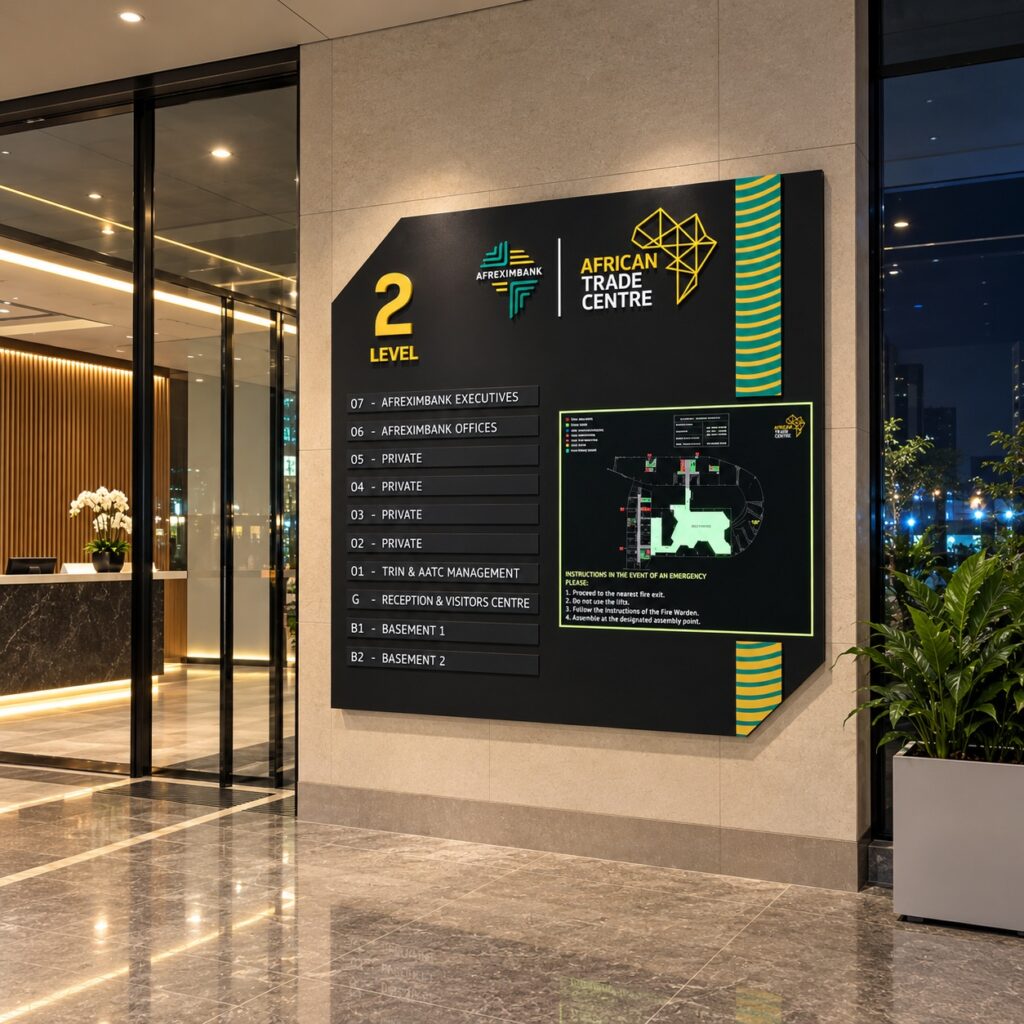 Wayfinding signage helps people move through complex buildings and developments efficiently.
It is particularly important in:
- Hotels and resorts
- Shopping malls
- Airports
- Hospitals
- Corporate campuses
- Residential developments
- Mixed-use projects
- Educational institutions
- Large commercial properties
A well-planned wayfinding system may combine directional arrows, floor information, destination names, maps, directories and identification signs.
Typography, contrast, mounting height, viewing distance and consistent design language are critical to making wayfinding intuitive.
Corporate Signage
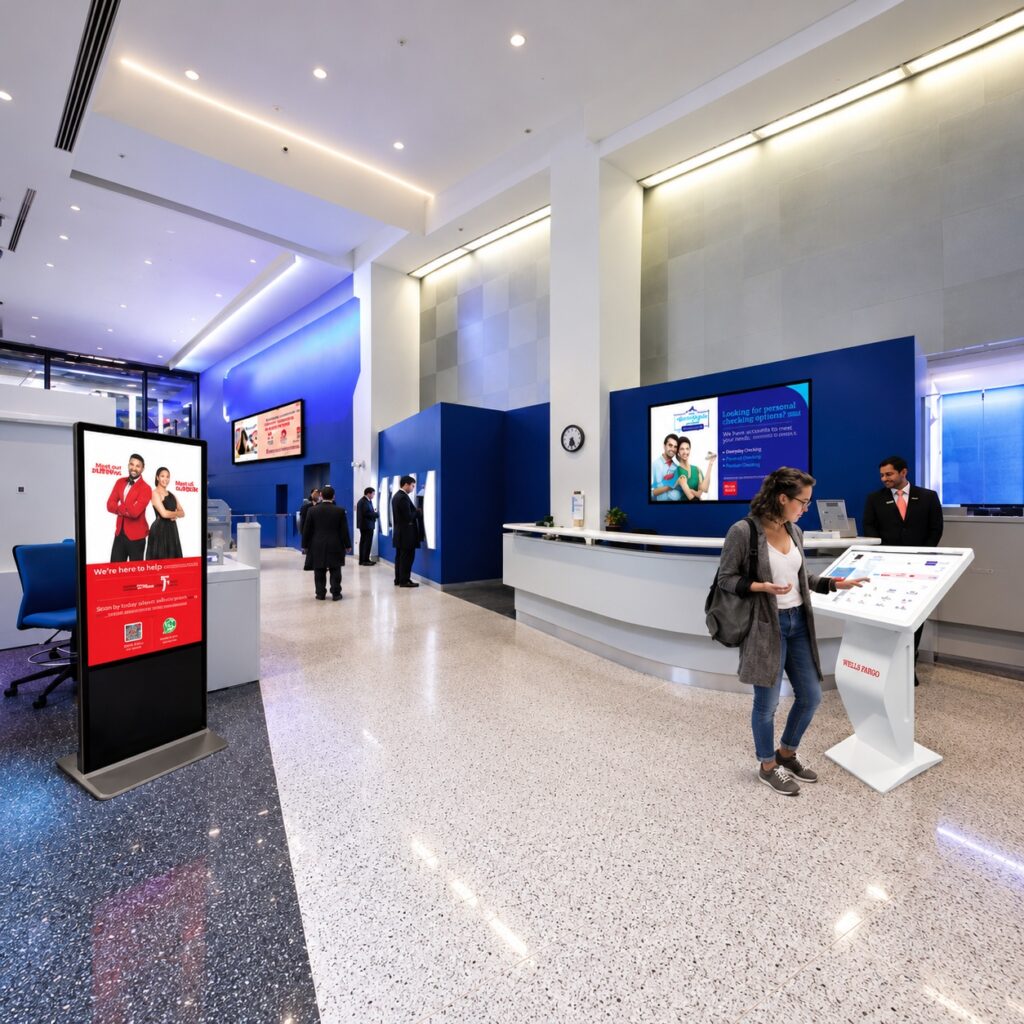 Corporate signage communicates the identity of a company within its workplace or property.
Applications can include:
- External company logos
- Building identification
- Reception branding
- Lobby signs
- Floor identification
- Meeting-room signs
- Directional signage
- Corporate directories
Premium corporate signage often relies on restrained typography, quality materials and carefully controlled illumination rather than excessive visual effects.
Hotel & Hospitality Signage
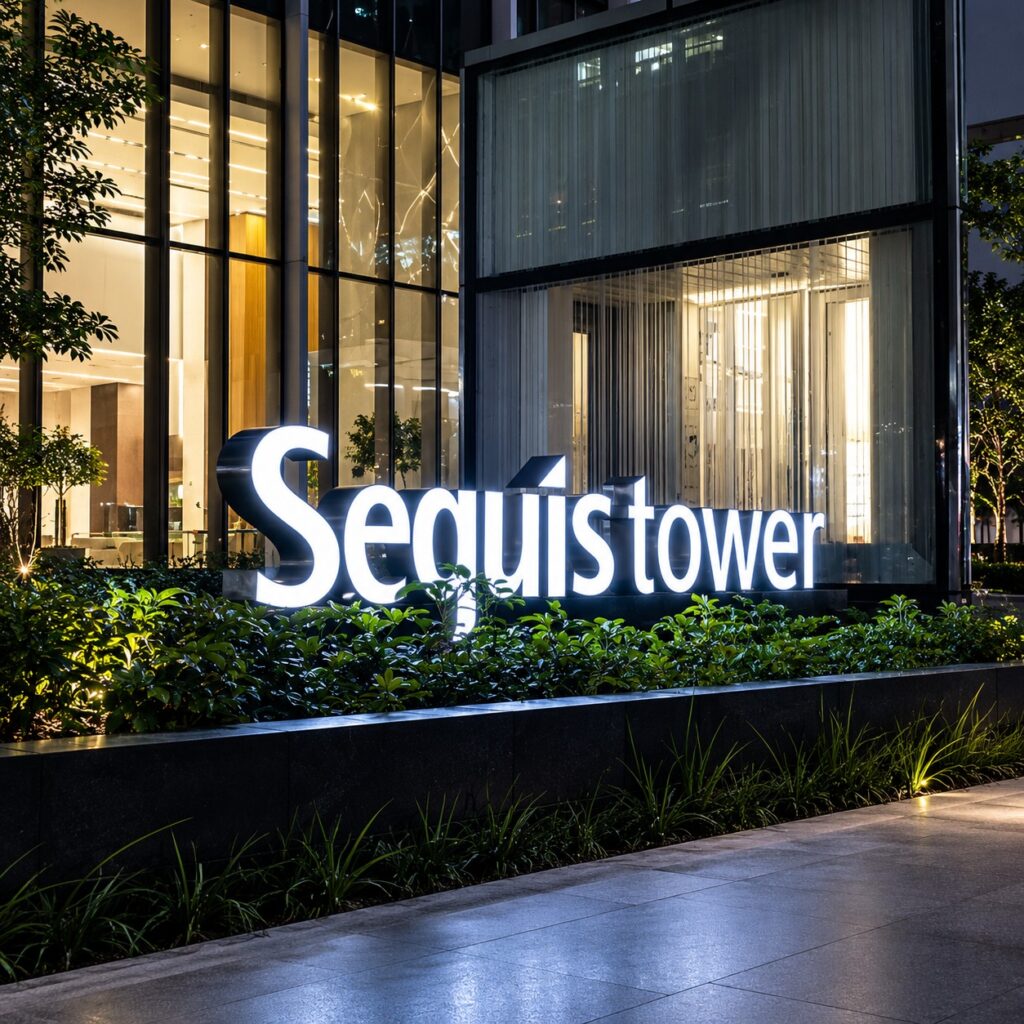 Hospitality projects require signage that supports both navigation and the guest experience.
A complete hotel signage package may include:
- Hotel name and entrance signage
- Reception identification
- Lobby directories
- Guest-room identification
- Restaurant signage
- Spa and wellness signage
- Pool and leisure signage
- Parking and arrival signage
- Emergency and safety signage
- Directional wayfinding
For luxury hotels and resorts, signage should coordinate with architecture, interior design, landscape and lighting to create a consistent guest journey.
Retail & Shopping Mall Signage
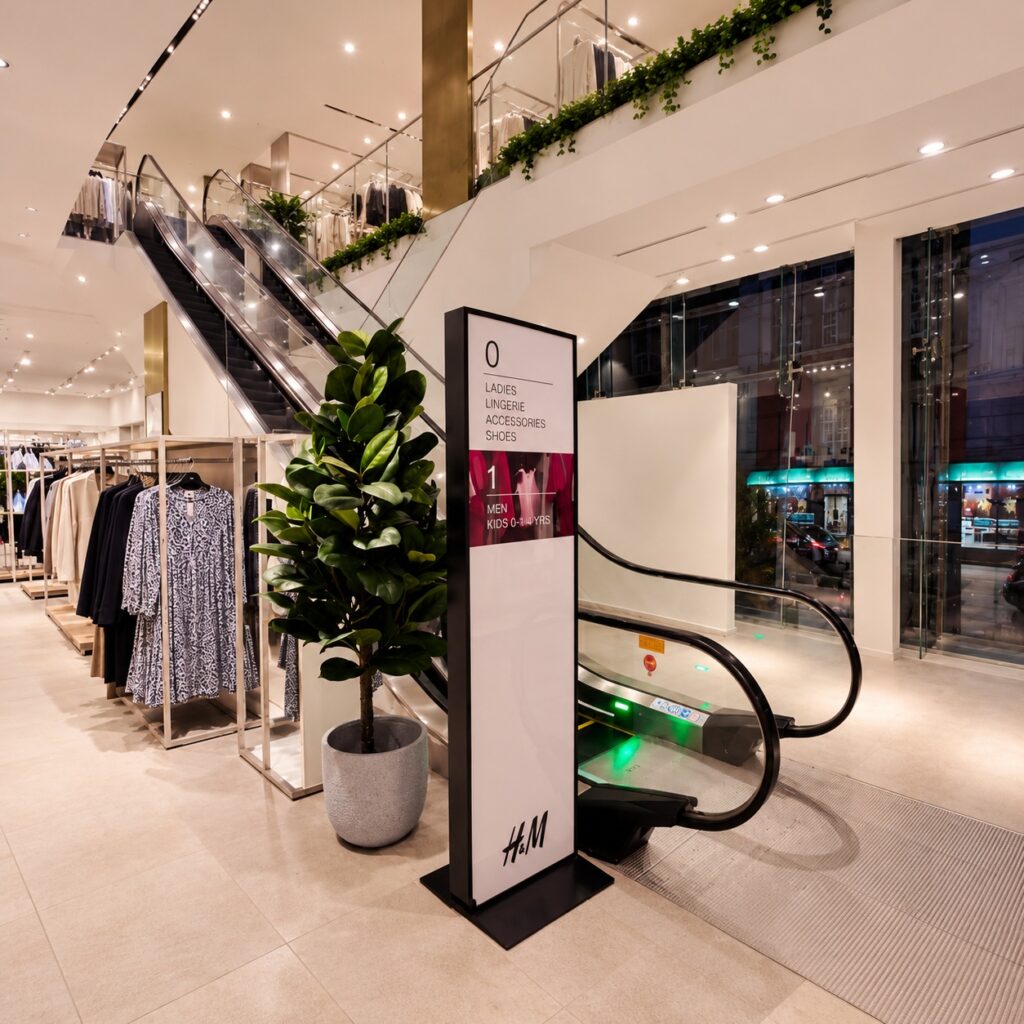 Retail environments require signage that is highly visible while remaining consistent with the brand and property guidelines.
Common retail applications include:
- Storefront signage
- 3D brand letters
- Illuminated logos
- Backlit signs
- Tenant identification
- Directory systems
- Promotional signs
- Wayfinding
- Parking and entrance signs
In shopping malls, signage often needs to comply with landlord guidelines covering dimensions, placement, materials, illumination and installation.
Monument & Pylon Signage
Monument and pylon signs are typically used where visibility from roads, entrances or larger sites is important.
They can identify:
- Commercial developments
- Hotels
- Residential communities
- Business parks
- Shopping destinations
- Mixed-use developments
These signs may combine structural frames, aluminium or metal cladding, dimensional lettering, logos and integrated LED illumination.
Because of their size and location, structural stability, foundations, visibility, access for maintenance and electrical requirements should be considered during the design stage.
Safety, Parking & Regulatory Signage
Not all signage is intended for branding. Safety and directional communication are essential components of many commercial and public environments.
Examples include:
- Parking identification
- Entry and exit signs
- Fire and emergency signs
- Restricted-area signs
- Traffic direction
- Accessible parking
- Loading-area identification
- Service and back-of-house signs
These signs should prioritize clarity and visibility while following applicable project, building and authority requirements.
Digital Signage
Digital signage uses electronic displays to provide changing visual information rather than a fixed graphic.
It can be used for:
- Retail promotions
- Corporate communication
- Visitor information
- Wayfinding
- Hospitality communication
- Public information
- Advertising
Digital signage requires different considerations from conventional fabricated signs, including screen technology, content management, viewing distance, brightness, ventilation, power requirements and maintenance.
Custom Signage for Unique Architectural Requirements
Some architectural projects cannot be effectively served by standard signage formats. Bespoke signage can be developed around a building’s geometry, façade materials, brand identity and lighting concept.
Custom solutions may combine multiple materials and techniques—for example, dimensional metal lettering with concealed LED illumination, architectural mounting systems or specially developed finishes.
For high-end commercial and hospitality projects, this level of customization can help signage become a deliberate part of the architecture rather than an afterthought.
The right signage solution ultimately depends on the purpose of the sign, its environment, the required viewing distance, brand identity, architectural language and expected operating conditions.
Signage Design, Materials & Technical Considerations for UAE Projects
A successful signage system needs more than an attractive graphic or logo. For architectural and commercial projects, the design must consider the building, viewing distance, materials, illumination, mounting conditions, environmental exposure and long-term maintenance.
In the UAE, these considerations become particularly important for outdoor signage exposed to intense sunlight, high temperatures, dust and changing environmental conditions. A signage solution should therefore be developed around the actual project rather than selected only for its appearance.
Signage Design Begins With the Project Environment
Before selecting a signage format, designers and project teams should understand where and how the sign will be viewed.
Important factors include:
- Building scale
- Sign location
- Viewing distance
- Pedestrian and vehicle movement
- Daytime visibility
- Nighttime visibility
- Ambient lighting
- Architectural materials
- Brand guidelines
- Mounting surface
- Electrical access
- Maintenance requirements
A large roadside development may require a highly visible monument or pylon sign, while a luxury hotel entrance may benefit from smaller dimensional letters with controlled halo illumination.
The objective is not simply to make a sign larger or brighter. The objective is to achieve the right balance between visibility, legibility, aesthetics and architectural integration.
Signage Materials & Finishes
Material selection has a direct influence on appearance, durability and maintenance.
Aluminium Signage
Aluminium is widely used for architectural and outdoor signage because it is lightweight and can be fabricated into different shapes and profiles.
It can be finished using options such as:
- Powder coating
- Painted finishes
- Brushed effects
- Custom colours
- Metallic finishes
Aluminium can be suitable for façade signage, directional systems, panels, letters and custom fabricated structures.
Stainless Steel Signage
Stainless steel provides a premium appearance and is often selected for corporate, hospitality and luxury architectural environments.
Depending on the desired visual character, finishes can include brushed, satin or polished surfaces.
Stainless steel lettering can also be combined with concealed illumination for a more refined nighttime effect.
Acrylic Signage
Acrylic offers flexibility for illuminated and non-illuminated applications. Its translucent characteristics can be useful where controlled light transmission is required.
It is commonly considered for:
- Illuminated letters
- Lightboxes
- Reception signage
- Retail signage
- Indoor identification
- Corporate branding
The thickness, colour, transparency and diffuser characteristics should be selected according to the intended application.
Other Custom Materials
Depending on the project, signage may incorporate additional materials or decorative finishes to complement the surrounding architecture.
The final material specification should consider the location, exposure, cleaning requirements, expected lifespan and desired aesthetic.
Choosing the Right Signage Illumination
Illumination is one of the most important technical elements of an illuminated sign.
The lighting system should provide sufficient brightness and uniformity without producing excessive glare, visible hotspots or unwanted light spill.
Common approaches include:
Front Illumination
The visible face of the letter or sign is illuminated directly. This creates strong brand visibility and is often used for retail, commercial and corporate signage.
Back or Halo Illumination
Light is emitted behind dimensional letters to create a soft glow against the wall or façade.
This approach can be particularly effective for hotels, luxury residences, corporate buildings and premium architectural environments.
Internal Illumination
LED modules are installed within a letter, box or fabricated sign to illuminate its face or translucent surface.
The internal cavity depth, diffuser and LED arrangement influence the final uniformity.
Edge Illumination
Light is introduced through or around the edge of a sign element to create a subtle illuminated outline or contemporary visual effect.
The lighting approach should always be selected according to the architecture and the viewing conditions rather than applied as a standard solution to every project.
LED Selection for Illuminated Signage
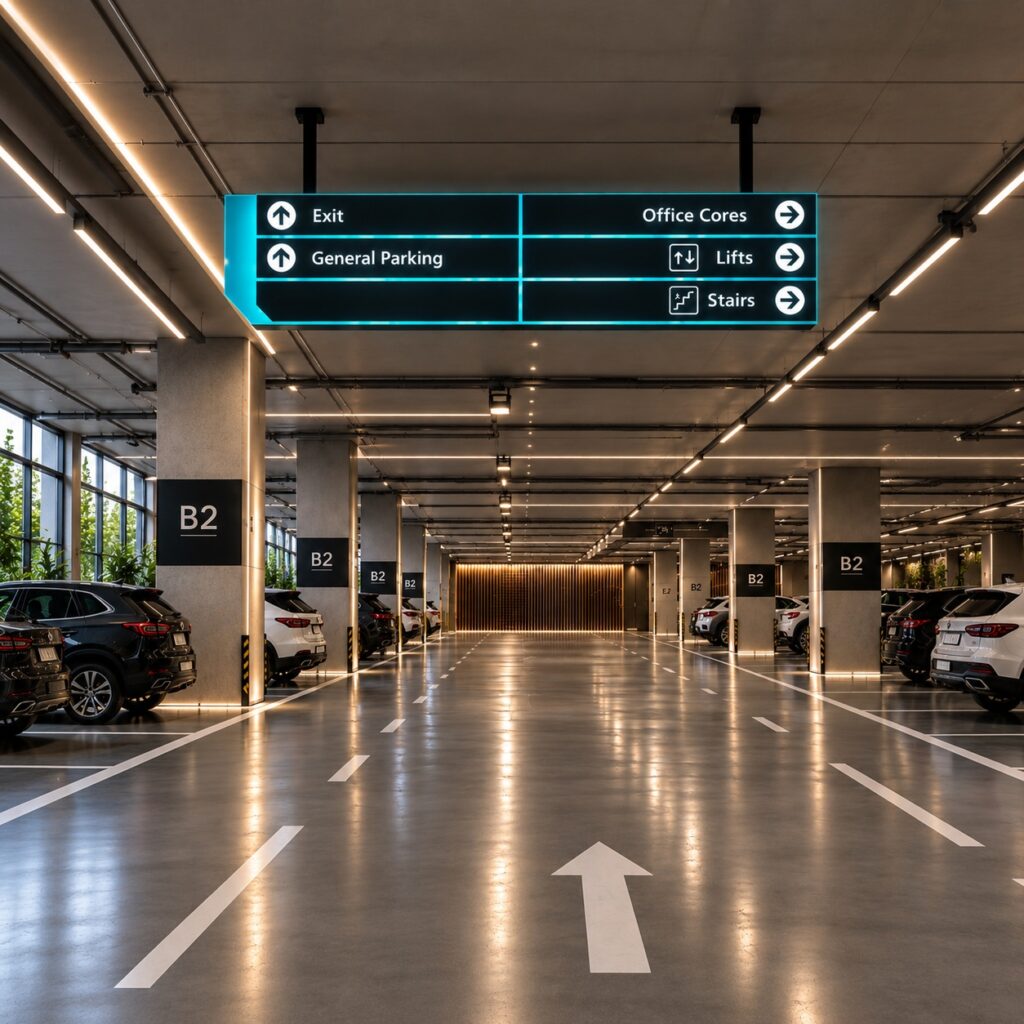 Modern illuminated signage commonly relies on LED technology because it can provide efficient, compact and controllable illumination.
However, selecting an LED system involves more than choosing a wattage.
Project teams may need to consider:
- Colour temperature
- Colour consistency
- Lumen output
- LED spacing
- Optical distribution
- Power supply capacity
- Heat management
- Dimming requirements
- Accessibility for maintenance
- Environmental protection
- Expected operating hours
For premium architectural signage, visual consistency is particularly important. Uneven brightness or visible hotspots can reduce the perceived quality of an otherwise well-fabricated sign.
Where signage is positioned close to facade lighting, landscape lighting or entrance lighting, the overall lighting composition should also be reviewed.
Signage & Architectural Lighting Integration
Signage and lighting increasingly form part of the same architectural experience.
A building may have facade lighting, entrance illumination, landscape lighting and branded signage operating together. If these elements are designed independently, the result can become visually inconsistent.
Integrated planning can help coordinate:
- Sign brightness
- Colour temperature
- Beam distribution
- Architectural accents
- Façade illumination
- Landscape lighting
- Entrance lighting
- Nighttime visual hierarchy
For example, a premium hotel façade may use subtle wall washing combined with halo-lit lettering rather than a highly illuminated sign competing with the architecture.
This is an area where Luzion’s architectural lighting expertise can add value to signage projects.
Typography, Visibility & Legibility
A signage design can look visually impressive but still fail if visitors cannot read it easily.
Typography should therefore be evaluated according to:
- Viewing distance
- Letter height
- Typeface characteristics
- Stroke width
- Contrast
- Illumination
- Background colour
- Mounting height
- Viewing angle
Wayfinding signage requires particularly careful attention because visitors often need to understand directional information quickly while moving through a building or development.
For multilingual environments, including projects serving international visitors, the relationship between different scripts, text sizes and directional symbols should also be considered during design development.
Daytime & Nighttime Appearance
Exterior signage can look completely different during daylight and after sunset.
During the day, the viewer may primarily see:
- Material finish
- Letter depth
- Colour
- Surface texture
- Shadow
- Mounting details
At night, the visual emphasis may shift toward:
- Illumination
- Brightness
- Glow
- Contrast
- Light distribution
- Surrounding ambient light
For this reason, illuminated signage should ideally be evaluated in both conditions.
A sign that appears premium during the day should maintain the same design intent at night.
Signage Installation & Mounting
Installation should be considered during the design stage, particularly for façade-mounted signage and large external signs.
Technical coordination may involve:
- Mounting brackets
- Structural fixing
- Concealed supports
- Anchor points
- Electrical connections
- Cable routing
- Access for maintenance
- Installation height
- Wall or façade construction
- Waterproofing considerations
For large monument or pylon signage, structural engineering and foundation requirements may also need to be evaluated separately according to the project.
Early coordination between the architect, contractor, façade consultant, MEP team and signage manufacturer can reduce site modifications and installation conflicts.
Outdoor Signage for UAE Conditions
UAE outdoor environments require careful material and component selection.
Depending on the location, signage may be exposed to:
- High temperatures
- Intense sunlight
- UV exposure
- Dust
- Sand
- Moisture
- Wind
- Frequent cleaning
Outdoor signage should therefore be specified according to the actual site conditions.
For illuminated signs, the protection level of electrical and LED components should also be appropriate for their installation environment.
The objective is to maintain visual quality and reliable performance over the expected operating life rather than focusing only on the initial installation.
What Influences Signage Cost in the UAE?
There is no single price for a custom signage project because cost depends on the design, dimensions, materials, illumination and installation conditions.
Important cost factors can include:
- Overall sign dimensions
- Material selection
- Letter depth and fabrication complexity
- Illumination type
- LED and electrical components
- Surface finish
- Mounting structure
- Installation height
- Site accessibility
- Quantity of signs
- Custom engineering requirements
- Transportation and installation
- Maintenance access
- Project-specific specifications
A simple indoor acrylic sign and a large illuminated architectural façade sign may look similar in concept but require completely different levels of fabrication, engineering and installation.
For this reason, project-specific quotation is generally more meaningful than a generic per-sign price.
Signage Planning for Dubai & UAE Developments
Signage requirements can vary according to the building, development, landlord, site and applicable authority requirements.
Projects in Dubai, Abu Dhabi and other UAE locations may involve coordination with property owners, developers, consultants, contractors, malls or relevant authorities depending on the application.
A professional signage design process should therefore consider approval and coordination requirements early rather than treating them as an afterthought.
For major commercial projects, the signage package may need to coordinate with:
- Architectural drawings
- Interior design
- Façade design
- Electrical drawings
- MEP coordination
- Brand guidelines
- Landlord requirements
- Site installation planning
- Safety requirements
The exact approval process should always be confirmed according to the project location and applicable authority or property guidelines.
Signage Solutions Across the GCC
The same design principles can be applied to projects throughout the GCC, while adapting material, installation and project coordination to local requirements.
Luzion can support architectural and commercial signage requirements for projects across:
UAE: Dubai, Abu Dhabi, Sharjah, Ajman, Al Ain and other Emirates
Saudi Arabia: Riyadh, Jeddah, Dammam, Khobar and major commercial centres
Qatar: Doha, Lusail and surrounding developments
Kuwait: Kuwait City and major commercial developments
Oman: Muscat, Salalah and other project locations
Bahrain: Manama and commercial developments
Across these markets, signage can be integrated with architectural lighting, façade illumination and wider project design to create a consistent visual identity.
A Coordinated Approach to Signage Design
The strongest signage outcomes usually come from early collaboration between the people responsible for architecture, branding, lighting, engineering and construction.
Rather than treating signage as a final graphic application, it can be incorporated into the project from the design-development stage.
This allows the team to coordinate:
Brand Identity → Signage Concept → Architecture → Materials → Illumination → Technical Details → Fabrication → Installation
The result is a signage system that is easier to understand, better integrated with the architecture and more appropriate for long-term commercial use.
Luzion Signage Solutions for Architectural & Commercial Projects
Signage is most effective when design, fabrication, illumination and architecture are considered as one coordinated system. For developers, architects, contractors, hospitality groups and commercial property owners, the objective is not simply to install a sign—it is to create a clear, durable and visually appropriate identity for the project.
Luzion combines its architectural lighting expertise with signage design and illumination requirements to support custom signage solutions for UAE and GCC projects. From building identification and corporate branding to hotel signage, retail signage, wayfinding and illuminated architectural signs, solutions can be developed around the project’s design language and technical requirements.
Signage Solutions Designed Around Your Project
Every project has a different combination of architectural, operational and branding requirements. Luzion’s approach begins by understanding the application before recommending a signage format.
The design process can consider:
- Project architecture
- Brand identity
- Signage location
- Required viewing distance
- Indoor or outdoor application
- Material and finish
- Illumination requirements
- Installation conditions
- Electrical requirements
- Maintenance access
- Project programme
- Quantity and sign schedule
This project-specific approach is particularly valuable for developments where signage needs to coordinate with architectural lighting, façade materials and interior design.
Signage & Architectural Lighting From One Technical Perspective
For many premium developments, signage is directly connected with the building’s lighting concept.
A hotel entrance, for example, may combine façade illumination, landscape lighting, entrance lighting and an illuminated hotel name. A retail development may combine storefront signage with architectural accents and wayfinding. A corporate headquarters may use discreet halo-lit lettering alongside carefully controlled façade illumination.
When these elements are considered together, the project can achieve a more consistent nighttime appearance.
Luzion’s architectural lighting expertise enables signage illumination to be considered alongside factors such as:
- Colour temperature
- Brightness
- Glare
- Light distribution
- Visual hierarchy
- Façade materials
- Surrounding architectural lighting
- Nighttime appearance
The aim is to ensure that signage remains visible without unnecessarily overpowering the architecture.
Signage for Hotels & Hospitality Projects
Hospitality signage needs to support both operational navigation and the guest experience.
A complete hotel or resort signage programme may include:
- Main entrance signage
- Hotel identification
- Driveway and arrival signage
- Reception and lobby signs
- Restaurant and café identification
- Spa and wellness signage
- Guest-room identification
- Floor directories
- Wayfinding
- Pool and leisure-area signage
- Parking signs
- Emergency and safety signs
- Back-of-house identification
For luxury hospitality projects, signage can be developed with materials, finishes and illumination that complement the interior and architectural design.
Subtle dimensional lettering, concealed illumination and premium metal finishes can create a sophisticated identity without excessive visual brightness.
Signage for Retail & Shopping Destinations
Retail signage has a direct relationship with visibility and brand recognition.
Luzion can support signage requirements such as:
- Storefront identification
- Illuminated logos
- 3D letters
- Channel letters
- Backlit signage
- Tenant signage
- Directory systems
- Wayfinding
- Entrance signage
- Promotional signage
For shopping malls and premium retail developments, signage should also be coordinated with the property’s architectural guidelines and tenant requirements.
A consistent system helps multiple brands coexist within the same development without compromising the overall visual identity of the property.
Corporate & Commercial Signage
Corporate signage provides a physical expression of a company’s identity within its building or workplace.
Applications can include:
- External building logos
- Corporate entrance signage
- Reception branding
- Lobby identification
- Floor directories
- Meeting-room signs
- Directional systems
- Department identification
- Parking and visitor signage
For corporate environments, a restrained material palette and carefully controlled typography can often create a stronger impression than excessive graphics or illumination.
Signage for Mixed-Use & Large Developments
Large developments require a coordinated signage hierarchy because visitors may interact with several different types of information throughout the site.
A mixed-use project may require:
Development Identity → Building Identification → Entrance Signage → Parking → Wayfinding → Retail Identification → Hospitality Signage → Directional Information
Each element should have a clear role while maintaining a common visual language.
For larger projects, creating a signage schedule and design standard early can help maintain consistency across buildings, entrances and public areas.
Luzion Signage Project Workflow
A structured workflow helps transform an initial signage requirement into a technically coordinated solution.
01. Project Brief
The process begins with the project scope, location, building type, signage requirements and brand information.
02. Design & Architectural Review
The proposed signage locations, architecture, viewing distances, surrounding finishes and application requirements are reviewed.
03. Signage Concept
Signage formats, dimensions, typography, materials, finishes and illumination approaches are developed according to the project.
04. Technical Development
Technical requirements such as mounting, electrical connections, LED components, cable routing, accessibility and installation conditions are considered.
05. Material & Finish Selection
Materials and finishes are selected according to appearance, application, environmental exposure and project specifications.
06. Fabrication
Approved signage is manufactured according to the finalized design and technical requirements.
07. Quality & Installation Coordination
The completed signage can then be prepared for project installation, with attention to dimensions, finish quality, illumination and mounting requirements.
For larger developments, coordination with architects, MEP consultants, contractors, façade teams and project management teams can be incorporated into the workflow.
Why Choose Luzion for Signage Solutions?
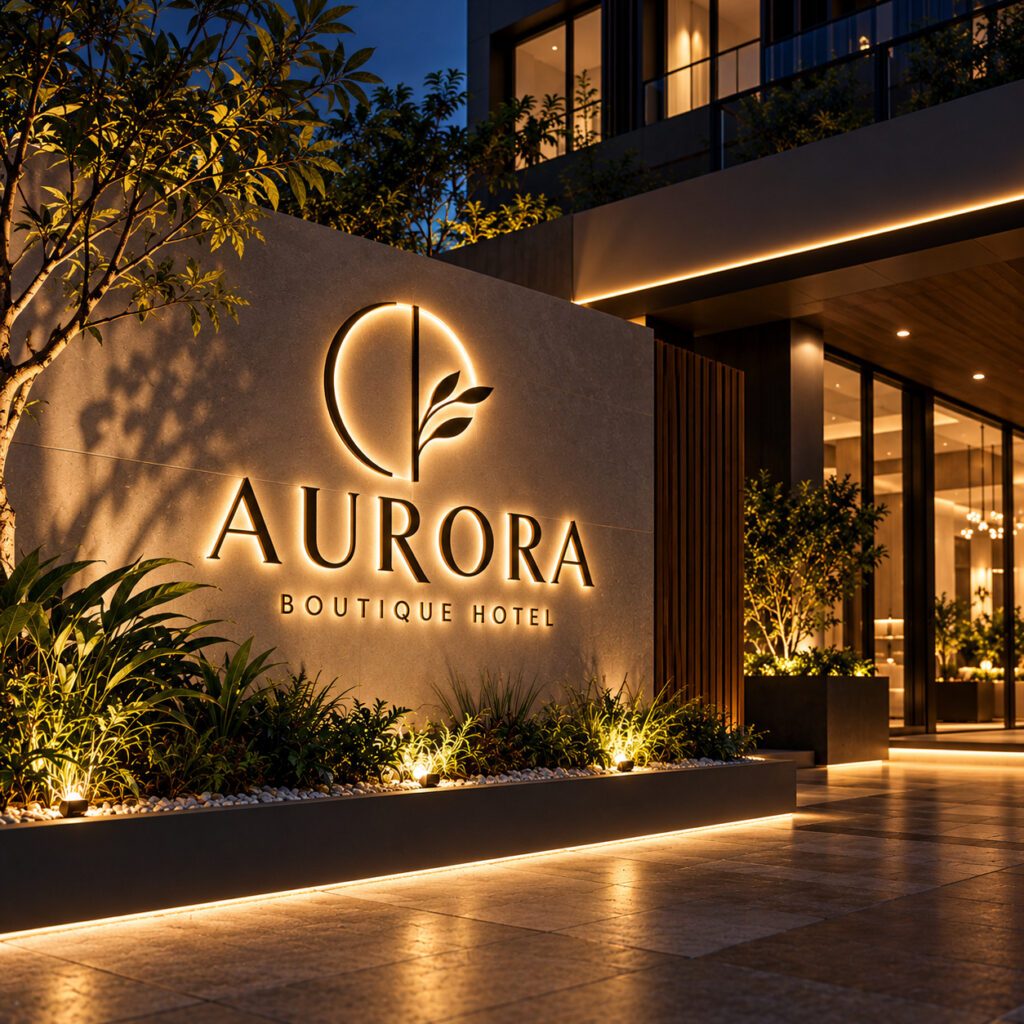 Luzion approaches signage from an architectural lighting perspective rather than treating it only as a printed or fabricated sign.
This can be particularly valuable when the project requires a combination of custom signage, illuminated branding and architectural lighting.
Key advantages include:
- Architectural lighting expertise
- Custom signage development
- Illuminated signage solutions
- LED lighting integration
- Material and finish coordination
- Technical project support
- Architectural and façade integration
- Hospitality and commercial applications
- UAE and GCC project support
- Coordination with professional project teams
For architects, developers and contractors, this integrated approach can help create signage that supports both the brand and the architecture.
Who Can Work With Luzion?
Luzion’s signage solutions are suited to professional project teams including:
- Architects
- Lighting designers
- Interior designers
- Real estate developers
- Hospitality developers
- MEP consultants
- Main contractors
- Fit-out contractors
- Retail brands
- Procurement teams
- Facility and property managers
Whether the requirement is a single architectural sign or a coordinated signage package for a larger development, the solution can be developed around the project’s specific requirements.
UAE & GCC Signage Support
Luzion supports signage and architectural lighting requirements for projects across the UAE and wider GCC market.
Key markets include:
UAE: Dubai, Abu Dhabi, Sharjah, Ajman, Ras Al Khaimah, Fujairah and Al Ain
Saudi Arabia: Riyadh, Jeddah, Dammam and Khobar
Qatar: Doha and Lusail
Kuwait: Kuwait City and major commercial developments
Oman: Muscat and Salalah
Bahrain: Manama and surrounding commercial areas
For international projects, signage specifications can be developed according to the project’s architectural design, technical documentation and procurement requirements.
Frequently Asked Questions About Signage Solutions
1. What signage solutions does Luzion provide in the UAE?
Luzion provides custom signage solutions including architectural signage, illuminated signage, LED signage, 3D letters, channel letters, corporate signage, hotel signage, retail signage, wayfinding, building identification and other project-specific signage applications.
2. Does Luzion provide custom signage design for Dubai projects?
Yes. Custom signage can be developed around the project’s architecture, branding, dimensions, materials, illumination requirements and installation conditions. Dubai and other UAE projects can be evaluated according to their specific site and development requirements.
3. What types of illuminated signage are available?
Depending on the project, illuminated signage can include front-lit, backlit, halo-lit, internally illuminated and edge-lit formats. LED technology can be integrated into dimensional letters, logos, lightboxes and custom architectural signs.
4. Can signage be integrated with architectural and facade lighting?
Yes. Signage illumination can be coordinated with architectural, façade, entrance and landscape lighting so that brightness, colour temperature and nighttime visual hierarchy remain consistent with the overall lighting concept.
5. What factors affect signage cost in the UAE?
Signage cost can depend on dimensions, material, fabrication complexity, illumination, LED components, finish, mounting structure, installation height, site access, quantity and project-specific engineering requirements. A project-specific quotation is therefore more accurate than a standard price.
6. Does Luzion support hotel, retail and corporate signage projects?
Yes. Signage requirements can be developed for hotels, resorts, retail destinations, corporate buildings, commercial developments, mixed-use projects and other architectural environments, subject to the project’s scope and technical requirements.
Create a Custom Signage Solution for Your Project
A successful signage system should communicate clearly, complement the architecture and maintain its visual impact throughout the life of the project.
Whether you are developing a hotel in Dubai, a retail destination in Abu Dhabi, a corporate building in Riyadh, a mixed-use development in Doha or a commercial project elsewhere in the GCC, the signage strategy should be considered as part of the wider architectural experience.
Luzion can support projects requiring custom signage, architectural signage, illuminated signage and signage integrated with architectural lighting.
Share your drawings, signage schedule, brand guidelines or project requirements with Luzion to discuss a suitable signage solution for your development. – sales@luzion.in
subscribe for newsletter

Luzion is a leading manufacturer and exporter of high-quality LED lighting solutions. With a focus on design, research, and innovation, we offer a wide range of products for commercial, industrial, residential, and outdoor spaces.


