
Outdoor Lighting Design Services for Architectural, Landscape & Facade Projects
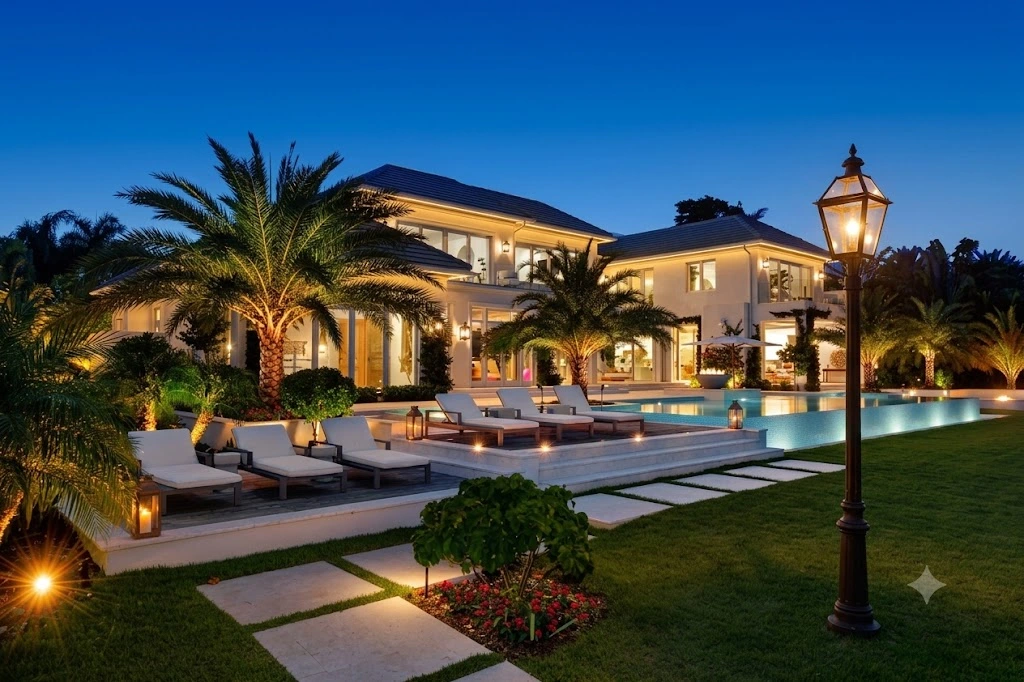 Outdoor spaces look very different after sunset. A building that feels simple during the day can become a strong architectural landmark with the right light, while a beautiful landscape can lose its character when every area is illuminated at the same brightness.
That is why Outdoor Lighting Design is more than selecting fixtures and placing them around a property. A well-planned scheme considers the architecture, landscape, visibility, atmosphere, energy use, maintenance and control strategy together.
The difference becomes clear when comparing a fixture-led approach with a designed solution. Buying ten floodlights may illuminate a façade, but it can also create glare, bright spots, dark areas and unnecessary energy consumption. A designed scheme may use a combination of linear fixtures, spotlights, wall washers and recessed fittings to create depth while using light only where it adds value.
Luzion Lighting combines lighting manufacturing with design support for residential, hospitality, commercial and public-realm applications. The approach can cover the project from concept development and fixture selection through photometric planning and technical documentation, supporting Outdoor Lighting Solutions for projects in India and international markets.
What Does Outdoor Lighting Design Actually Involve?
Professional Outdoor Lighting Design Services begin with understanding the project rather than starting with a product catalogue. The designer studies the site, architectural drawings, landscape plan, materials, intended use and visual priorities before deciding where light should go.
An Outdoor Lighting Consultant can then develop a lighting concept that combines functional illumination with architectural and landscape effects. This is particularly useful on larger developments where several lighting systems need to work together.
A typical process looks like this:
| Design Stage | What Happens |
|---|---|
| Site & Brief Analysis | Understand the architecture, landscape, usage and project requirements |
| Concept Development | Define mood, hierarchy, visual focal points and lighting layers |
| Fixture Selection | Select suitable luminaires, optics, lumen output and mounting methods |
| Photometric Planning | Check lux levels, uniformity, beam distribution and glare |
| Control Strategy | Define dimming, scheduling, sensors and lighting scenes |
| Documentation | Prepare layouts, fixture schedules, specifications and supporting files |
| Installation Support | Help coordinate the design with the installation team |
The goal is to reduce expensive changes later. When the lighting layout and photometric calculations are completed before procurement, contractors have clearer information and the risk of relocating fixtures or replacing unsuitable products becomes much lower.
Good design ultimately balances three things: visibility and safety, visual atmosphere, and project compliance.
Facade Lighting Design for Architectural Identity
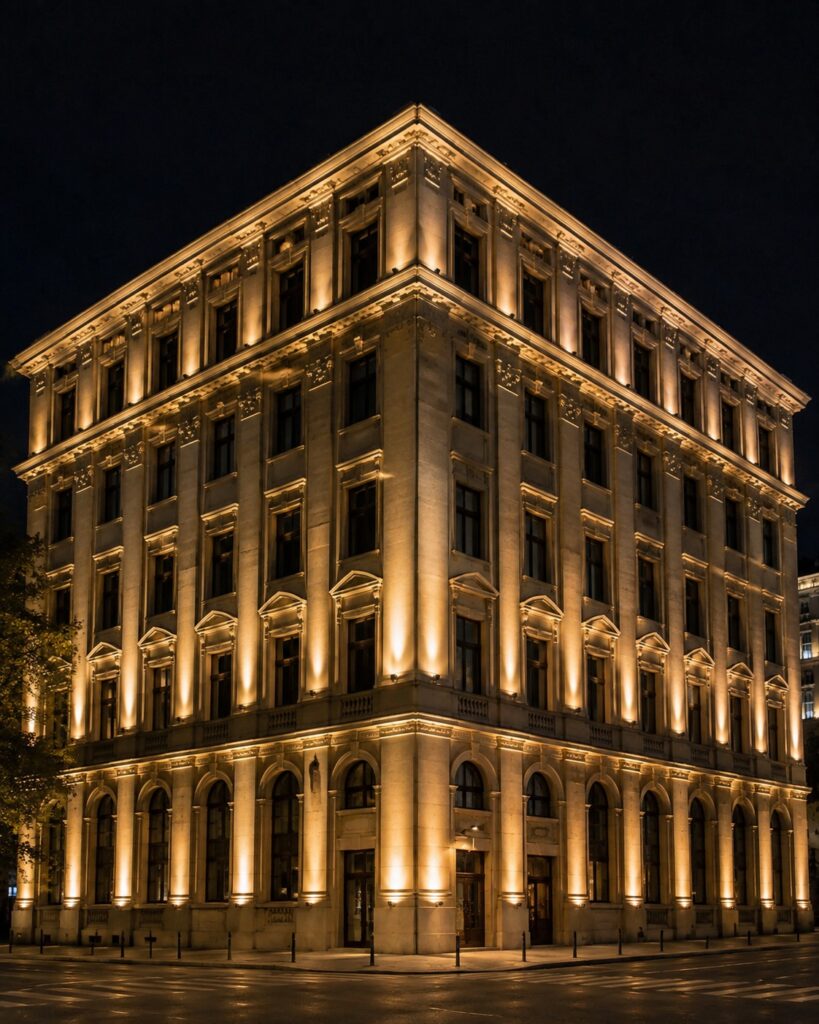 Facade Lighting Design focuses on the exterior envelope of a building and how its architecture appears after dark. The objective is not simply to make the entire building brighter. Instead, lighting should reveal important architectural features and establish a clear visual hierarchy.
For Building Facade Lighting, designers commonly use techniques such as grazing, wall washing, silhouetting and linear accents.
For example, a textured stone façade can benefit from grazing because light placed close to the surface reveals the texture. A large smooth wall may respond better to wall washing, creating a more even luminous surface. Narrow linear fixtures can emphasize parapets, architectural joints and horizontal or vertical lines.
Facade LED Lighting also offers practical advantages for large projects because LEDs support controlled beam distributions, dimming and consistent light output. However, fixture quality and optical performance remain important. A high-output LED does not automatically produce a good façade.
Glare requires particular attention on towers and glazed buildings. Fixtures should not direct excessive light toward apartments, offices, roads or neighbouring properties. In the UAE, Facade Lighting UAE projects also need to consider the already high nighttime brightness created by surrounding buildings, signage and urban infrastructure.
For a hotel, corporate headquarters or mixed-use tower, façade lighting can become part of the building’s identity. The same architectural lighting concept can continue from the façade into the entrance, landscape and public areas, creating a more coherent nighttime experience.
Landscape Lighting Design for Gardens, Paths and Features
Landscape Lighting Design brings gardens and outdoor environments to life after sunset. It can cover trees, planting beds, water features, pathways, boundary walls, steps, seating areas and architectural landscape elements.
The most effective Outdoor Landscape Lighting usually combines several layers rather than illuminating everything equally.
- Ambient lighting provides general visibility.
- Accent lighting highlights trees, sculptures, architectural features or planting.
- Task lighting supports movement around paths, stairs, entrances and activity areas.
A mature tree, for example, may look more dramatic with carefully positioned uplights directed into its canopy. Textured stone can benefit from grazing, while underwater or submersible fixtures can bring controlled light into a water feature.
In the UAE, landscape design also has to deal with environmental conditions. Landscape Lighting UAE projects may require suitable protection against heat, dust and moisture, along with corrosion-resistant materials in coastal areas. These considerations become particularly important in Dubai and other Gulf locations where outdoor equipment operates for long periods in demanding conditions.
A Landscape Lighting Dubai project should also be considered alongside the building façade. If the façade is strongly illuminated but the garden is completely dark, the composition can feel disconnected. Coordinating both systems creates a more balanced nighttime environment.
Outdoor Lighting Fixture Types and Where They Work Best
Different outdoor spaces require different optical and mounting approaches. The fixture should follow the lighting objective, not the other way around.
Outdoor Wall Lighting
Outdoor Wall Lighting works well around entrances, boundary walls and façades. It can provide functional illumination while also creating vertical architectural accents.
Outdoor Bollard Lighting
Outdoor Bollard Lighting is useful for pathways, driveways and pedestrian areas. The best installations provide clear guidance without creating excessive glare at eye level.
Outdoor In-Ground Lighting
Outdoor In Ground Lighting provides a discreet solution where the fixture body needs to remain visually minimal. It can illuminate trees, façades, columns, plazas and landscape elements from below.
Outdoor Flood Lighting
Outdoor Flood Lighting provides wider-area illumination and suits larger façades, open areas, service zones and selected security applications. Beam distribution should be matched to the size and distance of the target.
Outdoor Spot Lights
Outdoor Spot Lights offer more controlled accent lighting. They can highlight sculptures, trees, signage, columns and architectural details without flooding the surrounding area.
Outdoor Linear Lighting
Outdoor Linear Lighting works particularly well along parapets, steps, canopy edges and architectural joints. Continuous lines can reinforce the geometry of a building or landscape feature.
Outdoor Recessed Lighting
Outdoor Recessed Lighting integrates into ceilings, walls, steps or architectural surfaces where a clean appearance matters.
Outdoor Pathway Lighting
Outdoor Pathway Lighting focuses on safe movement and visual guidance. Spacing, mounting height and glare control are more important than simply increasing brightness.
Typical Outdoor Fixture Considerations
| Fixture Type | Typical Application | Common Beam Approach | Protection Consideration |
|---|---|---|---|
| Wall Light | Entrances, walls, façades | Wide / asymmetric | IP65–IP66+ depending on exposure |
| Bollard | Paths, driveways | Wide / controlled | IP65–IP66+ |
| In-Ground | Trees, façades, plazas | Narrow–medium | IP67 often preferred for exposed ground installations |
| Floodlight | Large façades, open areas | Wide / medium | IP66+ |
| Spotlight | Trees, sculptures, signage | Narrow / medium | IP65–IP66+ |
| Linear | Steps, façades, parapets | Linear / asymmetric | IP65–IP67 depending on installation |
| Recessed | Walls, ceilings, steps | Application-specific | Depends on installation location |
| Pathway Light | Walkways and steps | Controlled downward | IP65–IP66+ |
These are design-level guidelines rather than universal specifications. The required rating and beam angle should always follow the installation environment, manufacturer’s testing and project specification.
Outdoor Lighting for Hospitality and Commercial Projects
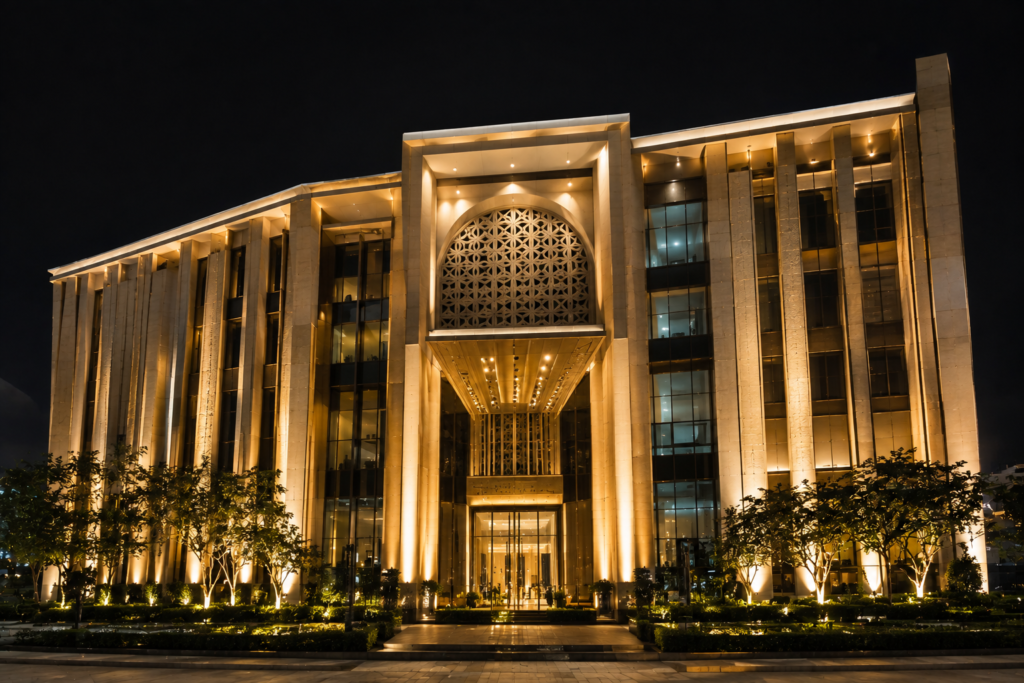 Hospitality projects require lighting that works on several levels at once. Guests need comfortable circulation, the property needs a recognizable identity and outdoor spaces such as restaurants, terraces and pools need an appropriate atmosphere.
Hotel Facade Lighting can establish the property’s identity from a distance, while Hospitality Outdoor Lighting can continue that visual language through entrances, gardens, terraces and arrival areas.
A resort provides a good example. Imagine a boutique hotel with a stone façade, landscaped arrival court, pool deck and outdoor restaurant. Rather than installing identical floodlights throughout the property, the design could use controlled façade grazing, low-level pathway fixtures, tree uplights and discreet pool/deck lighting. Each area serves a different purpose while remaining part of one lighting concept.
Resort Outdoor Lighting also needs to consider guest comfort. Bright fixtures directly visible from a dining terrace or hotel room can quickly become distracting.
Commercial buildings have different priorities. Commercial Outdoor Lighting often combines architectural appearance with visibility, wayfinding, signage integration and security requirements.
For offices, Office Exterior Lighting may focus on entrances, façade features and pedestrian circulation. For retail developments, Retail Exterior Lighting needs to make entrances and signage visible while creating an inviting arrival experience.
Large projects also require more than a product list. A contractor or MEP consultant may need fixture schedules, technical specifications, IES files, photometric information and compliance documentation before procurement.
Urban and Public Realm Lighting
Urban Lighting extends beyond individual buildings to the spaces people move through and gather in. This includes plazas, parks, pedestrian routes, civic spaces and master-planned developments.
Public Realm Lighting places greater emphasis on pedestrian safety, visual comfort, uniformity and long-term maintenance.
A Plaza Lighting Design may combine functional pedestrian lighting with feature lighting for public art, trees, water elements or civic architecture. A Park Lighting Design needs to provide safe movement while preserving the character of the landscape.
Public projects also face practical challenges. Fixtures may need stronger mechanical protection, accessible maintenance arrangements and reliable performance over long operating hours.
These requirements are increasingly relevant to master-planned communities and mixed-use developments across the GCC, where public-realm lighting can form part of the development strategy from an early stage.
Smart Controls for Outdoor Lighting
Lighting controls can transform an outdoor installation from a simple on/off system into a responsive lighting environment.
Smart Outdoor Lighting can use schedules, dimming, sensors and programmed scenes to adjust lighting according to time and activity.
For example, a hotel could operate its arrival lighting at a higher level during evening check-in hours, then reduce output later at night while retaining essential pathway and safety illumination.
Two protocols frequently appear in specifications:
| System | Primary Role | Typical Application |
|---|---|---|
| DALI | Lighting-specific addressing and dimming | Individual fixture/group control and scene management |
| KNX | Wider building automation integration | Lighting combined with HVAC, blinds and building management |
| Sensors | Automatic response | Daylight, occupancy or movement-based control |
| Scheduling | Time-based operation | Evening scenes and late-night energy reduction |
DALI Outdoor Lighting can provide detailed control over compatible luminaires, while KNX Outdoor Lighting can connect the lighting system with a wider building automation strategy.
For smaller landscape projects, sensor-based or scheduled Outdoor Lighting Controls can provide a simpler solution without introducing unnecessary system complexity.
Energy Efficiency and Dark-Sky Considerations
Energy Efficient Outdoor Lighting is not simply about replacing an older lamp with an LED. The overall design determines how much energy the project actually uses.
Correct lumen output, appropriate optics, controlled beam angles and scheduled dimming can reduce wasted light. A fixture that sends excessive light beyond the intended target consumes energy without improving the space.
Sustainable Outdoor Lighting also considers the environmental impact of unnecessary upward and sideways light.
Dark Sky Outdoor Lighting principles encourage controlled optics, appropriate color temperatures and reduced uplight. These principles are especially useful for resorts, villa compounds, rural developments and coastal projects where preserving the nighttime environment matters.
On larger developments, lighting efficiency can also support broader sustainability and ESG objectives.
Technical Standards Every Outdoor Lighting Scheme Should Meet
Outdoor luminaires face environmental conditions that indoor fixtures do not. Rain, dust, humidity, heat, cleaning processes and coastal exposure can all influence product selection.
Understanding IP Ratings
The IP code describes protection against solid particles and water. The exact rating required depends on the installation location.
| Rating | Practical Meaning | Typical Consideration |
|---|---|---|
| IP65 | Dust-tight + protection against water jets | Exposed outdoor applications |
| IP66 | Dust-tight + protection against powerful water jets | More demanding exterior environments |
| IP67 | Dust-tight + temporary immersion protection | Ground/recessed locations where water exposure is possible |
IP66 Outdoor Lighting is therefore a common consideration for exposed exterior installations, while IP67 can become more appropriate for certain in-ground applications.
However, IP rating is only one part of the specification. Weatherproof Outdoor Lighting should also consider housing material, gasket quality, driver location, thermal management and corrosion resistance.
Photometry Matters Before Procurement
Outdoor Lighting Photometry helps determine how a luminaire distributes light. Beam angle is particularly important because a narrow beam and a wide beam can produce completely different results even when the luminaires have similar lumen output.
For example:
- Narrow beam → suitable for distant architectural accents or selected trees.
- Medium beam → useful for façade details and landscape features.
- Wide beam → useful for broader surfaces and general area illumination.
The exact choice depends on mounting distance, target size, surface reflectance and required illumination.
For commercial-scale projects, photometric simulation in DIALux or similar software should normally happen before final fixture ordering. This allows the design team to review illumination levels, distribution, overlap and potential problem areas.
Outdoor Lighting Design Principles Worth Following
Good Outdoor Lighting Design Principles remain consistent across different project types.
1. Layer the Light
Avoid giving every surface the same illumination. Combine ambient, accent and task lighting.
2. Control Glare
A bright fixture visible from a pedestrian path can be more uncomfortable than a lower-output fixture with better shielding.
3. Match Light to Material
Stone, glass, metal, vegetation and textured surfaces respond differently to light.
4. Choose Color Temperature Intentionally
Warm light can create a comfortable hospitality or landscape atmosphere, while other applications may require a different appearance based on architecture and project requirements.
5. Design for Maintenance
A fixture may look perfect on day one but become difficult to service if access has not been considered.
6. Use Controls Where They Provide Value
Dimming and scheduling can reduce energy use and allow different scenes for different operating periods.
These principles should eventually appear in the Outdoor Lighting Specification, not remain only as design ideas.
Outdoor Lighting Projects Across the UAE, GCC and Beyond
The demand for architectural and landscape lighting continues to grow across developments in Dubai, Abu Dhabi, Riyadh, Doha and other major GCC markets.
Projects can include private villas, hotel developments, resorts, commercial buildings, mixed-use developments, landscape masterplans and public spaces. In Dubai, for example, a large development may need the façade, entrance, landscape and pedestrian areas to operate as one nighttime composition rather than as separate packages.
For Outdoor Lighting Projects Dubai, the project team may also need to consider local environmental conditions, surrounding brightness, project approvals and the documentation required by consultants and contractors.
Across the wider Outdoor Lighting GCC market, the same design principles apply while product selection may need to account for heat, dust, humidity and coastal conditions.
Where a project requires a regional supplier, an Outdoor Lighting Supplier UAE should be able to support more than product delivery. Technical documentation, fixture schedules, photometric files, customization and coordination can become important parts of procurement.
Outdoor Lighting Solutions by Region
Outdoor lighting requirements change from one market to another. Climate, building materials, local standards, architectural styles and long-term maintenance conditions all influence the right fixture, optic, mounting method and protection level.
Rather than treating every international project with the same specification, the lighting approach should respond to the conditions of the actual site. The following markets represent areas where Luzion has direct project experience and can support different Outdoor Lighting Solutions according to project requirements.
India
India covers a wide range of climates and architectural styles, from coastal humidity to dust and monsoon exposure. These conditions can significantly influence fixture selection, housing materials, protection requirements and maintenance planning.
Luzion supports villa, hotel, commercial and landscape lighting projects across cities including Ahmedabad, Mumbai, Bengaluru and Delhi. Each project can require a different approach depending on its environmental exposure rather than applying one standard specification to every location.
For architectural projects, Façade Lighting Design India can combine controlled façade illumination with landscape and entrance lighting to create a consistent nighttime appearance.
United Arab Emirates
The UAE combines high-profile architecture, luxury hospitality and demanding outdoor conditions. Heat, dust and intense sunlight make material selection, thermal performance and protection ratings particularly important for exterior installations.
Luzion supports villa, hotel, façade, landscape and commercial lighting projects across Dubai, Abu Dhabi and the Northern Emirates. A project in Dubai, for example, may require carefully controlled façade optics to manage glare and visual competition from surrounding buildings, while a villa landscape may need robust fixtures designed for continuous outdoor exposure.
For projects requiring a coordinated architectural approach, Outdoor & Architectural Lighting UAE, Villa Lighting Design UAE and Hotel Lighting Design UAE provide relevant service pathways.
Outdoor & Architectural Lighting UAE · Villa Lighting Design UAE · Hotel Lighting Design UAE
Saudi Arabia
Saudi Arabia has seen significant activity across hospitality, residential and large-scale development projects. Riyadh and Jeddah present different environmental conditions, so outdoor lighting specifications should respond to the individual project rather than relying on a single regional template.
Riyadh projects need to account for intense heat and dust, while coastal locations such as Jeddah introduce additional humidity and corrosion considerations. These factors can influence luminaire housing, driver selection, sealing and maintenance requirements.
Luzion supports façade, landscape and bespoke lighting requirements in Riyadh and Jeddah, including projects where architectural appearance and environmental performance need to work together.
Façade Lighting Ideas Saudi Arabia · Bespoke Lighting Saudi Arabia
Qatar, Kuwait, Oman and Bahrain
Outdoor projects across the wider GCC face many of the same environmental considerations found in the UAE and Saudi Arabia. Heat, dust, humidity and long operating periods can influence both product selection and maintenance planning.
Luzion also supports projects across Qatar, Kuwait, Oman and Bahrain. In these markets, Outdoor Architectural Lighting can cover façades, landscapes, pathways, entrances and public areas while maintaining a consistent design language across the development.
For broader regional requirements, see:
Architectural Lighting GCC · Landscape Lighting GCC · Façade Lighting GCC
United Kingdom
UK exterior lighting often operates within tighter environmental and planning constraints than many projects in the GCC. Listed buildings and conservation areas can restrict fixture visibility and mounting locations, while residential surroundings make glare and light spill important considerations.
Projects in London and other major UK cities often benefit from concealed linear lighting, carefully shielded façade fixtures and low-glare landscape illumination. Heritage properties may require warmer colour temperatures and lower-intensity illumination so that architectural materials such as traditional stone remain visually authentic.
For these projects, fixture selection should prioritise glare control, precise beam distribution and discreet integration rather than simply maximising light output.
United States
The United States covers a large range of climates, so exterior lighting specifications need to respond to local conditions.
Coastal locations in Florida and California can expose fixtures to humidity and salt, making corrosion resistance an important consideration. Projects across Arizona, Nevada and Texas can experience intense heat and UV exposure, while buildings in the Northeast and Midwest need products capable of handling freeze-thaw conditions.
The US also has a well-established residential landscape lighting market. Low-voltage garden and pathway lighting frequently works alongside architectural façade lighting on residential, hospitality and commercial developments.
This makes zoning and control particularly useful. A landscape, façade and entrance can operate at different levels rather than running every exterior fixture at full output throughout the night.
Europe
European lighting projects can involve strong energy-efficiency requirements alongside heritage and architectural conservation considerations.
Markets such as Germany, France and Italy demonstrate why fixture selection needs to consider both performance and context. Historic city centres can restrict visible fixtures and mounting methods, while energy-efficiency and light-pollution considerations encourage controlled optics, lower energy consumption and scheduled operation.
A suitable European scheme may therefore combine high-efficacy LED lighting, tight optical control, dimming and scheduling with concealed or heritage-sensitive mounting.
In historic areas of cities such as Rome, Milan or Paris, the lighting solution may need to become almost invisible during the day while producing a carefully controlled architectural effect after dark.
Australia
Australia’s strong indoor-outdoor lifestyle gives landscape, terrace, pool and garden lighting an important role alongside façade illumination.
Coastal cities such as Sydney, Perth and the Gold Coast can expose outdoor fixtures to salt air, increasing the importance of corrosion-resistant construction. Strong UV exposure also makes material and lens stability important considerations.
Projects in areas with bushfire risk may require additional attention to mounting materials and fixture construction around gardens and boundary areas.
A residential project in Sydney, for example, may need a coordinated scheme covering the façade, terrace, pool edge, pathways and planting rather than treating each outdoor zone as a separate lighting installation.
International Projects
Outdoor lighting design does not follow one universal specification. A successful scheme starts with the project’s location, architecture, environmental conditions and intended use.
For projects outside these markets, Luzion can review the requirements before committing to scope. This allows the team to understand the project location, technical requirements, drawings, expected quantities and documentation needs before recommending a suitable approach.
Frequently Asked Questions
1. What is included in outdoor lighting design services?
Outdoor lighting design can include site and brief analysis, lighting layouts, concept development, fixture selection, beam-angle planning, photometric calculations, control strategy and technical documentation. The exact scope depends on project size and requirements.
2. What IP rating is required for outdoor lighting?
There is no single IP rating for every outdoor application. IP65 and IP66 are common for exposed areas, while IP67 may be appropriate for certain in-ground installations. The final rating should reflect the installation environment and manufacturer’s tested specification.
3. How is facade lighting different from landscape lighting?
Façade lighting focuses primarily on the building envelope and architectural features. Landscape lighting focuses on trees, planting, paths, water features and outdoor spaces. On a well-designed project, both work together as one nighttime composition.
4. What control systems are used for outdoor lighting — DALI or KNX?
DALI is primarily focused on lighting control, addressing and dimming. KNX can integrate lighting with wider building automation systems. The best choice depends on the project’s control architecture and integration requirements.
5. How do you calculate lux levels for outdoor lighting design?
Lux calculations consider the luminaire’s lumen output, optics, mounting position, beam distribution, target surface and spacing. Professional designers commonly use photometric files and software such as DIALux to simulate the proposed scheme before installation.
6. Does Luzion supply outdoor lighting projects outside India?
Luzion is an India-based manufacturer supporting international lighting requirements. For a specific project, availability, technical requirements, shipping and documentation should be confirmed according to the project’s location and scope.
Plan Your Outdoor Lighting Project
Successful outdoor lighting rarely comes from choosing fixtures one by one. The strongest results come from treating the façade, landscape, pathways, architectural details and controls as parts of one lighting strategy.
Whether the project is a villa in Dubai, a hotel in Abu Dhabi, a commercial development in Riyadh, a landscape project in India or an architectural development in another international market, the design should begin with the project itself.
If you have architectural drawings, landscape plans, a fixture schedule or an initial project brief, share them with the lighting team. The next step can then focus on the right combination of Outdoor Lighting Projects, photometric planning, fixture selection and technical specification.
Start Your Outdoor Lighting Project → Contact Luzion Lighting
subscribe for newsletter

Luzion is a leading manufacturer and exporter of high-quality LED lighting solutions. With a focus on design, research, and innovation, we offer a wide range of products for commercial, industrial, residential, and outdoor spaces.


