
Facade Lighting Design: Architectural Illumination That Defines Buildings
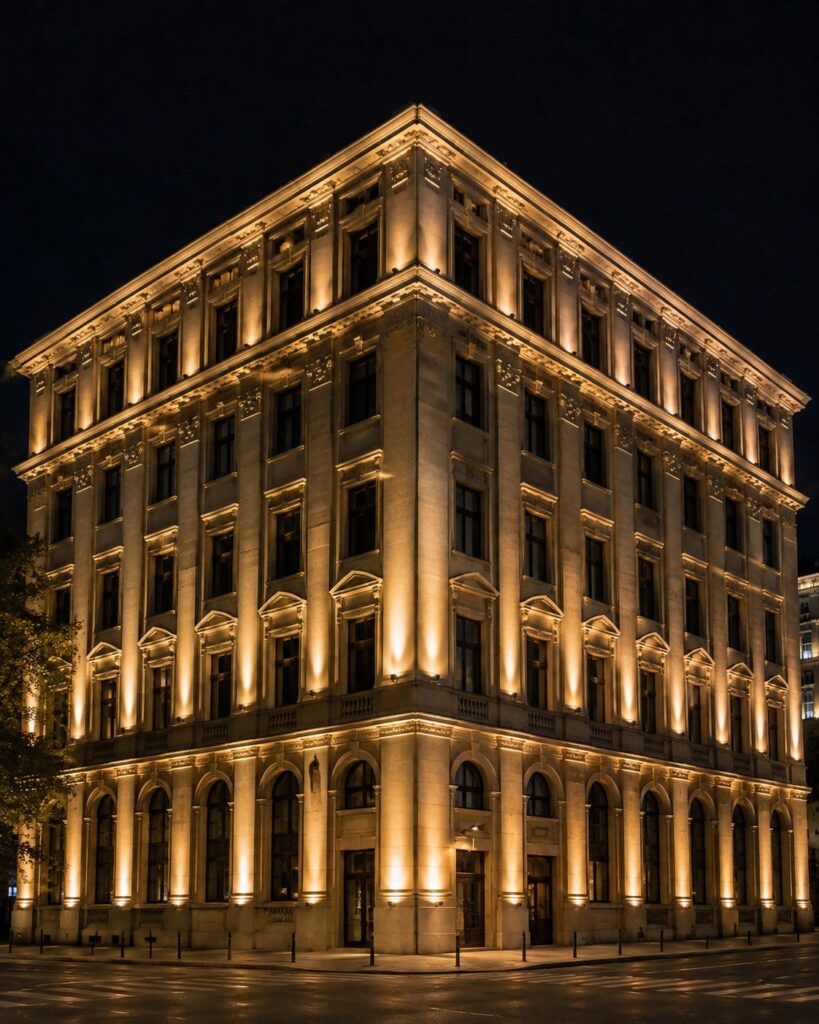 A building can have an impressive architectural form during the day and still lose its visual identity after sunset. Facade lighting design transforms that same structure into a carefully composed night-time experience by revealing architectural geometry, emphasizing materials, creating visual hierarchy and improving the way people perceive the building from surrounding spaces.
Effective facade lighting is not simply a matter of placing powerful LED fixtures on a wall. It requires an understanding of architecture, light distribution, surface materials, viewing distances, colour temperature, beam angles, glare control, mounting positions and the relationship between the building and its surroundings.
For architects, developers, lighting designers and project consultants, the objective is to create illumination that supports the architecture rather than competing with it.
At Luzion Lighting, facade lighting solutions are developed around this principle: the fixture should serve the architecture, while the light should reveal the intended character of the building.
What Is Facade Lighting Design?
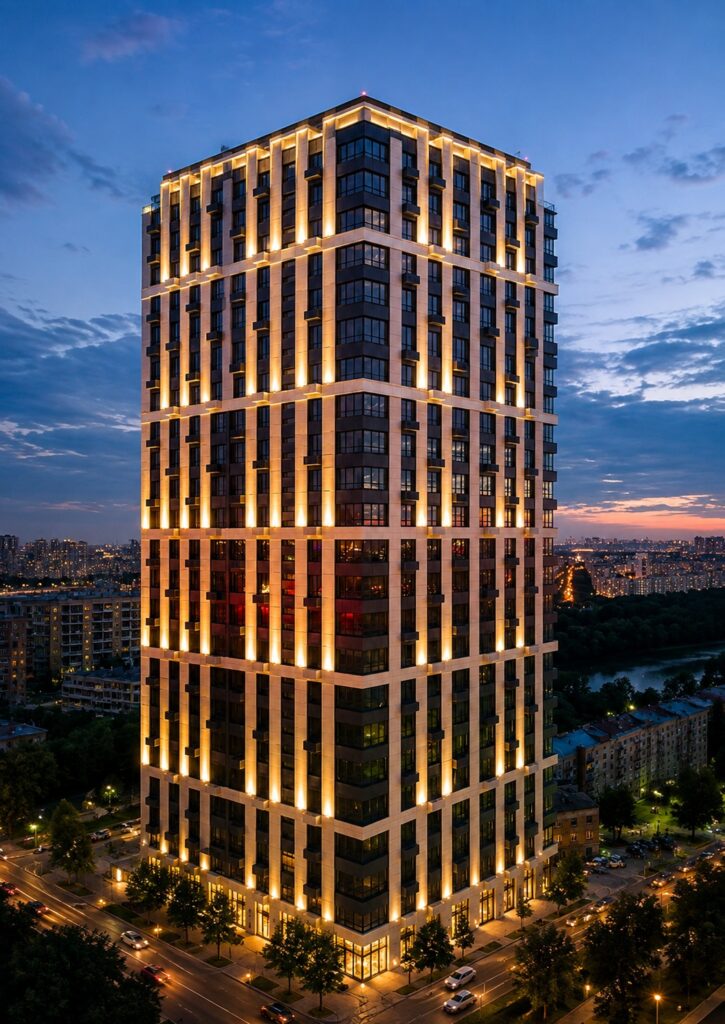 Facade lighting design is the planned use of artificial light to illuminate, highlight or visually transform a building’s exterior after dark.
Depending on the architectural objective, facade lighting may be used to:
- Highlight architectural details and textures
- Create depth across building elevations
- Emphasize columns, arches, reveals and structural elements
- Wash large surfaces with uniform illumination
- Create dramatic shadows and contrast
- Accentuate entrances and important architectural zones
- Illuminate high-rise buildings and commercial developments
- Create dynamic RGB or RGBW lighting effects
- Strengthen hotel, retail and corporate identities
- Improve the nighttime presence of landmark buildings
The best results come from designing the light distribution first and selecting the fixture second.
A narrow-beam spotlight may be ideal for a column, while a linear wall washer may be more appropriate for a broad stone elevation. Using the same fixture throughout a project can produce inconsistent illumination and unnecessary glare.
Why Facade Lighting Matters in Modern Architecture
Exterior illumination has become an important part of architectural identity.
Hotels, commercial buildings, residential towers, cultural institutions, retail developments and luxury villas increasingly use facade lights to create a recognizable appearance after sunset.
A successful scheme can make a building appear:
- Taller
- Wider
- More structured
- More dramatic
- More welcoming
- More luxurious
- More contemporary
- More visually distinctive
However, architectural lighting should not become decoration for its own sake.
The lighting designer must understand what the architect intended to communicate through the building’s form.
A stone facade may benefit from grazing that reveals texture. A glass facade may require controlled linear illumination to avoid reflections. A tower with repetitive vertical elements may benefit from narrow-beam uplighting that reinforces its proportions.
This is where professional architectural facade lighting differs from simply installing outdoor LED lights.
Start With the Architecture, Not the Fixture
Before selecting facade lights, the design team should study the building itself.
Important questions include:
What are the dominant architectural elements?
Identify columns, slabs, windows, arches, balconies, fins, entrances, rooflines and other features that establish the building’s visual identity.
Which elements should attract attention?
Not every part of a facade needs the same lighting level. A hierarchy of brightness can direct attention towards entrances, architectural features and focal points.
How will the building be viewed?
A facade viewed primarily from a nearby pedestrian plaza requires a different approach from a high-rise visible several kilometres away.
What materials are being illuminated?
Stone, concrete, brick, metal, glass and textured finishes reflect light differently.
What is the surrounding environment like?
Road traffic, neighbouring buildings, residential areas, commercial districts and public spaces all influence acceptable brightness and glare levels.
The answers determine the appropriate lighting technique, fixture position, optics and control strategy.
Understanding the Main Facade Lighting Techniques
Different architectural surfaces require different lighting approaches. A professional design may combine several techniques within the same project.
Wall Washing
Wall washing provides broad and relatively uniform illumination across a facade.
It is particularly useful for:
- Large architectural surfaces
- Stone facades
- Commercial buildings
- Hotel elevations
- Residential towers
- Institutional buildings
The fixture is positioned at an appropriate distance from the surface so that the light spreads across the wall.
The objective is generally to achieve visual uniformity rather than strong shadows.
Wall Grazing
Wall grazing places the light source close to the facade to reveal surface texture.
It works particularly well with:
- Natural stone
- Brick
- Textured concrete
- Decorative cladding
- Sculptural surfaces
Small changes in fixture position can dramatically change the appearance of the surface. A light placed too far away may flatten the texture, while one placed too close can create excessive contrast.
Uplighting
Uplighting directs light upward from ground level or another low mounting position.
It can emphasize:
- Columns
- Vertical architectural features
- Trees integrated into facade compositions
- Entrances
- Towers
- Structural elements
Narrow and medium beam angles are often selected when the designer wants to emphasize vertical proportions.
Downlighting
Downlighting directs illumination from above towards lower architectural surfaces.
It may be integrated into:
- Roof structures
- Canopies
- Cornices
- Balconies
- Architectural overhangs
It can create a controlled and comfortable visual environment around entrances and pedestrian areas.
Accent Lighting
Accent lighting uses focused beams to draw attention to specific architectural features.
Examples include:
- Sculptures
- Columns
- Statues
- Entrance portals
- Decorative elements
- Signage zones
Accent lighting should be used selectively. When every feature becomes equally bright, visual hierarchy disappears.
The Importance of Beam Angle in Facade Lighting
Beam angle is one of the most important specifications when selecting facade lights.
A narrow beam concentrates light into a smaller area, while a wider beam distributes light across a larger surface.
Typical applications include:
| Beam Distribution | Typical Application |
|---|---|
| Narrow | Columns, architectural details, tall vertical elements |
| Medium | Facade sections, arches, entrances |
| Wide | Large walls and broad elevations |
| Asymmetric | Wall washing and controlled facade illumination |
The correct beam angle depends on:
- Mounting distance
- Building height
- Facade width
- Target surface
- Required illumination level
- Fixture output
- Viewing distance
Selecting a beam angle purely from a product catalogue can therefore produce poor results.
A professional lighting design considers the relationship between beam angle, distance and target surface.
Colour Temperature and Architectural Character
Colour temperature strongly influences how a building is perceived at night.
Warm white light can create a sophisticated and welcoming appearance, particularly for hospitality, residential and heritage architecture.
Neutral white can provide a cleaner contemporary appearance for offices, commercial buildings and modern architecture.
Cooler colour temperatures may be appropriate for selected contemporary applications, but excessive use can make an architectural environment feel harsh.
The appropriate colour temperature should be selected according to:
- Architectural materials
- Building function
- Surrounding lighting
- Landscape design
- Brand identity
- Desired visual atmosphere
- Local environmental requirements
Rather than choosing colour temperature independently for every fixture, the project should establish a coherent lighting palette.
Designing for People, Not Just Buildings
A facade may look impressive in a rendering but uncomfortable in reality.
Glare must therefore be considered from the beginning of the design.
Potential glare sources include:
- Exposed high-output LEDs
- Poorly positioned floodlights
- Incorrect beam angles
- Fixtures directed towards roads
- Uncontrolled light spilling into adjacent properties
- Excessively bright architectural features
Good facade lighting design controls where light goes as carefully as it controls where light is visible.
Optical accessories, shielding, mounting angles and carefully selected optics can help maintain visual comfort while preserving architectural impact.
Facade Lighting Design: Technical Planning, Optics & Performance
A successful facade lighting scheme must perform technically as well as visually. Once the architectural concept has been established, the design team needs to translate it into measurable lighting performance.
This stage involves fixture selection, optical distribution, mounting positions, illuminance calculations, colour quality, ingress protection, impact resistance, thermal management, controls and maintenance considerations.
Choosing the Right Facade Lights
There is no single fixture suitable for every facade.
The most appropriate facade lights depend on the architecture and the required lighting effect.
LED Floodlights
LED floodlights are useful for illuminating large building surfaces and broad architectural elements.
They are commonly considered for:
- Large commercial buildings
- Industrial architecture
- High-rise structures
- Warehouses
- Stadiums
- Large exterior walls
The designer must pay particular attention to beam distribution and glare.
Linear Facade Lights
Linear LED lighting can follow architectural lines and create continuous visual elements.
They are useful for:
- Horizontal bands
- Vertical fins
- Cornices
- Parapets
- Window lines
- Building edges
- Recessed architectural details
Linear fixtures can provide a clean architectural appearance when carefully integrated into the building.
LED Wall Washers
Wall washers are designed to distribute light across vertical surfaces.
They are particularly useful where the intention is to create:
- Uniform facade illumination
- Consistent brightness
- Soft architectural emphasis
- Material enhancement
LED Spotlights
Spotlights provide focused illumination and are useful for architectural accents.
They can highlight:
- Columns
- Sculptural features
- Entrances
- Decorative elements
- Architectural details
Inground Lights
Inground fixtures can provide discreet illumination from ground level.
They are often used around:
- Building entrances
- Plinths
- Columns
- Landscape edges
- Vertical architectural elements
Drainage, loading, IP protection and maintenance access must be considered carefully.
IP Rating for Exterior Facade Lighting
Exterior lighting is exposed to weather, dust and environmental conditions.
The IP rating should therefore be selected according to the installation environment rather than simply choosing the highest available rating.
Depending on the application, facade lighting may require protection against:
- Dust
- Rain
- Water jets
- Moisture
- Condensation
- Outdoor contaminants
For demanding outdoor applications, appropriately specified IP-rated luminaires can improve long-term reliability.
The exact IP requirement should be determined from the fixture location, exposure and project specifications.
IK Rating and Mechanical Protection
Some facade lights are installed in locations where they may be exposed to accidental impact, vandalism or maintenance activity.
The IK rating indicates the mechanical impact resistance of a luminaire.
This can be particularly relevant for:
- Ground-level fixtures
- Public spaces
- Pedestrian areas
- Landscape-integrated facade lighting
- Transport environments
- Commercial developments
IP and IK ratings address different requirements and should not be treated as interchangeable specifications.
CRI and Colour Quality
Colour rendering becomes especially important when facade materials have distinctive tones or textures.
A high-quality LED source can reproduce architectural materials more naturally and consistently.
CRI should be considered alongside:
- Colour temperature
- LED technology
- Material finish
- Required visual fidelity
- Project application
For hospitality, luxury residential and premium commercial projects, colour quality can have a significant impact on the perceived quality of materials.
DIALux and Lighting Simulation
Before installation, a professional facade lighting design can be evaluated using lighting simulation.
DIALux can help designers study:
- Fixture positions
- Beam distributions
- Illuminance
- Uniformity
- Light levels
- Lighting layouts
- Different fixture options
Simulation allows design teams to identify problems before equipment reaches site.
For architects and consultants, this can make design decisions easier to communicate during coordination and approval stages.
Luzion can support architectural lighting projects with DIALux-based lighting design, helping project teams evaluate facade lighting concepts before final specification.
Creating a Lighting Hierarchy
One of the most common mistakes in exterior architectural lighting is making everything equally bright.
A successful design establishes hierarchy.
For example:
Primary elements
Main entrance, tower crown or signature architectural feature.
Secondary elements
Columns, facade bands, windows or structural features.
Supporting elements
Landscape edges, pathways and surrounding architectural details.
This hierarchy allows the eye to understand the building.
The brightest element should have a reason to be the brightest element.
Uniformity Versus Contrast
Uniform illumination is not always the goal.
Large commercial facades may benefit from controlled uniformity, while textured architectural surfaces can look more attractive with carefully designed contrast.
The decision depends on the architectural intent.
A stone wall might require grazing to reveal texture.
A modern glass building might require carefully controlled linear lighting.
A heritage structure might require subtle illumination that preserves its character.
Therefore, lighting quality cannot be defined by brightness alone.
Dynamic Facade Lighting
Modern buildings increasingly incorporate programmable lighting systems.
RGB and RGBW facade lighting can create dynamic scenes for:
- Events
- Festivals
- Brand activations
- National celebrations
- Public installations
- Hospitality environments
- Landmark buildings
DMX-based control can allow lighting designers to create programmed sequences and colour transitions.
However, dynamic lighting should be used with restraint.
Permanent architectural lighting should remain visually appropriate even when special-event programming is inactive.
Energy Efficiency
Facade lighting operates outdoors and can represent a significant electrical load on large developments.
LED technology provides an efficient foundation, but efficiency depends on the complete design.
Energy performance can be improved through:
- Correct lumen output
- Appropriate beam angles
- Efficient optics
- Accurate fixture positioning
- Dimming
- Scheduling
- Presence or environmental controls where appropriate
- Intelligent lighting management
A poorly aimed high-output luminaire can waste more energy than a correctly specified lower-output fixture.
The goal should therefore be efficient illumination, not simply high wattage.
Facade Lighting Design for Different Architectural Projects
Every building has a different architectural language. The lighting strategy should respond to the building’s function, scale, materials, surroundings and expected audience.
Hotel Facade Lighting
Hotels depend heavily on first impressions.
Facade lighting can strengthen the arrival experience and make the building recognizable after sunset.
Important areas can include:
- Main entrance
- Canopies
- Vertical facade elements
- Architectural signage
- Landscaping
- Guest arrival zones
- Rooftop features
The lighting should feel premium without creating excessive glare for arriving guests.
Warm and neutral white schemes are often considered for hospitality environments, depending on the architecture and brand identity.
Commercial and Office Buildings
Corporate and commercial buildings often require a refined appearance that reflects their brand.
Facade lighting can emphasize:
- Vertical structural elements
- Entrance portals
- Building edges
- Floor bands
- Architectural fins
- Signage
For offices located in dense urban environments, spill light and glare require particular attention.
Residential Towers and Luxury Villas
Residential architecture benefits from a more restrained approach.
For luxury villas, lighting may focus on:
- Entrance gateways
- Stone walls
- Columns
- Landscape features
- Balconies
- Architectural recesses
For residential towers, carefully positioned linear fixtures and controlled uplighting can emphasize the building’s vertical structure.
Retail and Shopping Developments
Retail architecture often requires strong visual identity.
Facade lighting can support:
- Brand visibility
- Entrances
- Storefronts
- Architectural forms
- Public plazas
- Wayfinding
Dynamic lighting can be incorporated for special campaigns, but permanent illumination should remain aligned with the architecture.
Landmark and Cultural Buildings
Landmark structures require particularly careful design because the lighting becomes part of the public image of the building.
A lighting designer may combine:
- Grazing
- Uplighting
- Accent lighting
- Linear lighting
- Colour-changing systems
The aim is to reveal the building’s identity rather than overwhelm its architecture.
Facade Lighting in the UAE and GCC
The Gulf region presents specific environmental considerations for exterior lighting.
Buildings in markets such as the UAE, Saudi Arabia, Qatar, Kuwait, Bahrain and Oman can experience high temperatures, dust, strong sunlight and demanding outdoor conditions.
For projects in Dubai, Abu Dhabi and other major cities, facade lighting specifications should consider:
- Thermal performance
- Outdoor durability
- IP protection
- Corrosion resistance
- UV exposure
- Maintenance accessibility
- Glare
- Energy consumption
- Control systems
However, the architectural concept should always come first.
A technically durable luminaire still needs to produce the correct optical result.
For UAE projects, Luzion can support architects, developers, consultants and contractors with architectural lighting products, technical documentation and lighting design coordination.
A Practical Facade Lighting Design Workflow
A professional project normally moves through several stages.
01. Architectural Analysis
Study elevations, sections, materials, architectural details and viewing angles.
02. Lighting Concept
Define the desired visual identity and establish the lighting hierarchy.
03. Technique Selection
Select wall washing, grazing, uplighting, downlighting, accent lighting or a combination.
04. Fixture Selection
Choose appropriate optics, lumen output, colour temperature, CRI, IP/IK rating and control compatibility.
05. Lighting Simulation
Use DIALux or equivalent tools to evaluate fixture positions and expected illumination.
06. Mock-Up
Where practical, test representative sections of the facade before final installation.
07. Technical Coordination
Coordinate lighting positions with architecture, structure, electrical systems, HVAC, signage and landscape.
08. Installation
Ensure mounting positions, aiming angles, cabling and protection match the approved design.
09. Commissioning
Aim fixtures, verify lighting scenes and adjust the system to achieve the intended architectural effect.
What Architects and Consultants Should Specify
A professional lighting specification should go beyond wattage.
Important parameters may include:
| Specification | Why It Matters |
|---|---|
| Wattage | Electrical load |
| Lumens | Light output |
| Beam angle | Light distribution |
| CCT | Visual appearance |
| CRI | Colour rendering |
| IP rating | Environmental protection |
| IK rating | Impact resistance |
| Optics | Precision and control |
| Driver | Electrical performance |
| Dimming | Lighting control |
| DMX/DALI | System integration |
| Housing material | Durability |
| Finish | Architectural integration |
| Mounting | Installation method |
Project teams should also request:
- Product datasheets
- Photometric files
- IES/LDT files
- Installation details
- Warranty information
- Technical drawings
- DIALux files where applicable
- Control specifications
- Maintenance information
This documentation helps architects, MEP consultants and contractors coordinate the lighting system with the wider project.
Common Facade Lighting Design Mistakes
Using Excessive Brightness
More light does not automatically create better architecture.
Ignoring Beam Angle
Incorrect optics can create hot spots, dark areas and unwanted spill light.
Exposing Light Sources
Visible LEDs can introduce glare and reduce visual comfort.
Treating Every Surface the Same
Different materials respond differently to illumination.
Selecting Fixtures Before Defining the Concept
The product should support the lighting objective rather than dictate it.
Ignoring Maintenance
Fixtures installed at height need practical access for cleaning, replacement and servicing.
Neglecting Surrounding Buildings
Light spill can affect neighbouring properties and occupants.
Skipping On-Site Testing
A lighting design can behave differently on the actual facade because of material reflectance, surrounding light and installation conditions.
The Role of Mock-Ups
A facade mock-up can be one of the most valuable stages of an architectural lighting project.
A small section of the building can be illuminated using proposed fixtures and optics.
The design team can then evaluate:
- Brightness
- Uniformity
- Beam spread
- Texture
- Glare
- Colour
- Fixture visibility
- Shadows
- Architectural impact
A successful mock-up can reduce the risk of making expensive changes after installation.
From Concept to Completed Facade
Facade lighting works best when architecture, lighting and electrical engineering are coordinated from the beginning.
The lighting designer should not be brought into the project only after the facade has been finalized.
Early coordination allows fixture recesses, mounting brackets, cable routes, access points and control infrastructure to be incorporated into the architecture.
This creates a cleaner final result and reduces installation compromises.
Building Better Facades With the Right Light
The most successful architectural lighting projects are rarely defined by the number of fixtures installed. They are defined by how intelligently those fixtures are used.
A carefully designed facade lighting system can make architecture more legible, strengthen a property’s identity and create a memorable experience after sunset.
For this reason, facade lighting should be treated as an architectural discipline rather than an afterthought.
Why Choose Luzion for Facade Lighting Solutions?
Luzion Lighting provides architectural LED lighting solutions for projects where performance, visual quality and design flexibility need to work together.
Our facade lighting capabilities can support:
- Architects
- Lighting designers
- Developers
- MEP consultants
- Contractors
- Interior and architectural consultants
- Hospitality groups
- Procurement teams
Depending on project requirements, solutions can include:
LED facade lights
For architectural elevations, exterior structures and building features.
Linear lighting
For architectural lines, bands, edges and continuous details.
Wall washers
For controlled illumination of vertical surfaces.
Spotlights and projectors
For focused architectural accents.
Inground lighting
For discreet ground-level architectural illumination.
Dynamic lighting systems
For RGB/RGBW and programmable architectural applications.
Lighting design support
Including DIALux-based planning and technical coordination.
How to Select Facade Lights for a Project
Before selecting a product, the project team should answer six questions:
1. What architectural element needs to be illuminated?
A column requires a different optical approach from a large wall.
2. How far is the fixture from the facade?
Distance affects beam angle, intensity and uniformity.
3. What is the facade material?
Stone, glass, concrete and metal require different approaches.
4. What lighting effect is required?
Determine whether the objective is washing, grazing, accenting, outlining or dynamic illumination.
5. What are the environmental conditions?
Consider IP protection, IK protection, temperature, dust, moisture and corrosion.
6. How will the system be maintained?
Access, cleaning and replacement should be considered before installation.
Facade Lighting Is a Balance of Light and Shadow
One of the most important principles in architectural illumination is that darkness also has a role.
If every architectural surface is illuminated equally, the building can appear flat.
Controlled shadow creates:
- Depth
- Contrast
- Texture
- Hierarchy
- Visual interest
The objective is not to eliminate darkness.
It is to use light and shadow together to reveal architecture.
A Better Approach to Facade Lighting Design
A strong facade lighting concept generally follows this sequence:
Understand the architecture → define the visual hierarchy → select the lighting technique → choose the optics → simulate the design → test critical areas → coordinate installation → commission the system.
This approach gives architects and project teams greater control over both aesthetics and performance.
It also helps avoid the common mistake of choosing fixtures first and trying to make the architecture fit the product afterwards.
Facade Lighting Design for Global Architectural Projects
Luzion supports architectural lighting requirements across international markets, including projects and enquiries from India, UAE, Saudi Arabia, Qatar, Kuwait, Bahrain, Oman, USA, UK and other global markets.
For each project, the appropriate lighting solution depends on the architecture, environment, technical specification and desired visual effect.
The objective remains consistent:
precise illumination, reliable performance and lighting that respects the architecture.
For dedicated UAE facade lighting requirements, explore Luzion’s Facade Lights UAE solutions page.
Frequently Asked Questions About Facade Lighting Design
What is facade lighting design?
Facade lighting design is the planned use of artificial lighting to illuminate and visually enhance a building’s exterior. It considers architectural form, materials, beam angles, fixture positions, colour temperature, glare, energy efficiency and control systems.
Which lights are commonly used for facade lighting?
Common solutions include LED wall washers, linear lights, floodlights, spotlights, projectors, inground lights and architectural LED fixtures. The correct choice depends on the facade, mounting distance and desired lighting effect.
What is the difference between wall washing and wall grazing?
Wall washing provides relatively broad and uniform illumination across a surface, while wall grazing places the light source closer to the facade to emphasize texture, relief and surface details.
What beam angle is best for facade lighting?
There is no single ideal beam angle. Narrow beams are useful for focused architectural elements, while wider distributions can illuminate larger surfaces. The correct selection depends on mounting distance, facade dimensions and the desired lighting effect.
Is DIALux useful for facade lighting design?
Yes. DIALux can help lighting designers evaluate fixture positions, illumination levels, distribution and uniformity before installation. It is particularly useful when coordinating architectural lighting with project teams.
What should be considered when selecting outdoor facade lights?
Important considerations include beam angle, lumen output, colour temperature, CRI, IP rating, IK rating, optics, housing material, thermal performance, control compatibility, installation method and long-term maintenance requirements.
Start Your Facade Lighting Project
Whether the requirement is a hotel facade, luxury villa, commercial building, high-rise tower, retail development or architectural landmark, the lighting strategy should begin with the building itself.
Luzion Lighting can support project teams with architectural facade lights, LED lighting solutions, technical specifications and lighting design support for projects in India and international markets.
Share your architectural drawings, elevations or project requirements with Luzion to discuss the appropriate facade lighting approach for your project. – sales@luzion.in
subscribe for newsletter

Luzion is a leading manufacturer and exporter of high-quality LED lighting solutions. With a focus on design, research, and innovation, we offer a wide range of products for commercial, industrial, residential, and outdoor spaces.


