

Interior Lighting Design Services: Creating Luxurious Spaces Through Light
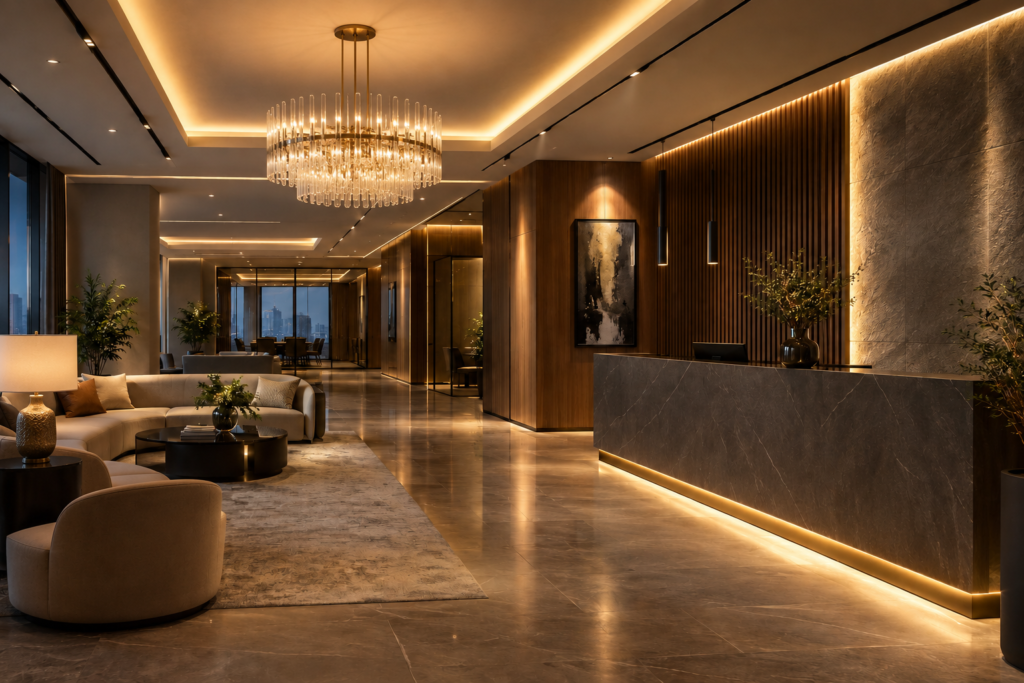 Luxury interiors are not defined only by marble, furniture, finishes or architectural details. The real character of a space often emerges when the lights are switched on. A carefully designed lighting scheme can reveal the texture of stone, bring warmth to timber, create depth across a feature wall, highlight artwork and make an otherwise ordinary room feel refined and atmospheric.
This is why Interior Lighting Design Services should be considered during the architectural and interior-design stages rather than treated as the final electrical requirement. The position of a luminaire, its beam angle, colour temperature, optical distribution, colour rendering and control strategy can significantly influence how a space is perceived and used.
At Luzion, interior lighting is approached as a balance between architecture, technology, visual comfort and human experience. From luxury residences and villas to hotels, restaurants, retail environments, offices and commercial developments, every lighting layer is planned to support the design intent of the space while maintaining long-term performance.
The objective is not simply to make an interior brighter. It is to make the right surfaces visible, create visual hierarchy, support activities and establish an atmosphere that feels natural, sophisticated and intentional.
What Is Professional Interior Lighting Design?
Professional Interior Lighting Design is the strategic planning of artificial and natural light within an interior environment to achieve functional, aesthetic, architectural and experiential objectives. It involves much more than selecting attractive fixtures. A professional lighting designer studies the architecture, ceiling geometry, furniture arrangement, materials, daylight contribution, activities, viewing angles and expected user experience before determining how light should be distributed.
A successful lighting scheme considers both the source and effect of light. The source may be a recessed downlight, linear LED profile, wall washer, spotlight, pendant or concealed luminaire. The effect is what matters to the occupant: a softly illuminated ceiling, a dramatic feature wall, a comfortable reading area, an accurately rendered artwork or a welcoming hotel lobby.
This approach allows lighting to become part of the architecture rather than appearing as an independent electrical element.
At Luzion, Interior Lighting Consultants incorporate architectural intent, spatial requirements, visual comfort, energy efficiency, lighting controls and technical performance. The company also provides lighting calculations, photometric analysis, DIALux design and customised Interior Lighting Solutions for different architectural and commercial applications.
Why Commercial Interior Lighting Design Matters
The difference between a well-lit interior and an exceptional interior is rarely the number of fixtures installed. It is the quality, hierarchy and control of illumination.
A luxury interior needs contrast. If every surface receives the same amount of light, the room can appear flat even when the illumination level is technically adequate. By introducing brighter and darker areas deliberately, designers create depth and direct attention toward important architectural elements.
Lighting also changes the perception of materials. A grazing beam can reveal the texture of stone or plaster, while a carefully controlled spotlight can make artwork and decorative objects visually prominent. Warm illumination can create intimacy in residential and hospitality environments, while more neutral light may support concentration and visual clarity in offices or task-oriented spaces.
Professional Commercial Lighting Design Services contribute to:
- Architectural expression by revealing form, texture and proportions.
- Visual comfort through appropriate illumination, glare control and balanced luminance.
- Energy performance through efficient LED systems and intelligent controls.
- Experience and atmosphere by allowing spaces to transition between functional and emotional modes.
- Brand identity by creating a consistent visual language across commercial environments.
The strongest results occur when these objectives are considered together rather than independently.
The Three Essential Layers of Architectural Interior Lighting Design
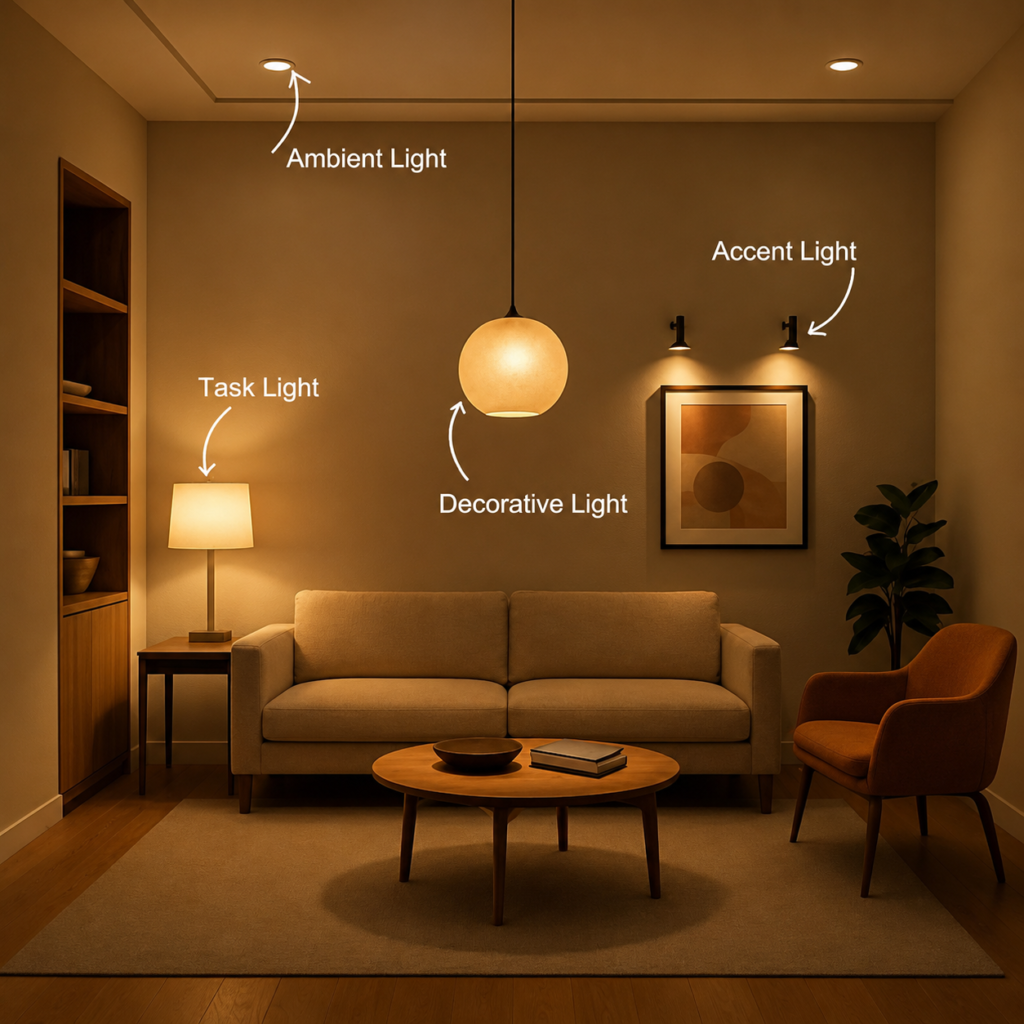 One of the fundamental principles of Architectural Interior Lighting Design is layering. Instead of depending on one central light source, sophisticated interiors combine several lighting layers that perform different roles.
Ambient Lighting
Ambient lighting establishes the general illumination of a space. It allows people to move comfortably and understand the overall geometry of the room.
Recessed downlights, concealed linear LED systems, indirect ceiling illumination and architectural luminaires can all contribute to ambient lighting. However, the objective should not simply be maximum brightness. The distribution should remain comfortable and visually balanced.
Task Lighting
Task lighting provides focused illumination where specific activities take place.
Kitchen worktops, reading areas, bathroom mirrors, dressing areas, desks and workstations often require additional task illumination. Proper positioning is critical because a technically bright light can still create uncomfortable shadows if it is placed incorrectly.
Accent Lighting
Accent lighting directs attention toward selected architectural or decorative elements.
Artwork, sculptures, feature walls, shelving, columns, textured surfaces and premium materials can all benefit from carefully controlled accent lighting. Narrow or medium beam optics allow designers to create visual hierarchy without unnecessarily illuminating the surrounding surfaces.
When ambient, task and accent layers are combined intelligently, the interior gains depth, flexibility and atmosphere rather than simply increased brightness.
| Room | Primary Light Type | Color Temperature | Pro Tip |
|---|---|---|---|
| Living Room | Ambient + Accent | Warm White (2700K) | Use dimmers for movie nights. |
| Kitchen | Task + Ambient | Neutral White (4000K) | Under-cabinet LEDs are essential. |
| Bedroom | Soft Ambient | Extra Warm (2400K) | Use bedside sconces to save space. |
| Home Office | Task | Cool White (5000K) | Position light to avoid screen glare. |
Living Room Lighting Design
The living room is often the most flexible space in a residence. It may be used for conversation, relaxation, entertainment, reading and social gatherings. A successful Living Room Lighting Design therefore needs several lighting scenes rather than one fixed illumination level.
A layered approach can combine concealed cove lighting or indirect illumination for ambient light with recessed downlights for general visibility and adjustable accent spots for artwork, feature walls or architectural details. Decorative pendants or chandeliers can provide an additional visual focal point where the interior design calls for a statement element.
In premium interiors, glare should be carefully controlled. Recessed fixtures with suitable shielding, precise optics and thoughtful positioning can create comfortable illumination without producing distracting bright points within the occupant’s field of view.
Luzion Expert Tip: Avoid automatically placing downlights in a uniform grid. Lighting positions should respond to furniture, circulation, architectural axes, artwork and the surfaces that need to be highlighted.
Bedroom Lighting Design
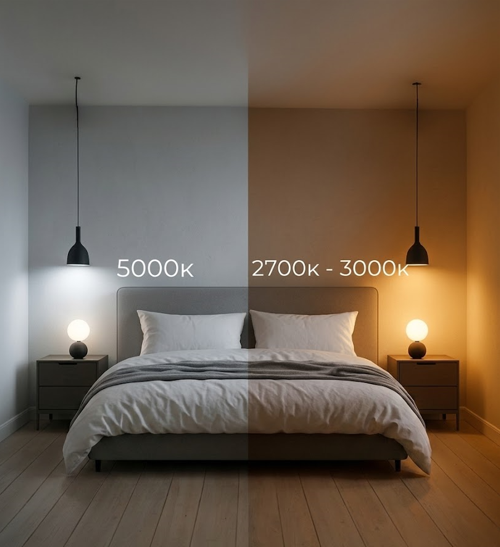 A bedroom should feel calm rather than excessively illuminated. The lighting strategy should support relaxation while still providing enough flexibility for reading, dressing and everyday activities.
Warm colour temperatures are commonly appropriate for bedrooms because they contribute to a more intimate atmosphere. Concealed LED illumination can create a soft architectural glow, while bedside reading lights provide focused illumination without requiring the entire room to be illuminated.
Wardrobes and dressing areas can benefit from integrated linear lighting, especially where accurate colour rendering is important. Lighting inside joinery should also be planned so that the source does not create uncomfortable glare when doors are opened.
For luxury bedrooms, dimming and scene control can further improve the experience. A single room may require different settings for waking, reading, relaxing and sleeping, making controllability an important part of the overall lighting concept.
Kitchen & Dining Lighting Design
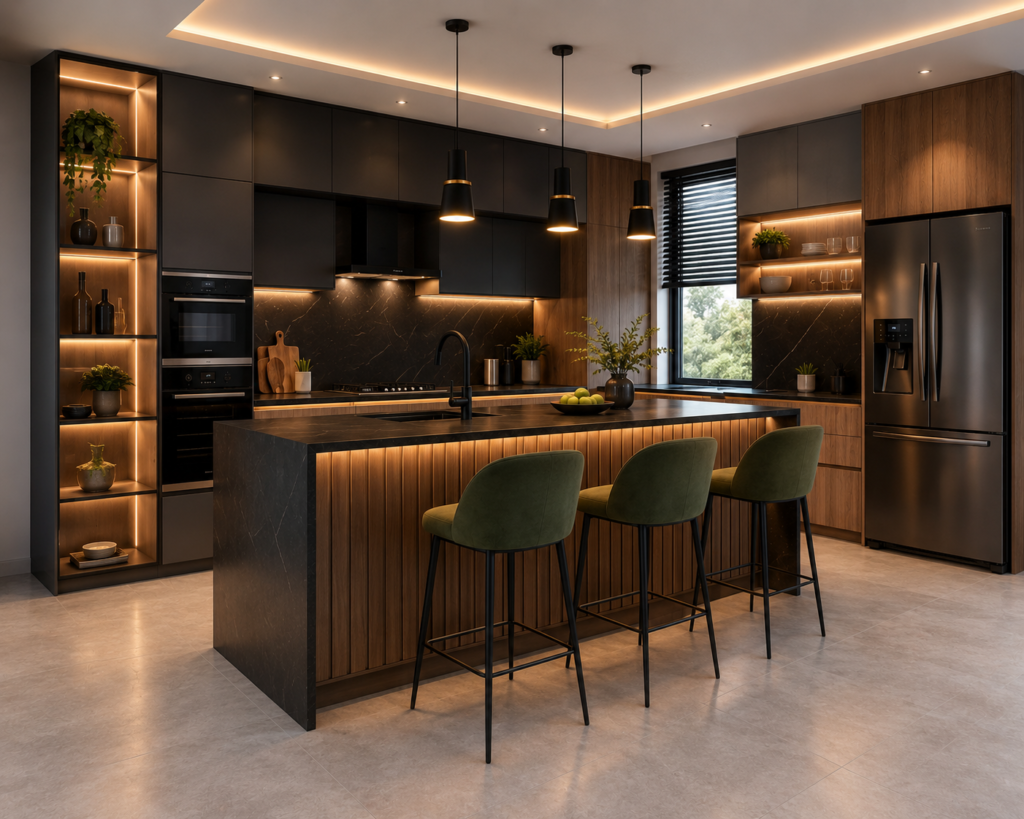 Kitchens combine general illumination with detailed visual tasks, making lighting quality particularly important. Worktops, islands, preparation areas and storage zones need sufficient illumination without excessive shadows.
A layered scheme may combine ceiling illumination with under-cabinet linear lighting and carefully positioned pendants above an island or dining table. The result should provide adequate visibility while maintaining the visual character of the kitchen.
For premium kitchens, colour rendering deserves particular attention. High-CRI LED sources can help natural materials, food, stone, timber and finishes appear closer to their intended colours.
The dining area can follow a different lighting mood. Decorative pendants or suspended luminaires positioned above the table can create a visual centre while warmer, dimmable illumination helps establish a more intimate hospitality-inspired atmosphere.
Bathroom & Vanity Lighting Design
Bathroom lighting needs to balance functionality with comfort. A poorly positioned ceiling fixture can create unwanted shadows on the face, particularly around a vanity mirror.
For grooming and personal-care activities, lighting should be positioned to provide balanced facial illumination. Vertical or side-mounted lighting can often provide better results than relying exclusively on a ceiling source.
Material selection is equally important because bathrooms contain moisture and require appropriate fixture protection. Depending on the location and environmental exposure, the appropriate IP rating should be considered during specification.
In premium bathrooms, concealed linear lighting beneath vanities, within niches or around architectural details can create a refined atmosphere while maintaining a clean visual appearance.
Architectural Interior Lighting Design Service for Walls, Ceilings & Feature Elements
The most sophisticated interior lighting schemes often focus less on the fixture itself and more on the surface receiving the light.
A textured wall can be illuminated using grazing techniques to reveal its surface character. A ceiling recess can receive concealed linear illumination to create an indirect glow. A feature wall can be softly washed to establish a background layer while artwork receives focused accent illumination.
This approach is particularly effective in luxury interiors because the light becomes visually integrated into the architecture.
Architectural Interior Lighting Design can be used to emphasise:
- Feature walls, stone and textured surfaces.
- Ceiling details, coves and architectural recesses.
- Staircases, corridors and circulation zones.
- Artwork, sculptures, shelving and bespoke joinery.
- Reception areas, branded environments and commercial focal points.
The key is restraint. The objective is not to illuminate every architectural element equally. It is to establish a visual hierarchy that tells the eye where to look.
Decorative Lighting vs Architectural Lighting
Decorative lighting and architectural lighting serve different purposes, although the two can work together beautifully.
Decorative fixtures such as chandeliers, pendants and designer wall lights contribute visual identity. They can become sculptural elements within an interior and reinforce the design language of a room.
Architectural lighting, on the other hand, focuses more heavily on the behaviour and distribution of light. Recessed luminaires, concealed linear systems, wall washers and adjustable spotlights can be integrated into the architecture so that the lighting effect becomes the primary visual element.
The strongest luxury interiors rarely choose between the two. Instead, they create a balance where decorative fixtures provide personality while architectural illumination establishes the underlying atmosphere.
Choosing the Right LED Technology for Interior Lighting Solutions
Premium interior lighting depends heavily on the quality of the LED system and its optical performance. A fixture can look attractive but still produce poor results if the LED, optics, driver or thermal design is inadequate.
Several technical parameters should therefore be evaluated before selecting a luminaire.
Colour Temperature
CCT, measured in Kelvin, influences the visual warmth or coolness of the light.
Warm white around 2700K–3000K is commonly suited to intimate residential and hospitality environments, while 3000K–4000K can be considered for spaces requiring greater visual clarity. The final choice should always reflect the materials, daylight, application and desired atmosphere.
Colour Rendering Index
CRI indicates how accurately a light source reveals colours compared with a reference source.
High-CRI lighting is particularly valuable for luxury interiors containing artwork, premium fabrics, timber, stone, retail merchandise and decorative materials where colour appearance is important.
Beam Angle
Beam angle determines how concentrated or wide the light distribution is.
Narrow beams can create focused accents, while wider distributions can provide broader illumination. Selecting the correct optic is essential because beam angle affects both visual emphasis and uniformity.
Glare Control
Glare can compromise even a beautiful interior. Fixture shielding, cut-off angles, installation position, optics and luminance distribution should all be evaluated to maintain visual comfort.
Drivers & Dimming
The driver is an important part of the lighting system. Compatibility with the required dimming or control protocol should be established before specification.
Depending on project requirements, systems may incorporate DALI, DMX, 0–10V, TRIAC or other control technologies.
Thermal Management
LED performance and longevity depend on effective thermal management. Quality housing materials, heat dissipation and appropriate driver integration contribute to reliable long-term performance.
Smart Interior Lighting & Lighting Controls
Modern luxury interiors increasingly require lighting systems that can adapt to different activities.
A residence may require a bright morning scene, a relaxed evening scene, a dining scene and a movie-night setting. Hotels and commercial interiors may require scheduled operation, zoning, dimming and integration with building-management systems.
Smart lighting controls make these transitions possible without changing the physical lighting installation.
Depending on the project, intelligent systems can support:
- Dimming and scene creation.
- Zoning and scheduled operation.
- Occupancy or daylight-responsive control.
- Integration with smart-home or building-management systems.
- Energy monitoring and operational scheduling for commercial properties.
The value of smart lighting is not technology for its own sake. The system should make the environment more comfortable, adaptable and energy efficient while remaining simple for users to operate.
Office Interior Lighting Design
A successful Office Interior Lighting Design must support productivity, concentration, collaboration and employee wellbeing while controlling glare and visual fatigue.
Workstations require balanced illumination, especially where employees use screens for extended periods. Lighting should be coordinated with desk layouts, monitor positions, ceiling systems and daylight to reduce reflections and uncomfortable contrast.
Meeting rooms, reception areas, breakout zones and circulation spaces may require different lighting scenes. A reception area can use architectural and decorative lighting to reinforce brand identity, while work areas may benefit from efficient, controllable and visually comfortable illumination.
Professional Commercial Interior Lighting Design for offices should also consider energy performance, occupancy sensors, daylight harvesting, zoning and integration with building-management systems.
Hospitality Interior Lighting Design for Hotels, Restaurants & Resorts
Hospitality environments depend heavily on atmosphere and guest experience. Hospitality Interior Lighting Design must therefore combine technical performance with emotional impact.
Hotels may require distinct lighting strategies for lobbies, guest rooms, corridors, restaurants, lounges, spas and outdoor transition areas. Restaurants often need carefully controlled table lighting, decorative focal points and warm illumination that enhances food presentation and material quality.
A successful hospitality lighting scheme should be flexible enough to support different times of day and operational requirements. Bright, welcoming scenes may be appropriate during daytime, while warmer and more intimate scenes can create a refined evening atmosphere.
Luzion develops Hotel Interior Lighting Design and hospitality lighting concepts that coordinate architectural lighting, decorative fixtures, controls, energy efficiency and guest comfort.
Retail, Restaurant & Commercial Lighting Design Services
Retail and commercial environments require lighting that supports both function and business objectives.
In retail spaces, light must guide customers, highlight merchandise, reinforce brand identity and maintain accurate colour appearance. Adjustable spotlights, wall washers, linear systems and flexible track lighting can help create visual hierarchy and adapt to changing displays.
Restaurants and cafés require a more atmospheric approach. Lighting should support table presentation, circulation, service operations and the overall character of the venue. Decorative pendants, concealed lighting and focused accent illumination can work together to create a memorable dining environment.
Professional Commercial Lighting Design Services can support:
- Retail stores and showrooms.
- Restaurants, cafés and food halls.
- Corporate offices and headquarters.
- Hotels, resorts and serviced apartments.
- Healthcare and institutional interiors.
- Galleries, museums and cultural spaces.
- Mixed-use developments and commercial buildings.
How to Create a Luxury Hotel Feel in a Residential Interior
Many homeowners want the atmosphere associated with five-star hotels: warm illumination, carefully controlled contrast, discreet fixtures and a sense of calm.
The secret is rarely a single expensive luminaire. It is the coordination of multiple layers.
Concealed linear illumination can create a soft architectural background. Accent lighting can highlight artwork or stone. Decorative fixtures can provide visual identity, while bedside and task lighting provide functional control.
The important principle is to avoid excessive uniformity. Luxury hospitality environments typically use light to create zones, hierarchy and mood rather than flooding every surface with the same intensity.
This same philosophy can be adapted to villas, penthouses and premium residential projects.
Interior Lighting Solutions for Different Project Types
Interior lighting requirements vary significantly depending on how a building is used.
Luxury Residential Interiors
Lighting should support comfort, personalisation, architectural detailing and different lifestyle scenarios.
Hotels & Resorts
Guest experience becomes central. Lobby, guestrooms, restaurants, corridors, lounges and wellness areas each require distinct lighting strategies.
Retail & Showrooms
Light must support merchandise presentation, visual hierarchy and accurate colour appearance while reinforcing the brand environment.
Corporate Offices
Productivity, visual comfort, glare management and energy performance become major considerations.
Restaurants & Cafés
Lighting contributes strongly to atmosphere, table presentation, material perception and customer experience.
Healthcare & Institutional Spaces
Functional visibility, comfort, safety and appropriate illumination levels must take priority while maintaining a welcoming environment.
Common Interior Lighting Mistakes to Avoid
Even expensive interiors can lose their visual quality when lighting is planned without considering the architecture.
Using Too Many Downlights
A ceiling filled with uniformly spaced downlights can create a flat appearance and unnecessary glare. Fixture positions should respond to the room’s actual requirements.
Choosing Fixtures Only by Appearance
A beautiful luminaire does not automatically provide good optical performance. LED quality, CRI, beam angle, glare, driver performance and thermal management must also be considered.
Ignoring Furniture Layout
Lighting should respond to where people sit, work, dine, read and move. Final furniture layouts should therefore be coordinated with lighting positions.
Treating Lighting as an Electrical Afterthought
Late-stage lighting decisions often lead to compromises in ceiling details, joinery, controls and fixture positioning. Professional lighting design should begin alongside the architectural and interior design process.
Using the Same Lighting Strategy Everywhere
An office, hotel lobby, restaurant, retail showroom and residential bedroom have different functional and emotional requirements. Each space needs a tailored lighting approach.
How Interior Lighting Consultants Plan Professional Lighting Projects
A successful lighting project requires more than product selection. It requires a structured process that connects design intent with technical performance.
At Luzion, lighting design is developed through consultation, architectural analysis, concept development and technical planning. The company works with architects, interior designers, developers, MEP consultants and contractors to coordinate lighting requirements throughout the project lifecycle.
Project Consultation
The first stage establishes the project’s objectives, architecture, interior concept, functional requirements, budget considerations and expected user experience.
Architectural & Interior Analysis
Drawings, ceiling plans, elevations, furniture layouts, materials, daylight and circulation are studied to determine where lighting is required and where visual emphasis should be created.
Lighting Concept
The design team develops the overall lighting language, including ambient, task, accent and decorative layers, along with CCT, fixture positioning and desired atmosphere.
DIALux & Photometric Analysis
Where required, professional lighting calculations and simulations can be used to evaluate illumination levels, distribution and fixture performance before installation. Luzion’s DIALux design process includes analysis of architectural drawings, ceiling layouts, interior finishes, lighting requirements and energy objectives.
Technical Coordination
Lighting layouts, fixture schedules, power requirements, control zones, mounting details and installation recommendations are coordinated with the wider project team.
Installation & Support
The final stage focuses on correct installation, aiming, commissioning and ensuring that the completed lighting environment reflects the approved design intent.
Commercial Interior Lighting Design for Luxury Projects UAE
The UAE has developed one of the world’s most visually ambitious environments for luxury residential, hospitality, retail and commercial architecture. From high-rise interiors and private villas to five-star hotels, restaurants, branded retail spaces and corporate headquarters, lighting plays a major role in defining how architecture is experienced. Interior Lighting Design in the UAE therefore requires more than decorative fixtures; it requires a coordinated approach to architectural integration, visual comfort, material presentation, energy performance and lighting controls.
In Dubai, premium residences, hospitality destinations, retail environments and commercial developments frequently use layered illumination to create sophisticated interiors. Concealed linear LED lighting, trimless downlights, adjustable accent spots, decorative pendants and wall-washing techniques can be combined to reveal marble, timber, metal, glass and textured finishes without creating excessive glare. For luxury villas and hotel interiors, warm illumination and dimmable scenes can create a more intimate atmosphere, while commercial and retail environments may require higher visual clarity and carefully controlled accent lighting.
In Abu Dhabi, interior lighting projects extend across luxury residences, hotels, government buildings, offices, cultural destinations and commercial developments. Lighting schemes often need to balance architectural character with operational efficiency, maintenance access and control requirements. In Sharjah and Ras Al Khaimah, hospitality, residential, cultural and mixed-use projects create further opportunities for architectural and decorative lighting solutions tailored to the character of each development.
For UAE projects, fixture selection should also consider the environmental conditions, installation environment, maintenance strategy and required protection levels. While interior environments are generally protected from direct weather exposure, kitchens, bathrooms, spas, pool-adjacent spaces, service areas and semi-outdoor transition zones may require appropriate IP-rated lighting fixtures. The final specification should therefore be based on the actual environmental conditions rather than applying one rating across an entire project.
Why Choose Luzion for Commercial Lighting Design Services?
Exceptional interior lighting requires more than access to fixtures. It requires an understanding of how light interacts with architecture and how technical decisions affect the finished environment.
Luzion combines lighting design expertise with product knowledge and technical planning to create solutions tailored to individual project requirements. Its wider lighting-design capabilities include architectural, commercial, hospitality, residential, retail, landscape, smart and sustainable lighting applications, supported by lighting calculations and photometric analysis.
The approach focuses on creating lighting environments that are visually refined without compromising performance. Every project can be evaluated according to architectural intent, material palette, user requirements, energy objectives, control requirements and long-term maintenance.
For architects, interior designers, developers and consultants, this creates a more coordinated path from concept → lighting design → product specification → technical coordination → implementation.
Whether you require Interior Lighting Consultants, Professional Interior Lighting Design Services, Commercial Interior Lighting Design or a complete Architectural Interior Lighting Design Service, Luzion can help transform your project vision into a technically coordinated lighting environment.
Interior Lighting Design: A Practical Selection Guide
Before approving a lighting system, project teams should evaluate more than wattage and appearance.
| Rating | Practical Meaning | Typical Consideration |
|---|---|---|
| IP65 | Dust-tight + protection against water jets | Exposed outdoor applications |
| IP66 | Dust-tight + protection against powerful water jets | More demanding exterior environments |
| IP67 | Dust-tight + temporary immersion protection | Ground/recessed locations where water exposure is possible |
The right specification depends on the space rather than a single universal formula. A luxury bedroom, retail showroom, restaurant, office and hotel lobby should not automatically use identical lighting characteristics.
The Future of Luxury Interior Lighting
The direction of premium interior lighting is moving toward greater architectural integration and more intelligent control.
Visible fixtures will continue to coexist with increasingly discreet lighting systems. Concealed linear LEDs, trimless recessed luminaires, integrated joinery lighting and architectural profiles allow designers to create illumination without visually dominating the interior.
At the same time, smart controls are making lighting more responsive. Users can create scenes, adjust brightness and adapt spaces according to different activities and times of day.
Sustainability is also becoming an increasingly important design consideration. Efficient LED systems, appropriate illumination levels, dimming, occupancy controls and thoughtful fixture selection can reduce unnecessary energy consumption without sacrificing the quality of the environment.
The future of luxury is therefore not simply more light. It is better-controlled, better-integrated and more purposeful light.
Final Thoughts: Luxury Begins With the Quality of Light
The most memorable interiors are rarely defined by brightness alone. They are defined by atmosphere, proportion, materiality and visual hierarchy.
A carefully designed lighting scheme can make a marble wall appear richer, create warmth around a dining table, draw attention toward artwork, make a corridor feel inviting and transform an ordinary ceiling into an architectural feature.
That is why professional Interior Lighting Design Services should begin before the final fixtures are selected. The architecture, interior design, furniture, materials, daylight and lighting technology need to be considered as one coordinated system.
At Luzion, the philosophy is simple: light should enhance architecture rather than compete with it. By combining design thinking, LED technology, optical control, technical planning and project-specific solutions, Luzion helps architects, designers, developers and project owners create interiors that feel refined, comfortable and purposeful.
When the lighting is right, the fixture becomes less important.
The space becomes the experience.
FAQs – Interior Lighting Design
1. What are Interior Lighting Design Services?
Interior Lighting Design Services involve the planning, specification and coordination of lighting systems for interior spaces. They include architectural analysis, lighting concepts, fixture selection, photometric calculations, control planning, technical coordination and installation support.
2. What is the best lighting for a luxury interior?
There is no single fixture or colour temperature that works for every luxury interior. The strongest schemes normally combine ambient, task, accent and decorative lighting. Warm CCTs around 2700K–3000K are often suitable for residential and hospitality environments, while higher CRI, controlled optics and appropriate dimming can further improve the quality of the space.
3. What is Commercial Interior Lighting Design?
Commercial Interior Lighting Design is the planning of lighting for offices, hotels, retail spaces, restaurants, showrooms, healthcare facilities and other commercial environments. It combines visual comfort, functionality, energy performance, brand identity and user experience.
4. What colour temperature is best for interior lighting?
The ideal CCT depends on the application, material palette, daylight and desired atmosphere. 2700K–3000K can create a warm and intimate environment, while 3000K–4000K may provide greater visual clarity for offices, kitchens and other task-oriented spaces. A professional lighting designer should evaluate CCT as part of the complete lighting scheme rather than selecting it in isolation.
5. How does professional interior lighting design improve a project?
Professional lighting design coordinates illumination with architecture, furniture, materials, activities and user experience. It can improve visual comfort, highlight architectural features, support functionality, optimise energy consumption and reduce costly changes during installation.
6. What CRI should be used for luxury interiors?
The appropriate CRI depends on the application, but high-CRI LED sources are particularly valuable where accurate colour appearance matters, such as artwork, retail merchandise, premium fabrics, natural materials and decorative finishes. CRI should also be considered alongside LED spectrum, CCT and overall optical performance.
7. Can Luzion provide DIALux lighting design for interior projects?
Yes. Luzion provides professional lighting design and DIALux-based planning as part of its wider technical lighting capabilities. The process can include architectural drawings, ceiling layouts, interior finishes, lighting requirements, fixture selection, calculations and simulation to help evaluate lighting performance before installation.
8. Can Luzion develop customised Interior Lighting Solutions for commercial projects?
Yes. Luzion works with architects, interior designers, developers, consultants and contractors to develop project-specific Interior Lighting Solutions. Its capabilities cover luxury residences, villas, hotels, offices, retail spaces, restaurants, healthcare environments and commercial developments across the UAE and GCC.
9. Do you provide Office Interior Lighting Design and Hotel Interior Lighting Design?
Yes. Luzion can develop tailored Office Interior Lighting Design, Hotel Interior Lighting Design, retail lighting, restaurant lighting and wider hospitality lighting solutions based on the project’s architecture, operational requirements, user experience and energy objectives.
Get Professional Interior Lighting Design
Whether you are developing a luxury villa, five-star hotel, premium office, retail showroom, restaurant or commercial interior, the lighting should be considered as part of the architecture from the beginning.
Contact Luzion Lighting for Professional Interior Lighting Design and let our experts develop a tailored lighting concept based on your architecture, materials, spatial requirements, design vision, and project objectives.
Explore Professional Lighting Consultancy
subscribe for newsletter

Luzion is a leading manufacturer and exporter of high-quality LED lighting solutions. With a focus on design, research, and innovation, we offer a wide range of products for commercial, industrial, residential, and outdoor spaces.


