
Facade Lights UAE | Architectural Facade Lighting Solutions
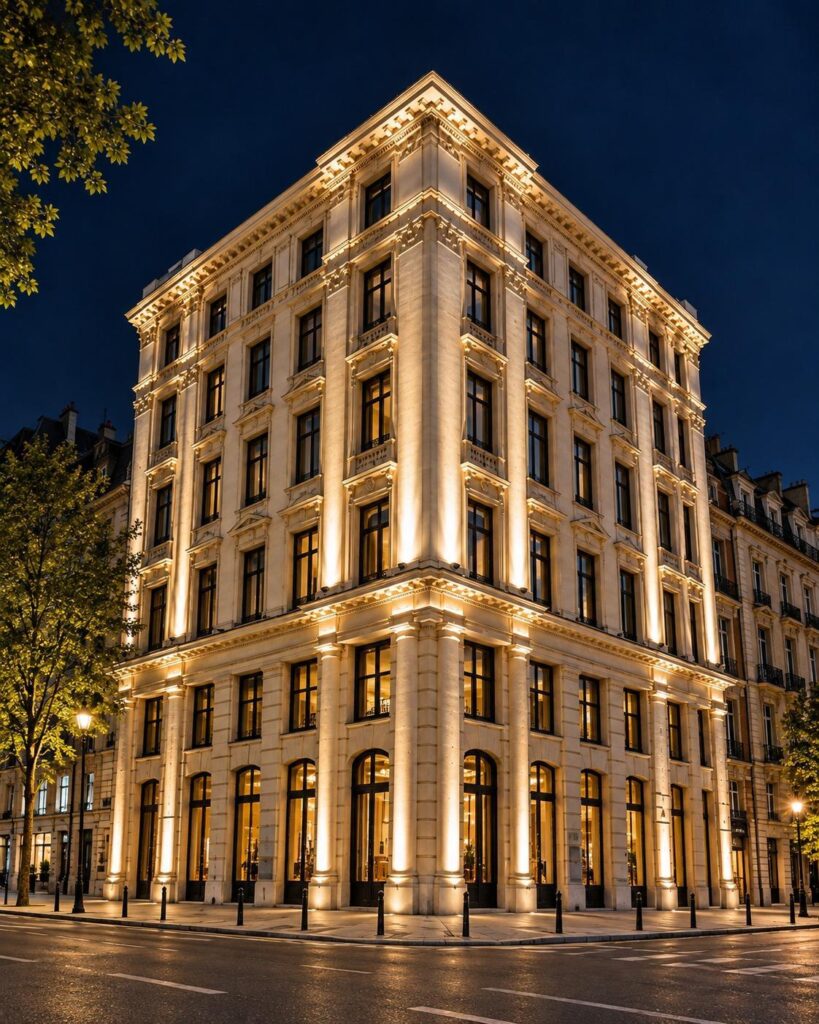 Modern architecture in the UAE is defined by bold forms, premium materials, dramatic entrances and buildings designed to remain visually distinctive after sunset. The right facade lights in UAE can transform these architectural elements into a refined nighttime identity while maintaining visual comfort, energy efficiency and long-term outdoor performance.
Luzion Lighting provides facade lighting solutions for UAE architectural projects, supporting architects, developers, lighting designers, MEP consultants, contractors and procurement teams with architectural LED luminaires and technical lighting support.
From luxury hotels and high-rise towers in Dubai to villas, commercial developments, retail destinations and landmark buildings across Abu Dhabi and the wider UAE, facade illumination requires more than high-output lighting. It requires the right combination of optics, beam angles, mounting positions, colour temperature, protection ratings and control systems.
Facade Lights for UAE Architectural Projects
Every building has a different architectural character. A successful facade lighting scheme should therefore respond to the building’s geometry, materials, scale and surrounding environment.
Luzion facade lighting solutions can be considered for:
- Hotels and resorts
- High-rise towers
- Luxury villas
- Commercial buildings
- Corporate offices
- Shopping malls
- Retail developments
- Residential buildings
- Cultural and institutional buildings
- Restaurants and hospitality venues
- Landmark architecture
- Entrance structures and architectural features
The objective is to create a controlled lighting composition that enhances the building rather than simply making the entire facade brighter.
Facade Lighting Solutions in UAE
Architectural projects across the UAE can require different types of exterior lighting depending on the facade and desired visual effect.
LED Wall Washers
LED wall washers are suitable for broad vertical surfaces where the design objective is controlled and relatively uniform illumination.
They can be used for:
- Hotel facades
- Commercial elevations
- Stone-clad buildings
- Large architectural walls
- Institutional buildings
- Retail developments
Correct mounting distance and optical distribution are essential for achieving consistent illumination.
Linear Facade Lights
Linear LED fixtures can follow architectural lines and integrate with:
- Facade bands
- Building edges
- Cornices
- Vertical fins
- Recessed details
- Canopies
- Architectural profiles
They are particularly useful where the lighting concept is based on clean continuous lines.
LED Spotlights & Projectors
Focused facade spotlights can highlight specific architectural elements such as:
- Columns
- Entrance features
- Sculptural details
- Decorative structures
- Towers
- Vertical elements
Beam angle selection is particularly important when using focused fixtures on tall or distant surfaces.
LED Floodlights
Floodlights can provide broad illumination for larger exterior surfaces and architectural structures.
For UAE applications, fixture positioning and optical control should be carefully planned to reduce glare and unnecessary light spill.
Inground Facade Lights
Inground luminaires can provide discreet architectural illumination from ground level.
They can be integrated around:
- Columns
- Building entrances
- Plinths
- Landscape edges
- Architectural walls
- Vertical facade features
Drainage, loading, IP protection and maintenance access should be considered during specification.
RGB & RGBW Facade Lighting
For selected architectural and entertainment projects, RGB or RGBW systems can introduce programmable colour effects.
These systems can be used for:
- Special events
- Festivals
- Brand activations
- National celebrations
- Hospitality environments
- Landmark buildings
Dynamic lighting should remain coordinated with the building’s permanent architectural identity.
Facade Lighting Design for Dubai
Dubai’s architectural landscape includes high-rise towers, luxury hotels, retail destinations, villas and large commercial developments.
For facade lighting in Dubai, designers often need to balance architectural impact with the surrounding urban environment.
Important considerations include:
- Building height
- Viewing distance
- Beam angle
- Glare control
- Light spill
- Facade material
- Fixture accessibility
- Energy consumption
- Control requirements
- Outdoor durability
High-rise buildings may require different optical distributions at lower, middle and upper levels rather than applying one fixture specification across the entire facade.
For luxury villas and low-rise developments, a more selective approach can emphasize entrances, columns, stonework, landscape interfaces and architectural details.
Facade Lighting Solutions in Abu Dhabi
Abu Dhabi combines residential, commercial, hospitality, cultural and institutional architecture with a strong emphasis on refined urban environments.
Facade lights in Abu Dhabi should therefore be selected according to the building’s architectural language and the intended relationship between the facade, public realm and surrounding properties.
Lighting strategies can include:
- Subtle wall washing
- Architectural grazing
- Linear facade illumination
- Focused uplighting
- Entrance accent lighting
- Controlled architectural outlining
The goal is to create a sophisticated nighttime appearance without unnecessary brightness.
Facade Lighting Across the UAE
Luzion can support architectural lighting requirements across major UAE locations, including:
Dubai
High-rise towers, hotels, commercial buildings, retail developments and luxury residential projects.
Abu Dhabi
Hospitality, corporate, institutional, residential and landmark architecture.
Sharjah
Cultural, residential, commercial and urban developments.
Ajman
Residential, hospitality and commercial projects.
Ras Al Khaimah
Hotels, resorts, villas and destination developments.
Fujairah
Hospitality, resort and coastal architectural applications.
Umm Al Quwain
Residential, hospitality and commercial developments.
The appropriate lighting specification should always be developed around the project’s architecture and environmental conditions rather than location alone.
Choosing Facade Lights for the UAE Climate
UAE exterior lighting operates in a demanding environment.
High temperatures, dust, intense solar exposure and, in coastal areas, humidity and salt-laden air can influence the long-term performance of outdoor luminaires.
When specifying facade lights for UAE projects, project teams should evaluate:
IP Protection
The appropriate IP rating helps protect luminaires against dust and water exposure.
IK Protection
For ground-level or publicly accessible installations, mechanical impact resistance may also be important.
Thermal Performance
LED luminaires and drivers should be selected with appropriate thermal management for the installation environment.
Housing Material
Aluminium and appropriate protective finishes can support durability in demanding exterior applications.
Corrosion Resistance
Coastal locations require particular attention to material selection and protective finishes.
Maintenance Access
Fixtures installed at height should be positioned with future cleaning, inspection and replacement in mind.
Beam Angles for UAE Facade Lighting
Beam angle is one of the most important specifications when selecting facade lights.
A narrow beam can create a concentrated architectural accent, while a wider beam can cover a larger facade area.
The correct distribution depends on:
- Mounting distance
- Building height
- Facade width
- Architectural detail
- Fixture output
- Required illumination
- Viewing distance
For example, a narrow beam may be appropriate for a tall column, while a wider distribution may be better suited to a broad wall.
The same luminaire should not automatically be used across every architectural element.
Facade Lighting for Hotels & Resorts in UAE
Hospitality projects require a particularly refined approach to exterior lighting.
Guests experience the building from arrival, parking areas, pedestrian paths, entrance zones and surrounding landscape.
Facade lighting can emphasize:
- Hotel entrances
- Porte-cochères
- Architectural columns
- Canopies
- Tower elements
- Resort buildings
- Landscape interfaces
- Feature walls
The lighting should support the hospitality experience while avoiding excessive glare.
For luxury resorts, carefully controlled warm or neutral white illumination can complement architectural materials and landscape lighting.
Facade Lighting for Luxury Villas
Luxury villas often benefit from selective illumination rather than high-output general lighting.
Facade lights can highlight:
- Entrance portals
- Stone cladding
- Columns
- Arches
- Boundary walls
- Balconies
- Landscape features
- Architectural recesses
A combination of concealed linear lighting, spotlights, wall washers and inground fixtures can create layers of light while preserving the architectural character of the property.
Facade Lighting for High-Rise Buildings
High-rise facade projects require careful consideration of scale.
A fixture that performs well at ground level may not provide the appropriate effect at upper floors.
Designers should evaluate:
- Viewing distance
- Wind exposure
- Fixture mounting
- Beam angle
- Optical intensity
- Maintenance access
- Control zones
- Structural coordination
For tall buildings, the lighting system may be divided into multiple zones to provide better control and maintenance flexibility.
DIALux Design Support for UAE Projects
Lighting simulation can help project teams understand how proposed facade lights will perform before installation.
Luzion can support DIALux lighting design and technical evaluation for suitable projects.
Simulation can assist with:
- Fixture positioning
- Beam selection
- Lighting distribution
- Illumination levels
- Uniformity
- Different lighting concepts
- Fixture comparison
Architects and consultants can use these studies to coordinate lighting decisions with architectural elevations and project requirements.
For larger projects, mock-ups can also be useful for evaluating the actual relationship between light, facade material and surrounding environment.
Architectural Facade Lighting: More Than Illumination
A successful facade lighting project creates visual hierarchy.
Not every architectural element needs the same brightness.
The design may establish:
Primary features
Main entrance, tower crown, signature architectural element or landmark feature.
Secondary features
Columns, facade bands, structural elements and decorative details.
Supporting elements
Landscape edges, pathways and surrounding architectural components.
This hierarchy creates depth and prevents the building from appearing visually flat.
The objective is not simply to illuminate more surface area.
It is to illuminate the right surfaces with the right amount of light.
Facade Lighting Controls in UAE Projects
Modern architectural projects may require integrated control systems.
Depending on the project, facade lighting can incorporate:
- DALI
- DMX
- RGB
- RGBW
- Programmable scenes
- Dimming
- Time scheduling
- Centralized lighting control
Control systems can allow different lighting scenes for normal operation, events and special occasions.
For dynamic facades, the control strategy should be developed alongside the lighting concept rather than added after fixture selection.
What Architects & Consultants Should Specify
When evaluating facade lights for a UAE project, the product specification should include more than wattage.
Important parameters include:
| Specification | Project Consideration |
|---|---|
| Wattage | Electrical load |
| Lumens | Required light output |
| Beam angle | Optical distribution |
| CCT | Architectural appearance |
| CRI | Colour quality |
| IP rating | Outdoor protection |
| IK rating | Impact resistance |
| Optics | Light control |
| Driver | Electrical performance |
| Dimming | Lighting control |
| DMX/DALI | System integration |
| Housing | Outdoor durability |
| Finish | Architectural integration |
| Mounting | Installation requirements |
Project teams may also require:
- Product datasheets
- IES/LDT files
- Photometric information
- Technical drawings
- Installation details
- Warranty information
- Control specifications
- DIALux files where applicable
Why Choose Luzion for Facade Lighting in UAE?
Luzion Lighting provides architectural LED lighting solutions for professional projects where design, performance and technical coordination are important.
Our facade lighting solutions are intended for:
- Architects
- Lighting designers
- Developers
- MEP consultants
- Contractors
- Procurement teams
- Hospitality developers
- Commercial property owners
From individual facade fixtures to coordinated architectural lighting requirements, project teams can work with Luzion to evaluate suitable lighting approaches based on the building, application and specification.
We can support projects with:
Architectural LED Lighting
Exterior luminaires designed for architectural applications.
Facade Lighting Solutions
Lighting options for walls, columns, architectural details and building elevations.
DIALux Support
Lighting simulation and technical design assistance for suitable projects.
Technical Documentation
Datasheets, photometric files and product information for project coordination.
Project-Based Lighting Support
Assistance for architects, consultants, contractors and procurement teams.
Facade Lights UAE: From Concept to Installation
A successful facade lighting project usually follows a structured process.
01. Project Brief
Understand the building, location, architectural intent and lighting objectives.
02. Architectural Review
Review elevations, materials, heights, details and viewing conditions.
03. Lighting Concept
Define the visual hierarchy and desired lighting effects.
04. Product Selection
Select appropriate facade lights, optics, output, CCT and protection ratings.
05. DIALux Simulation
Evaluate fixture positions and lighting performance where required.
06. Technical Coordination
Coordinate luminaires with architectural, structural and electrical requirements.
07. Mock-Up
Test representative facade areas when the project requires physical validation.
08. Installation & Aiming
Install and accurately aim luminaires according to the approved design.
09. Commissioning
Fine-tune lighting levels, scenes and controls to achieve the intended nighttime appearance.
Frequently Asked Questions
What are facade lights used for in UAE projects?
Facade lights are used to illuminate and emphasize building exteriors, architectural details, entrances, columns, walls and other exterior features. They are commonly used for hotels, villas, commercial buildings, high-rise towers, retail developments and landmark architecture.
Which facade lights are suitable for Dubai and Abu Dhabi?
The appropriate fixture depends on the building and desired lighting effect. Common solutions include LED wall washers, linear lights, spotlights, floodlights and inground luminaires. Beam angle, IP rating, thermal performance and mounting position should be evaluated for each application.
What IP rating is recommended for facade lights in UAE?
The appropriate IP rating depends on the installation location and exposure to dust and water. Exterior facade lighting should be specified according to actual environmental conditions rather than choosing an IP rating without considering the installation.
Can facade lighting be designed using DIALux?
Yes. DIALux can be used to evaluate fixture positions, illumination levels, distribution and uniformity for facade lighting projects. It can help project teams assess a lighting concept before installation.
Can Luzion supply facade lights for UAE projects?
Luzion provides architectural LED lighting solutions for professional projects and can support architects, consultants, developers, contractors and procurement teams with facade lighting products and technical information for UAE requirements.
Can RGB or RGBW facade lighting be used for UAE buildings?
Yes. RGB and RGBW systems can be considered for buildings that require programmable architectural lighting, event scenes or dynamic colour effects. The control system, fixture specification and architectural intent should be considered together.
Start Your UAE Facade Lighting Project
Whether you are developing a hotel in Dubai, a luxury villa in Abu Dhabi, a commercial building in Sharjah or a landmark project elsewhere in the UAE, facade lighting should be considered as part of the architecture rather than as an afterthought.
Luzion Lighting can support architects, developers, lighting designers, MEP consultants and contractors with architectural facade lighting solutions, technical information and project-oriented lighting support.
Share your facade elevations, drawings, project specifications or lighting requirements with Luzion to discuss a suitable approach for your UAE project.
Looking for facade lights in UAE? Talk to Luzion about your architectural lighting requirement.
subscribe for newsletter

Luzion is a leading manufacturer and exporter of high-quality LED lighting solutions. With a focus on design, research, and innovation, we offer a wide range of products for commercial, industrial, residential, and outdoor spaces.


