
Facade Lights for Architectural & Commercial Buildings
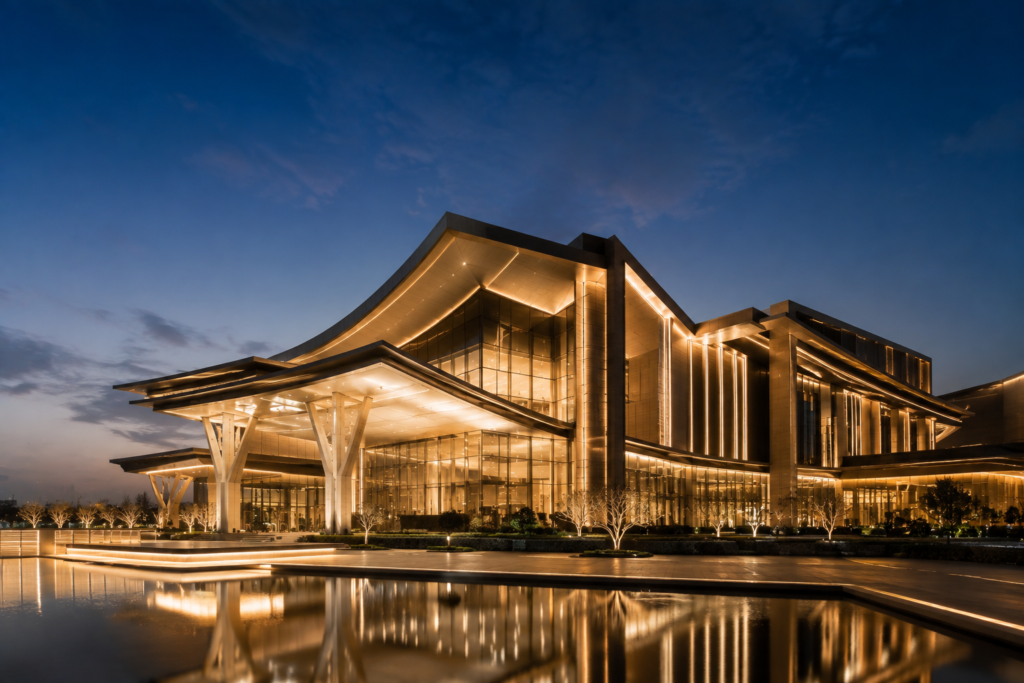 A building can have strong architecture during the day, but after sunset, its character depends heavily on how the exterior is illuminated. The right Facade Lights reveal architectural proportions, emphasise materials and create a refined visual identity without making the building appear excessively bright.
At Luzion Lighting, we develop and manufacture LED Facade Lights for architects, lighting designers, developers, MEP consultants, contractors and procurement teams working on architectural and commercial projects. Our range can be specified for hotels, resorts, commercial buildings, residential towers, retail destinations, high-rise developments, landmarks and other exterior applications.
Rather than treating facade illumination as a simple decorative layer, we consider the relationship between the building form, lighting effect, fixture position, optics and viewing distance. This helps create Architectural Facade Lights installations that complement the architecture and perform reliably in demanding outdoor environments.
What Are Facade Lights?
Facade Lights are architectural outdoor luminaires designed to illuminate, highlight or accentuate the exterior surfaces and structural elements of a building.
Depending on the architectural requirement, a project may use different fixture types and optical distributions. Broad-beam luminaires can create an even wash across large surfaces, while narrow-beam fixtures can emphasise columns, fins, reveals or textured materials.
Modern Facade Lighting Products can include:
- LED Facade Lights
- Facade Wall Washers
- Linear Facade Lights
- Facade Uplighters
- Inground Facade Lights
- Facade Grazing Lights
- Architectural spotlights
- Surface-mounted luminaires
- Recessed architectural fixtures
- RGB and RGBW luminaires
- Programmable dynamic lighting systems
The correct product depends on the desired lighting effect, façade material, installation position and environmental conditions.
Architectural Facade Lights That Work With the Building
Good exterior lighting does not compete with architecture. It supports it.
A stone façade may require grazing to reveal texture, while a smooth concrete surface may benefit from a controlled wall wash. Vertical architectural elements can be emphasised using narrow-beam uplighting, while long horizontal lines may be highlighted with linear LED systems.
This is why Architectural Facade Lights should be selected according to the building rather than using the same fixture throughout an entire project.
Important considerations include:
- Building geometry
- Façade material
- Surface texture
- Mounting location
- Viewing distance
- Required illumination level
- Beam angle
- Light distribution
- Colour temperature
- Colour rendering
- Environmental exposure
- Maintenance access
The result should be a visually balanced façade where important architectural features receive attention while secondary areas remain appropriately subdued.
Facade Lights for Different Architectural Elements
One of the advantages of modern LED technology is the ability to create different layers of illumination across the same building.
Columns & Vertical Features
Narrow-beam Facade Uplighters can emphasise columns, vertical fins and structural elements. This technique can make a building appear taller and reinforce its architectural rhythm.
Walls & Large Surfaces
Facade Wall Washers are suitable for broader surfaces where a more uniform illumination effect is required. They can be used on stone, concrete, rendered surfaces and other architectural finishes.
Textured Facades
For textured stone, brick, decorative concrete and architectural relief, Facade Grazing Lights can be positioned close to the surface. The resulting shadows reveal texture and create greater depth.
Architectural Lines
Linear Facade Lights can emphasise edges, reveals, horizontal bands, vertical lines and contemporary façade geometry. They are particularly useful for minimalist and modern buildings where concealed or integrated illumination is preferred.
Entrances & Focal Points
Smaller architectural accent fixtures can highlight entrances, canopies, arches, architectural features and important points of arrival.
LED Facade Lights for Modern Buildings
LED technology has become an important part of contemporary architectural lighting because it provides flexibility in output, optics, colour temperature, control and fixture form.
High-quality LED Facade Lights can be specified for both subtle architectural illumination and visually prominent landmark applications.
Depending on the project, LED facade systems can offer:
- High optical control
- Different beam angles
- Multiple lumen outputs
- Various colour temperatures
- High colour rendering
- Dimming capability
- RGB/RGBW colour options
- Long operating life
- Energy-efficient operation
- Compact fixture dimensions
- Outdoor-rated construction
For professional projects, the fixture should not be selected only on wattage. The actual photometric performance, beam distribution, lumen output and mounting position are equally important.
Facade Lighting Solutions for Hotels, Commercial & Residential Projects
The application of Facade Lighting Solutions varies according to the building’s purpose.
Hotels & Resorts
Hotel Facade Lighting can create a memorable nighttime identity and strengthen the guest arrival experience. Warm white illumination, architectural accents and concealed linear lighting can be combined to create a sophisticated atmosphere.
For resorts, Resort Facade Lighting can work together with landscape lighting, pathways, pools and outdoor hospitality areas.
Commercial Buildings
For offices and corporate buildings, Commercial Facade Lights can emphasise the structure without excessive brightness. Controlled white illumination is often effective for creating a clean and professional appearance.
Residential Towers & Villas
Residential projects may require a more discreet approach. Building Facade Lights can highlight balconies, vertical elements, entrance areas and architectural details while maintaining a comfortable residential environment.
Retail & Mixed-Use Developments
Retail destinations can use architectural illumination to improve visibility and create a stronger nighttime presence. Outdoor Facade Lights can be coordinated with entrance lighting, signage and landscape elements to create a consistent visual identity.
Choosing the Right Facade Lights
There is no single fixture that works for every façade. Product selection should begin with the required lighting effect.
A professional lighting team may evaluate:
Beam Angle — determines how broadly or narrowly light is distributed.
Lumen Output — helps determine the amount of useful light delivered by the fixture.
Colour Temperature — influences the visual warmth or coolness of the architecture.
CRI — becomes particularly relevant when accurate material and colour appearance is important.
IP Rating — outdoor fixtures may require suitable protection such as IP65, IP66 or IP67, depending on their location and exposure.
Mounting Method — surface-mounted, recessed, inground or concealed installation can produce very different visual results.
Control System — projects requiring dimming, colour-changing or programmed scenes may require compatible control infrastructure.
These technical factors should work together with the architectural concept to achieve the intended result.
Facade Lights for UAE & GCC Architecture
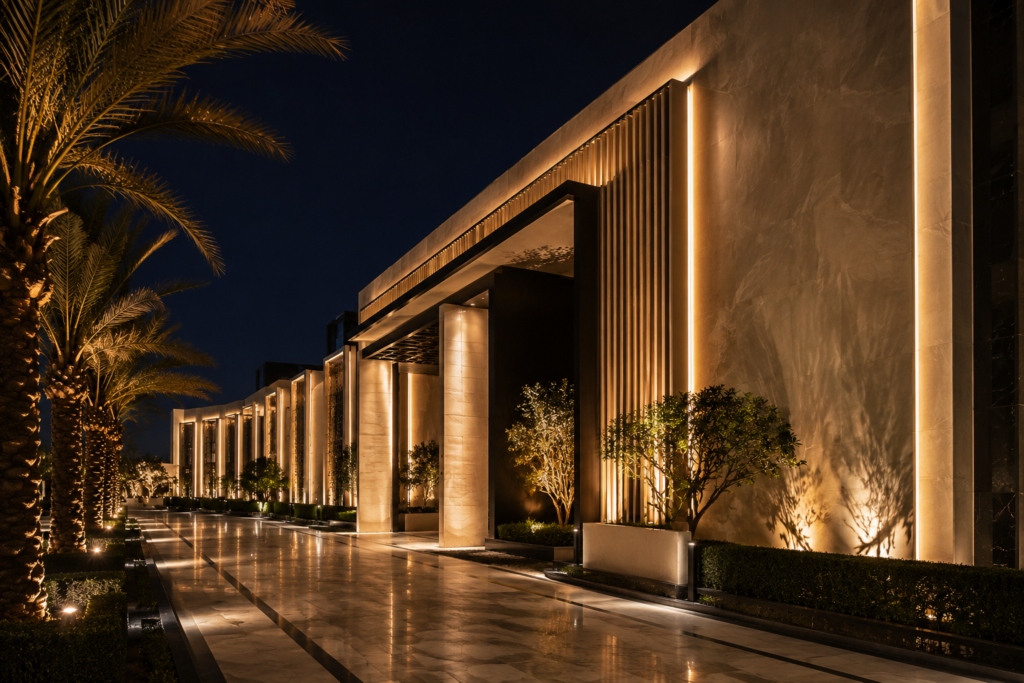 The GCC is one of the world’s most active regions for luxury hospitality, commercial development, high-rise architecture and landmark projects. As a result, demand for premium Facade Lights UAE and wider GCC architectural lighting continues across new developments and refurbishment projects.
Luzion can support Facade Lights Dubai, Facade Lights Abu Dhabi, Facade Lights Saudi Arabia, Facade Lights Qatar, Facade Lights Kuwait, Facade Lights Bahrain and Facade Lights Oman projects with application-specific LED lighting solutions.
The environmental conditions of the region also make product selection important. Heat, dust, humidity and coastal exposure can influence fixture performance, materials and maintenance requirements. Therefore, the appropriate Outdoor Architectural Lighting system should be selected according to the project’s actual environmental and technical conditions.
Types of Facade Lights for Architectural Applications
Every building has a different façade geometry, material palette and architectural language. For this reason, selecting the right Facade Lights is not simply a matter of choosing a high-output LED fixture. The optical system, mounting position, beam distribution and intended visual effect all influence the final result.
A professional Facade Lighting Solution may combine several fixture types to create layers of light, shadow and architectural emphasis. At Luzion Lighting, our range of Architectural Facade Lights can be specified according to the building design, project requirements and desired nighttime appearance.
Facade Wall Washers
Facade Wall Washers are designed to provide broad and controlled illumination across architectural surfaces. They are commonly used when the objective is to create a relatively even appearance across a large wall or façade plane.
Wall washers can be used for:
- Hotel façades
- Commercial buildings
- Shopping malls
- Corporate offices
- Residential towers
- Cultural buildings
- Public architecture
- Large architectural surfaces
The distance between the luminaire and façade, mounting height, beam angle and optical distribution should be considered carefully. Incorrect positioning can create uneven illumination, excessive brightness or unwanted hot spots.
For large developments, combining several carefully positioned LED Wall Washers can provide a consistent visual rhythm across the building.
Facade Grazing Lights
Where the architectural surface has texture, Facade Grazing Lights can produce a much more dramatic effect than conventional wall washing.
Grazing fixtures are positioned close to the façade so that light travels across the surface. This creates shadows that reveal:
- Stone texture
- Brickwork
- Decorative panels
- Architectural relief
- Textured concrete
- Vertical fins
- Sculptural surfaces
Wall Grazing is particularly effective when the façade material itself is intended to be a visual feature.
For luxury hotels, cultural buildings and premium architectural projects, carefully controlled grazing can create depth without requiring excessive light output.
Linear Facade Lights
Modern architecture frequently uses clean lines, geometric forms and continuous façade details. Linear Facade Lights are designed to complement these architectural characteristics.
They can be used to highlight:
- Vertical façade lines
- Horizontal bands
- Roof edges
- Architectural reveals
- Structural frames
- Canopies
- Balconies
- Building contours
Depending on the project, linear luminaires can be surface-mounted, recessed or concealed within architectural details.
For minimalist architecture, concealed LED Linear Facade Lighting can produce a continuous visual line while keeping the light source discreet.
Facade Uplighters
Facade Uplighters direct light upwards to emphasise vertical architectural elements.
They are commonly used around:
- Columns
- Entrance structures
- Towers
- Vertical walls
- Arches
- Building corners
- Landscaping adjacent to façades
Narrow and medium beam distributions can create different effects. A narrow beam can create a strong vertical accent, while a wider beam can provide broader illumination.
For high-rise and landmark buildings, multiple Facade Uplighters may be combined with other fixtures to establish architectural hierarchy.
Inground Facade Lights
Where the project requires a clean architectural appearance, Inground Facade Lights can provide illumination without creating prominent surface-mounted fixtures.
These fixtures can be positioned around:
- Building entrances
- Plinths
- Columns
- Pathways beside façades
- Landscape zones
- Architectural edges
- Low-level façade details
Inground lighting requires careful attention to drainage, installation conditions, load requirements, maintenance access and appropriate outdoor protection.
When integrated correctly, Inground Facade Lighting can provide a discreet solution for premium architectural environments.
Facade Spotlights & Accent Lighting
Not every architectural feature needs broad illumination. Some elements require focused light to establish visual importance.
Architectural spotlights can be used for:
- Sculptures
- Columns
- Decorative elements
- Entrances
- Architectural signage zones
- Roof features
- Landmark details
- Landscape elements adjacent to buildings
The purpose of accent lighting is to create hierarchy. By selectively illuminating important features, a building can appear more sophisticated than when every surface is treated with equal brightness.
RGB & RGBW Facade Lights
For landmark buildings, entertainment destinations and projects requiring dynamic architectural expression, RGB Facade Lights and RGBW Facade Lights can introduce colour-changing capabilities.
RGB systems can create a broad range of coloured lighting effects, while RGBW systems add a dedicated white-light channel, providing greater flexibility for both coloured scenes and architectural white illumination.
These systems can be used for:
- Special events
- National celebrations
- Hospitality destinations
- Entertainment venues
- Landmark buildings
- Public spaces
- Seasonal lighting
- Brand-related lighting scenes
However, dynamic lighting should always be coordinated with the architectural concept. Excessive colour changes can reduce the elegance of a building, whereas carefully programmed scenes can create a distinctive identity.
DMX-Controlled Facade Lighting
For projects requiring programmable lighting, DMX Lighting Control can provide precise control over compatible luminaires.
A dynamic facade system can be programmed for:
- Static colour scenes
- Gradual colour transitions
- Event-specific scenes
- Timed sequences
- Dimming
- Different lighting zones
- Seasonal programmes
This makes Dynamic Facade Lighting particularly useful for major hotels, landmark architecture, entertainment destinations and large public developments.
For projects where dynamic lighting is not required, conventional dimming and scheduled operation can provide a simpler and more energy-conscious solution.
Combining Different Facade Lighting Techniques
The strongest architectural results often come from combining multiple types of Facade Lights rather than relying on one fixture.
For example, a luxury hotel may use:
Linear Facade Lights → architectural edges
Wall Washers → broad façade surfaces
Uplighters → columns and entrances
Grazing Lights → textured stone
Inground Fixtures → concealed architectural details
RGBW Lighting → selected landmark elements
This layered strategy allows the designer to establish a visual hierarchy between primary, secondary and background architectural elements.
The result is more controlled than simply increasing fixture wattage across the entire façade.
Facade Lights & Beam Angle Selection
Beam Angle is one of the most important technical considerations when selecting architectural exterior lighting.
A narrow beam can concentrate light on a specific architectural feature, while a wider beam can distribute illumination across a larger area.
The appropriate beam depends on:
- Distance from the façade
- Height of the building
- Surface width
- Desired illumination level
- Architectural texture
- Viewing distance
- Mounting position
- Required visual effect
For example, a narrow beam may work well for a column or vertical fin, while a broader distribution may be more suitable for a large flat wall.
This is why professional Facade Lighting Products should be evaluated using photometric data rather than relying only on wattage or fixture appearance.
Colour Temperature & Architectural Character
Colour temperature influences how materials and architecture appear after sunset.
Warm white light can create a sophisticated and welcoming appearance for hospitality, residential and heritage-inspired architecture. Neutral white can provide a clean contemporary appearance for commercial and modern buildings.
The selection should consider:
- Façade material
- Architectural style
- Surrounding lighting
- Project branding
- Hospitality requirements
- Landscape lighting
- Local environmental context
For premium projects, maintaining consistency in colour temperature across different fixture types is important for achieving a cohesive visual result.
Energy-Efficient LED Facade Lights
Modern LED Facade Lights provide opportunities to achieve strong architectural effects while maintaining efficient operation.
Energy performance can be improved through:
- Correct lumen selection
- Efficient optics
- Appropriate beam angles
- Dimming
- Scheduled operation
- Zoning
- Intelligent controls
- Avoiding unnecessary over-lighting
The goal is not simply to use lower wattage fixtures. It is to use the right amount of light in the right location.
This design principle can improve both visual quality and long-term operating efficiency.
Outdoor Facade Lights for Demanding Environments
Exterior luminaires are exposed to environmental conditions that indoor lighting does not experience. The appropriate Outdoor Facade Lights should therefore be selected according to the project’s climate and installation location.
Important considerations can include:
- IP protection
- Thermal management
- Corrosion resistance
- UV exposure
- Dust
- Humidity
- Coastal environments
- Installation height
- Maintenance accessibility
For GCC projects, these considerations are particularly relevant when specifying Facade Lights UAE, Facade Lights Saudi Arabia, Facade Lights Qatar, Facade Lights Kuwait, Facade Lights Bahrain and Facade Lights Oman.
Product selection should always be based on actual site conditions and project specifications rather than assuming one protection level is suitable for every application.
Choosing the Right Facade Lights for Your Project
The ideal fixture depends on what the architecture needs to communicate at night.
If the objective is uniform illumination, Facade Wall Washers may be appropriate. For textured surfaces, Facade Grazing Lights can provide greater depth. For contemporary architectural lines, Linear Facade Lights can create clean visual continuity. For columns and vertical elements, Facade Uplighters can provide strong architectural emphasis.
For landmark and entertainment projects, RGBW Facade Lights and DMX Lighting Control can introduce programmable visual effects.
A professional lighting approach evaluates these options together to create a complete Facade Lighting Solution rather than selecting products individually.
Facade Lights Across the GCC Region
The Gulf region has become an important market for premium architectural and exterior lighting. From high-rise towers and luxury hotels to retail destinations, mixed-use developments, villas and landmark architecture, modern projects increasingly require carefully selected Facade Lights to establish a distinctive nighttime identity.
Luzion Lighting provides Facade Lighting Solutions for architectural projects across the six GCC markets: UAE, Saudi Arabia, Qatar, Kuwait, Bahrain and Oman.
Our approach combines architectural requirements with fixture performance, optical control, environmental durability and project-specific lighting objectives. Rather than applying the same product combination to every location, we consider the building, façade materials, climate, viewing distance and required lighting effect.
Facade Lights UAE
The UAE has a highly developed architectural environment with premium hospitality, commercial, residential and retail projects.
Facade Lights UAE can be used to highlight building geometry, entrances, vertical elements, architectural textures, podiums and rooflines.
For contemporary developments, Architectural Facade Lights can combine linear illumination with wall washing, grazing and accent lighting. For luxury properties, warmer colour temperatures and carefully controlled illumination can create a more refined appearance.
Facade Lights Dubai
Dubai’s skyline and large-scale architectural developments create strong demand for premium Facade Lights Dubai.
High-rise towers, hotels, shopping destinations, corporate buildings and mixed-use developments can use different lighting techniques according to their architectural form.
Facade Lighting Dubai applications may include:
- Linear façade illumination
- Wall washing
- Wall grazing
- Architectural uplighting
- Inground lighting
- Accent lighting
- RGBW dynamic lighting
- DMX-controlled systems
For premium buildings, the focus should be on creating architectural definition rather than simply increasing brightness.
Facade Lights Abu Dhabi
Facade Lights Abu Dhabi can support luxury hotels, commercial buildings, residential developments, cultural architecture and large-scale mixed-use projects.
Facade Lighting Abu Dhabi should consider façade materials, viewing distances, surrounding buildings and the desired relationship between architectural lighting and public spaces.
Other important UAE locations include Sharjah, Ajman, Ras Al Khaimah, Fujairah, Umm Al Quwain and Al Ain, where architectural lighting can be applied to hospitality, residential, commercial and institutional projects.
Facade Lights Saudi Arabia
Saudi Arabia is undergoing extensive development across hospitality, tourism, commercial, residential and cultural sectors. This makes Facade Lights Saudi Arabia relevant to both new construction and architectural refurbishment.
A successful Facade Lighting Solution Saudi Arabia needs to account for the scale of modern developments as well as environmental conditions such as heat, dust and sand exposure.
Facade Lights Riyadh
Riyadh is a major centre for corporate, commercial, hospitality and mixed-use development.
Facade Lights Riyadh can emphasise vertical structures, architectural frames, entrances, podiums and distinctive building features.
For modern towers and commercial properties, Linear Facade Lights can reinforce clean architectural geometry, while controlled wall washers and accent fixtures can create depth.
Facade Lights Jeddah
Jeddah’s hospitality, commercial and waterfront developments create opportunities for distinctive Facade Lights Jeddah applications.
For hotels and resorts, Facade Lighting Jeddah can be integrated with landscape and entrance lighting to create a consistent arrival experience.
Coastal exposure should also be considered when selecting outdoor luminaires, materials, finishes and protection levels.
Facade Lights Dammam & Khobar
Commercial, hospitality and residential developments in Dammam and Khobar can benefit from carefully specified Outdoor Facade Lights.
The selection should consider building height, viewing distance, façade material and environmental exposure. Efficient LED systems with suitable optics can provide architectural definition without unnecessary over-lighting.
Facade Lights NEOM
Large-scale developments associated with NEOM require a forward-looking approach to architectural lighting.
Facade Lighting NEOM can involve contemporary architecture, hospitality destinations, public spaces and landmark structures where smart controls, energy efficiency and carefully managed nighttime illumination are important.
Facade Lights Diriyah & AlUla
Projects in Diriyah and AlUla require particular sensitivity to architectural identity and cultural context.
Facade Lighting Diriyah should complement heritage-inspired architecture through controlled illumination and appropriate colour temperatures.
For Facade Lighting AlUla, lighting can be carefully integrated with the relationship between buildings, landscape and surrounding heritage environments. Minimising unnecessary light spill becomes particularly important in visually sensitive locations.
Facade Lights Qatar
Qatar has developed a distinctive architectural environment through luxury hotels, commercial buildings, cultural destinations, residential developments and major urban projects.
Facade Lights Qatar can highlight architectural forms while supporting the overall nighttime identity of a development.
Facade Lights Doha
Doha is the country’s principal commercial and architectural centre.
Facade Lighting Doha can incorporate:
- Wall washers
- Linear LED systems
- Uplighters
- Grazing fixtures
- Inground lights
- Accent lighting
- RGBW systems
- Programmable controls
For luxury hospitality projects, Hotel Facade Lighting can be combined with entrance and landscape lighting to create a coordinated guest experience.
Facade Lights Lusail
Modern towers, residential developments, retail properties and hospitality projects make Facade Lights Lusail an important architectural lighting application.
Linear Facade Lights can emphasise contemporary façade geometry, while dynamic systems can be considered for landmark buildings where programmable lighting forms part of the design concept.
Other relevant Qatar locations include Al Rayyan and Al Wakrah.
Facade Lights Kuwait
Kuwait has a diverse mix of commercial towers, retail destinations, hospitality properties, residential developments and mixed-use architecture.
Facade Lights Kuwait should be selected according to the architectural character and environmental requirements of each project.
Facade Lights Kuwait City
Facade Lights Kuwait City can be used across corporate towers, commercial buildings, hotels, retail developments and mixed-use projects.
Architectural wall washers can provide broad illumination, while Linear Facade Lights can emphasise modern façade geometry.
Other relevant locations include Hawally, Salmiya, Al Ahmadi, Farwaniya and Sabah Al Salem, where architectural exterior lighting can support commercial, residential and hospitality developments.
Facade Lights Bahrain
Bahrain combines commercial development, hospitality, residential architecture and contemporary urban projects.
Facade Lights Bahrain can create a refined nighttime identity while maintaining an appropriate relationship with surrounding architecture.
Facade Lights Manama
Facade Lights Manama can be used for hotels, offices, retail developments, mixed-use properties and landmark buildings.
Controlled white illumination can provide a sophisticated corporate appearance, while layered lighting can give hospitality projects greater warmth and depth.
Other locations including Riffa, Muharraq, Seef and Hamad Town can also benefit from project-specific Facade Lighting Solutions.
Facade Lights Oman
Oman presents a distinctive architectural environment where contemporary developments often exist alongside traditional architectural influences.
Facade Lights Oman therefore need to balance modern LED technology with architectural character.
Facade Lights Muscat
Facade Lights Muscat can be applied to hotels, resorts, commercial buildings, villas, retail properties and institutional architecture.
Facade Lighting Muscat can use warm white illumination, controlled wall washing, grazing and accent lighting to highlight architectural elements while maintaining a refined appearance.
Facade Lights Salalah
The hospitality and tourism environment makes Facade Lights Salalah particularly relevant for hotels, resorts and tourism developments.
Resort Facade Lighting can be coordinated with landscape lighting, pathways, entrances and outdoor hospitality spaces.
Facade Lights Sohar, Nizwa & Duqm
Commercial and tourism development in Sohar, Nizwa and Duqm can require different approaches.
Facade Lighting Sohar may focus on commercial and hospitality architecture, while Facade Lighting Nizwa can require greater sensitivity to local architectural character. In emerging development areas such as Duqm, lighting can support new commercial, hospitality and infrastructure projects.
Facade Lights for GCC Architectural Applications
Across the GCC, our Facade Lighting Products can be specified for:
- Luxury hotels
- Resorts
- High-rise buildings
- Commercial towers
- Shopping malls
- Residential towers
- Villas
- Corporate offices
- Mixed-use developments
- Cultural buildings
- Landmarks
- Monuments
- Retail destinations
- Public architecture
The fixture selection depends on the building’s architecture, desired lighting effect, environmental conditions and technical requirements.
Why GCC Projects Need Project-Specific Facade Lights
A lighting product that performs well on a low-rise building may not be appropriate for a high-rise tower. Similarly, a fixture suitable for an inland environment may require different material or protection considerations in a coastal location.
Professional Facade Lighting Solutions therefore consider:
Architecture — geometry, proportions and façade materials.
Optics — beam angle, distribution and light control.
Environment — heat, dust, humidity and coastal exposure.
Performance — lumen output, efficiency and colour consistency.
Maintenance — accessibility, installation method and long-term servicing.
Controls — dimming, scheduling and dynamic lighting where required.
This project-specific approach helps ensure that Facade Lights contribute to the architecture rather than becoming visually dominant.
Luzion Facade Lights for GCC Projects
From Facade Lights Dubai and Facade Lights Abu Dhabi to Facade Lights Riyadh, Jeddah, Doha, Kuwait City, Manama and Muscat, Luzion supports architectural projects with application-focused LED lighting systems.
Our product and technical approach can accommodate projects requiring subtle architectural illumination as well as larger landmark installations with dynamic lighting and advanced controls.
The final selection is always based on the project’s architecture, photometric requirements, environmental conditions and intended visual effect.
How to Select the Right Facade Lights
Choosing the right Facade Lights requires more than comparing wattage and fixture appearance. The correct luminaire must produce the required lighting effect, fit the architectural detail, withstand the installation environment and remain practical to operate and maintain.
For architects, lighting designers, MEP consultants and contractors, the selection process should consider the complete relationship between the fixture and the building.
Key factors include:
- Required Lumen Output
- Beam Angle
- Light distribution
- Colour temperature
- CRI
- Fixture dimensions
- Mounting method
- IP protection
- Material and finish
- Driver compatibility
- Dimming requirements
- Control system
- Installation and maintenance access
A professional Facade Lighting Solution combines these factors rather than selecting products only by wattage.
Beam Angle & Light Distribution
Beam Angle determines how light spreads from the fixture and has a major impact on the appearance of the façade.
Narrow optics can concentrate light on columns, architectural fins and vertical details, while wider optics can illuminate larger surfaces.
For example:
- Narrow beam → columns and architectural accents
- Medium beam → vertical façade elements
- Wide beam → broad wall surfaces
- Asymmetric distribution → wall washing
- Controlled grazing → textured architectural surfaces
The fixture should be positioned according to its photometric distribution and the distance between the luminaire and façade.
This is particularly important for High-Rise Facade Lighting, where an incorrect beam can create uneven illumination or excessive spill.
Lumen Output & Wattage
A higher wattage does not automatically mean better Facade Lighting.
The required output depends on:
- Building height
- Façade dimensions
- Surface reflectance
- Mounting distance
- Beam angle
- Viewing distance
- Desired lighting level
- Surrounding ambient illumination
Using excessive output can produce glare and unnecessary energy consumption, while insufficient output may fail to reveal the architecture.
Professional lighting calculations can help determine the appropriate combination of lumen output, optics and fixture spacing.
Colour Temperature & CRI
Colour temperature plays an important role in the character of architectural lighting.
Warm white light can create a welcoming and sophisticated appearance, making it suitable for hospitality, residential and heritage-inspired architecture.
Neutral white can provide a cleaner contemporary appearance and may work well for commercial and modern buildings.
The appropriate Colour Temperature should be considered alongside façade material, surrounding lighting and architectural intent.
CRI is also relevant where accurate colour rendering of materials and architectural finishes is important.
IP Rating for Outdoor Facade Lights
Because Outdoor Facade Lights are exposed to weather and environmental conditions, appropriate ingress protection is essential.
Depending on the installation location and project specification, fixtures may require protection such as:
- IP65
- IP66
- IP67
The required rating depends on the actual installation environment. Areas exposed to direct rain, water spray, dust or ground-level conditions may have different requirements from protected façade locations.
For GCC projects, environmental factors such as heat, dust, humidity and coastal exposure should be evaluated before specifying the final product.
Energy-Efficient Facade Lights
A well-designed Energy-Efficient Facade Lighting system starts with accurate lighting design.
Instead of illuminating every part of a building at maximum output, the lighting strategy should determine where light is actually required.
Efficiency can be improved through:
- High-efficiency LED luminaires
- Appropriate lumen selection
- Correct beam angles
- Controlled optics
- Dimming
- Lighting schedules
- Zoning
- Automated controls
- Reduced unnecessary light spill
For large commercial buildings and hotels, operating schedules can significantly influence long-term energy consumption.
The goal is to achieve the required architectural effect using the most appropriate amount of light.
Smart Facade Lighting & Dynamic Controls
Modern Facade Lighting Products can be integrated with control systems when a project requires flexible operation.
Depending on the application, systems may incorporate:
- Dimming
- RGB
- RGBW
- DMX Lighting Control
- Programmable scenes
- Time-based scheduling
- Zonal control
- Event-specific lighting
- Dynamic colour sequences
Dynamic Facade Lighting can be particularly effective for landmark buildings, hotels, entertainment destinations and major public developments.
However, dynamic lighting should remain consistent with the architectural concept. A restrained lighting programme can often create a more premium result than constant colour changes.
Facade Lights for Hotels & Resorts
Hospitality architecture is one of the most important applications for premium Facade Lights.
A hotel façade is often one of the first elements guests see when approaching a property. Its nighttime appearance therefore contributes to the overall brand experience.
Hotel Facade Lighting can highlight:
- Entrance structures
- Columns
- Balconies
- Rooflines
- Architectural screens
- Stone façades
- Vertical elements
- Decorative details
For resorts, Resort Facade Lighting can be coordinated with landscape lighting, pools, pathways and outdoor dining areas.
The lighting hierarchy should help create a welcoming atmosphere while maintaining architectural sophistication.
Facade Lights for Commercial Buildings
Commercial architecture often requires a stronger and more structured nighttime identity.
Commercial Facade Lights can be used for:
- Office buildings
- Corporate headquarters
- Shopping malls
- Retail destinations
- Mixed-use developments
- Business centres
- Showrooms
Linear systems can emphasise contemporary architectural geometry, while wall washers and accent fixtures can highlight important façade areas.
For high-rise commercial projects, the lighting strategy should also consider how the building appears from roads, surrounding properties and distant viewpoints.
Facade Lights for Residential Architecture
Residential towers and luxury villas often benefit from a more subtle approach.
Building Facade Lights can highlight architectural elements without creating excessive brightness for residents or surrounding properties.
For villas, low-profile fixtures, concealed linear lighting and carefully positioned uplighters can provide a premium appearance.
For residential towers, lighting can focus on:
- Entrance areas
- Vertical architectural features
- Balconies
- Podiums
- Rooflines
- Selected façade details
The objective is to enhance the architecture while maintaining visual comfort.
Facade Lighting Consultant & Technical Project Support
Selecting Facade Lights is only one part of a successful architectural lighting project. The fixture must work within the overall lighting design.
Luzion can support professional project teams with:
Facade Lighting Consultation
Understanding the architectural intent, project requirements and desired nighttime appearance.
Lighting Concept
Developing the appropriate lighting hierarchy and selecting suitable lighting techniques.
DIALux Lighting Design
Using photometric data to evaluate fixture positions, illumination and light distribution.
Product Selection
Matching the appropriate Facade Lighting Products to the architecture and environmental conditions.
Technical Coordination
Supporting coordination with architectural, electrical and MEP requirements.
Control Strategy
Planning dimming, RGB/RGBW and DMX Lighting Control where required.
Project Support
Providing technical assistance during product selection and project implementation.
Facade Lighting Solutions by Luzion
Luzion develops and supplies architectural LED lighting solutions for projects where performance, aesthetics and technical reliability need to work together.
Our Facade Lighting Solutions can include:
- LED Facade Lights
- Facade Wall Washers
- Linear Facade Lights
- Facade Uplighters
- Inground Facade Lights
- Facade Grazing Lights
- Architectural spotlights
- RGB/RGBW fixtures
- Dynamic lighting systems
- Outdoor architectural luminaires
The appropriate combination depends on the project’s architectural requirements and lighting objectives.
Why Choose Luzion for Facade Lights?
Luzion brings together architectural lighting expertise and LED manufacturing capabilities, allowing project teams to approach product selection from both design and technical perspectives.
We work with:
- Architects
- Lighting designers
- Developers
- MEP consultants
- Contractors
- Project managers
- Procurement teams
- Hospitality operators
Our focus is on creating lighting systems that are appropriate for the architecture, technically considered and suitable for long-term outdoor operation.
From a single architectural façade to a large-scale GCC development, the lighting approach can be adapted to the project’s specific requirements.
Frequently Asked Questions About Facade Lights
What are Facade Lights used for?
Facade Lights are used to illuminate and accentuate building exteriors, architectural details, textures, entrances, columns, rooflines and other structural features.
Which type of Facade Lights is best for a building?
There is no universal fixture. Facade Wall Washers work well for broad surfaces, Facade Grazing Lights reveal textures, Linear Facade Lights emphasise architectural lines, and Facade Uplighters highlight vertical structures.
Are LED Facade Lights suitable for outdoor projects?
Yes. LED Facade Lights are widely used for exterior architectural applications. The appropriate fixture should be selected according to the project’s environmental conditions, installation requirements and required IP protection.
What IP rating should Facade Lights have?
The required rating depends on the installation environment. Outdoor projects may use products with ratings such as IP65, IP66 or IP67, depending on exposure and project specifications.
Can Facade Lights be controlled with DMX?
Yes. Compatible RGB/RGBW luminaires can be integrated with DMX Lighting Control for programmable architectural scenes, colour changes, dimming and event-based lighting.
Can Facade Lights be used for high-rise buildings?
Yes. High-Rise Facade Lighting requires careful consideration of beam angle, lumen output, mounting distance, viewing distance, glare and maintenance access.
Can Luzion supply Facade Lights for GCC projects?
Yes. Luzion can support Facade Lights UAE, Facade Lights Saudi Arabia, Facade Lights Qatar, Facade Lights Kuwait, Facade Lights Bahrain and Facade Lights Oman requirements, subject to project specifications.
How do I select the right Facade Lights for my project?
The selection should consider the architectural surface, required lighting effect, mounting position, beam angle, lumen output, colour temperature, IP rating, controls and maintenance requirements. A professional Facade Lighting Consultant can help determine the appropriate solution.
Specify the Right Facade Lights for Your Project
The best Facade Lights do not simply make a building brighter—they reveal its architecture with precision.
Whether you are developing a luxury hotel in Dubai, a commercial tower in Riyadh, a landmark project in Doha, a mixed-use development in Kuwait City, a hospitality project in Manama or a resort in Muscat, the lighting system should be designed around the building itself.
Luzion provides LED Facade Lights, Architectural Facade Lights and complete Facade Lighting Solutions for architects, developers, consultants, contractors and project procurement teams.
subscribe for newsletter

Luzion is a leading manufacturer and exporter of high-quality LED lighting solutions. With a focus on design, research, and innovation, we offer a wide range of products for commercial, industrial, residential, and outdoor spaces.


