

Search
Category
- Bollard Light
- Commercial Lighting
- Energy-Efficient Lighting
- LAMPS
- LED Lights
- LED Uplighter
- Light and Colour Theory
- Lighting & Signage Solutions
- Lighting Design and Facade Lighting
- Lighting Design Consultancy UAE
- lighting design principles
- Lighting Fundamentals and Design Principles
- Lighting Solutions
- Nature of Light in Lighting Design
- Panel Lights vs. Spot Lights
- Portable Lights
- Signage Solutions
- Smart Controllers for Streetlights
- Solar Lights
- Tree Lighter
- Uncategorized
Recent Posts

Irish bespoke lights

Japanese bespoke lights

Greek bespoke lights

Turkish luxury chandeliers

Polish bespoke chandeliers
Tags
- Architectural Lighting
- Architectural Lighting Design
- Architectural Lighting Design UAE
- automation
- Best Lighting Design Consultancy in UAE
- COB LED Technology
- COB Spotlights
- Color Temperature in Lighting
- Commercial Lighting Design
- Commercial Lighting Fixtures
- Commercial Lighting Innovations
- Commercial Lighting UAE
- Cylinder COB Lights
- Dialux Lighting Design
- Dialux Lighting Design UAE
- Energy Efficient Lighting
- Energy-Efficient Lighting USA
- Exterior Lighting Solutions
- Facade & Exterior Lighting
- Facade Lighting
- Facade Lighting Design
- Facade Lighting Design UAE
- Facade lighting ideas
- Facade Lighting UAE
- Facade Uplighting
- Green Building Design
- Indoor & Exterior Lighting Solutions
- Interior Lighting Design
- Lamps
- LED Lighting Solutions
- LED lights
- LED Panel
- LED Uplighters
- LED vs Halogen
- Light and Color Theory
- Lighting Basics
- Lighting Consultancy UAE
- Lighting Design
- Lighting Design Consultancy in UAE
- Lighting Design Principles
- Lighting Design UAE
- Lighting Fundamentals Guide
- Lighting Layers
- Lumen Output in Lighting
- Modern Building Lighting Ideas
- Modern Lighting Ideas
- Office Lighting Solutions
- Outdoor Lighting Consultants UAE
- Panel Lights vs. Spot Lights
- Portable Lights
- smart light
- Smart Lighting Systems
- Sustainable Architecture
- Sustainable Lighting UAE
- Villa Lighting UAE
17Aug 2026
- Signage Solutions


Metro Signage Solutions for Advanced Wayfinding, Station & Passenger Information Systems
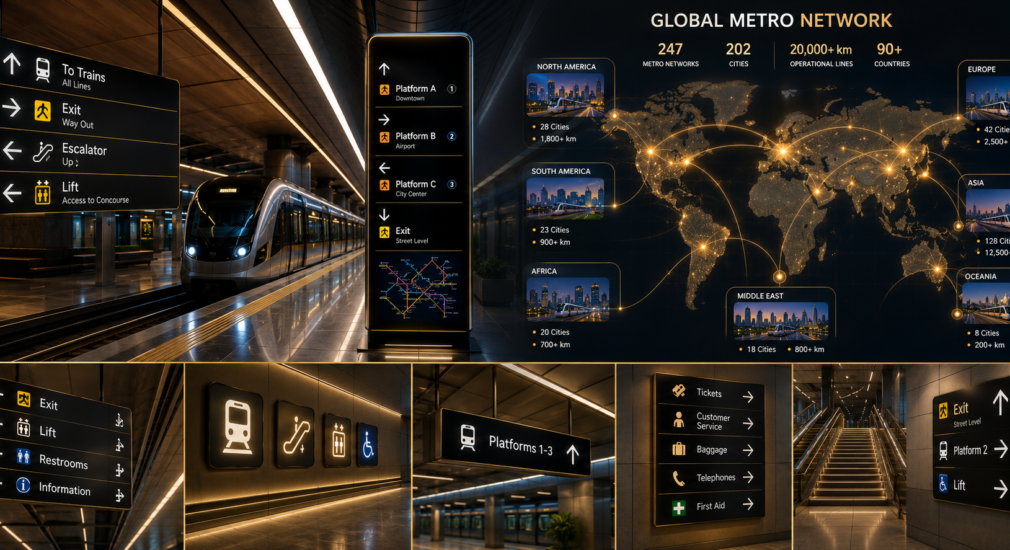
Modern transportation infrastructure is judged not only by the quality of its trains, platforms, tunnels, and stations, but also by how effortlessly passengers can understand and navigate the environment. Metro signage solutions form the visual intelligence of a transit network, transforming complex stations into intuitive, safe, and accessible passenger environments.
From station entrances and platforms to interchange corridors, emergency routes, ticketing zones, elevators, and exits, every sign must communicate the right information at the right moment. A sophisticated metro signage system therefore goes far beyond printed boards or directional arrows. It combines information hierarchy, typography, color, symbols, materials, illumination, accessibility, durability, and precise placement into one coordinated wayfinding experience.
For operators, developers, architects, and infrastructure contractors, professionally engineered metro station signage can reduce passenger confusion, improve circulation, reinforce station identity, and support safer movement during both normal operations and emergencies. Where transit architecture itself requires carefully coordinated illumination, complementary Architectural Lights can help create a visually integrated station environment.
Why Metro Signage Is a Critical Part of Transit Infrastructure
A successful signage program begins with one fundamental principle: passengers should not have to stop and think about where they need to go.
In a large interchange, passengers may need to identify platforms, understand route connections, locate exits, find elevators, access toilets, reach ticketing areas, or follow emergency instructions within seconds. This makes metro wayfinding solutions an operational requirement rather than simply an aesthetic feature.
The most effective systems use a consistent visual language across the entire station. Directional arrows, pictograms, route colors, typography, numbering systems, accessibility symbols, and destination names should work together as a unified information architecture. In stations incorporating retail, offices, commercial concourses or mixed-use developments, Commercial Lights can also be coordinated with the architectural environment to maintain visual comfort and a refined passenger experience.
Quick Technical Comparison
| Rating | Practical Meaning | Typical Consideration |
|---|---|---|
| IP65 | Dust-tight + protection against water jets | Exposed outdoor applications |
| IP66 | Dust-tight + protection against powerful water jets | More demanding exterior environments |
| IP67 | Dust-tight + temporary immersion protection | Ground/recessed locations where water exposure is possible |
The Technical Foundation Behind Premium Station Signage
High-performance metro signage manufacturing starts long before fabrication. The signage strategy must consider viewing distance, passenger flow, mounting height, environmental conditions, lighting levels, vandal resistance, cleaning requirements, maintenance access, and the expected lifespan of each installation.
Materials may include aluminum, stainless steel, acrylic, polycarbonate, engineered plastics, illuminated components, reflective finishes, and digitally printed or fabricated graphics. The appropriate specification depends on whether the sign is installed indoors, outdoors, underground, exposed to moisture, subject to heavy passenger traffic, or positioned within a high-impact public area.
A comprehensive metro signage design should also account for accessibility from the beginning. Tactile information, Braille, high-contrast graphics, recognizable pictograms, accessible routes, and clearly positioned facility identifiers can make a station considerably easier to navigate for passengers with different mobility and sensory requirements.
Digital systems can complement permanent signage through real-time passenger information, service updates, disruption announcements, and changing operational messages. The strongest systems do not replace physical wayfinding; they integrate digital information into a consistent overall passenger experience.
Designed for Global Transit Standards
Different transportation authorities have different operational requirements, architectural languages, accessibility expectations, and procurement standards. A capable metro signage manufacturer therefore needs to understand both the technical and visual requirements of the project.
Whether the requirement is metro railway signage, platform identification, station maps, illuminated signs, passenger information displays, tactile signage, or a complete metro signage solutions package, the objective remains consistent: make movement clearer, safer, faster, and more intuitive.
A premium signage program should be coordinated with architecture, interior design, engineering, electrical systems, branding, passenger-flow planning, and facility management rather than treated as an isolated graphic package. For the wider transportation infrastructure, Luzion also provides Railway Lighting solutions for stations, platforms, tracks, tunnels, and related rail environments.
A Premium Signage Strategy for Complex Transit Environments
The right solution is rarely the sign with the most information. It is the sign that delivers the right information at the right decision point.
For major metro and railway projects, we recommend developing the signage program around five principles:
- Clear information hierarchy for rapid passenger recognition
- Consistent typography, pictograms, colors, and directional language
- Durable materials engineered for demanding public environments
- Accessibility integrated into the core wayfinding system
- Scalable physical and digital signage for future operational requirements
This approach allows metro station wayfinding to become part of the infrastructure itself—functional, recognizable, durable, and visually sophisticated. Where stations connect directly with surrounding buildings, plazas, façades or public-realm architecture, coordinated Facade Lights can further strengthen the visual relationship between the transit structure and its surrounding urban environment.
Is Your Metro Signage Ready for the Next Passenger Journey?
If your project requires more than individual signs, consider a complete signage strategy covering metro signage design, manufacturing, supply, installation, wayfinding, passenger information, accessibility, and technical coordination.
Honest recommendation: don’t select a signage supplier based only on fabrication capability or the lowest quotation. For a major transit project, evaluate the supplier’s ability to translate passenger-flow requirements into a complete, technically coordinated signage system that can perform for years.
CTA: Share your station layout, project scope, or signage requirement to discuss a tailored Metro Signage Solution built around your passenger flow, architectural environment, and operational requirements.
Metro Signage Solutions Worldwide: Premium Transit Signage for Global Cities
Metro Signage Solutions Worldwide: Premium Transit Signage for Global Cities
Metro systems are becoming increasingly sophisticated, and their signage must evolve with them. From high-density Asian networks to modern Middle Eastern rail systems and established European transport infrastructure, every market requires a signage strategy that balances wayfinding, safety, accessibility, durability, branding, and passenger information.
The following regional approach is designed around the terminology and commercial intent used by metro authorities, infrastructure developers, architects, EPC contractors, and transportation consultants.
Metro Signage Solutions in the United States & Canada
North American transit networks require signage that can perform across large stations, interchange hubs, underground environments, and high-volume passenger corridors. Metro signage solutions USA commonly include platform identification, directional signage, station maps, accessibility information, emergency signs, and passenger information displays.
Major markets such as New York, Washington D.C., Los Angeles, Chicago, Boston, Toronto, Vancouver, and Montreal offer opportunities for sophisticated metro station signage, railway wayfinding, and transit information systems. For large transportation projects, signage should integrate clearly with existing station architecture while maintaining consistent visual communication throughout the network.
A professional transit signage manufacturer can support projects with design development, material selection, fabrication, illumination, accessibility features, and installation coordination. For projects where the station forms part of a larger commercial or mixed-use development, integrated Commercial Lights can also support the surrounding architectural environment.
Metro Signage Solutions in the United Kingdom & Europe
European transportation networks place strong emphasis on consistent passenger information, multilingual communication, accessibility, and recognizable wayfinding systems. Metro signage solutions UK can support underground, metro, tram, and railway environments where passengers must navigate complex interchanges quickly.
Important cities include London, Manchester, Birmingham, Paris, Berlin, Munich, Madrid, Barcelona, Rome, Milan, Amsterdam, Brussels, Zurich, and Copenhagen. These markets create demand for railway station signage, platform signs, directional systems, passenger information displays, and durable wayfinding solutions.
A well-engineered railway signage system should maintain visual consistency across stations while adapting to different architectural environments and passenger-flow requirements. Where architectural identity is a major consideration, professional lighting design can be coordinated with signage, and Luzion’s Lighting Design services provide technical planning, photometric analysis and lighting simulations for complex projects.
Metro Signage Solutions in China, Japan & South Korea
Asia’s major metropolitan networks require highly organized passenger communication because of exceptional passenger volumes and complex interchange environments. Metro signage manufacturer solutions in this region can include platform identification, route maps, directional signs, illuminated signage, digital passenger information, and accessibility systems.
Major cities include Beijing, Shanghai, Shenzhen, Guangzhou, Tokyo, Osaka, Kyoto, Seoul, and Busan. In these environments, effective metro wayfinding solutions must communicate quickly while remaining visually clean and internationally recognizable.
For large-scale infrastructure, signage should be designed as part of the station’s complete passenger-information architecture rather than treated as an independent graphic application.
Metro Signage Solutions in Southeast Asia
Rapid urban development is creating significant demand for modern transit infrastructure across Southeast Asia. Markets such as Singapore, Kuala Lumpur, Jakarta, Bangkok, Manila, and Ho Chi Minh City require reliable metro station signage, transit wayfinding, platform identification, and passenger information systems.
Singapore MRT signage, Kuala Lumpur MRT signage, Jakarta MRT signage, and Bangkok metro signage represent the type of high-density transportation environments where clear directional communication is essential.
For these markets, a strong metro signage system should combine durable construction with clear typography, standardized pictograms, accessibility considerations, and easy maintenance.
Metro Signage Solutions in the Middle East
The Middle East has become one of the most important markets for sophisticated transportation infrastructure, with major investments in metro, railway, airport, and integrated mobility projects.
UAE, Saudi Arabia, Qatar & Other Major Middle Eastern Cities
Key markets include Dubai, Abu Dhabi, Riyadh, Jeddah, Doha, Kuwait City, Muscat, Manama, and Cairo. Projects in these locations can require premium metro signage solutions, station wayfinding, illuminated signs, passenger information displays, accessibility signage, and architectural signage.
Dubai Metro signage and Doha Metro signage demonstrate the importance of integrating passenger information with contemporary station architecture. In emerging networks such as Riyadh Metro, scalable signage systems can support future expansion while maintaining a consistent passenger experience.
For Middle Eastern projects, material durability, illumination, climate resistance, visibility, and architectural integration should be considered from the earliest design stage. This same performance-driven approach is valuable when selecting Industrial Lights for adjoining infrastructure, service areas, maintenance facilities, logistics zones, and technical spaces.
Metro Signage Solutions in Australia & New Zealand
Australian and New Zealand transportation projects require clear communication across metro, rail, tram, and multimodal environments. Metro signage solutions Australia can include station identification, platform signage, directional wayfinding, passenger information, accessibility signage, and safety communication.
Major cities include Sydney, Melbourne, Brisbane, Perth, Adelaide, Auckland, and Wellington. The combination of railway, metro, tram, and urban transport infrastructure makes consistent transit wayfinding solutions particularly valuable.
Premium signage should combine robust materials with accessible information, strong visual hierarchy, and long-term maintainability.
Metro Signage Solutions in India
India represents one of the most dynamic markets for metro signage manufacturer India, metro rail signage India, railway station signage, and integrated transportation wayfinding. Rapid expansion of metro networks across multiple states is creating demand for signage that can support extremely high passenger volumes while remaining durable, accessible, and visually consistent.
Metro Signage Solutions Across Indian States
Metro and urban rail development spans several important states and territories. Major opportunities exist across Gujarat, Maharashtra, Delhi NCR, Karnataka, Telangana, Tamil Nadu, Uttar Pradesh, West Bengal, Rajasthan, Kerala, Haryana, Madhya Pradesh, Punjab, and Bihar.
Each region may involve different station architectures, passenger demographics, environmental conditions, project standards, and operating requirements. A professional metro signage supplier India should therefore be capable of adapting materials, graphics, mounting systems, illumination, accessibility features, and installation methods to the specific project.
Metro Signage Solutions Across Indian Cities
India’s major metro markets include Ahmedabad, Mumbai, Pune, Delhi, Noida, Gurugram, Bengaluru, Hyderabad, Chennai, Kolkata, Jaipur, Lucknow, Kanpur, Nagpur, Kochi, Patna, and Bhopal.
These cities require a combination of metro station signage, platform identification, directional wayfinding, passenger information, emergency communication, accessibility signage, and Architectural Lights integration. In high-density stations, signage must help passengers make decisions quickly without creating visual clutter.
For expanding networks, the preferred approach is a scalable metro signage system that can be replicated across stations while allowing individual locations to retain their architectural character.
Technical Priorities by Market
| IP Rating | General Protection | Typical Outdoor Consideration |
|---|---|---|
| IP44 | Protection against solid objects and water splashes | Sheltered outdoor areas |
| IP65 | Dust-tight and protected against water jets | Façades and exposed architectural applications |
| IP66 | Dust-tight and protected against powerful water jets | More demanding exposed environments |
| IP67 | Dust-tight and suitable for temporary water immersion | Inground and selected landscape applications |
| IP68 | Dust-tight with protection for continuous immersion under specified conditions | Underwater applications, subject to manufacturer specifications |
The Premium Approach to Global Transit Wayfinding
A global signage program should never be built around one universal template. The strongest metro signage solutions maintain a consistent technical philosophy while adapting to local architecture, regulations, climate, language, passenger behavior, and operational requirements.
Honest Recommendation
If your objective is to attract international metro and railway projects, position your company as a complete metro signage solutions provider, not simply as a signage manufacturer. Highlight design capability, engineering coordination, material expertise, accessibility, manufacturing, installation, quality control, and project execution.
CTA: Planning a metro, railway, or transit project? Share your project location and signage scope to develop a market-specific Metro Signage Solution tailored to the station environment and passenger journey.
Premium Metro Signage Solutions: From Station Wayfinding to Intelligent Passenger Information
A modern metro network needs more than attractive signs. It needs a coordinated communication system that works across entrances, concourses, platforms, interchanges, service areas, emergency routes, and public spaces. This is where metro signage solutions become an important part of transportation infrastructure.
The right signage strategy connects physical design with passenger behavior. Every sign should answer a clear question: Where am I? Where do I go next? How do I get there safely? What information do I need before making my next decision?
The Architecture of a Complete Metro Signage System
A comprehensive metro signage system normally combines several signage categories, each serving a specific stage of the passenger journey.
- Station identification signage
- Directional and wayfinding signage
- Platform and track identification
- Entrance and exit signage
- Passenger information displays
- Safety and emergency signage
- Accessibility and tactile signage
- Digital and illuminated signage
- Station maps and network information
- Architectural and identification signage
The strongest systems maintain one visual language across all these applications. Typography, colors, arrows, pictograms, numbering, materials, mounting positions, and illumination should appear coordinated rather than independently designed.
Metro Wayfinding Solutions for Complex Stations
In a major interchange, passengers may encounter multiple platforms, lines, exits, elevators, commercial areas, and connecting transport modes. Poorly positioned signs can create hesitation, congestion, and unnecessary passenger movement.
Professional metro wayfinding solutions establish a sequence of information points along the passenger journey. Decision points receive clear directional information, while confirmation signs reassure passengers that they are following the correct route.
This approach is especially valuable for major networks in London, Paris, Tokyo, Dubai, Singapore, Delhi, Mumbai, Riyadh, Doha, Sydney, Toronto, and New York, where passenger volumes and interchange complexity can be substantial.
Railway and Transit Signage Beyond the Metro
The same principles apply to railway stations, tram networks, bus terminals, airports, and integrated transportation hubs. Railway signage solutions can connect platform information, station identification, passenger directions, accessibility routes, safety communication, and public information into one coordinated system.
For transport authorities operating multiple modes, a unified transit wayfinding system can create a more consistent passenger experience between metro stations, railway platforms, bus connections, parking areas, and pedestrian approaches.
Digital Metro Signage and Passenger Information
Physical signage provides permanent orientation, while digital signage can communicate changing information. A sophisticated digital metro signage strategy can display service updates, platform information, disruptions, announcements, maps, and other time-sensitive passenger information.
The objective should not be to replace physical signs with screens. Instead, digital displays should complement permanent metro station signage and follow the same information hierarchy. For intelligent infrastructure projects, lighting controls and connected systems can also be explored through Luzion’s Smart Lighting Solutions, particularly where transit architecture incorporates sensors, automation and energy-management strategies.
Illuminated, Accessible & High-Performance Signage
Visibility is critical in underground stations, tunnels, platforms, parking areas, and environments with changing lighting conditions. Illuminated metro signage can improve recognition while contributing to a premium architectural appearance.
Accessibility should also be incorporated from the beginning. Tactile metro signage, Braille, high-contrast information, accessible route identification, and recognizable pictograms can support passengers with different mobility and visual requirements.
Material selection is equally important. A professional metro signage manufacturer should consider durability, cleaning, vandal resistance, moisture, UV exposure, installation conditions, maintenance access, and expected service life before recommending a specification.
Major Applications Across Global Transit Markets
Demand for metro signage manufacturer and metro signage supplier services continues to extend across established and developing transportation markets.
In North America, opportunities include New York, Los Angeles, Chicago, Washington D.C., Toronto, Vancouver, and Montreal, where complex public transportation networks require robust wayfinding and passenger information.
In Europe, important markets include London, Paris, Berlin, Madrid, Milan, Rome, Amsterdam, Zurich, and Brussels, where signage must integrate with established transport standards and distinctive station architecture.
Across Asia, cities such as Tokyo, Osaka, Beijing, Shanghai, Seoul, Singapore, Bangkok, Jakarta, Kuala Lumpur, and Manila require highly efficient communication systems for dense passenger environments.
In the Middle East, major opportunities exist in Dubai, Abu Dhabi, Riyadh, Jeddah, Doha, Kuwait City, Muscat, and Manama, where premium infrastructure, architectural integration, climate considerations, and long-term durability are particularly important.
The Indian Metro Market: Designed for Scale
India requires a specialized approach because metro and railway development spans different climates, architectural environments, passenger volumes, and infrastructure standards.
Major opportunities exist in Delhi, Mumbai, Ahmedabad, Pune, Bengaluru, Hyderabad, Chennai, Kolkata, Jaipur, Lucknow, Kanpur, Nagpur, Kochi, Bhopal, and Patna.
Across states including Gujarat, Maharashtra, Karnataka, Telangana, Tamil Nadu, Uttar Pradesh, Rajasthan, West Bengal, Kerala, Madhya Pradesh, Punjab, Bihar, Haryana, and Delhi NCR, signage programs must combine scalability with practical manufacturing and installation considerations.
For Indian infrastructure projects, the ideal metro signage supplier India should be able to support the complete lifecycle—from design coordination and prototyping through fabrication, quality control, delivery, installation, and project completion.
A Refined Standard for Metro Signage Excellence
Premium signage is ultimately measured by performance, not decoration.
The most effective metro station wayfinding programs make information easier to recognize, reduce visual confusion, support accessibility, and integrate naturally with the surrounding architecture.
For project owners and transportation consultants, the right signage partner should demonstrate more than a product catalogue. Look for engineering understanding, manufacturing capability, material expertise, project coordination, quality assurance, installation experience, and the ability to deliver consistent results across an entire network.
Which Metro Signage Strategy Creates the Strongest Passenger Experience?
The strongest approach is a complete signage ecosystem, rather than selecting individual signs independently. Start with passenger-flow analysis and information hierarchy, then develop the visual language, technical specifications, materials, accessibility requirements, fabrication details, and installation methodology.
Honest Recommendation
If you want your website to compete internationally for metro signage projects, build your SEO and content strategy around genuine expertise. Use metro signage solutions, metro signage manufacturer, metro station signage, metro wayfinding solutions, railway signage solutions, and country-specific search terms naturally within useful technical content—not through repetitive keyword placement.
Create dedicated pages for major markets, applications, materials, accessibility, digital signage, railway signage, and completed projects. Support those pages with detailed case studies and internal links so Google can understand your topical authority.
CTA: Have a metro, railway, or transit project requiring coordinated signage? Share the station type, location, and scope to explore a technically engineered signage approach for your passenger environment.
Metro Signage Solutions: From Infrastructure Complexity to Exceptional Passenger Experience
A successful metro signage project is not defined by how many signs are installed. It is defined by how effectively the entire network communicates with its passengers.
From the first station entrance to the correct platform, interchange, elevator, exit, or emergency route, signage must create a continuous and intuitive information journey. For this reason, premium metro signage solutions combine strategic planning, technical engineering, design, manufacturing, accessibility, installation, and quality control into one coordinated process.
Context: Why Modern Metro Networks Need Better Signage
Metro systems are becoming larger, busier, and more interconnected. Stations increasingly combine multiple lines, railway connections, buses, commercial areas, parking facilities, elevators, escalators, emergency routes, and pedestrian approaches.
In such environments, passengers make dozens of navigation decisions during a single journey. A missing directional sign, inconsistent symbol, poorly positioned platform identifier, or unclear exit reference can create confusion and unnecessary passenger movement.
This is why metro station signage should be considered part of the passenger infrastructure rather than simply a visual branding element.
Across markets such as India, the UAE, Saudi Arabia, Qatar, the United States, the United Kingdom, Australia, Singapore, Japan, Germany, France, and Canada, transportation projects increasingly require signage systems that combine clarity, accessibility, durability, and architectural integration.
Problem: When Signage Becomes an Operational Challenge
The challenge is rarely a lack of signs. More often, the problem is information that is difficult to understand, inconsistent, poorly positioned, or visually overwhelming.
Common issues include:
- Too much information on one sign
- Inconsistent arrows, typography, or pictograms
- Poor visibility from passenger decision points
- Inadequate accessibility information
- Weak integration between physical and digital signage
- Materials unsuitable for heavy public use
- Difficult maintenance and replacement
- Inconsistent signage between stations
- Poor coordination with architectural and MEP requirements
A professional metro wayfinding solution addresses these issues before they become installation problems.
The objective is to establish an information hierarchy where essential directions are immediately visible and supporting information appears only when passengers need it.
Process: From Signage Strategy to Installation
A premium metro signage manufacturer should approach every project as a coordinated technical process.
1. Project & Passenger Analysis
The process begins by understanding the station architecture, passenger movement, entrances, platforms, interchange routes, facilities, accessibility requirements, operational zones, and emergency pathways.
The outcome is a clear understanding of where passengers make decisions and what information they need at each location.
2. Signage Planning & Information Architecture
Next, the project team develops the signage hierarchy. This determines which information belongs on directional signs, platform identifiers, maps, information panels, facility signs, safety signage, and digital displays.
A structured metro signage system prevents unnecessary information from competing for passenger attention.
3. Design Development
The visual system is then developed around typography, color, symbols, arrows, numbering, multilingual requirements, accessibility, contrast, mounting positions, and station identity.
The design should remain consistent across metro station wayfinding, railway signage, platform signs, entrances, exits, and passenger information displays.
4. Material & Engineering Specification
Material selection depends on the environment and expected service life. Aluminum, stainless steel, acrylic, polycarbonate, illuminated elements, reflective surfaces, and specialized finishes may be considered according to project requirements.
Engineering should also address fixing methods, structural support, electrical integration, illumination, maintenance access, cleaning, environmental exposure, and vandal resistance.
5. Prototype & Quality Validation
Before large-scale production, representative signage can be prototyped and reviewed for visibility, proportions, material finish, mounting, accessibility, illumination, and overall visual consistency.
This stage is especially important for large networks because correcting a design issue before mass production is significantly more efficient than modifying completed installations.
6. Manufacturing, Installation & Commissioning
Once approved, the signage can move into controlled production followed by packaging, logistics, installation, inspection, testing, and commissioning.
For large infrastructure programs, consistent production standards help ensure that signs across different stations maintain the same visual and technical quality.
Results: What a Well-Engineered Signage Program Delivers
A successful metro signage solution should create measurable operational and passenger benefits.
Passenger Benefits
- Faster recognition of destinations and routes
- Easier navigation through complex stations
- Improved accessibility
- Reduced hesitation at decision points
- Better understanding of station facilities
- Clearer emergency communication
Infrastructure Benefits
- Consistent signage across multiple stations
- Durable and maintainable installations
- Better architectural integration
- Easier future expansion
- More efficient maintenance and replacement
- Stronger visual identity for the transportation network
The result is a system that feels natural to passengers because the information appears exactly where it is needed.
Global Applications: One Standard, Adapted to Each Market
A sophisticated international metro signage supplier should maintain consistent technical principles while adapting to local conditions.
In India, projects across Gujarat, Maharashtra, Karnataka, Telangana, Tamil Nadu, Uttar Pradesh, Rajasthan, West Bengal, Kerala, Madhya Pradesh, Haryana, and Delhi NCR can require scalable signage systems capable of serving rapidly expanding metro networks. Major cities include Ahmedabad, Mumbai, Pune, Delhi, Bengaluru, Hyderabad, Chennai, Kolkata, Jaipur, Lucknow, Kanpur, Nagpur, Kochi, Bhopal, and Patna.
In the Middle East, major opportunities include Dubai, Abu Dhabi, Riyadh, Jeddah, Doha, Kuwait City, Muscat, and Manama, where premium architecture, climate conditions, illumination, durability, and passenger information are important considerations.
In North America, markets such as New York, Los Angeles, Chicago, Washington D.C., Toronto, Vancouver, and Montreal require wayfinding systems that can work across complex multimodal transportation environments.
In Europe, cities such as London, Paris, Berlin, Madrid, Milan, Rome, Amsterdam, Zurich, and Brussels require signage that works within established transportation networks while maintaining strong accessibility and information standards.
Across Asia-Pacific, cities including Tokyo, Osaka, Seoul, Singapore, Kuala Lumpur, Jakarta, Bangkok, Sydney, Melbourne, and Auckland represent major environments for modern metro signage solutions, railway wayfinding, digital passenger information, and station identification.
A Premium Framework for Long-Term Signage Performance
The strongest signage programs follow a simple philosophy: clarity first, engineering second, aesthetics in harmony with both.
Good design attracts attention. Good wayfinding directs it. Good engineering ensures that the system continues to perform after years of passenger use.
For transportation authorities, EPC contractors, architects, consultants, and infrastructure developers, the ideal signage partner should therefore offer more than fabrication. The partner should understand the complete journey from passenger-flow analysis to design, engineering, manufacturing, installation, and long-term performance.
The Final Standard: Signage That Works Before It Is Noticed
The highest standard for metro signage solutions is almost invisible success.
Passengers should instinctively recognize the correct direction, identify their platform, locate an accessible route, understand an interchange, and find an exit without stopping to interpret complicated information.
That is the difference between simply manufacturing signs and engineering a complete metro wayfinding system.
Honest Recommendation
If you want your website to compete internationally for metro signage projects, make your SEO and content strategy demonstrate genuine expertise. Use metro signage solutions, metro signage manufacturer, metro station signage, metro wayfinding solutions, railway signage solutions, and country-specific search terms naturally within useful technical content—not through repetitive keyword placement.
Create dedicated pages for major markets, applications, materials, accessibility, digital signage, railway signage, and completed projects. Support those pages with detailed case studies and internal links so Google can understand your topical authority.
CTA: If your next project requires a complete Metro Signage Solution, share your project location, station type, and scope to discuss the right technical, design, and manufacturing approach.
FAQs for Metro Signage Solutions
1. What are Metro Signage Solutions?
Metro Signage Solutions are integrated systems for station identification, passenger wayfinding, platform signage, directional signage, safety signage, accessibility signage, and passenger information. They are designed to make complex metro environments easier, safer, and more intuitive to navigate.
2. What does a complete Metro Station Signage system include?
A complete metro station signage system can include entrance and exit signs, platform identifiers, directional wayfinding, station maps, facility signs, emergency signage, tactile and Braille signage, illuminated signs, and digital passenger information displays.
3. Why is professional Metro Wayfinding important?
Effective metro wayfinding solutions help passengers make quick decisions at entrances, concourses, interchanges, platforms, and exits. A well-planned system can reduce confusion while improving accessibility, passenger flow, and the overall station experience.
4. Can Metro Signage Solutions be customized for different countries?
Yes. Professional metro signage manufacturers can adapt signage to local architecture, languages, accessibility requirements, environmental conditions, transportation standards, and authority specifications across markets such as India, UAE, Saudi Arabia, Qatar, USA, UK, Europe, and Asia.
5. What materials are used for Metro and Railway Signage?
Depending on the application, metro signage manufacturing may use aluminum, stainless steel, acrylic, polycarbonate, reflective materials, illuminated components, and other engineered finishes selected for durability, visibility, maintenance, and environmental performance.
6. Do you provide complete Metro Signage design and installation?
A capable metro signage supplier can provide an end-to-end service covering signage design, engineering, prototyping, manufacturing, quality control, supply, installation, and commissioning, creating one coordinated signage system from concept to completion.
Your Station Deserves More Than Signs
Create Metro Signage Solutions engineered for clarity, durability, illumination and seamless passenger wayfinding across global transit environments.
From Metro Station Signage and Metro Directional Signage to premium LED Metro Signage and illuminated wayfinding systems, Luzion delivers project-focused solutions.
Partner with our team for custom metro signage, technical consultation, specification support and scalable manufacturing for UAE, Saudi Arabia, India and international projects.
Talk to a Metro Signage Expert
Explore a Signage Consultation
Related posts

01 Oct 2026
Irish bespoke lights
Irish Bespoke Lights: Where Craftsmanship Meets Architectural Design Irish bespoke lights bring together craftsmanship, design individuality and practical lighting performance.…

30 Sep 2026
Japanese bespoke lights
Japanese Bespoke Lights: Craftsmanship, Design & Architectural Identity Japanese bespoke lights bring together traditional craftsmanship, refined materiality and contemporary lighting…

30 Sep 2026
Greek bespoke lights
Greek Bespoke Lights for Luxury Architectural Projects Greek bespoke lights combine artistic expression, Mediterranean design influences and project-specific craftsmanship to…

29 Sep 2026
Turkish luxury chandeliers
Turkish Luxury Chandeliers: Heritage, Craftsmanship & Design Turkish luxury chandeliers bring together decorative craftsmanship, architectural scale and contemporary lighting technology…
29 Sep 2026
Polish bespoke chandeliers
Polish Bespoke Chandeliers: Craftsmanship, Character and Contemporary Design A chandelier can do more than illuminate a room. In a well-designed…
subscribe for newsletter

Luzion is a leading manufacturer and exporter of high-quality LED lighting solutions. With a focus on design, research, and innovation, we offer a wide range of products for commercial, industrial, residential, and outdoor spaces.
