
Search
Category
- Bollard Light
- Commercial Lighting
- Energy-Efficient Lighting
- LAMPS
- LED Lights
- LED Uplighter
- Light and Colour Theory
- Lighting & Signage Solutions
- Lighting Design and Facade Lighting
- Lighting Design Consultancy UAE
- lighting design principles
- Lighting Fundamentals and Design Principles
- Lighting Solutions
- Nature of Light in Lighting Design
- Panel Lights vs. Spot Lights
- Portable Lights
- Signage Solutions
- Smart Controllers for Streetlights
- Solar Lights
- Tree Lighter
- Uncategorized
Recent Posts
Irish bespoke lights
Japanese bespoke lights

Greek bespoke lights
Turkish luxury chandeliers
Polish bespoke chandeliers
Tags
- Architectural Lighting
- Architectural Lighting Design
- Architectural Lighting Design UAE
- automation
- Best Lighting Design Consultancy in UAE
- COB LED Technology
- COB Spotlights
- Color Temperature in Lighting
- Commercial Lighting Design
- Commercial Lighting Fixtures
- Commercial Lighting Innovations
- Commercial Lighting UAE
- Cylinder COB Lights
- Dialux Lighting Design
- Dialux Lighting Design UAE
- Energy Efficient Lighting
- Energy-Efficient Lighting USA
- Exterior Lighting Solutions
- Facade & Exterior Lighting
- Facade Lighting
- Facade Lighting Design
- Facade Lighting Design UAE
- Facade lighting ideas
- Facade Lighting UAE
- Facade Uplighting
- Green Building Design
- Indoor & Exterior Lighting Solutions
- Interior Lighting Design
- Lamps
- LED Lighting Solutions
- LED lights
- LED Panel
- LED Uplighters
- LED vs Halogen
- Light and Color Theory
- Lighting Basics
- Lighting Consultancy UAE
- Lighting Design
- Lighting Design Consultancy in UAE
- Lighting Design Principles
- Lighting Design UAE
- Lighting Fundamentals Guide
- Lighting Layers
- Lumen Output in Lighting
- Modern Building Lighting Ideas
- Modern Lighting Ideas
- Office Lighting Solutions
- Outdoor Lighting Consultants UAE
- Panel Lights vs. Spot Lights
- Portable Lights
- smart light
- Smart Lighting Systems
- Sustainable Architecture
- Sustainable Lighting UAE
- Villa Lighting UAE
17Aug 2026
- Lighting Solutions


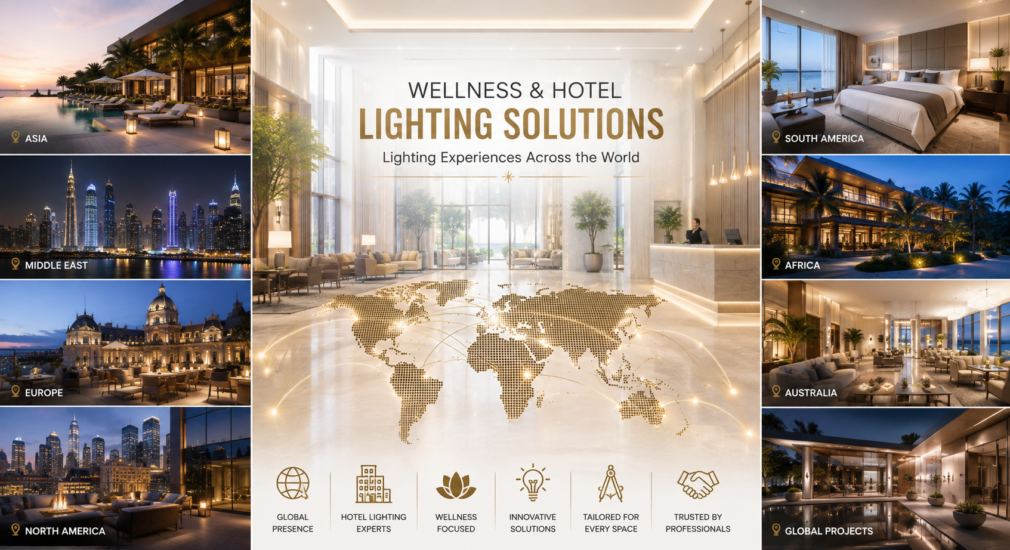
Wellness & Hotel Lighting Solutions for Luxury Hospitality Spaces Worldwide
A successful hotel or wellness destination is experienced through more than architecture, interiors and materials. Light is one of the most influential elements shaping how guests perceive a space, how they move through it and how they emotionally connect with the environment. From the first illuminated approach to a resort entrance to the calm, layered ambience of a spa treatment room, carefully considered Wellness & Hotel Lighting Solutions can transform an ordinary hospitality environment into a memorable destination.
Across India, the GCC, the UK, USA, Europe, China and emerging hospitality markets worldwide, architects, interior designers, lighting designers, developers and hotel operators are increasingly treating lighting as an integral part of the design strategy rather than simply a functional requirement.
Luxury hotels, resorts, wellness retreats, spas, restaurants, fitness centres and destination properties require lighting that works at several levels simultaneously. It must complement architectural form, create visual comfort, support guest wellbeing, reinforce the property’s identity, provide safe circulation and operate efficiently over many years.
For this reason, modern hotel lighting design combines architectural LED lighting, decorative illumination, facade lighting, landscape lighting, intelligent controls, concealed sources, accent lighting and carefully calibrated colour temperatures to create a complete visual experience.
Lighting as an Essential Element of Wellness Hospitality Design
Wellness-oriented hospitality design places greater emphasis on comfort, tranquillity and sensory experience. Guests visiting a luxury hotel, spa or wellness retreat are often looking for an environment that feels calm, private and restorative. Lighting has a direct role in creating that atmosphere.
A brightly illuminated environment with excessive glare can feel commercial and uncomfortable, while a carefully layered lighting scheme can make the same architectural space feel warm, intimate and sophisticated.
This is why contemporary wellness lighting design considers factors such as:
- Colour temperature
- Colour rendering
- Glare control
- Illumination levels
- Light distribution
- Dimming capability
- Daylight interaction
- Circadian considerations
- Architectural surfaces
- Material reflectance
- Guest circulation
- Lighting scenes and controls
In a wellness resort, for example, the lighting requirement for a meditation lounge is very different from that of a reception desk or fitness studio. Similarly, a luxury hotel lobby may require a combination of decorative pendants, concealed linear lighting, architectural spotlights and accent illumination rather than one uniform lighting system.
The objective is not simply to make a space brighter. The objective is to make the space feel right.
Why Lighting Matters in Hotels, Resorts and Wellness Destinations
Hospitality properties contain numerous environments, each with its own functional and emotional requirements. A guest may experience an entrance, reception, lobby, restaurant, corridor, guest room, spa, swimming pool, garden and facade within a single stay.
Each transition creates an opportunity for lighting to influence perception.
Creating a Welcoming Arrival Experience
The arrival sequence establishes the first impression of a hotel or resort. Architectural lighting can highlight entrance canopies, columns, landscape elements, pathways, signage and facade details without overwhelming the architecture.
For luxury properties, entrance lighting often combines concealed linear fixtures, wall washers, inground luminaires, uplighters and carefully positioned accent lights. The result should feel intentional rather than excessively illuminated.
In resort environments, lighting can also respond to the surrounding landscape. A tropical property in Goa, for instance, may benefit from subtle illumination of vegetation, pathways and architectural textures, while a desert resort in the UAE or Saudi Arabia may use dramatic shadow, facade grazing and controlled architectural accents to complement the surrounding environment.
Supporting Relaxation and Recovery
Wellness spaces demand a more sensitive lighting approach.
Spa treatment rooms, meditation areas, yoga studios and relaxation lounges generally benefit from soft, low-glare illumination. Indirect lighting can reduce visual stress while concealed sources help preserve clean architectural lines.
Dimmable lighting allows staff to adjust the atmosphere according to the activity. A yoga studio may require a brighter setting during an active session and a softer scene during meditation or relaxation.
Enhancing Architectural Features
Architecture becomes more expressive when light is carefully integrated with its form.
Wall washing can reveal stone, timber, textured plaster and other materials. Grazing can emphasise surface relief, while narrow-beam spotlights can draw attention to artwork, sculptures, architectural details or landscape features.
For architects and lighting designers, this creates an opportunity to use light as an architectural material.
The principle is particularly important in luxury hospitality projects where materials and detailing represent a significant part of the property’s identity.
Integrating Architectural Lighting with Hotel Interior Design
Hotel lighting should never operate independently from interior architecture.
The ceiling geometry, furniture arrangement, wall finishes, flooring, artwork, joinery and decorative elements all influence the final lighting result. This requires close collaboration between architects, interior designers, lighting designers, MEP consultants, electrical consultants, hospitality consultants, contractors and developers.
A premium hotel lobby may combine several lighting layers:
Ambient lighting establishes the overall illumination.
Accent lighting directs attention toward artwork, furniture or architectural features.
Decorative lighting contributes to the hotel’s visual identity.
Indirect lighting creates depth and softness.
Task lighting provides functional illumination where required.
Architectural lighting reveals materials, volumes and spatial hierarchy.
The strongest hotel lighting schemes rarely depend on a single fixture type. Instead, they use a coordinated lighting vocabulary across the property.
This approach is particularly valuable for international hospitality developments where the lighting design must remain consistent with the brand’s architectural and interior standards while also responding to the local environment.
Human-Centric Lighting for Wellness-Oriented Hospitality
Human-centric lighting has become increasingly relevant to wellness-focused hospitality design. Instead of treating light solely as illumination, this approach considers how changing light conditions can support the rhythm and experience of occupants throughout the day.
In appropriate applications, tunable white systems can provide different colour temperatures at different times. Warmer light can create a relaxing evening atmosphere, while cooler or neutral settings can support alertness and activity during daytime functions.
For hotels and wellness properties, this can be incorporated into selected areas such as:
- Guest rooms and suites
- Wellness lounges
- Yoga studios
- Fitness centres
- Treatment spaces
- Restaurants
- Executive lounges
- Corridors
- Reception areas
Human-centric lighting should, however, be treated as part of a complete lighting strategy rather than a standalone technology. Architectural integration, appropriate illumination levels, glare control, daylight and user requirements remain equally important.
Designing Different Lighting Experiences Throughout the Property
One of the defining characteristics of premium hospitality lighting is the ability to create distinct experiences within the same development.
A hotel entrance can be visually dramatic, the lobby can feel elegant and welcoming, corridors can become quieter transitional spaces, guest rooms can feel intimate, and wellness areas can become deliberately calming.
This progression can be achieved through carefully controlled variations in:
- Brightness
- Beam angles
- Colour temperature
- Contrast
- Light direction
- Fixture positioning
- Surface illumination
- Shadow
- Lighting controls
For example, a luxury resort might use stronger architectural emphasis at the entrance before transitioning to softer illumination around the reception and lobby. Moving deeper into the property, indirect and concealed lighting can create a more private atmosphere around spa and wellness areas.
This layered approach gives guests a sense of movement and discovery.
The Role of Lighting in Luxury Hospitality Architecture
Across major hospitality destinations—from Dubai, Abu Dhabi and Riyadh to London, New York, Milan, Paris, Singapore, Shanghai and Sydney—luxury hotels increasingly compete through experience as much as accommodation.
Lighting therefore becomes part of the property’s brand language.
A contemporary urban hotel may require precise architectural lines and integrated linear lighting. A heritage property may benefit from restrained illumination that respects historic materials. A wellness retreat may prioritise softness, darkness, natural materials and low-glare sources. A destination resort may use landscape and facade lighting to create a recognisable night-time identity.
The same lighting solution cannot be applied universally.
The design must respond to the architecture, climate, cultural context, operational requirements and intended guest experience.
Lighting for Different Hospitality Design Philosophies
Architectural lighting can also support different design directions.
A minimalist hotel may use recessed and concealed lighting to keep the architecture visually clean.
A contemporary luxury resort may combine linear LEDs, architectural spotlights and carefully controlled facade illumination.
A traditional property may use warm decorative lighting to complement stone, wood and heritage details.
A wellness retreat may prioritise indirect illumination, natural daylight and low-glare lighting to create a peaceful environment.
This is where collaboration between the lighting manufacturer and project design team becomes valuable. A lighting solution should not simply fit the specification; it should contribute to the architectural intent.
Building a Complete Wellness & Hotel Lighting Strategy
A comprehensive hospitality lighting strategy begins before product selection.
Architects and designers first establish the architectural concept and guest journey. Lighting designers then determine how light should interact with the spaces, surfaces and activities. MEP consultants coordinate electrical infrastructure and control requirements, while contractors and procurement teams evaluate installation, durability, maintenance and project delivery.
A specialist architectural lighting manufacturer can support this process through product selection, customisation, technical documentation, photometric data, lighting calculations and DIALux lighting design.
For international projects, this integrated approach is particularly important because hospitality developments often involve multiple stakeholders working across different disciplines and geographical locations.
From a boutique wellness retreat in Rishikesh or Kerala to a luxury resort in Goa, a five-star property in Dubai or Abu Dhabi, a hospitality development in Riyadh or Doha, or an international hotel in London, Milan, New York or Shanghai, the fundamental principle remains the same: lighting should support architecture, experience, comfort and operational performance together.
Creating Atmosphere Through Light, Shadow and Material
One of the most sophisticated aspects of hospitality lighting is the controlled relationship between light and shadow.
Uniform illumination can flatten architecture. Carefully positioned light can reveal depth.
A wall washer can bring a textured surface to life. A concealed linear fixture can create a floating ceiling effect. An inground luminaire can define a pathway without visually dominating it. A narrow-beam spotlight can isolate a piece of artwork. Soft landscape lighting can make an outdoor wellness garden feel connected to the interior.
This relationship between illumination and shadow is particularly important in luxury hospitality environments, where atmosphere is often created through subtle details rather than excessive brightness.
The best lighting design is therefore not necessarily the lighting that is most visible. Often, it is the lighting that allows the architecture, materials, landscape and people to become the focus.
A Global Approach to Wellness & Hotel Lighting
The international hospitality industry is highly diverse, but the demand for sophisticated lighting continues to grow across established and emerging markets.
India is seeing significant development across luxury hotels, resorts, wellness destinations and urban hospitality projects in cities such as Mumbai, Delhi, Bengaluru, Hyderabad, Chennai and Ahmedabad, alongside resort-led markets such as Goa, Rajasthan, Kerala and Uttarakhand.
The GCC presents a different scale of opportunity, with Dubai, Abu Dhabi, Riyadh, Doha, Muscat and emerging destinations such as NEOM and the Red Sea region developing ambitious hospitality and wellness environments.
In the UK, USA and Europe, hospitality projects increasingly combine architectural character, sustainability, smart controls and refined guest experiences. Meanwhile, markets across China and Asia-Pacific continue to develop luxury resorts, wellness destinations and high-end urban hotels.
For lighting manufacturers and design consultants, understanding these regional differences is essential.
A successful global lighting solution must combine design flexibility, technical precision, energy efficiency, durability and architectural sensitivity.
The Foundation of a Memorable Guest Experience
Ultimately, wellness and hotel lighting is about creating an environment people remember.
Guests may not consciously identify the beam angle of a spotlight, the optical system of a wall washer or the technical specification of a linear LED. They experience the combined result—the warmth of a lobby, the calmness of a spa, the elegance of a restaurant, the drama of a facade and the comfort of a guest room.
That is the real value of professionally designed hospitality lighting.
When architectural lighting, interior design, wellness principles, smart controls and high-performance LED technology work together, light becomes an invisible layer of the guest experience.
For architects, developers, hotel operators, lighting designers, MEP consultants and hospitality project teams, the goal is therefore not simply to illuminate a building. It is to shape how the building is experienced after sunset.
Wellness & Hotel Lighting Solutions for Every Hospitality & Wellness Environment
A successful hospitality lighting scheme does not rely on one fixture, one colour temperature or one lighting level throughout a property. Hotels, resorts and wellness destinations contain a sequence of spaces with different functional, architectural and emotional requirements. The lighting for a five-star lobby must create a very different experience from a spa treatment room, while a hotel facade needs a completely different optical approach from a guest suite.
Modern Wellness & Hotel Lighting Solutions therefore combine multiple layers of illumination, including ambient, task, accent, decorative, architectural and indirect lighting. The objective is to create visual hierarchy while maintaining comfort, efficiency, safety and design consistency.
For architects, interior designers, lighting consultants, MEP consultants, hospitality developers and contractors, this application-based approach allows every part of a property to contribute to the overall guest experience.
Hotel Entrance & Arrival Lighting
The arrival experience is one of the most important moments in hospitality design. Before guests reach reception, they encounter the driveway, landscape, entrance signage, porte-cochère, facade and architectural features of the property.
Well-planned hotel entrance lighting should provide sufficient visibility without creating excessive glare or an overly commercial appearance.
Architectural lighting can be used to highlight:
- Entrance canopies
- Columns and structural elements
- Hotel signage
- Driveways and pedestrian paths
- Landscape features
- Sculptures
- Water elements
- Building textures
- Architectural details
In luxury resorts, the lighting strategy can extend from the arrival road into the landscape, creating a gradual transition from the surrounding environment into the property.
In urban hotels such as those found in Dubai, Mumbai, London, New York or Shanghai, entrance lighting may need to compete with surrounding city illumination. The solution is not necessarily higher brightness; carefully controlled optics, contrast and focal points can create a stronger visual identity with less light.
Lobby & Reception Lighting
The lobby is often the visual heart of a hotel.
It is simultaneously a circulation zone, waiting area, social environment, reception point and architectural showcase. The lighting design therefore needs several layers working together.
A refined hotel lobby may combine:
General illumination for comfortable movement.
Accent lighting for artwork, furniture and architectural features.
Decorative fixtures for visual identity.
Linear lighting for ceilings, coves and architectural lines.
Downlights and spotlights for controlled illumination.
Indirect lighting for softness and depth.
The reception desk should have appropriate task illumination while remaining visually integrated with the overall environment. Excessive brightness directly above guests can create discomfort and unflattering facial shadows, so glare control becomes particularly important.
Architectural lighting can also emphasise ceiling heights, feature walls, columns, stone surfaces and decorative installations.
For luxury hospitality interiors, the strongest result often comes from making the light source less obvious while allowing the architecture and materials to become the visual focus.
Guest Room & Suite Lighting
Guest rooms require one of the most flexible lighting environments within a hotel.
A guest may use the room for working, reading, relaxing, preparing for an event, sleeping or simply enjoying the view. Lighting therefore needs to respond to different activities.
A comprehensive hotel guest room lighting solution can include:
- Bedside reading lights
- Recessed downlights
- Wardrobe illumination
- Headboard lighting
- Cove lighting
- Decorative pendants
- Mirror lighting
- Desk lighting
- Bathroom illumination
- Accent lighting
- Dimmable ambient lighting
Layered illumination allows guests to create their preferred atmosphere rather than being restricted to a single lighting condition.
Warm colour temperatures are often suitable for evening relaxation, while functional areas such as desks, wardrobes and bathrooms require more precise task illumination.
In luxury suites, concealed linear lighting can be integrated into joinery, headboards, ceiling details and architectural recesses to provide illumination without visually cluttering the interior.
Corridor & Lift Lobby Lighting
Hotel corridors may appear simple, but they play an important role in the overall guest journey.
Lighting should provide safe navigation while avoiding a monotonous, overly bright environment.
Recessed downlights, linear fixtures, wall washers and concealed ceiling illumination can be used to establish rhythm along long corridors.
Accent lighting can highlight artwork, wall textures or room-number features. Lift lobbies may receive slightly stronger architectural emphasis to create a visual destination at circulation nodes.
Good corridor lighting also considers maintenance. Hotel corridors operate for long periods, making efficient LED systems, durable components and appropriate control strategies important for long-term operational performance.
Restaurant, Lounge & Bar Lighting
Restaurants and lounges require lighting that supports both function and atmosphere.
Guests need enough light to read menus, see food and interact comfortably, but excessive illumination can destroy the intimate character expected from a premium dining environment.
Hospitality restaurant lighting may combine:
- Decorative pendant lights
- Adjustable spotlights
- Wall washing
- Cove lighting
- Table illumination
- Accent lighting
- Concealed linear LEDs
- Dimmable ambient systems
Colour rendering is especially important in dining areas. High-quality light can help food, materials and interior finishes appear natural and visually appealing.
Lighting scenes can also support different operating periods. A restaurant may use a brighter setting during breakfast, a balanced atmosphere during lunch and a warmer, more intimate scene during dinner.
This flexibility is increasingly valuable in luxury hotels where one venue may serve multiple purposes throughout the day.
Ballroom & Event Space Lighting
Ballrooms and event spaces need adaptability.
Corporate conferences, weddings, gala dinners, exhibitions and private events can all require different lighting conditions.
A flexible lighting system may integrate:
- Dimmable architectural lighting
- Tunable white systems
- Decorative fixtures
- Adjustable spotlights
- Linear lighting
- Scene controls
- DMX integration
- DALI control
- Event-specific lighting
The lighting infrastructure should ideally be planned during the architectural and MEP design stages so that future event requirements do not compromise the interior design.
Hotel Facade & Architectural Lighting
The exterior of a hotel becomes a visual landmark after dark.
Hotel facade lighting can emphasise architectural proportions, material textures, vertical elements, balconies, rooflines and entrance features.
Different facade conditions require different optical techniques.
Wall Washing
Wall washers provide broad, controlled illumination for large architectural surfaces.
Grazing
Grazing places light close to a textured surface, revealing relief and material detail.
Uplighting
Uplighters can emphasise columns, vertical architectural elements and landscape structures.
Linear Facade Lighting
Linear LED systems can create continuous architectural lines and integrate into edges, reveals and facade details.
Accent Lighting
Narrow-beam projectors and spotlights can draw attention to specific architectural features without illuminating the entire facade.
Facade lighting should always be carefully coordinated with the building’s surroundings. In urban environments, unnecessary brightness can create visual pollution, while poor aiming can cause glare to neighbouring properties or passing traffic.
For luxury hospitality architecture, precision is usually more effective than excessive intensity.
Landscape & Outdoor Hotel Lighting
Outdoor spaces are increasingly important to wellness and hospitality experiences.
Guests may move through gardens, courtyards, terraces, pools, pathways and outdoor dining spaces during the evening. Lighting needs to provide safe navigation while preserving the atmosphere of the landscape.
Landscape lighting can include:
- Bollard lights
- Inground lights
- Spike spotlights
- Underwater lighting
- Step lights
- Pathway lighting
- Tree uplighting
- Wall washers
- Linear architectural lighting
- Poolside illumination
In wellness resorts, landscape lighting should generally feel integrated with nature rather than visually overpowering it.
Subtle tree uplighting, concealed pathway illumination and controlled architectural accents can create a tranquil night-time environment.
This is especially relevant to destinations such as Goa, Kerala, Rajasthan, the UAE, Saudi Arabia, Bali, Phuket and Mediterranean resort locations where outdoor areas form a significant part of the guest experience.
Wellness & Spa Lighting Solutions
Wellness facilities require a fundamentally different lighting philosophy from conventional commercial environments.
A spa or wellness centre should feel removed from the visual intensity of everyday life. Lighting can support this transition through lower contrast, indirect illumination, warm tones and carefully controlled brightness.
Spa Reception Lighting
The spa reception introduces the wellness environment.
Soft architectural lighting can be combined with decorative elements, textured walls, natural materials and subtle accent illumination.
The reception desk should remain visually identifiable without becoming excessively bright.
Concealed linear lighting can be integrated into counters, ceilings, niches and wall details to create a refined atmosphere.
Treatment Room Lighting
Treatment rooms require visual comfort and flexibility.
Therapists need sufficient task lighting for professional work, while guests generally benefit from a calmer environment.
Dimming is particularly useful because treatment requirements can change throughout the session.
A combination of indirect ambient lighting and adjustable task illumination allows the room to transition between functional and relaxation modes.
Low-glare fixtures are especially valuable where guests spend extended periods looking upward from treatment beds.
Meditation & Relaxation Spaces
Meditation rooms require perhaps one of the most restrained lighting approaches within a wellness property.
The aim is often to minimise visual distractions.
Indirect lighting, concealed LED sources and soft wall illumination can provide enough orientation without competing with the intended experience.
Lighting can be integrated into architectural recesses, ceiling coves, niches and feature walls so that the source remains discreet.
The result is a space where the perception of light becomes more important than the visibility of the fixture.
Yoga Studio Lighting
Yoga and movement spaces require flexibility because different classes may have different atmospheres.
A morning yoga session may benefit from a balanced, comfortable illumination level, while meditation, breathwork or restorative sessions may require softer lighting.
Dimmable systems and scene control can help operators create different environments without changing the physical installation.
Large windows and daylight should also be considered during the lighting design stage. Artificial lighting should complement rather than compete with natural illumination.
Fitness Centre Lighting
Fitness areas require stronger functional illumination than meditation or treatment spaces.
Good visibility, glare control and comfortable colour rendering are important for exercise equipment, circulation and mirrors.
Linear LED lighting, downlights and adjustable accent fixtures can provide a contemporary appearance while maintaining adequate illumination.
For premium wellness clubs, the lighting design can also contribute to the brand identity by integrating architectural lines, illuminated ceilings or dynamic lighting scenes.
Sauna, Steam & Hydrotherapy Areas
Moisture-rich environments require carefully selected luminaires with appropriate ingress protection and construction.
Lighting for sauna, steam and hydrotherapy areas should consider:
- IP rating
- Temperature resistance
- Moisture exposure
- Electrical safety
- Installation conditions
- Glare
- Maintenance access
Underwater and wet-area lighting should be selected according to the specific environment rather than using standard interior products.
Wellness Pools & Water Features
Water can become an architectural lighting element when illuminated correctly.
Underwater lights can create subtle visual depth, while concealed linear illumination can highlight pool edges and architectural features.
In luxury resorts, water features may also serve as focal points from restaurants, lobbies and outdoor lounges.
The lighting should remain controlled so that reflections, glare and excessive brightness do not compromise the relaxing atmosphere.
Human-Centric Lighting Across Wellness Environments
The growing focus on wellbeing has increased interest in lighting systems that can adapt throughout the day.
Tunable white lighting can allow selected hospitality environments to transition between different colour temperatures and illumination levels.
Potential applications include:
- Wellness lounges
- Yoga studios
- Guest rooms
- Fitness areas
- Treatment spaces
- Co-working lounges
- Restaurants
- Spa reception areas
The objective is not to turn every hotel into a technologically complex environment. Technology should remain subordinate to the guest experience.
A successful lighting system should operate intuitively and allow hotel staff to create predefined scenes without complicated intervention.
Smart Lighting for Hotels & Wellness Resorts
Modern hospitality projects increasingly integrate lighting with building management and automation systems.
Depending on the project requirements, lighting may incorporate DALI, DMX, KNX, occupancy sensors, daylight sensors, scene controllers and BMS integration.
Smart controls can support:
- Energy management
- Automated scheduling
- Scene creation
- Occupancy-based operation
- Daylight response
- Centralised monitoring
- Guest room controls
- Event programming
For large hotel developments, intelligent controls can also improve operational consistency across hundreds of spaces.
However, smart lighting should always be planned around the operational model of the hotel. A sophisticated control system is only valuable when hotel staff can use it reliably.
Lighting Solutions for Different Global Hospitality Environments
The application of hotel and wellness lighting changes according to geography, climate, architecture and hospitality culture.
A beachfront resort in Goa, Bali or Phuket may prioritise landscape integration, pools and outdoor social spaces. A luxury urban hotel in Dubai, London, New York or Milan may place greater emphasis on facade identity, lobby design and premium interior detailing.
A wellness retreat in Rishikesh, Kerala or the Swiss Alps may use natural materials and restrained illumination, while a large destination resort in Saudi Arabia, the UAE or China may require extensive exterior, landscape and architectural lighting systems.
This is why global hospitality projects benefit from lighting manufacturers and consultants who understand both technical requirements and architectural intent.
From Hotel Lighting Concept to Complete Project Solution
The best hospitality lighting results come from early coordination.
Architects establish the building’s visual language. Interior designers define materials and spatial experiences. Lighting designers translate those ideas into lighting layers. MEP consultants coordinate electrical requirements. Developers and operators establish performance and maintenance expectations. Contractors manage installation, commissioning and site coordination.
A specialist lighting partner can connect these stages through:
Concept support → Lighting design → DIALux simulation → Photometric analysis → Product selection → Customisation → Technical documentation → Mock-up support → Manufacturing → Installation coordination
This integrated approach helps reduce conflicts between architecture, lighting and electrical infrastructure while ensuring the final installation reflects the original design intent.
Lighting Beyond Illumination
In modern hotels, resorts and wellness destinations, lighting is no longer simply a technical service.
It contributes to architecture.
It supports interiors.
It shapes the guest journey.
It influences mood.
It reinforces brand identity.
It can support wellness-oriented environments.
And when intelligently designed, it can improve energy performance and operational efficiency at the same time.
Whether the project is a luxury hotel in Mumbai, Bengaluru, Dubai, Riyadh, Doha, London, Paris, Milan, New York or Shanghai, a resort in Goa, Udaipur, Bali or the Red Sea, or a dedicated wellness retreat in Rishikesh, Kerala or the Swiss Alps, the lighting strategy should be developed around the property’s architecture, users and operational requirements.
Wellness & Hotel Lighting Solutions Across Global Hospitality Markets
The demand for sophisticated hotel and wellness environments extends across established hospitality capitals, emerging resort destinations and rapidly developing tourism markets. Yet no two regions have exactly the same architectural language, climate, development standards, guest expectations or operational requirements.
For this reason, Wellness & Hotel Lighting Solutions should be adapted to the character of each market rather than based on a single global template. A luxury hotel in Dubai may require a different facade and outdoor lighting strategy from a heritage property in Florence. A wellness retreat in Kerala may use light very differently from an urban hotel in London, while a large destination resort in Saudi Arabia may require extensive landscape, facade and smart lighting infrastructure.
For architects, lighting designers, interior designers, MEP consultants, developers, hospitality consultants, contractors and procurement teams, regional understanding is therefore an important part of successful hospitality lighting design.
Hotel & Wellness Lighting Solutions in India
India’s hospitality sector combines luxury urban hotels, heritage properties, beach resorts, mountain retreats, wellness destinations and large integrated developments.
This diversity creates opportunities for highly customised architectural lighting.
Major hospitality markets include Mumbai, Delhi, Bengaluru, Hyderabad, Chennai, Ahmedabad, Pune, Jaipur, Udaipur, Goa, Kochi, Thiruvananthapuram, Chandigarh, Gurugram, Noida, Lucknow, Indore, Surat, Vadodara, Nashik, Nagpur, Bhubaneswar, Visakhapatnam, Dehradun, Rishikesh, Shimla and Srinagar.
Each location brings different architectural and environmental considerations.
Luxury Hotel Lighting in Mumbai & Delhi
Large metropolitan destinations such as Mumbai and Delhi require lighting strategies capable of responding to dense urban surroundings.
Hotel facade lighting may focus on architectural identity, entrance visibility and premium night-time presence. Interior environments can combine decorative fixtures with recessed architectural lighting, linear systems, accent illumination and intelligent controls.
For luxury properties, lighting must remain refined even when the surrounding urban environment is highly illuminated.
Hospitality Lighting in Bengaluru, Hyderabad & Chennai
Technology-driven urban centres such as Bengaluru and Hyderabad continue to support premium hotels, business hospitality and mixed-use developments.
Lighting design in these environments often needs to balance contemporary architecture with operational efficiency.
Smart controls, efficient LED systems, flexible meeting spaces, restaurants, lounges, guest rooms and wellness facilities can all benefit from coordinated lighting strategies.
Chennai’s hospitality developments may also require careful consideration of heat, humidity and coastal conditions when selecting exterior lighting equipment.
Resort & Wellness Lighting in Goa
Goa is one of India’s most recognisable leisure and resort destinations.
Hotels and resorts in Goa frequently integrate architecture with gardens, pools, outdoor restaurants, pathways and natural landscapes. As a result, resort lighting solutions need to extend beyond the building.
Landscape lighting, tree uplighting, pathway illumination, pool lighting, facade accents and discreet architectural lighting can help establish a relaxed evening environment.
The goal is generally to preserve the resort’s connection with its surroundings rather than overpowering the landscape with excessive illumination.
Wellness Lighting in Kerala & Rishikesh
Kerala and Rishikesh have strong associations with wellness, Ayurveda, yoga, meditation and nature-based retreats.
These environments benefit from restrained lighting approaches.
Warm, indirect illumination, concealed linear lighting, low-glare fixtures and carefully positioned landscape lighting can support a sense of tranquillity.
Wellness retreat lighting should work with natural materials, vegetation, water and daylight rather than competing with them.
Heritage & Luxury Resort Lighting in Rajasthan
Rajasthan offers a distinctive combination of heritage architecture, luxury hospitality and destination tourism.
Cities such as Jaipur, Udaipur and Jodhpur contain properties where stone, courtyards, arches, domes and historic architectural details form an important part of the guest experience.
Architectural lighting can reveal these elements through wall washing, grazing, uplighting and controlled accent illumination.
For heritage hospitality projects, the lighting should respect the architectural character rather than making historic structures appear overly contemporary.
Hospitality Lighting Across Gujarat
Gujarat’s major commercial and urban centres, including Ahmedabad, Surat, Vadodara and Rajkot, also present opportunities for hotel, commercial hospitality and wellness developments.
Architectural LED lighting, hotel facade illumination, landscape lighting, lobby lighting, restaurant lighting and bespoke fixtures can be integrated according to the project’s architecture and positioning.
For large developments, early coordination between architects, lighting designers, MEP consultants and contractors is especially important.
Wellness & Hotel Lighting Solutions in the UAE
The UAE is one of the world’s most prominent luxury hospitality and architectural development markets.
Dubai, Abu Dhabi, Sharjah, Ras Al Khaimah, Fujairah and Al Ain represent different hospitality environments, from urban luxury hotels and branded residences to beachfront resorts and destination developments.
Hotel Lighting Design in Dubai
Dubai’s hospitality architecture often places strong emphasis on visual identity.
Hotels, resorts and mixed-use destinations compete through architecture, interiors, landscape and experiential design. Lighting can contribute to this identity through precision facade illumination, entrance lighting, landscape integration, decorative interiors and dynamic architectural features.
The city’s highly illuminated urban environment also makes glare control and optical precision particularly important.
Hospitality Lighting in Abu Dhabi
Abu Dhabi combines luxury hospitality, cultural architecture, waterfront developments and large-scale resorts.
Lighting strategies may involve facade illumination, landscape lighting, hotel entrances, public areas, guest rooms and wellness facilities.
The use of efficient LED systems and intelligent controls can also support operational requirements across large properties.
Resort Lighting in Ras Al Khaimah & Fujairah
Mountain, coastal and destination resorts require a stronger connection between architecture and landscape.
Low-level pathway lighting, facade accents, landscape illumination, pool lighting and carefully controlled outdoor fixtures can create a comfortable night-time environment while preserving views of the surrounding landscape.
Hotel & Wellness Lighting in Saudi Arabia
Saudi Arabia is undergoing significant hospitality and tourism development, creating new opportunities for architectural lighting, resort illumination and wellness environments.
Important destinations include Riyadh, Jeddah, Al Khobar, Dammam, Diriyah, NEOM and the Red Sea region.
Luxury Hospitality Lighting in Riyadh
Riyadh combines high-end hotels, commercial developments, cultural destinations and new mixed-use projects.
Interior lighting needs to support luxury materials, large public spaces, restaurants, lounges, meeting areas and wellness facilities.
Facade lighting can reinforce architectural identity while carefully managed lighting controls help reduce unnecessary energy consumption.
Jeddah & Red Sea Hospitality Lighting
Coastal hospitality projects require consideration of humidity, salt exposure, outdoor environments and landscape integration.
Exterior luminaires therefore need suitable material selection, ingress protection and durability.
In resort environments, lighting can be integrated into beaches, pathways, gardens, pools, outdoor restaurants and architectural structures to create a cohesive night-time experience.
NEOM & Emerging Destination Developments
Large-scale destinations such as NEOM represent a different category of hospitality development.
Projects of this scale require lighting strategies that consider architecture, landscape, technology, sustainability, energy management and long-term operational performance.
Lighting designers and manufacturers must be able to support complex specifications, customised products, intelligent controls and large project requirements.
Wellness & Hotel Lighting Solutions in Qatar
Doha and Lusail are important hospitality and mixed-use destinations in Qatar.
Hotels, resorts, restaurants and wellness facilities in these markets often combine contemporary architecture with high-performance building systems.
Architectural LED lighting can be used for:
- Hotel facades
- Lobby ceilings
- Feature walls
- Restaurants
- Guest rooms
- Spa areas
- Landscape
- Pool decks
- Pathways
- Public spaces
The hot climate also makes efficient LED technology and suitable outdoor product construction important considerations.
Hospitality Lighting in Oman, Kuwait & Bahrain
Wellness & Hotel Lighting Solutions in Oman
Muscat and Salalah combine luxury hotels, resorts, cultural architecture and natural landscapes.
Hospitality lighting can integrate architectural elements with mountains, gardens, courtyards and coastal environments.
Wellness & Hotel Lighting Solutions in Kuwait
Kuwait City has a strong urban hospitality market where hotels, restaurants, commercial destinations and wellness facilities require contemporary architectural and interior lighting.
Wellness & Hotel Lighting Solutions in Bahrain
Manama and surrounding hospitality developments combine hotels, retail, restaurants and waterfront environments.
Lighting can help differentiate public spaces while providing practical illumination for guests and operators.
Hotel & Wellness Lighting Solutions in the UK
The UK hospitality market includes luxury urban hotels, heritage properties, boutique hotels, country retreats and wellness destinations.
Important locations include London, Manchester, Birmingham, Edinburgh, Glasgow, Liverpool, Bristol, Leeds, Bath, Oxford and Cambridge.
Luxury Hotel Lighting in London
London properties often combine historic architecture with contemporary interiors.
Lighting designers may need to work within listed or heritage buildings while introducing modern lighting systems discreetly.
Architectural details, artwork, decorative interiors and guest experience can be supported through carefully concealed sources, accent lighting and intelligent controls.
Wellness & Country Retreat Lighting
Outside major cities, wellness resorts and country hotels can benefit from subtle landscape lighting, warm architectural illumination and low-glare pathways.
The objective is often to preserve the relationship between the building and its natural surroundings.
Hotel Lighting Solutions Across Europe
Europe has an exceptionally diverse hospitality architecture, ranging from historic buildings and palaces to contemporary luxury resorts.
Important hospitality markets include Italy, France, Germany, Spain, Portugal, Switzerland, Austria, Greece, the Netherlands, Belgium, Denmark, Sweden, Norway, Finland and Ireland.
Wellness & Hotel Lighting Solutions in Italy
Milan, Rome, Florence and Venice are important destinations for luxury hospitality and design.
Italian hotel lighting often places strong emphasis on materials, detailing, decorative elements and architectural integration.
Bespoke lighting can be particularly valuable where standard products cannot fully achieve the desired design language.
Wellness & Hotel Lighting Solutions in France
Paris, Nice and Cannes combine luxury hotels, heritage architecture and resort hospitality.
Lighting needs to complement sophisticated interiors while preserving architectural character.
Wellness & Hotel Lighting Solutions in Spain & Portugal
Barcelona, Madrid, Lisbon and Porto contain a mixture of contemporary hotels, historic properties and resort developments.
Facade lighting, landscape illumination, restaurant lighting and hospitality interiors all require different technical approaches.
Wellness & Hotel Lighting Solutions in Switzerland & Austria
Zurich, Geneva, Vienna and alpine destinations create opportunities for luxury hotels and wellness resorts where lighting must respond to both architecture and natural surroundings.
Wellness properties in mountain environments often benefit from restrained outdoor lighting that protects the character of the landscape.
Greece & Mediterranean Hospitality
Greek islands and Mediterranean destinations often depend heavily on outdoor hospitality areas.
Pool decks, terraces, gardens, pathways, restaurants and building facades can become important parts of the evening guest experience.
Hotel & Wellness Lighting Solutions in the USA
The United States contains a broad hospitality ecosystem ranging from urban luxury hotels to wellness resorts and destination properties.
Major markets include New York, Los Angeles, Miami, Las Vegas, San Francisco, Chicago, Boston, Washington DC, Seattle, Houston, Dallas, Austin, Orlando, San Diego, Phoenix, Scottsdale and Honolulu.
Luxury Hotel Lighting in New York
New York hospitality projects often combine compact urban architecture with high-end interiors.
Lighting must work efficiently within complex ceiling structures while highlighting artwork, materials, furniture and architectural details.
Resort & Wellness Lighting in Miami, Scottsdale & Honolulu
Resort destinations require strong integration between architecture and outdoor spaces.
Pools, terraces, gardens, restaurants and wellness facilities become extensions of the guest room experience.
Lighting should therefore transition smoothly between indoor and outdoor environments.
Hospitality Lighting in Las Vegas
Las Vegas represents a more theatrical hospitality environment.
Hotels, resorts, restaurants and entertainment destinations may require sophisticated architectural lighting, dynamic systems, accent illumination and programmable scenes.
The technical solution needs to balance visual impact with operational control and energy efficiency.
Wellness & Hotel Lighting in China
China has a rapidly evolving luxury hospitality and wellness sector, with major markets including Shanghai, Beijing, Shenzhen, Guangzhou, Hangzhou, Chengdu, Chongqing, Suzhou, Sanya, Macau and Hong Kong.
Luxury Hotel Lighting in Shanghai & Beijing
Large metropolitan properties often require advanced architectural lighting, hospitality interiors, smart controls and energy-efficient systems.
Resort Lighting in Sanya
Sanya is particularly significant for resort hospitality.
Beachfront environments, pools, gardens, wellness facilities and outdoor restaurants require carefully coordinated landscape and architectural illumination.
The challenge is to create a visually rich environment without excessive brightness.
Wellness & Hotel Lighting Across Asia-Pacific
Beyond China, major hospitality markets include Singapore, Malaysia, Indonesia, Thailand, Japan, South Korea and Australia.
Singapore’s premium hotels often require highly integrated architectural and smart lighting systems.
Bali and Phuket are important resort and wellness destinations where landscape, pool and outdoor hospitality lighting play a central role.
Tokyo and Kyoto present opportunities for sophisticated urban and culturally sensitive hospitality lighting.
Sydney and Melbourne combine contemporary architecture with premium hotel, restaurant and wellness environments.
Across these markets, the integration of lighting with architecture, landscape and hospitality interiors remains a defining feature of successful projects.
Lighting Considerations for Different Global Climates
Location is not only an SEO consideration or geographical reference. It can directly influence lighting specifications.
Hot and humid environments may require products with appropriate thermal performance and ingress protection.
Coastal developments may require careful consideration of corrosion resistance and material selection.
Desert hospitality projects may face dust, heat and high outdoor temperatures.
Mountain destinations can introduce cold temperatures, snow and difficult installation conditions.
Urban properties may require strict glare control because of neighbouring buildings and public roads.
Therefore, product selection should always be based on the actual project environment.
Sustainable Hotel & Wellness Lighting by Region
Sustainability has become increasingly important across global hospitality markets.
Hotels operate for long hours and contain large numbers of rooms, public spaces, kitchens, restaurants, corridors and exterior areas. Efficient lighting can therefore have a meaningful effect on operational energy use.
A sustainable hospitality lighting strategy may combine:
- High-efficiency LED luminaires
- Occupancy sensors
- Daylight-responsive controls
- Dimming
- Scheduled lighting scenes
- Long-life components
- Appropriate optical distribution
- Smart building integration
- Reduced maintenance requirements
The objective is to achieve the required visual experience with responsible energy consumption.
One Global Standard, Adapted to Every Destination
Although hotel and wellness projects differ considerably across countries, several principles remain consistent.
Lighting should support architecture.
It should provide visual comfort.
It should respond to the function of each space.
It should be efficient and maintainable.
It should respect the surrounding environment.
And it should contribute to the emotional experience of the guest.
From Ahmedabad to Dubai, Riyadh to London, New York to Milan, Shanghai to Singapore and Goa to Bali, professional hospitality lighting requires a combination of design sensitivity and technical expertise.
This is why architects, developers, lighting designers, MEP consultants, hospitality consultants and procurement teams increasingly look beyond individual luminaires and seek complete lighting solutions capable of supporting the entire project lifecycle.
Advanced Wellness & Hotel Lighting Solutions for High-Performance Hospitality Projects
A premium hotel, resort or wellness destination requires more than attractive luminaires. The lighting system must perform consistently across guest rooms, public areas, wellness facilities, restaurants, landscapes and architectural exteriors while supporting the design intent established by the project team.
This is where architectural lighting expertise, photometric planning, smart controls, material selection and project-specific manufacturing become essential.
Whether a project is located in India, the UAE, Saudi Arabia, Qatar, Oman, the UK, USA, Europe, China or Asia-Pacific, the lighting solution should be developed around the property’s architecture, operational requirements, environmental conditions and guest experience.
Lighting Technologies for Modern Hotels & Wellness Destinations
Modern hospitality projects can incorporate a wide range of architectural and decorative lighting technologies. The right combination depends on the spatial requirements, ceiling architecture, materials, operating hours and desired atmosphere.
Architectural LED Lighting
LED technology has become fundamental to contemporary hotel and wellness lighting because it provides design flexibility, energy efficiency, long service life and a wide range of optical options.
Architectural LED luminaires can be integrated into:
- Ceilings
- Walls
- Joinery
- Headboards
- Facades
- Landscape structures
- Staircases
- Corridors
- Reception counters
- Feature architecture
- Outdoor pathways
For hospitality applications, fixture quality remains critical. Optical consistency, thermal management, colour stability, driver performance and long-term reliability can influence the appearance and maintenance requirements of the entire property.
Linear Lighting
Linear lighting is particularly useful for modern hospitality architecture.
It can be integrated into ceiling coves, wall recesses, architectural reveals, furniture, wardrobes, headboards and facade details.
Continuous illumination can create clean architectural lines while keeping the light source visually discreet.
For wellness environments, concealed linear lighting can provide soft indirect illumination without introducing visually distracting fixtures.
Downlights & Adjustable Spotlights
Downlights provide controlled general illumination, while adjustable spotlights can highlight artwork, furniture, architectural elements and feature walls.
In hotel interiors, beam angle selection is important. A narrow beam can create a precise accent, while a wider beam can provide more uniform illumination.
Lighting designers should consider mounting height, target distance, surface reflectance and viewing angle before finalising the optical specification.
Wall Washers & Grazing Lighting
Wall washing and grazing are valuable techniques for hospitality interiors and facades.
Wall washers can reveal large surfaces such as stone, textured walls and feature finishes.
Grazing places the light source closer to the surface and can reveal texture, relief and architectural depth.
These techniques are particularly effective in luxury hotels where materials form an important part of the interior experience.
Inground Lights & Uplighters
Inground luminaires can provide discreet illumination for pathways, landscape features, architectural edges and outdoor circulation.
Uplighters can emphasise trees, columns, sculptures and vertical architectural elements.
Outdoor fixtures should always be selected according to installation conditions, drainage, mechanical exposure and required IP protection.
Bespoke Lighting for Luxury Hospitality
Luxury hospitality projects often contain architectural details that cannot be served effectively by standard products.
Bespoke lighting can be developed for:
- Feature chandeliers
- Decorative pendants
- Custom linear profiles
- Sculptural fixtures
- Illuminated architectural details
- Custom wall lights
- Special ceiling installations
- Furniture-integrated lighting
- Unique facade elements
Custom manufacturing allows architects and interior designers to achieve a stronger relationship between the lighting fixture and the overall design language.
Smart Lighting & Lighting Control Systems
Lighting controls are increasingly important in modern hotels because different spaces operate under different schedules and require different lighting scenes.
A hospitality lighting system may integrate technologies such as DALI, DMX, KNX, occupancy sensors, daylight sensors and building management system integration, depending on the project’s requirements.
DALI Lighting Controls
DALI can provide individual or grouped control of compatible luminaires, supporting dimming, scene creation and lighting management.
It can be valuable in guest rooms, corridors, public spaces, restaurants and large hospitality developments where flexible control is required.
DMX Lighting
DMX is particularly useful where dynamic or programmable lighting is required.
Applications may include:
- Facade lighting
- Entertainment spaces
- Event areas
- Architectural features
- Decorative installations
- Dynamic hospitality environments
Smart Hotel Lighting
Smart lighting can help hotel operators manage scenes, schedules and energy consumption.
For example, corridors may operate at different illumination levels according to occupancy or time of day, while landscape and facade lighting can follow predetermined schedules.
Guest room lighting can also provide intuitive control over reading lights, ambient illumination, bedside lighting and relaxation scenes.
Technology should remain easy to operate. The best smart lighting system is one that provides sophisticated control without creating unnecessary complexity for hotel staff or guests.
Human-Centric Lighting for Wellness Hospitality
Wellness-focused hospitality environments increasingly explore lighting systems that respond to the changing needs of occupants throughout the day.
Tunable white lighting can provide adjustable colour temperatures and illumination levels in suitable applications.
Potential areas include:
- Guest rooms
- Wellness lounges
- Yoga studios
- Fitness centres
- Spa reception areas
- Treatment spaces
- Meditation rooms
- Co-working areas
A professionally designed system can create different lighting scenes for daytime activity, relaxation and evening use.
However, human-centric lighting should not be treated as a marketing feature alone. The design must consider visual comfort, appropriate illumination levels, glare, daylight, controls and the actual function of the space.
Energy-Efficient Hotel Lighting
Hotels, resorts and wellness destinations can operate lighting systems for extended periods every day.
Energy efficiency is therefore important for both operational performance and sustainability objectives.
An energy-conscious lighting strategy can combine efficient LED luminaires with:
- Dimming
- Occupancy detection
- Daylight harvesting
- Scheduling
- Scene control
- Intelligent automation
- Appropriate beam selection
- Efficient optical distribution
Reducing unnecessary illumination can be just as important as selecting an efficient luminaire.
A carefully designed lighting system delivers light where it is required rather than simply increasing fixture quantity or output.
Sustainable Lighting for Hotels, Resorts & Wellness Centres
Sustainability in hospitality lighting extends beyond wattage.
A complete strategy can consider the full lifecycle of the lighting installation.
Important factors include:
Energy performance — efficient luminaires and intelligent controls can reduce unnecessary consumption.
Longevity — durable products can reduce replacement frequency.
Maintenance — accessible and reliable systems can simplify hotel operations.
Material selection — appropriate materials and construction can improve product durability.
Lighting pollution — controlled outdoor illumination can reduce unnecessary spill light.
Adaptive control — automated scheduling can prevent lighting from operating at full output when it is not required.
For environmentally sensitive resorts, the relationship between lighting and the surrounding landscape is particularly important.
Glare Control & Visual Comfort
Luxury lighting is not defined by brightness.
It is defined by control.
Glare can negatively affect guest comfort, especially in areas where people spend extended periods such as lounges, restaurants, treatment rooms, guest rooms and reception areas.
Lighting designers can reduce glare through:
- Appropriate fixture positioning
- Recessed sources
- Deep-set optics
- Diffusers
- Correct beam angles
- Indirect illumination
- Suitable mounting heights
- Controlled luminance
- Careful aiming
In wellness environments, visual comfort becomes even more important because the lighting concept is often based on calmness and relaxation.
Colour Temperature, CRI & Lighting Quality
Colour temperature strongly influences the perceived atmosphere of a hospitality environment.
Warmer light can create a more intimate and relaxing atmosphere, while neutral or cooler settings may be more appropriate for functional environments.
However, colour temperature should be selected according to the space, materials, daylight conditions and design concept rather than following a universal rule.
CRI, or Colour Rendering Index, is also important where the appearance of materials, artwork, skin tones and food matters.
High-quality colour rendering can enhance restaurants, retail areas, guest rooms, spas and premium interiors.
For lighting designers, the relationship between colour temperature, CRI, optics, surface finishes and ambient illumination should be considered as a complete system.
DIALux Lighting Design & Photometric Planning
Professional lighting design requires more than selecting fixtures based on appearance.
Photometric planning allows designers and consultants to understand how light will perform within the actual space.
DIALux and similar lighting design workflows can support:
- Illuminance calculations
- Uniformity analysis
- Fixture positioning
- Beam distribution
- Light levels
- Glare considerations
- Interior simulations
- Exterior calculations
- Landscape lighting studies
For hotel and wellness projects, this process can help identify potential lighting issues before installation.
A project team can evaluate the relationship between architectural elements, furniture, ceiling geometry and lighting positions before final construction.
Lighting Specifications for Architects & Consultants
Architects, lighting designers and MEP consultants often require detailed technical information before a product can be specified.
A professional hospitality lighting package may include:
- Product dimensions
- Wattage
- Lumen output
- Colour temperature
- CRI
- Beam angle
- IP rating
- IK rating where applicable
- Material and finish
- Driver information
- Dimming compatibility
- Photometric files
- Installation details
- Cut-out dimensions
- Mounting options
- Product lifecycle information
Clear documentation helps consultants evaluate products and reduces uncertainty during procurement and installation.
Supporting Hospitality Developers & Procurement Teams
Developers and procurement managers have additional priorities beyond visual design.
They may need to consider:
- Project budget
- Product availability
- Lead time
- Minimum order requirements
- Customisation
- Warranty
- Maintenance
- Replacement availability
- Technical compliance
- Installation requirements
- Consistency across multiple properties
A lighting manufacturer with project experience can help bridge the gap between design ambition and practical delivery.
This is particularly valuable for international hospitality projects where products may need to be coordinated across different countries and project teams.
Lighting for Architects, Interior Designers & Lighting Designers
The most successful hotel lighting projects are collaborative.
Architects
Architects establish the overall form, spatial hierarchy and relationship between architecture and light.
Interior Designers
Interior designers determine materials, furniture, finishes and decorative elements that influence how light is perceived.
Lighting Designers
Lighting designers develop the lighting concept, optical strategy, fixture positioning, control requirements and visual hierarchy.
MEP Consultants
MEP consultants coordinate electrical infrastructure, power requirements, controls and building systems.
Landscape Architects
Landscape architects help integrate outdoor lighting with planting, pathways, water features and exterior architecture.
Hospitality Consultants
Hospitality consultants consider guest experience, operational requirements and brand standards.
Contractors
Contractors coordinate installation, site conditions, cabling, mounting and commissioning.
Procurement Teams
Procurement professionals evaluate commercial, technical and delivery considerations.
A specialist lighting partner must therefore communicate effectively with all these disciplines.
From Lighting Concept to Manufacturing & Installation
A structured project workflow can make hospitality lighting more efficient.
1. Project Brief
The process begins with understanding the property, architectural concept, operational model, lighting requirements, budget and project schedule.
2. Concept Development
Lighting designers and architects establish the desired atmosphere, visual hierarchy and lighting language.
3. Photometric Planning
Products are positioned and evaluated using lighting calculations and simulations.
4. Product Selection
Luminaires are selected according to optical performance, aesthetics, installation conditions, durability and controls.
5. Customisation
Where required, dimensions, finishes, optics, mounting systems or decorative elements can be customised.
6. Technical Approval
Drawings, specifications, photometric data and samples can be reviewed by the project team.
7. Manufacturing
Approved products are manufactured according to the project requirements.
8. Installation & Coordination
Products are coordinated with ceilings, facades, electrical systems, landscape elements and architectural details.
9. Commissioning
Lighting scenes, dimming systems and control strategies are tested and adjusted to achieve the intended result.
Why Choose Luzion for Wellness & Hotel Lighting Solutions
For international hospitality projects, a lighting manufacturer should be capable of supporting both design requirements and technical execution.
Luzion provides architectural lighting solutions for hospitality, commercial, residential, outdoor and specialised environments, with capabilities spanning architectural LED products, linear lighting, wall washers, inground lighting, uplighters, facade lighting, landscape lighting, bespoke fixtures and smart lighting solutions.
The value of a project-focused lighting partner extends beyond the luminaire itself.
Luzion can support project teams with lighting product selection, customised solutions, technical information and DIALux lighting design, helping architects, lighting designers, consultants, contractors and developers move from concept to implementation.
For luxury hospitality environments, this approach allows lighting to be developed as part of the architecture rather than added as an afterthought.
Creating Distinctive Hospitality Experiences Through Light
A hotel is remembered through a collection of experiences.
The arrival.
The lobby.
The restaurant.
The room.
The spa.
The pool.
The landscape.
The facade.
The transition between spaces.
Lighting connects all of these moments.
A sophisticated lighting strategy does not make every area equally bright. Instead, it establishes hierarchy, contrast, rhythm and atmosphere.
A feature wall may become a focal point.
A concealed linear light may make a ceiling appear lighter.
A warm accent may transform a restaurant into an intimate dining environment.
A carefully illuminated tree may make a wellness garden feel connected to nature.
A precisely controlled facade may turn a hotel into a recognisable landmark.
This is the difference between basic illumination and architectural lighting.
A Global Lighting Partner for Hotels, Resorts & Wellness Destinations
As hospitality architecture continues to evolve, lighting is becoming increasingly integrated with wellness, sustainability, technology and experiential design.
From luxury hotels in Dubai, Abu Dhabi, Riyadh, Doha, Mumbai, Delhi, London, New York, Milan and Shanghai to resort destinations in Goa, Kerala, Rajasthan, Bali, Phuket, Sanya and the Red Sea, every project requires a lighting strategy appropriate to its architecture and environment.
The strongest results come when architectural design, interior design, lighting technology and operational requirements are considered together.
For developers, architects, lighting designers, hospitality consultants, MEP professionals and procurement teams, the objective is to create lighting that looks exceptional on opening day and continues to perform reliably throughout the property’s operating life.
Frequently Asked Questions
What are Wellness & Hotel Lighting Solutions?
Wellness & Hotel Lighting Solutions encompass architectural, decorative, ambient, accent, landscape, facade and smart lighting systems designed specifically for hotels, resorts, spas, wellness centres and hospitality environments.
What type of lighting is best for luxury hotels?
There is no single best fixture for every hotel. A successful luxury hotel generally uses layered lighting that combines ambient, accent, decorative, architectural and indirect illumination according to the function and design of each space.
How should lighting be designed for a hotel spa?
Spa lighting should prioritise visual comfort, low glare, controllability and a calm atmosphere. Indirect lighting, concealed linear systems, dimmable fixtures and carefully selected colour temperatures can be used according to the treatment and relaxation requirements.
What is human-centric lighting in hospitality?
Human-centric lighting considers how light conditions can change throughout the day. Tunable white systems and controllable illumination can be used in selected hospitality and wellness environments to create different lighting scenes for activity, relaxation and evening use.
Can hotel lighting be integrated with smart controls?
Yes. Depending on project requirements, hotel lighting can integrate with systems such as DALI, DMX, KNX, sensors and building management systems. These technologies can support dimming, scheduling, scene creation and energy management.
Why is DIALux lighting design useful for hotel projects?
DIALux can help lighting professionals evaluate illuminance, uniformity, fixture positions and optical performance before installation. This makes it useful for coordinating lighting with hotel architecture, interiors and outdoor spaces.
Can lighting products be customised for luxury hotel projects?
Yes. Bespoke lighting can be developed for projects requiring specific dimensions, finishes, mounting configurations, optical characteristics or decorative forms that are not available through standard products.
Does Luzion support architects, lighting designers and hospitality project teams?
Luzion can support professional project teams with architectural lighting products, customised lighting solutions, technical information, product selection and DIALux lighting design support for hospitality and other architectural applications.
Let’s Create the Next Hospitality Landmark
The future of hotel and wellness lighting lies in the integration of architecture, wellbeing, technology, sustainability and human experience.
From a boutique wellness retreat to a five-star urban hotel, from a beachfront resort to a large-scale destination development, the right lighting strategy can transform architecture after sunset and create a stronger connection between guests and place.
Luzion works with architects, lighting designers, developers, MEP consultants, hospitality professionals, contractors and procurement teams to develop architectural lighting solutions tailored to the project’s design and performance requirements.
Whether the destination is in India, the GCC, the UK, USA, Europe, China or another international hospitality market, the approach remains focused on one objective: creating lighting that is technically precise, visually refined and genuinely integrated with the architecture.
Related posts
01 Oct 2026
Irish bespoke lights
Irish Bespoke Lights: Where Craftsmanship Meets Architectural Design Irish bespoke lights bring together craftsmanship, design individuality and practical lighting performance.…
30 Sep 2026
Japanese bespoke lights
Japanese Bespoke Lights: Craftsmanship, Design & Architectural Identity Japanese bespoke lights bring together traditional craftsmanship, refined materiality and contemporary lighting…
30 Sep 2026
Greek bespoke lights
Greek Bespoke Lights for Luxury Architectural Projects Greek bespoke lights combine artistic expression, Mediterranean design influences and project-specific craftsmanship to…
29 Sep 2026
Turkish luxury chandeliers
Turkish Luxury Chandeliers: Heritage, Craftsmanship & Design Turkish luxury chandeliers bring together decorative craftsmanship, architectural scale and contemporary lighting technology…
29 Sep 2026
Polish bespoke chandeliers
Polish Bespoke Chandeliers: Craftsmanship, Character and Contemporary Design A chandelier can do more than illuminate a room. In a well-designed…
subscribe for newsletter

Luzion is a leading manufacturer and exporter of high-quality LED lighting solutions. With a focus on design, research, and innovation, we offer a wide range of products for commercial, industrial, residential, and outdoor spaces.
