
Search
Category
- Bollard Light
- Commercial Lighting
- Energy-Efficient Lighting
- Facade LIghts
- LAMPS
- LED Lights
- LED Uplighter
- Light and Colour Theory
- Lighting Design and Facade Lighting
- Lighting Design Consultancy UAE
- lighting design principles
- Lighting Fundamentals and Design Principles
- Lighting Solutions
- Nature of Light in Lighting Design
- Panel Lights vs. Spot Lights
- Portable Lights
- Signage Solutions
- Smart Controllers for Streetlights
- Solar Lights
- Tree Lighter
- Uncategorized
Recent Posts
Tags
- Architectural Lighting
- Architectural Lighting Design
- Architectural Lighting Design UAE
- automation
- Best Lighting Design Consultancy in UAE
- COB LED Technology
- COB Spotlights
- Color Temperature in Lighting
- Commercial Lighting Design
- Commercial Lighting Fixtures
- Commercial Lighting Innovations
- Commercial Lighting UAE
- Cylinder COB Lights
- Dialux Lighting Design
- Dialux Lighting Design UAE
- Energy Efficient Lighting
- Energy-Efficient Lighting USA
- Exterior Lighting Solutions
- Facade & Exterior Lighting
- Facade Lighting
- Facade Lighting Design
- Facade Lighting Design UAE
- Facade lighting ideas
- Facade Lighting UAE
- Facade Uplighting
- Green Building Design
- Indoor & Exterior Lighting Solutions
- Interior Lighting Design
- Lamps
- LED Lighting Solutions
- LED lights
- LED Panel
- LED Uplighters
- LED vs Halogen
- Light and Color Theory
- Lighting Basics
- Lighting Consultancy UAE
- Lighting Design
- Lighting Design Consultancy in UAE
- Lighting Design Principles
- Lighting Design UAE
- Lighting Fundamentals Guide
- Lighting Layers
- Lumen Output in Lighting
- Modern Building Lighting Ideas
- Modern Lighting Ideas
- Office Lighting Solutions
- Outdoor Lighting Consultants UAE
- Panel Lights vs. Spot Lights
- Portable Lights
- smart light
- Smart Lighting Systems
- Sustainable Architecture
- Sustainable Lighting UAE
- Villa Lighting UAE
20Nov 2026
- Facade LIghts


How to Choose Exterior Facade Lights for Modern Buildings: Wall Washing vs. Grazing vs. Uplighting
Exterior facade lighting shapes how a building is experienced after sunset. Across fast-growing architectural hubs in the UAE and wider GCC—from commercial towers and retail destinations to luxury villas and hospitality developments—lighting does far more than provide basic visibility. Done right, it defines structural geometry, brings out premium surface textures, and gives a property a memorable night-time presence. Done poorly, it causes harsh glare, uneven hotspots, and premature fixture failure.
Choosing the right approach comes down to one practical question: What kind of surface, architectural depth, and outdoor climate are you designing for? Below is a clear breakdown of the three core facade lighting techniques and how to specify them for long-term performance.
1. Wall Washing: For Smooth, Uniform Illumination
Wall washing places wide-beam luminaires at a calculated setback distance from the building to cast a smooth, uninterrupted layer of light across vertical surfaces.
-
Best suited for: Smooth precast concrete, rendered plaster, GRC panels, and large contemporary elevations where architects want a calm, balanced appearance.
-
Key benefit: Minimizes minor surface variations and eliminates harsh shadows, making facades look cleaner and visually wider.
-
Fixture choice: Surface-mounted architectural floodlights or wide-beam linear wall washers equipped with anti-glare louvers or visors.
2. Wall Grazing: For Textured Stone, Cladding, and Relief Facades
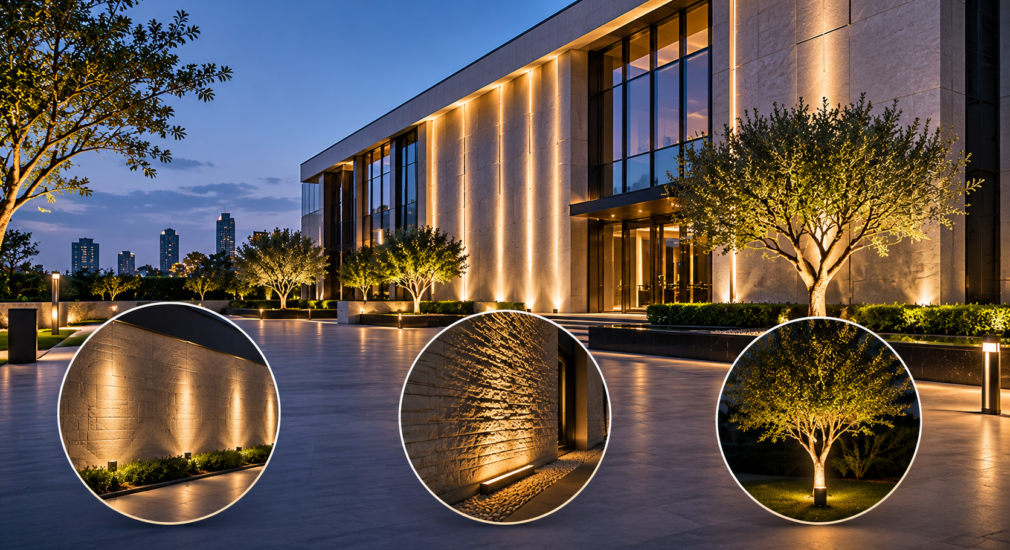
Wall grazing mounts fixtures close to the base or soffit of a wall, directing a tight, narrow beam nearly parallel to the surface. As light skims across the material at a steep angle, every groove, joint, and texture creates crisp shadow contrast.
-
Best suited for: Natural limestone, travertine, split-face stone cladding, fluted architectural panels, and textured brickwork.
-
Key benefit: Adds dramatic three-dimensional depth and highlights the natural character of high-end facade finishes.
-
What to watch out for: Avoid grazing on uneven plaster or poorly finished render—the grazing angle will amplify every surface imperfection.
3. Recessed Linear Ground Uplights: For Columns, Arches, and Tall Entryways
Recessed linear ground uplights sit flush inside walkways, podium decks, planter edges, or coping ledges, projecting light upward along columns, mashrabiya screens, arches, and double-height entrances.
-
Best suited for: Hotel drop-offs, commercial lobbies, colonnades, mosques, and modern villas where visible fixture housings would disrupt clean daytime sightlines.
-
Key benefit: Keeps the architectural envelope completely uncluttered by day while delivering strong vertical lift after dark.
-
Technical must-haves: Specify IP67 ingress protection, high impact and drive-over ratings (IK08–IK10) for pedestrian and podium zones, and internal honeycomb louvers or asymmetric optics to prevent upward glare.
Quick Comparison: Choosing the Right Facade Lighting Technique
| Lighting Technique | Ideal Facade Surface | Mounting Position | Visual Effect |
|---|---|---|---|
| Wall Washing | Smooth concrete, plaster, flat GRC panels | Set back from the wall (podium, canopy, or pole) | Even, soft, uniform brightness |
| Wall Grazing | Textured stone, travertine, fluted panels | Close to the wall base or upper soffit | High-contrast depth and tactile shadow detail |
| Linear Ground Uplights | Columns, arches, tall entry facades | Recessed flush into ground or ledge | Clean daytime look with strong vertical lift |
4 Key Specification Checks for UAE & GCC Climate Conditions
Designing Facade Lights in the UAE and across the GCC region requires stricter hardware standards than temperate climates due to intense summer heat, fine desert dust, and coastal salinity.
-
High Ambient Temperature Rating ($T_a$ up to $50^\circ\text{C}$): Standard outdoor fixtures often derate or fail early during peak summer months in Dubai, Abu Dhabi, Riyadh, and Doha. Ensure luminaires are engineered with heavy-duty die-cast aluminum heat sinks and drivers rated for continuous operation in high ambient temperatures.
-
Coastal & Dust Protection (IP66/IP67 + Marine-Grade Finish): Projects near coastal zones (such as Jumeirah, Saadiyat Island, or Jeddah Corniche) face salt-laden humidity alongside sandstorms. Look for IP66 or IP67 sealed optics, stainless steel 316 fasteners, and marine-grade anti-corrosion powder coating.
-
Beam Angle & Surface Reflectance Mockups: Always run an on-site night mockup before locking quantities. Light-colored limestone and white render reflect significantly more light than dark basalt or bronze cladding, which directly impacts required wattage and beam angles ($10^\circ$, $24^\circ$, or asymmetric $15^\circ \times 45^\circ$).
-
Glare Control & Dark-Sky Compliance: Municipal guidelines and green building codes (such as Estidama and Al Sa’fat) place strict limits on upward light spill and disability glare. Use cowls, baffles, and precision optics to keep light focused strictly on the facade plane.
Frequently Asked Questions (FAQ)
1. What is the difference between wall washing and wall grazing on a building facade? Wall washing places lights further away from the wall with a wide beam to create an even, smooth glow that hides surface flaws. Wall grazing places narrow-beam lights very close to the wall so the light skims across the surface, emphasizing textures like stone, brick, or fluted cladding.
2. Which IP rating is best for exterior facade lights in the UAE and GCC? For surface-mounted wall washers and floodlights exposed to dust storms and rain, IP66 is the minimum recommended rating. For recessed ground uplights installed in walkways, planters, or podiums where water pooling or irrigation occurs, IP67 is essential.
3. What color temperature works best for architectural facade lighting? Warm white (2700K to 3000K) works best for natural stone, travertine, wood accents, and hospitality or residential facades. Neutral white (4000K) is typically preferred for modern glass, aluminum, and minimalist concrete commercial buildings.
4. How do you prevent glare from ground-recessed facade uplights? To eliminate harsh glare for pedestrians and drivers, specify recessed linear uplights with asymmetric optical lenses, recessed LED chips, and internal honeycomb louvers or anti-glare baffles that shield the light source from direct view.
5. Why do outdoor LED facade lights fail early in high-temperature climates? Premature failure usually comes from inadequate thermal dissipation, low-grade drivers not rated for $50^\circ\text{C}$ ambient heat, poor moisture sealing at cable glands, or lack of surge protection (minimum 4kV–10kV). Specifying architectural-grade housings and properly rated drivers prevents early lumen depreciation.
Bringing Your Facade Vision to Life
Selecting the right exterior facade lighting comes down to matching the optical beam to your building’s surface—using wall washing for clean uniformity, wall grazing for rich stone and cladding texture, and recessed linear uplights for dramatic vertical lift—while ensuring every fixture is engineered to withstand extreme heat, dust, and coastal humidity.
Planning an architectural lighting project in the UAE, GCC, or beyond? Explore our end-to-end Facade Lighting Design solutions to get tailored optical layouts, luminaire specifications, and technical support for your next building facade.
Related posts
20 Nov 2026
How to Light Outdoor Building Signage: Best Fixtures, Beam Angles & UAE Specs
An architectural sign is often the first visual touchpoint for visitors, customers, and tenants approaching a commercial tower, hotel, retail…
29 Oct 2026
Custom Signage for UAE Projects: Design, Materials and Applications
Custom signage in UAE projects plays an important role in architectural identity, brand visibility and customer experience. From luxury hotels…
27 Oct 2026
Directional vs Directory Signage: Key Differences, Uses and Design Tips
Directional vs directory signage is an important distinction when planning an effective wayfinding system for commercial buildings, offices, hotels, hospitals…
27 Oct 2026
LED Video Walls: Types, Applications and Design Guide
LED video walls have become an important part of modern commercial environments, from shopping malls and hotels to corporate offices,…
26 Oct 2026
Monument vs Pylon Signs: Which Is Better for Commercial Projects?
Outdoor signage plays an important role in helping businesses establish visibility, guide visitors and create a professional identity. For shopping…
subscribe for newsletter

Luzion is a leading manufacturer and exporter of high-quality LED lighting solutions. With a focus on design, research, and innovation, we offer a wide range of products for commercial, industrial, residential, and outdoor spaces.
