

Search
Category
- Bollard Light
- Commercial Lighting
- Energy-Efficient Lighting
- LAMPS
- LED Lights
- LED Uplighter
- Light and Colour Theory
- Lighting Design and Facade Lighting
- Lighting Design Consultancy UAE
- lighting design principles
- Lighting Fundamentals and Design Principles
- Lighting Solutions
- Nature of Light in Lighting Design
- Panel Lights vs. Spot Lights
- Portable Lights
- Signage Solutions
- Smart Controllers for Streetlights
- Solar Lights
- Tree Lighter
- Uncategorized
Recent Posts
Neon vs LED Neon: Which Is Better for Signage?




Tags
- Architectural Lighting
- Architectural Lighting Design
- Architectural Lighting Design UAE
- automation
- Best Lighting Design Consultancy in UAE
- COB LED Technology
- COB Spotlights
- Color Temperature in Lighting
- Commercial Lighting Design
- Commercial Lighting Fixtures
- Commercial Lighting Innovations
- Commercial Lighting UAE
- Cylinder COB Lights
- Dialux Lighting Design
- Dialux Lighting Design UAE
- Energy Efficient Lighting
- Energy-Efficient Lighting USA
- Exterior Lighting Solutions
- Facade & Exterior Lighting
- Facade Lighting
- Facade Lighting Design
- Facade Lighting Design UAE
- Facade lighting ideas
- Facade Lighting UAE
- Facade Uplighting
- Green Building Design
- Indoor & Exterior Lighting Solutions
- Interior Lighting Design
- Lamps
- LED Lighting Solutions
- LED lights
- LED Panel
- LED Uplighters
- LED vs Halogen
- Light and Color Theory
- Lighting Basics
- Lighting Consultancy UAE
- Lighting Design
- Lighting Design Consultancy in UAE
- Lighting Design Principles
- Lighting Design UAE
- Lighting Fundamentals Guide
- Lighting Layers
- Lumen Output in Lighting
- Modern Building Lighting Ideas
- Modern Lighting Ideas
- Office Lighting Solutions
- Outdoor Lighting Consultants UAE
- Panel Lights vs. Spot Lights
- Portable Lights
- smart light
- Smart Lighting Systems
- Sustainable Architecture
- Sustainable Lighting UAE
- Villa Lighting UAE
26Oct 2026
- Signage Solutions


Monument vs Pylon Signs: Which Is Better for Commercial Projects?
Outdoor signage plays an important role in helping businesses establish visibility, guide visitors and create a professional identity. For shopping centres, commercial buildings, hotels, business parks and mixed-use developments, choosing the right freestanding sign can influence both visibility and the overall appearance of a property.
Two common options are monument signs and pylon signs. Although both are used for outdoor identification and branding, they differ in height, structure, viewing distance, placement and architectural impact.
Understanding the difference between monument vs pylon signs helps architects, developers, signage contractors and property managers select a solution that suits their project’s requirements.
What Are Monument Signs?
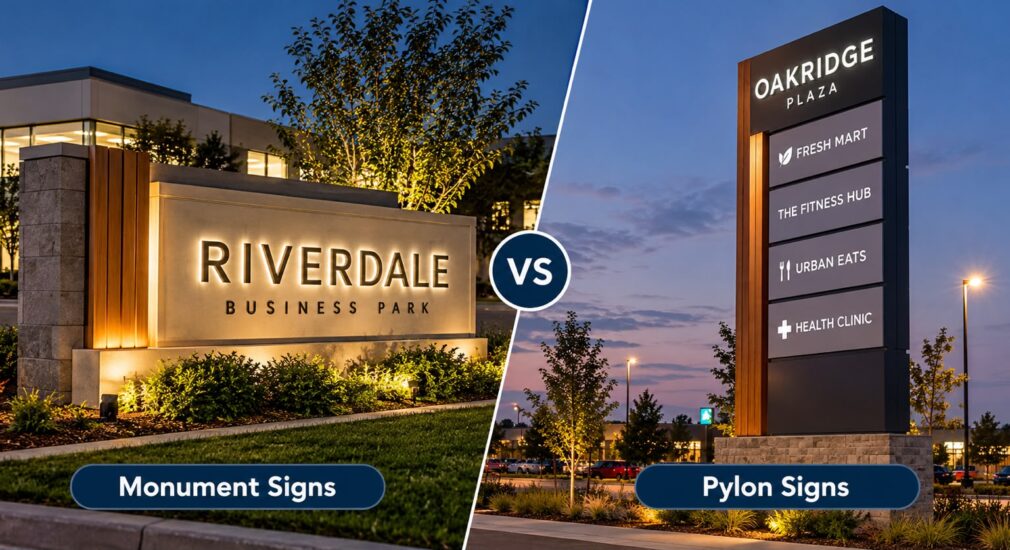
Monument signs are freestanding outdoor signs positioned relatively close to the ground. They typically feature a solid, substantial base constructed from materials such as metal, stone, concrete, aluminium or architectural cladding.
These signs are commonly installed near property entrances, hotel driveways, residential communities, office complexes and institutional buildings. Their low-profile design allows them to integrate with the surrounding landscape and architecture.
Common applications of monument signs include:
- Hotel and resort entrances
- Residential communities and gated developments
- Corporate offices and business parks
- Hospitals, schools and universities
- Shopping centres and commercial properties
Monument signage can incorporate dimensional lettering, illuminated logos, directional information and LED lighting. The final design depends on the project’s branding requirements, architectural style and local signage regulations.
For premium developments, custom monument signs can combine durable finishes, carefully designed typography and concealed illumination to create a distinctive entrance feature.
What Are Pylon Signs?
Pylon signs are freestanding signs supported by a tall pole, structural frame or engineered support system. Their elevated position makes them suitable for locations where businesses need to attract attention from roads, highways or large parking areas.
They are frequently used for shopping malls, retail centres, fuel stations, commercial developments and multi-tenant business properties.
Common applications of pylon signs include:
- Shopping malls and retail destinations
- Highway-facing commercial properties
- Fuel stations and service centres
- Business parks and industrial estates
- Multi-tenant commercial complexes
Pylon signage can display a single brand or multiple tenant names within one structure. Depending on the design, it may feature illuminated panels, LED displays, individual letters or internally illuminated sign faces.
Because pylon signs are often taller and more exposed to wind, their structural design, foundations, materials and installation require appropriate engineering assessment.
Monument vs Pylon Signs: Key Differences
Although both sign types identify businesses and properties, their practical functions are different.
| Feature | Monument Signs | Pylon Signs |
|---|---|---|
| Height | Generally low-profile | Generally tall and elevated |
| Structure | Solid base or architectural enclosure | Pole, frame or engineered support |
| Visibility | Primarily approaching visitors and nearby traffic | Greater visibility from a distance |
| Typical location | Property entrances and pedestrian approaches | Roadside locations and large commercial sites |
| Design character | Architectural and landscape-integrated | Prominent and visibility-focused |
| Branding | Property identity and entrance branding | Business identity and multi-tenant branding |
| Illumination | Halo-lit letters, LED panels or concealed lighting | Illuminated sign faces, LED letters or digital displays |
| Space requirements | Requires suitable ground-level frontage | Requires suitable clearance, structural support and site space |
| Typical applications | Hotels, residences and corporate campuses | Malls, retail centres and highway-facing developments |
The most suitable option depends on the property’s location, viewing distance, traffic conditions, branding objectives and planning requirements.
Which Sign Is Better for Your Project?
Choose Monument Signs for Architectural Integration
Monument signs are a strong choice when the entrance experience and architectural appearance are priorities. Their lower height allows them to complement landscape features, boundary walls, entrance gates and building materials.
Hotels, luxury residential communities, corporate campuses and healthcare facilities may benefit from monument signage that provides clear identification without dominating the surrounding architecture.
For these projects, consider material quality, letter proportions, illumination levels, landscaping coordination and visibility from approaching vehicles.
Choose Pylon Signs for Long-Distance Visibility
Pylon signs are often more suitable when a business needs to be identified from a major road or across a large commercial site.
Shopping centres, retail parks and multi-tenant developments can use elevated signage to display brand names before visitors reach the entrance.
The design should account for viewing distance, traffic speed, sign dimensions, mounting height and the number of businesses represented. Illumination and contrast should support legibility without creating excessive glare.
Consider Both for Large Developments
Some commercial projects benefit from using both monument and pylon signage.
For example, a retail destination in Dubai could use a pylon sign near the main access road to establish visibility, followed by a monument sign at the entrance to reinforce the property’s identity.
Similarly, a business park in Riyadh or a hospitality development in Doha may combine roadside identification with lower-level directional signage.
A coordinated signage strategy helps maintain consistent branding while serving different visitor needs.
Illuminated Monument and Pylon Signage
Illumination can improve the visibility of outdoor signs during evening hours and support consistent brand presentation. However, the lighting approach should suit the sign’s construction, environment and intended viewing distance.
Common options include:
- Front-lit signage: Light illuminates the face of individual letters or sign panels.
- Backlit or halo-lit lettering: Light creates a controlled glow behind dimensional letters.
- Internally illuminated signs: LEDs illuminate translucent sign faces from within.
- External architectural lighting: Dedicated luminaires illuminate sign structures or surrounding features.
For UAE and GCC projects, specify materials, electrical components and finishes suitable for the installation environment. High temperatures, dust, humidity and coastal exposure can affect product selection and maintenance requirements.
Consider appropriate ingress protection, corrosion resistance, thermal management, access for servicing and energy-efficient LED systems. The correct specification will depend on the site’s actual exposure conditions.
Design and Installation Considerations in UAE & GCC
Monument and pylon signs should be developed around site conditions rather than selected on appearance alone.
Location and visibility: Assess approach routes, vehicle speeds, sightlines, surrounding buildings and landscape obstructions.
Structural requirements: Pylon signs may require detailed wind-load calculations, foundation design and structural approvals. Monument signs also need suitable foundations and stable construction.
Materials and finishes: Select finishes based on the climate, expected service life, maintenance access and architectural context.
Lighting and electrical safety: Choose suitable LED modules, drivers, optical arrangements and weather protection. Plan access for inspection and replacement.
Permits and regulations: Confirm local authority requirements, permitted dimensions, placement, illumination and structural approvals before fabrication. Requirements can differ between Dubai, Abu Dhabi, Sharjah, Riyadh, Jeddah, Doha, Muscat, Kuwait City and Manama.
Branding and wayfinding: Ensure that the sign communicates the correct information clearly and aligns with the wider signage system.
Early coordination between architects, developers, MEP consultants, structural engineers and signage contractors can help reduce installation conflicts and avoid costly redesigns.
Custom Monument and Pylon Signage Solutions
Custom signage should reflect the project’s identity while meeting practical requirements for visibility, durability and maintenance.
Design options may include architectural metal cladding, dimensional lettering, illuminated logos, integrated LED lighting and multi-tenant information panels. The appropriate combination depends on the application and the required visual effect.
For commercial developments across the UAE and GCC, a project-specific approach helps align signage design with the building’s architecture, site conditions and branding standards.
Explore Luzion’s signage solutions to learn more about signage options for commercial and architectural projects. For related requirements, consider linking to the relevant illuminated signage, outdoor signage and custom signage content on your website.
Frequently Asked Questions
1. What is the main difference between monument and pylon signs?
Monument signs are generally low-profile structures installed near ground level, while pylon signs are elevated on poles or structural supports to improve visibility from greater distances.
2. Are monument signs better than pylon signs?
Neither is universally better. Monument signs are often suitable for architectural entrances and property identification, while pylon signs are useful for roadside visibility and large commercial developments.
3. Can monument signs be illuminated?
Yes. Monument signs can incorporate front-lit lettering, halo-lit letters, internally illuminated panels or dedicated LED luminaires, depending on their design.
4. Are pylon signs suitable for shopping malls?
Yes. Pylon signs are commonly used by shopping malls and retail destinations because their elevated position can improve visibility from access roads and surrounding traffic routes.
5. Which materials are suitable for outdoor monument and pylon signs?
Aluminium, steel, architectural cladding and other exterior-grade materials may be suitable. Selection should consider structural requirements, corrosion resistance, climate exposure and maintenance needs.
6. Do monument and pylon signs require permits in the UAE?
Depending on the location, sign dimensions, installation method and local regulations, permits or approvals may be required. Confirm the applicable requirements with the relevant local authority before installation.
Conclusion
The choice between monument vs pylon signs depends on visibility, architectural integration, site conditions and signage objectives. Monument signs are ideal for entrance identification and landscape-integrated branding, while pylon signs provide elevated visibility for roadside locations and multi-tenant developments.
Luzion Lighting supports architectural and commercial projects with signage and lighting solutions designed to complement modern built environments. For architects, developers and commercial property owners across the UAE and GCC, a coordinated signage strategy can strengthen brand recognition, improve visitor navigation and enhance the overall visual appeal of a property.
Related posts
26 Oct 2026
Neon vs LED Neon: Which Is Better for Signage?
Choosing between traditional neon and LED neon depends on the desired appearance, energy consumption, installation requirements and long-term maintenance. Both…
24 Oct 2026
Digital Signage in UAE & GCC: Types, Applications and Design Guide
Digital signage has become an important part of how businesses communicate with customers, visitors and employees. From retail displays and…
24 Oct 2026
Wayfinding Signage in UAE & GCC: A Complete Design Guide
Wayfinding signage helps people navigate buildings, public spaces and large commercial developments without confusion. From hospital departments and hotel reception…
24 Oct 2026
Front-Lit vs Backlit vs Halo-Lit Signage: Which Is Best for Your Project?
Choosing the right illumination style can transform the appearance of a business sign. Whether it is a retail storefront in…
23 Oct 2026
Outdoor Signage in UAE: Types, Materials and Design Guide
Outdoor signage is an essential part of commercial architecture, helping businesses establish visibility, communicate their identity and guide visitors. In…
subscribe for newsletter

Luzion is a leading manufacturer and exporter of high-quality LED lighting solutions. With a focus on design, research, and innovation, we offer a wide range of products for commercial, industrial, residential, and outdoor spaces.
