

Search
Category
- Bollard Light
- Commercial Lighting
- Energy-Efficient Lighting
- LAMPS
- LED Lights
- LED Uplighter
- Light and Colour Theory
- Lighting Design and Facade Lighting
- Lighting Design Consultancy UAE
- lighting design principles
- Lighting Fundamentals and Design Principles
- Lighting Solutions
- Nature of Light in Lighting Design
- Panel Lights vs. Spot Lights
- Portable Lights
- Signage Solutions
- Smart Controllers for Streetlights
- Solar Lights
- Tree Lighter
- Uncategorized
Recent Posts



Commercial Signage Solutions UAE & GCC

Canadian Bespoke Lights
Tags
- Architectural Lighting
- Architectural Lighting Design
- Architectural Lighting Design UAE
- automation
- Best Lighting Design Consultancy in UAE
- COB LED Technology
- COB Spotlights
- Color Temperature in Lighting
- Commercial Lighting Design
- Commercial Lighting Fixtures
- Commercial Lighting Innovations
- Commercial Lighting UAE
- Cylinder COB Lights
- Dialux Lighting Design
- Dialux Lighting Design UAE
- Energy Efficient Lighting
- Energy-Efficient Lighting USA
- Exterior Lighting Solutions
- Facade & Exterior Lighting
- Facade Lighting
- Facade Lighting Design
- Facade Lighting Design UAE
- Facade lighting ideas
- Facade Lighting UAE
- Facade Uplighting
- Green Building Design
- Indoor & Exterior Lighting Solutions
- Interior Lighting Design
- Lamps
- LED Lighting Solutions
- LED lights
- LED Panel
- LED Uplighters
- LED vs Halogen
- Light and Color Theory
- Lighting Basics
- Lighting Consultancy UAE
- Lighting Design
- Lighting Design Consultancy in UAE
- Lighting Design Principles
- Lighting Design UAE
- Lighting Fundamentals Guide
- Lighting Layers
- Lumen Output in Lighting
- Modern Building Lighting Ideas
- Modern Lighting Ideas
- Office Lighting Solutions
- Outdoor Lighting Consultants UAE
- Panel Lights vs. Spot Lights
- Portable Lights
- smart light
- Smart Lighting Systems
- Sustainable Architecture
- Sustainable Lighting UAE
- Villa Lighting UAE
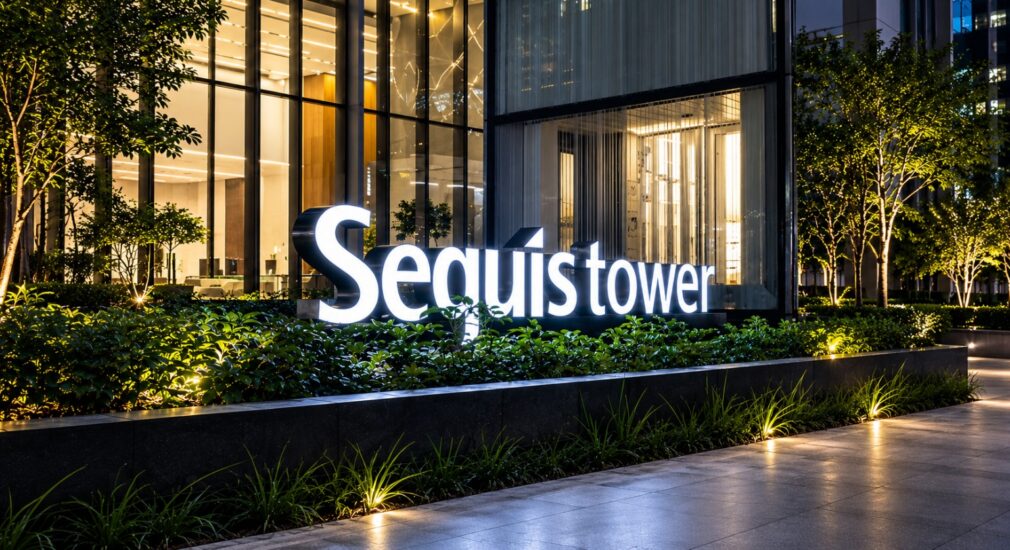
23Oct 2026
- Signage Solutions


Outdoor Signage in UAE: Types, Materials and Design Guide
Outdoor signage is an essential part of commercial architecture, helping businesses establish visibility, communicate their identity and guide visitors. In the UAE, outdoor signs must combine attractive design with reliable materials, effective illumination and resistance to demanding environmental conditions.
From illuminated shopfront signs in Dubai to corporate building identification in Abu Dhabi and hospitality signage in Sharjah, the right solution depends on the building design, viewing distance, installation location and intended application.
This guide explores the main types of outdoor signage in the UAE, commonly used materials, LED illumination options, technical specifications and important considerations for commercial signage projects across the GCC.
What Is Outdoor Signage?
Outdoor signage refers to signs installed outside buildings or within external environments to identify businesses, display brand names, promote services or provide directions. It includes illuminated signboards, 3D letters, building identification signs, freestanding structures, digital displays and directional signage.
Outdoor signage is commonly used across retail stores, shopping malls, hotels, restaurants, office buildings, residential developments, hospitals, industrial facilities and commercial properties.
For architectural projects, signage should complement the building façade, remain legible under different lighting conditions and use materials appropriate for the installation environment. Proper coordination between signage, exterior lighting and architectural finishes helps create a consistent visual identity.
Types of Outdoor Signage in UAE
Choosing the right outdoor sign depends on the project requirements, brand identity, available space and expected viewing distance. The following signage types are suitable for a wide range of commercial and architectural applications.
1. Illuminated Outdoor Signage
Illuminated outdoor signage uses artificial lighting to improve visibility during evening hours and in low-light conditions. It is commonly installed on retail storefronts, hotels, restaurants, corporate offices and shopping destinations.
Popular options include:
- Front-lit signage: Light passes through the front face of individual letters or sign panels.
- Halo-lit signage: Light projects behind the letters, creating a soft glow on the mounting surface.
- Backlit signage: Internal illumination passes through a translucent sign face.
- LED lightboxes: Enclosed sign systems featuring an illuminated graphic or brand name.
- Externally illuminated signs: LED floodlights or linear luminaires illuminate the sign from outside.
The illumination method should be selected according to the brand’s visual identity, ambient brightness, mounting surface and desired appearance. Correct LED positioning and diffusion help minimise hotspots, shadows and uneven illumination.
2. 3D Letter Signage
3D letter signage uses individually fabricated letters to create depth and a distinctive architectural appearance. It is suitable for hotel entrances, premium retail stores, office façades, restaurants and commercial developments.
Common materials include aluminium, stainless steel and acrylic. Depending on the design, letters can be supplied with a brushed metal finish, powder coating, polished surfaces or integrated LED illumination.
Front-lit and halo-lit options provide different visual effects. The appropriate letter depth, face material, fixing arrangement and lighting configuration should be determined before fabrication.
3. Outdoor LED Sign Boards
Outdoor LED sign boards combine sign panels or fabricated lettering with LED illumination to improve visibility and brand recognition. They are widely considered for shops, showrooms, commercial entrances and roadside business identification.
LED signboards can be designed in different shapes, sizes and finishes to suit the building’s architecture. Their performance depends on suitable LED modules, power supplies, thermal management, electrical protection and enclosure design.
For installations exposed to direct sunlight, the sign face should provide sufficient contrast and legibility. For illuminated signs, brightness and light distribution should also be evaluated under actual site conditions.
4. Pylon and Monument Signs
Pylon and monument signs are freestanding structures commonly installed near property entrances, access roads, business parks and commercial developments.
Pylon signs generally provide greater height and long-distance visibility, while monument signs have a lower profile and can be integrated with landscaping, stonework or architectural plinths.
These signs are useful for hotels, shopping centres, industrial estates, corporate campuses and residential communities. Their design should account for foundation requirements, wind loading, structural stability, visibility and applicable local approvals.
5. Outdoor Directional and Wayfinding Signage
Outdoor wayfinding signage helps visitors navigate large or complex properties. Applications include hospitals, hotels, shopping malls, office campuses, parking facilities and residential developments.
A coordinated system may include entrance signs, directional arrows, parking signs, building directories and pedestrian guidance.
Consistent typography, contrast, symbols and positioning improve readability. Sign placement should consider pedestrian movement, vehicle access, viewing angles and accessibility requirements.
6. Outdoor Digital Signage
Digital signage uses electronic displays to present changing information, promotions, announcements and advertising content. It is suitable for retail destinations, commercial properties, hospitality environments and selected public-facing applications.
Outdoor digital displays require careful attention to daylight visibility, heat dissipation, dust and water protection, electrical safety and maintenance access.
Before specifying a display, assess its operating environment, screen brightness, content management requirements, power consumption and applicable advertising permissions.
7. Outdoor Safety and Identification Signs
Safety and identification signage communicates essential information in commercial buildings, industrial facilities, parking areas and workplaces.
Examples include warning signs, restricted-access signs, building identification, parking instructions and directional information.
The required dimensions, symbols, reflectivity, illumination and placement depend on the application and relevant regulations. Safety signage should be designed for clarity and compliance rather than decorative appearance alone.
Best Materials for Outdoor Signage in UAE
The UAE’s environmental conditions make material selection an important part of outdoor signage design. High temperatures, intense sunlight, dust, humidity, wind and coastal exposure can affect the appearance and durability of signs.
Common materials include:
| Material | Common applications | Key considerations |
|---|---|---|
| Aluminium | Sign panels, letter returns and lightboxes | Lightweight, with corrosion resistance influenced by alloy and finish |
| Stainless steel | Premium lettering and corporate signage | Select the appropriate grade and finish for site exposure |
| Acrylic | Illuminated lettering and translucent sign faces | Consider UV stability, impact resistance and thermal movement |
| Aluminium composite panels | Sign faces and selected cladding applications | Verify panel grade, fire requirements and installation method |
| Powder-coated metal | Sign structures, panels and supports | Coating quality and surface preparation affect durability |
| Polycarbonate | Selected illuminated panels and protective covers | Assess UV resistance, impact performance and optical stability |
There is no single material suitable for every project. A coastal resort, an exposed roadside sign and a shaded commercial entrance may require different material specifications.
The complete signage assembly should also be considered. Fixings, sealants, electrical enclosures, cable entries and mounting brackets all contribute to long-term performance.
Technical Specifications for Outdoor LED Signage
Technical specifications should be established before fabrication to help ensure the sign is suitable for its intended environment.
| Parameter | What to specify | Purpose |
|---|---|---|
| IP rating | Appropriate protection for the complete installation | Helps manage dust and water exposure |
| Operating temperature | Manufacturer-declared operating range | Supports reliable performance under site conditions |
| LED colour | Required colour temperature or brand colour | Maintains visual consistency |
| Brightness | Suitable output for ambient light and viewing distance | Improves readability while controlling glare |
| Power supply | Correct electrical output, loading and protection | Supports safe and reliable operation |
| Materials and finish | UV stability and suitable corrosion resistance | Helps preserve appearance and durability |
| Thermal management | Appropriate heat dissipation for the enclosure | Reduces heat-related performance risks |
| Structural support | Suitable fixings, anchors and wind-load design | Supports installation stability |
| Maintenance access | Safe access to replaceable components | Simplifies inspection and servicing |
What IP Rating Is Suitable for Outdoor Signage?
The required IP rating depends on the installation location, exposure and component being protected. IP65 is commonly considered for equipment requiring dust protection and resistance to water jets, but it should not automatically be specified for every outdoor sign.
Exposed LED modules, power supplies and complete sign assemblies may have different protection ratings. Verify the relevant product documentation and installation requirements before approving the specification.
How Can Outdoor Signage Withstand UAE Heat?
Outdoor signage should be designed for the actual temperature and exposure conditions of the installation site.
Important considerations include UV-stable materials, appropriate LED operating-temperature ratings, thermal management, compatible sealants and protection for electrical connections. Enclosed illuminated signs should be evaluated for heat accumulation, while materials and fixings should accommodate thermal expansion.
Regular inspection and suitable maintenance access can also help identify damaged seals, loose fixings and deteriorating finishes before they affect performance.
Which LED Colour Temperature Is Best for Outdoor Signage?
The ideal colour temperature depends on the brand, architectural setting and desired visual effect. Warm white may suit hospitality environments and premium architectural applications, while neutral or cooler white may be appropriate for some contemporary retail and corporate settings.
For brand-specific colours, test the actual sign face with the selected LED system before final approval. RGB or RGBW illumination can be considered for dynamic effects where the application permits.
Outdoor Signage Design Considerations for UAE and GCC Projects
Effective outdoor signage combines visual communication, architectural coordination and practical engineering.
Visibility and viewing distance: Assess the distance from which the sign must be read, the viewing angle and whether the audience is walking or travelling by vehicle.
Daylight readability: Select suitable colours, contrast and surface finishes to maintain legibility under strong sunlight.
Night-time illumination: Check brightness, uniformity, glare and unwanted light spill into surrounding properties.
Architectural integration: Coordinate sign dimensions, finishes and mounting details with the façade materials and exterior lighting design.
Weather resistance: Evaluate sunlight, temperature, humidity, dust, rain, wind and coastal exposure at the project location.
Installation and maintenance: Plan cable routes, access panels, structural fixings and safe servicing arrangements before installation.
Local permissions: Confirm applicable signage, advertising, building and property requirements with the relevant authority before fabrication. Requirements can vary by emirate, municipality, development and sign type.
Dubai, Abu Dhabi and Sharjah projects should therefore be assessed according to their actual location and applicable approval process. Requirements should not be assumed to be identical throughout the UAE or across the GCC.
Outdoor Signage Applications Across the UAE
Outdoor signage serves a broad range of commercial and architectural projects throughout the Emirates.
- Dubai: Retail storefronts, hotels, shopping destinations, corporate buildings and mixed-use developments.
- Abu Dhabi: Office buildings, hospitality projects, institutional facilities and residential communities.
- Sharjah and Ajman: Retail premises, commercial buildings, industrial facilities and community entrances.
- Ras Al Khaimah and Fujairah: Resorts, hospitality developments, coastal properties and commercial destinations.
- Al Ain: Commercial premises, institutional buildings and hospitality projects.
Across the wider GCC, outdoor signage is also relevant to commercial developments in Riyadh and Jeddah in Saudi Arabia; Doha in Qatar; Muscat in Oman; Kuwait City in Kuwait; and Manama in Bahrain.
Each project should be specified according to its local environment, authority requirements, architectural design and installation conditions.
How to Choose the Right Outdoor Signage Solution
Before selecting an outdoor signage system, architects, developers, contractors and procurement teams should establish a clear project brief.
- Define the purpose: Determine whether the sign is for branding, identification, advertising, navigation or safety.
- Confirm the site conditions: Record mounting height, viewing distance, façade material, sunlight exposure and accessibility.
- Select the signage type: Compare 3D letters, lightboxes, sign panels, freestanding structures and digital displays.
- Choose suitable materials: Consider appearance, corrosion resistance, UV exposure, thermal movement and maintenance requirements.
- Specify illumination: Confirm brightness, colour, uniformity, power requirements and control options.
- Coordinate engineering: Review mounting details, wind loading, electrical provisions and maintenance access.
- Verify approvals: Confirm the relevant permissions before manufacturing or installation.
- Review documentation: Request dimensioned drawings, material specifications, electrical details and product documentation where applicable.
A structured design and procurement process helps reduce installation conflicts, avoidable revisions and long-term maintenance issues.
Why Custom Outdoor Signage Matters for Commercial Projects
Standard signage formats may not suit every building façade, brand identity or site constraint. Custom outdoor signage allows the dimensions, materials, typography, mounting system and illumination to be coordinated with the project’s architecture.
For hotels, premium retail destinations, corporate headquarters and mixed-use developments, custom fabrication can create a more cohesive relationship between brand communication and building design.
Illuminated letters, architectural sign panels, LED lightboxes and directional signs can be planned as part of a wider visual system. Where exterior lighting is also required, signage and façade illumination should be coordinated early to maintain visual consistency and control glare.
Luzion Lighting supports architectural lighting requirements for commercial and built-environment projects. For projects involving both outdoor signage and exterior LED lighting, early coordination can help align the signage concept with the wider lighting specification.
Planning an outdoor signage or architectural lighting project in the UAE or GCC? Prepare the project location, dimensions, drawings, mounting details and illumination requirements before requesting a technical review or quotation.
Frequently Asked Questions About Outdoor Signage in UAE
1. What are the most popular types of outdoor signage in the UAE?
Popular options include illuminated signboards, 3D letter signage, LED lightboxes, pylon signs, monument signs, digital displays, directional signs and building identification signs. The right choice depends on visibility, location, branding and installation requirements.
2. Which material is best for outdoor signage in Dubai?
Aluminium, stainless steel, acrylic and aluminium composite panels are common options. Material selection should account for UV exposure, temperature, humidity, corrosion risk, structural requirements and maintenance access.
3. Is LED illumination suitable for outdoor signage in the UAE?
Yes. LED illumination can provide effective visibility and energy-efficient operation when the system is correctly specified. Thermal management, suitable electrical protection, optical design and environmental protection are essential for reliable outdoor performance.
4. What IP rating should outdoor LED signage have?
The appropriate rating depends on the equipment, enclosure design and environmental exposure. IP65 may be suitable for some applications, but the complete installation should be evaluated against the manufacturer’s specifications and actual site conditions.
5. Do outdoor signs require approval in Dubai or Abu Dhabi?
Many outdoor advertising and building signage installations are subject to local permissions or property requirements. The process varies according to the sign type, location and relevant authority. Confirm current requirements before fabrication and installation.
6. Can outdoor signage be customised for hotels, malls and commercial buildings?
Yes. Custom signage can be tailored to building dimensions, corporate identity, material finishes, illumination and mounting requirements. Architectural coordination is particularly useful for hotels, retail destinations, commercial façades and mixed-use developments.
Final Considerations
Outdoor signage in the UAE requires a balance of visibility, architectural design, material durability and technical performance. Selecting the appropriate sign type, specifying suitable LED components and confirming local requirements before fabrication can help deliver a more reliable installation.
For architects, developers, contractors and procurement teams, a well-prepared signage brief provides a stronger basis for comparing solutions and coordinating signage with the wider commercial building design.
Related posts
21 Oct 2026
Channel Letter Signage in UAE: Types, Materials and Applications
Channel letter signage is widely used by retail stores, hotels, restaurants, shopping malls and commercial buildings to display business names,…
21 Oct 2026
3D Letter Signage in UAE: Materials, Finishes and Applications
In a competitive commercial environment, signage plays an important role in how customers recognise a brand, locate a business and…
21 Oct 2026
Types of Illuminated Signage: A Guide for UAE & GCC Projects
Illuminated signage plays an important role in how commercial buildings, hotels, retail developments and corporate spaces communicate their identity. In…
17 Oct 2026
Commercial Signage Solutions UAE & GCC
How to Choose Commercial Signage Solutions in the UAE & GCC Commercial signage plays an important role in how people…
02 Oct 2026
Canadian Bespoke Lights
Canadian Bespoke Lighting: Where Design Becomes a Signature Luxury architecture is rarely defined by one element alone. The character of…
subscribe for newsletter

Luzion is a leading manufacturer and exporter of high-quality LED lighting solutions. With a focus on design, research, and innovation, we offer a wide range of products for commercial, industrial, residential, and outdoor spaces.
