

Search
Category
- Bollard Light
- Commercial Lighting
- Energy-Efficient Lighting
- LAMPS
- LED Lights
- LED Uplighter
- Light and Colour Theory
- Lighting Design and Facade Lighting
- Lighting Design Consultancy UAE
- lighting design principles
- Lighting Fundamentals and Design Principles
- Lighting Solutions
- Nature of Light in Lighting Design
- Panel Lights vs. Spot Lights
- Portable Lights
- Signage Solutions
- Smart Controllers for Streetlights
- Solar Lights
- Tree Lighter
- Uncategorized
Recent Posts




Commercial Signage Solutions UAE & GCC

Canadian Bespoke Lights
Tags
- Architectural Lighting
- Architectural Lighting Design
- Architectural Lighting Design UAE
- automation
- Best Lighting Design Consultancy in UAE
- COB LED Technology
- COB Spotlights
- Color Temperature in Lighting
- Commercial Lighting Design
- Commercial Lighting Fixtures
- Commercial Lighting Innovations
- Commercial Lighting UAE
- Cylinder COB Lights
- Dialux Lighting Design
- Dialux Lighting Design UAE
- Energy Efficient Lighting
- Energy-Efficient Lighting USA
- Exterior Lighting Solutions
- Facade & Exterior Lighting
- Facade Lighting
- Facade Lighting Design
- Facade Lighting Design UAE
- Facade lighting ideas
- Facade Lighting UAE
- Facade Uplighting
- Green Building Design
- Indoor & Exterior Lighting Solutions
- Interior Lighting Design
- Lamps
- LED Lighting Solutions
- LED lights
- LED Panel
- LED Uplighters
- LED vs Halogen
- Light and Color Theory
- Lighting Basics
- Lighting Consultancy UAE
- Lighting Design
- Lighting Design Consultancy in UAE
- Lighting Design Principles
- Lighting Design UAE
- Lighting Fundamentals Guide
- Lighting Layers
- Lumen Output in Lighting
- Modern Building Lighting Ideas
- Modern Lighting Ideas
- Office Lighting Solutions
- Outdoor Lighting Consultants UAE
- Panel Lights vs. Spot Lights
- Portable Lights
- smart light
- Smart Lighting Systems
- Sustainable Architecture
- Sustainable Lighting UAE
- Villa Lighting UAE
31Aug 2026
- Signage Solutions


Airport Signage Solutions, Wayfinding & Passenger Navigation
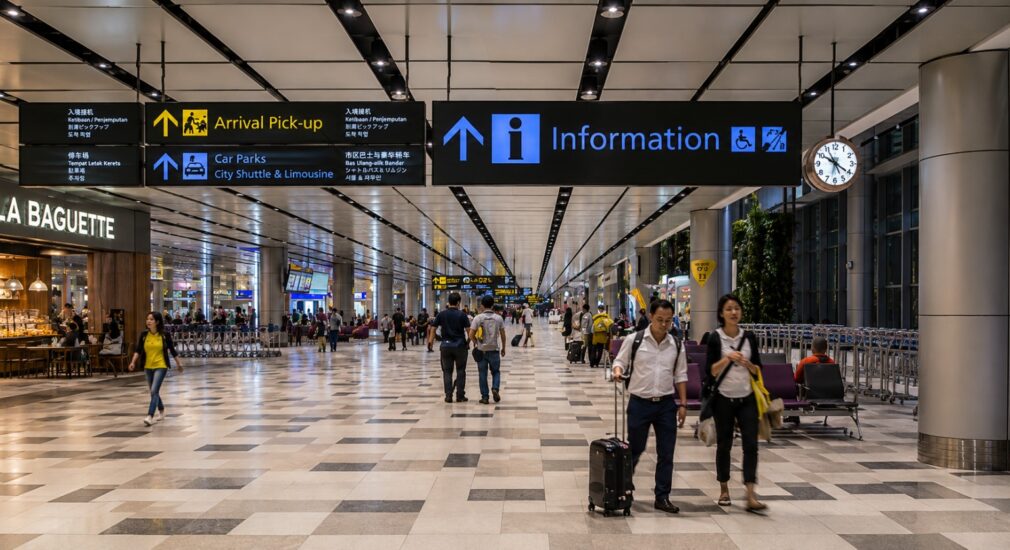
Airport Signage Solutions for Modern Aviation Facilities
Airport Signage Solutions help airports create clear, organised and intuitive environments for passengers, staff and visitors. A modern airport contains multiple terminals, entrances, check-in areas, security zones, boarding gates, baggage facilities, lounges, parking areas and transportation connections. As a result, passengers need clear information at every important stage of their journey.
A well-planned signage system connects these areas through a consistent visual language. It combines airport wayfinding signage, directional signs, terminal identification, passenger information, safety signage and architectural signage into one coordinated system.
Moreover, airport signage contributes to the overall architectural identity of a terminal. Sign proportions, typography, materials, colours, illumination and mounting methods can complement the surrounding architecture while maintaining excellent visibility.
For this reason, airport signage requires more than attractive graphics. It requires careful planning, technical coordination and reliable manufacturing.
Luzion develops customised architectural lighting and signage solutions for commercial and infrastructure environments. Our approach focuses on combining design quality, fabrication accuracy and appropriate illumination for project-specific requirements.
Airport Wayfinding Signage for Passenger Movement
Airport Wayfinding Signage plays a central role in passenger navigation. People arriving at an airport may have limited knowledge of the terminal layout. International travellers may also face language differences or unfamiliar symbols.
Therefore, a clear wayfinding system should answer three basic questions:
- Where am I?
- Where do I need to go?
- Which direction should I take?
A successful Airport Wayfinding System provides these answers at the right points throughout the passenger journey.
Typical wayfinding destinations include:
- Airport entrances
- Departure halls
- Arrival halls
- Check-in counters
- Baggage drop areas
- Security screening
- Immigration
- Customs
- Boarding gates
- Baggage reclaim
- Airport lounges
- Restrooms
- Parking areas
- Taxi and transport zones
- Car rental facilities
- Airport exits
In addition, signage can identify elevators, escalators, pedestrian routes and accessibility facilities.
The system should maintain a consistent hierarchy so passengers can recognise important information quickly. Arrows, symbols, typography and colour coding should work together rather than compete for attention.
Airport Directional Signage for Clear Navigation
Airport Directional Signage guides passengers through decision points where they need to choose a route. These decision points can occur inside terminals, along corridors, at intersections, near escalators and around transportation facilities.
For example, a passenger leaving the security area may need directions toward several boarding gates. Another passenger may need to find baggage reclaim or ground transportation after arrival. In both situations, the signage should provide concise information before the passenger reaches the next decision point.
Depending on the architectural environment, airports can use:
- Overhead directional signs
- Suspended airport signs
- Wall-mounted directional signs
- Freestanding wayfinding signs
- Pylon signs
- Monolith signs
- Corridor signs
- Floor-level guidance systems
- Parking directional signs
Each format serves a different visual and spatial requirement.
For instance, overhead signage can remain visible in large passenger halls, while wall-mounted signs can work effectively in corridors. Similarly, freestanding signs can provide information where walls or ceilings do not offer suitable mounting locations.
Airport Terminal Signage
Airport Terminal Signage identifies important buildings, halls, concourses and passenger areas. It helps passengers understand their location while also strengthening the visual identity of the airport.
Terminal signage may include:
- Terminal identification
- Concourse identification
- Arrival hall identification
- Departure hall identification
- Boarding area identification
- VIP area identification
- Passenger service identification
- Lounge identification
Large terminal identification signs can become architectural features when designers carefully integrate materials, typography and illumination.
Furthermore, the same visual language should continue across internal and external signage. This consistency allows passengers to recognise the airport’s navigation system from the approach road through to the boarding area.
Airport Signage Design Principles
Effective Airport Signage Design starts with the passenger journey rather than the sign itself. Architects, signage designers and airport consultants should first understand circulation patterns, viewing distances and decision points.
Several factors influence the final design.
Visibility
Passengers should recognise important signs from an appropriate distance. Designers therefore need to consider character size, sign dimensions, mounting height and viewing angles.
Legibility
Typography should remain easy to read in crowded environments. Clear letterforms, appropriate spacing and strong contrast can improve information recognition.
Consistency
Every sign should follow the approved airport graphic standards. Consistent arrows, symbols, colours and typography make the entire system easier to understand.
Placement
Signage should appear before a passenger reaches a navigation decision. Poor placement can create confusion even when the information itself remains correct.
Architectural Integration
Premium airport terminals require signage that complements the architecture. Materials, finishes and mounting details should therefore work with ceilings, walls, columns and interior finishes.
Illumination
Illuminated signs can improve visibility during night operations and in locations with changing ambient light. However, the lighting should remain controlled and avoid unnecessary glare.
Creating a Better Passenger Experience
An airport can contain impressive architecture, advanced technology and premium interiors. However, passengers still need straightforward information to move through the facility confidently.
That is why Airport Signage Solutions form an important part of the passenger experience.
Clear signage can reduce unnecessary hesitation, support smoother circulation and help passengers locate essential facilities. At the same time, a coordinated signage system can strengthen the airport’s architectural identity.
Consequently, airport signage should receive the same level of planning attention as other important architectural and operational elements.
Types of Airport Signage
Modern airports require different sign formats for different locations. A terminal entrance has different requirements from a baggage reclaim area, while an external roadway requires different construction from an interior corridor.
For that reason, Airport Signage Solutions can include multiple sign categories within one coordinated project.
Airport Identification Signs
Identification signs tell passengers exactly where they are. These signs can identify terminals, concourses, boarding areas, lounges, parking structures and other major facilities.
Large identification signs can use fabricated metal, acrylic, illuminated lettering or other architectural materials depending on the project requirements.
Clear identification becomes particularly important in large airport campuses where several terminals or buildings may serve different passenger groups.
Airport Gate Signage
Airport Gate Signage identifies individual boarding gates and associated passenger zones.
Gate signs may display:
- Gate numbers
- Concourse information
- Boarding zone information
- Directional arrows
- Passenger facility information
Overhead and suspended formats often work well in large concourses because passengers can see them above normal circulation levels.
Additionally, fixed gate identification can work alongside digital flight information displays. Fixed signage identifies the location, while digital systems communicate changing operational information.
Airport Baggage Claim Signage
Passengers arriving at an airport need immediate directions toward baggage reclaim and customs.
Airport Baggage Claim Signage can identify:
- Baggage reclaim
- Baggage belts
- Oversized baggage
- Lost baggage services
- Customs
- Terminal exits
- Ground transportation
Clear information helps passengers move from aircraft arrival areas toward the next stage of their journey.
Airport Information Signage
Airport Information Signs provide permanent information about facilities, services and passenger routes.
Applications can include:
- Airport directories
- Passenger service identification
- Lounge information
- Restroom identification
- Transportation information
- Facility directories
- Customer service locations
Where information changes frequently, digital displays can complement fixed signage.
Airport Safety and Regulatory Signage
Safety communication remains essential across passenger and operational areas.
Airport safety signage may identify:
- Emergency exits
- Fire equipment
- Restricted areas
- Staff-only zones
- Security areas
- Emergency routes
- Safety instructions
- Controlled-access locations
The design should follow the applicable airport standards and local requirements.
Accessibility and Tactile Signage
Modern airport environments should also consider passengers with different accessibility needs.
Accessible Airport Signage can incorporate tactile characters, raised information, pictograms and Braille where required by the project.
Applications may include:
- Accessible restrooms
- Elevators
- Assistance facilities
- Accessible routes
- Passenger services
- Emergency information
Requirements vary between countries and airport authorities. Therefore, the final design should follow the approved project standards and applicable regulations.
Illuminated Airport Signage
Illuminated Airport Signage combines functional communication with architectural lighting.
LED illumination can support:
- Terminal identification
- Directional signs
- Entrance signs
- Pylon signage
- Architectural lettering
- Light box signage
- Passenger information signs
Internal LED modules, backlighting and edge lighting can create different visual effects.
The lighting design should provide consistent illumination across the sign surface. In addition, designers should consider brightness, diffusion, energy consumption, maintenance access and the surrounding ambient light.
For premium airport environments, controlled illumination can help signage remain visible while maintaining a refined architectural appearance.
LED Airport Signage
LED Airport Signage offers an efficient approach for projects that require illuminated communication.
LED systems can support backlit panels, internally illuminated boxes, illuminated letters and directional signage.
The final construction should consider:
- LED positioning
- Heat management
- Diffusion
- Power requirements
- Service access
- Sign depth
- Environmental conditions
- Required illumination levels
For outdoor applications, the complete assembly should suit the installation environment.
Airport Digital Signage
Airport Digital Signage supports information that may change throughout the day.
Typical applications include:
- Flight information
- Gate changes
- Boarding updates
- Passenger announcements
- Airport directories
- Transportation information
- Retail information
- Interactive wayfinding
Digital signage does not necessarily replace conventional signage. Instead, both systems can work together.
Fixed signs can communicate permanent destinations, while digital screens can communicate dynamic information.
Airport Parking and Roadway Signage
The passenger journey begins before entering the terminal. Drivers may need directions toward parking, drop-off areas, pick-up zones, taxi stands, rental cars and public transportation.
Airport Parking Signage and roadway signs should therefore form part of the wider wayfinding strategy.
External signage requires careful consideration of:
- Long viewing distances
- Vehicle speed
- Daylight visibility
- Night-time visibility
- Weather exposure
- Sign height
- Mounting structure
- Traffic circulation
A connected system helps passengers transition smoothly from airport roads to parking areas and terminal entrances.
Materials for Airport Signage
Material selection depends on location, design intent and environmental exposure.
Potential materials include:
- Aluminium
- Stainless steel
- Acrylic
- Polycarbonate
- Fabricated metal
- Powder-coated metal
- Anodised aluminium
- Specialised graphic surfaces
Interior signage can prioritise refined finishes and lightweight construction. Conversely, exterior signage may require stronger weather resistance and durable finishes.
The final specification should balance appearance, durability, maintenance and project requirements.
Airport Signage Mounting Systems
Mounting arrangements influence both visibility and architectural integration.
Common options include:
- Ceiling suspension
- Wall mounting
- Surface mounting
- Projecting signs
- Freestanding structures
- Pole-mounted signs
- Pylon structures
- Architectural integration
Early coordination helps avoid conflicts with ceilings, electrical systems, structural elements and interior finishes.
As a result, signage should form part of the design coordination process rather than remain a late-stage installation item.
Custom Airport Signage Manufacturing
Every airport has its own architectural identity, passenger flow and technical requirements. Therefore, Custom Airport Signage often provides better results than generic signage products.
Custom manufacturing allows project teams to define:
- Sign dimensions
- Materials
- Finishes
- Colours
- Typography
- Graphics
- Illumination
- Mounting methods
- Branding
- Accessibility features
A manufacturer can develop these elements according to approved drawings and project specifications.
Moreover, custom fabrication allows multiple sign types to maintain a consistent visual language throughout a large airport development.
Airport Signage Fabrication
Airport Signage Fabrication requires accuracy because passengers encounter signs at close and distant viewing points throughout the facility.
Fabrication processes may include:
- Metal cutting
- CNC machining
- Laser cutting
- Sheet metal forming
- Acrylic fabrication
- Letter fabrication
- Surface finishing
- Powder coating
- Graphic application
- LED integration
- Final assembly
Each production stage can influence the appearance and durability of the finished product.
For large signs, modular construction can simplify transportation and installation. Manufacturers can divide larger assemblies into manageable sections and assemble them at the project site.
Airport Signage Prototyping
A prototype or sample can help project teams verify the final appearance before mass production.
The review may cover:
- Dimensions
- Material
- Finish
- Typography
- Graphics
- Colour
- Illumination
- Mounting details
- Overall appearance
This stage can reduce the risk of producing large quantities before the design receives final approval.
Airport Signage Quality Control
Quality control should continue throughout the manufacturing process.
Before dispatch, the manufacturer can inspect:
- Dimensions
- Surface finishes
- Graphic accuracy
- Assembly
- Illumination
- Mounting components
- Electrical connections
- Packaging condition
For illuminated signs, the team can also verify LED operation and light distribution.
Consequently, pre-dispatch inspection helps reduce avoidable issues during site installation.
Airport Signage Project Coordination
Large airport developments involve architects, developers, airport authorities, consultants, contractors and procurement teams.
Each stakeholder has different priorities.
Architects focus on visual integration. Interior designers consider material and spatial relationships. Lighting designers evaluate illumination. MEP consultants coordinate electrical requirements. Contractors manage site installation. Procurement teams evaluate specifications, production schedules and delivery.
An experienced Airport Signage Manufacturer can help connect these requirements during the manufacturing process.
A typical workflow can include:
- Project requirement review
- Drawing and signage schedule review
- Material selection
- Technical development
- Sample or prototype approval
- Manufacturing
- Quality inspection
- Packaging
- Logistics coordination
- Installation support
This structured approach helps maintain consistency between approved designs and finished signage.
Airport Signage Solutions Worldwide
Luzion can position its Airport Signage Solutions for projects across India, the UAE, GCC, Middle East, USA, UK, Europe, Asia and Africa.
Each market has different architectural, environmental and regulatory conditions. Therefore, the final signage specification should always reflect the requirements of the individual project.
Airport Signage Solutions in India
India continues to develop airports and aviation infrastructure across major metropolitan and regional markets.
Airport Signage Solutions India can support terminal identification, passenger wayfinding, directional signage, illuminated signs, parking guidance and architectural signage.
Key locations include:
- Delhi
- Mumbai
- Bengaluru
- Hyderabad
- Chennai
- Kolkata
- Ahmedabad
- Pune
- Kochi
- Goa
- Jaipur
- Lucknow
- Surat
- Vadodara
Luzion’s manufacturing base in Ahmedabad, Gujarat provides a strong foundation for customised production and international project supply.
Airport Signage Solutions in UAE
The UAE represents an important market for premium aviation infrastructure and architectural environments.
Airport Signage Solutions UAE can cover:
- Dubai
- Abu Dhabi
- Sharjah
- Ras Al Khaimah
- Fujairah
- Al Ain
- Ajman
Airport Signage Solutions Dubai
Dubai’s aviation environment includes major international passenger facilities and supporting transportation infrastructure. Airport Signage Solutions Dubai can target terminal wayfinding, directional signage, illuminated architectural signage and passenger information applications.
Airport Signage Solutions Abu Dhabi
Airport Signage Solutions Abu Dhabi can support terminal identification, passenger navigation, illuminated signs, transportation areas and other aviation facilities.
Airport Signage Solutions in Saudi Arabia
Saudi Arabia offers significant opportunities across established airports and emerging aviation developments.
Airport Signage Solutions Saudi Arabia can support projects in:
- Riyadh
- Jeddah
- Dammam
- Medina
- Mecca
- Abha
- Tabuk
- NEOM
The growing infrastructure environment creates demand for durable, visually coordinated and customised airport signage systems.
Airport Signage Solutions Across GCC
Luzion can also target airport projects across the wider GCC.
Airport Signage Solutions in Qatar
Airport Signage Solutions Qatar can support airport wayfinding, terminal signage, illuminated signs and passenger information applications in Doha and other locations.
Airport Signage Solutions in Kuwait
Airport Signage Solutions Kuwait can cover terminal identification, directional systems, parking guidance and architectural signage.
Airport Signage Solutions in Oman
Airport Signage Solutions Oman can support airport facilities in Muscat and other aviation markets.
Airport Signage Solutions in Bahrain
Airport Signage Solutions Bahrain can address passenger navigation, terminal identification and illuminated signage requirements around Manama and other locations.
Together, these markets create a strong regional opportunity for customised airport signage manufacturing.
Airport Signage Solutions in the USA
The USA has a large network of international, domestic and regional airports.
Airport Signage Solutions USA can target:
- New York
- Los Angeles
- San Francisco
- Chicago
- Dallas
- Houston
- Miami
- Atlanta
- Seattle
- Boston
- Phoenix
- Las Vegas
- Washington, DC
Projects may require directional signage, accessibility systems, terminal identification, illuminated signs and custom architectural signage.
All US projects should follow the specific airport, authority and jurisdictional requirements applicable to the installation.
Airport Signage Solutions in the UK
Airport Signage Solutions UK can target major aviation markets including:
- London
- Manchester
- Birmingham
- Edinburgh
- Glasgow
- Bristol
- Leeds
- Liverpool
- Belfast
- Cardiff
- Newcastle
Applications can include airport wayfinding, terminal identification, directional signage, illuminated signage and passenger information systems.
Airport Signage Solutions in Europe
Europe provides opportunities across established aviation markets.
Priority locations include:
Germany: Berlin, Frankfurt, Munich, Hamburg
France: Paris, Lyon, Marseille, Nice
Italy: Rome, Milan, Venice, Florence
Spain: Madrid, Barcelona, Valencia, Malaga
Netherlands: Amsterdam, Rotterdam
Switzerland: Zurich, Geneva
Austria: Vienna
Belgium: Brussels
Portugal: Lisbon, Porto
Ireland: Dublin
Poland: Warsaw, Krakow
A project-specific approach can accommodate different architectural styles, materials and technical requirements across European markets.
Airport Signage Solutions in Asia
Asia represents another major aviation market.
Luzion can target airport signage opportunities across:
- Singapore
- Malaysia
- Thailand
- Indonesia
- Philippines
- Vietnam
- Japan
- South Korea
- China
- Australia
- New Zealand
Major cities include Singapore, Kuala Lumpur, Bangkok, Jakarta, Manila, Ho Chi Minh City, Tokyo, Seoul, Shanghai, Beijing, Sydney, Melbourne and Auckland.
Airport Signage Solutions in Africa
African aviation infrastructure also creates opportunities for customised signage systems.
Priority markets include:
- South Africa
- Egypt
- Nigeria
- Kenya
- Morocco
- Ghana
- Tanzania
- Ethiopia
- Rwanda
Major cities include Johannesburg, Cape Town, Cairo, Lagos, Abuja, Nairobi, Casablanca, Accra, Dar es Salaam, Addis Ababa and Kigali.
Airport Signage Applications
Airport signage supports multiple passenger and operational environments. Each area requires information that matches its function, traffic pattern and architectural conditions.
Airport Entrances
Entrance signage provides immediate identification and helps passengers understand the building they are entering.
Large architectural lettering, illuminated identification signs and directional information can create a strong first impression.
Departure Areas
Departure signage can guide passengers toward check-in, baggage drop, security, immigration and boarding areas.
Clear hierarchy becomes particularly important during peak travel periods when passenger volumes increase.
Arrival Areas
Arrival signage directs passengers toward baggage reclaim, customs, exits and ground transportation.
A connected signage system can make the transition from aircraft arrival to terminal exit easier to understand.
Check-In Areas
Check-in halls require clear identification of counters, airlines, baggage drop zones and passenger services.
Signage should remain visible within busy spaces and work alongside digital information systems.
Security and Immigration
Security and immigration areas require clear directions and operational information.
The signage should communicate instructions without creating unnecessary visual complexity.
Boarding Gates
Gate signage helps passengers locate their assigned boarding area.
Overhead, suspended and wall-mounted formats can provide visibility across different terminal layouts.
Baggage Reclaim
Baggage reclaim signage directs passengers toward belts, customs, lost baggage services and exits.
Clear information can reduce confusion in large arrival halls.
Airport Parking
Parking signage guides drivers toward car parks, exits, pedestrian connections and terminal access.
External signs should account for viewing distance, traffic movement and night-time visibility.
Ground Transportation
Airport transportation areas can include taxis, buses, trains, metro connections, shuttles and rental vehicles.
A coordinated directional system helps passengers identify each transport option quickly.
Airport Signage for Architects and Designers
Architects often want signage to complement the building’s visual language.
Therefore, Airport Signage Design should consider architectural materials, ceiling systems, wall finishes, interior lighting and circulation patterns.
Interior designers can coordinate sign finishes with surrounding materials. Lighting designers can integrate illuminated signage with architectural lighting. At the same time, signage manufacturers can develop mounting and fabrication details that support the approved design.
This collaborative approach can create a more refined and consistent airport environment.
Airport Signage for Developers and Contractors
Developers and contractors require signage that meets project specifications while supporting practical installation and long-term maintenance.
Important considerations include:
- Fabrication accuracy
- Material quality
- Finish consistency
- Illumination performance
- Mounting details
- Packaging
- Delivery schedules
- Installation coordination
- Maintenance access
- Project documentation
A capable manufacturing partner can support these requirements from design development through production and delivery.
Why Choose a Custom Airport Signage Manufacturer?
Standard signage may not always suit a unique airport architecture or project identity.
A Custom Airport Signage Manufacturer can develop signage around the exact requirements of the airport, architect, consultant or contractor.
Customisation can include:
- Bespoke dimensions
- Custom finishes
- Airport branding
- Illuminated graphics
- LED integration
- Special mounting systems
- Multilingual information
- Accessibility features
- Indoor signage
- Outdoor signage
- Architectural identification
This flexibility allows the signage system to support both functional requirements and architectural objectives.
Luzion Airport Signage Solutions
Luzion combines architectural lighting knowledge with customised manufacturing capabilities for projects where signage and illumination need to work together.
Our approach can support Airport Signage Solutions, Airport Wayfinding Signage, Illuminated Airport Signage, LED Signage and customised architectural signage according to project requirements.
Based in Ahmedabad, Gujarat, India, Luzion serves architectural and infrastructure projects in domestic and international markets.
Project support can include:
- Design requirement review
- Technical coordination
- Custom fabrication
- Material selection
- Finish development
- LED illumination
- Sample development
- Quality inspection
- Packaging
- Export coordination
- Project documentation
When airport signage includes illuminated elements, combining signage fabrication with architectural lighting expertise can simplify coordination between visual design and lighting performance.
Frequently Asked Questions
What are Airport Signage Solutions?
Airport Signage Solutions are coordinated signage systems that help passengers navigate terminals, identify facilities, understand directions and access important airport services.
What types of airport signage can be manufactured?
Airport signage can include directional signs, wayfinding signs, terminal identification, gate signs, baggage claim signs, parking signs, information signs, safety signage, accessibility signage, illuminated signs and custom architectural signage.
What is Airport Wayfinding Signage?
Airport Wayfinding Signage helps passengers navigate between important destinations such as check-in, security, immigration, boarding gates, baggage reclaim, parking and transportation areas.
Can airport signage include LED illumination?
Yes. LED Airport Signage can use internal illumination, backlighting or edge lighting depending on the required design and application.
Can airport signage be customised?
Yes. Custom airport signage can use project-specific dimensions, materials, finishes, graphics, branding, mounting methods and illumination.
What materials are suitable for airport signage?
Aluminium, stainless steel, acrylic, polycarbonate and fabricated metal are among the materials that can support airport signage applications. The final choice depends on the installation environment, design intent and project requirements.
Can airport signage be manufactured for international projects?
Yes. Airport signage can support international projects when the manufacturer works according to approved drawings, specifications, local requirements and project logistics.
Can airport signage integrate with architectural lighting?
Yes. Illuminated signage can coordinate with architectural lighting to create consistent visibility across terminal interiors, entrances and external areas.
What is the difference between airport signage and airport wayfinding?
Airport signage is a broad category that includes identification, information, safety, directional and architectural signs. Airport wayfinding focuses specifically on helping passengers understand routes and navigate from one location to another.
Is digital signage suitable for airports?
Digital signage can support changing information such as flight updates, gate changes, passenger announcements and dynamic directories. Fixed signage can continue to provide permanent directional and identification information.
Does airport signage need to follow local standards?
Yes. Airport signage should follow the requirements of the relevant airport authority, project consultant, local regulations and applicable accessibility or safety standards.
Build a Clearer Airport Experience with Custom Signage
A well-designed airport signage system connects architecture, passenger movement, information and visual identity. From terminal identification to directional signage, illuminated signs, parking guidance and accessibility systems, every element contributes to a more understandable airport environment.
For architects, developers, aviation consultants, contractors, MEP consultants, lighting designers and procurement teams, the right manufacturing partner can simplify the journey from approved design to finished signage.
Luzion provides customised architectural lighting and signage manufacturing capabilities from India for domestic and international project requirements.
Related posts

21 Oct 2026
Channel Letter Signage in UAE: Types, Materials and Applications
Channel letter signage is widely used by retail stores, hotels, restaurants, shopping malls and commercial buildings to display business names,…

21 Oct 2026
3D Letter Signage in UAE: Materials, Finishes and Applications
In a competitive commercial environment, signage plays an important role in how customers recognise a brand, locate a business and…
21 Oct 2026
Types of Illuminated Signage: A Guide for UAE & GCC Projects
Illuminated signage plays an important role in how commercial buildings, hotels, retail developments and corporate spaces communicate their identity. In…

17 Oct 2026
Commercial Signage Solutions UAE & GCC
How to Choose Commercial Signage Solutions in the UAE & GCC Commercial signage plays an important role in how people…

02 Oct 2026
Canadian Bespoke Lights
Canadian Bespoke Lighting: Where Design Becomes a Signature Luxury architecture is rarely defined by one element alone. The character of…
subscribe for newsletter

Luzion is a leading manufacturer and exporter of high-quality LED lighting solutions. With a focus on design, research, and innovation, we offer a wide range of products for commercial, industrial, residential, and outdoor spaces.
