
Search
Category
- Bollard Light
- Commercial Lighting
- Energy-Efficient Lighting
- LAMPS
- LED Lights
- LED Uplighter
- Light and Colour Theory
- Lighting Design and Facade Lighting
- Lighting Design Consultancy UAE
- lighting design principles
- Lighting Fundamentals and Design Principles
- Lighting Solutions
- Nature of Light in Lighting Design
- Panel Lights vs. Spot Lights
- Portable Lights
- Signage Solutions
- Smart Controllers for Streetlights
- Solar Lights
- Tree Lighter
- Uncategorized
Recent Posts
Commercial Signage Solutions UAE & GCC
Canadian Bespoke Lights
Tags
- Architectural Lighting
- Architectural Lighting Design
- Architectural Lighting Design UAE
- automation
- Best Lighting Design Consultancy in UAE
- COB LED Technology
- COB Spotlights
- Color Temperature in Lighting
- Commercial Lighting Design
- Commercial Lighting Fixtures
- Commercial Lighting Innovations
- Commercial Lighting UAE
- Cylinder COB Lights
- Dialux Lighting Design
- Dialux Lighting Design UAE
- Energy Efficient Lighting
- Energy-Efficient Lighting USA
- Exterior Lighting Solutions
- Facade & Exterior Lighting
- Facade Lighting
- Facade Lighting Design
- Facade Lighting Design UAE
- Facade lighting ideas
- Facade Lighting UAE
- Facade Uplighting
- Green Building Design
- Indoor & Exterior Lighting Solutions
- Interior Lighting Design
- Lamps
- LED Lighting Solutions
- LED lights
- LED Panel
- LED Uplighters
- LED vs Halogen
- Light and Color Theory
- Lighting Basics
- Lighting Consultancy UAE
- Lighting Design
- Lighting Design Consultancy in UAE
- Lighting Design Principles
- Lighting Design UAE
- Lighting Fundamentals Guide
- Lighting Layers
- Lumen Output in Lighting
- Modern Building Lighting Ideas
- Modern Lighting Ideas
- Office Lighting Solutions
- Outdoor Lighting Consultants UAE
- Panel Lights vs. Spot Lights
- Portable Lights
- smart light
- Smart Lighting Systems
- Sustainable Architecture
- Sustainable Lighting UAE
- Villa Lighting UAE
31Aug 2026
- Lighting Solutions


Retail Store Lighting Solutions
Retail Store Lighting Solutions for Modern Retail Environments Worldwide
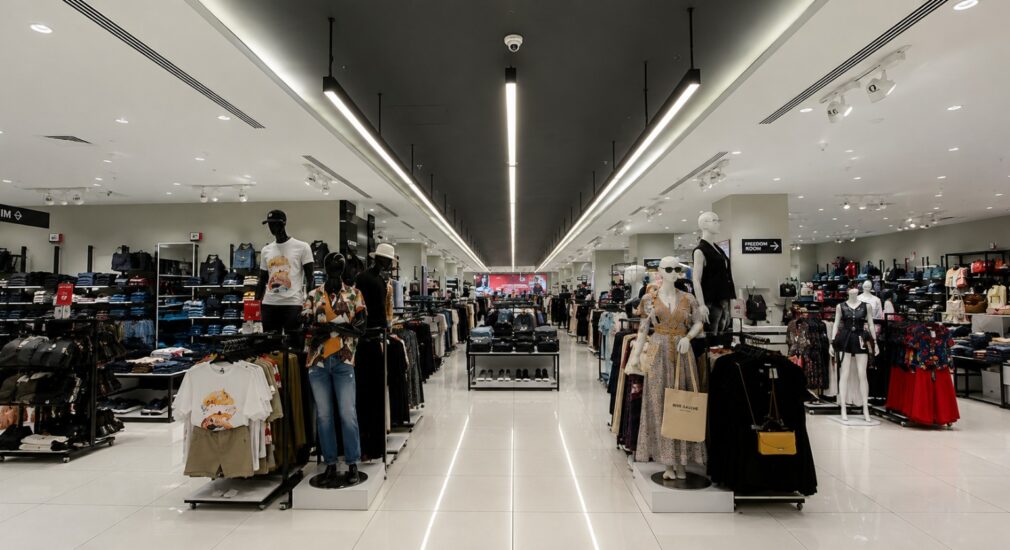
Retail Store Lighting plays a defining role in how customers perceive products, brands and physical retail environments. In a modern store, lighting is not simply installed to make merchandise visible; it is carefully designed to create visual hierarchy, reveal product quality, support navigation, strengthen brand identity and establish an atmosphere that encourages customers to explore.
From luxury fashion boutiques and jewellery stores to supermarkets, department stores, electronics showrooms, furniture outlets and large-format retail developments, every environment requires a different lighting strategy. The right combination of ambient illumination, accent lighting, display lighting, architectural elements and controlled contrast can transform an ordinary retail interior into a carefully curated commercial experience.
Luzion develops Retail Lighting Solutions for architects, interior designers, lighting designers, developers, MEP consultants, contractors and procurement teams seeking specification-oriented lighting for retail projects in India and international markets.
Our approach combines architectural aesthetics with optical performance, energy efficiency, visual comfort and project-specific requirements. Solutions can incorporate LED Retail Lighting, Retail Track Lighting, Retail Downlights, Retail Spotlights, Retail Linear Lighting, Retail Display Lighting, Retail Accent Lighting, Wall Washers, Recessed Lighting and customised architectural luminaires.
What Is Retail Store Lighting?
Retail Store Lighting is the planned use of artificial illumination to support merchandise presentation, customer movement, visual comfort, brand identity and commercial functionality within a retail environment.
Unlike conventional general lighting, retail lighting is designed around what the customer needs to see and experience. A product display may require concentrated accent illumination, while a circulation zone may require comfortable and uniform ambient lighting. A fitting room requires careful vertical illumination, while a storefront may require stronger visual emphasis to attract attention from outside.
A successful Retail Lighting Design therefore considers the complete customer journey rather than treating the store as one uniformly illuminated space.
The lighting strategy may address:
- Storefront and entrance lighting
- Window display illumination
- General ambient lighting
- Product and merchandise lighting
- Accent and focal lighting
- Shelf and cabinet illumination
- Wall washing
- Feature display lighting
- Fitting-room lighting
- Checkout and POS areas
- Circulation and aisle lighting
- Back-of-house and storage areas
- Architectural and decorative lighting
- Exterior retail façade lighting
This layered approach allows lighting designers to create different levels of emphasis throughout the store while maintaining a coherent visual language.
Why Retail Lighting Is Critical to the Shopping Experience
A retail environment communicates with customers through architecture, materials, colour, displays and light. Lighting connects many of these elements together.
A well-designed lighting system can make merchandise appear more vibrant, establish focal points, reveal textures and finishes, and help customers intuitively understand the organisation of a store. Large retail environments can also use lighting to structure circulation and support wayfinding.
For premium retail, this becomes particularly important. Luxury products often depend on the visual perception of materials, colours, textures, finishes and craftsmanship. Poorly selected light sources can reduce the perceived quality of merchandise, while carefully controlled high-quality illumination can make products appear more refined and visually distinctive.
Creating Visual Hierarchy
Not every product or architectural feature needs the same level of illumination.
Retail lighting can establish a hierarchy between:
Background → Merchandise → Feature Products → Hero Displays
Ambient lighting provides the foundation, while directional Retail Spotlights, track lights and accent luminaires can draw attention towards priority merchandise.
This creates a visual sequence through the store and helps designers determine where customers naturally look first.
Enhancing Product Presentation
Lighting should reveal products rather than simply illuminate them.
High-quality light sources with appropriate colour rendering can help preserve the appearance of fabrics, leather, cosmetics, food, jewellery, furniture finishes and other merchandise. High-CRI lighting is particularly relevant in fashion, cosmetics and premium retail applications where colour accuracy directly affects product perception.
Supporting Customer Movement
In larger stores, lighting can help establish circulation routes, highlight important departments and distinguish different zones.
A combination of ceiling lighting, linear illumination, wall washing and accent lighting can create subtle transitions between areas without relying entirely on architectural partitions.
Strengthening Brand Identity
Lighting can also become part of a retailer’s visual identity.
A luxury fashion store may use warm, focused illumination and strong contrast. A contemporary electronics showroom may require a cleaner, more uniform environment. A supermarket may prioritise visibility, efficiency and easy navigation.
The lighting language should therefore respond to the brand, merchandise category, architecture and target customer.
Retail Lighting Solutions for Different Store Formats
There is no universal lighting specification that works equally well for every retail environment. The lighting requirements of a jewellery boutique can differ substantially from those of a supermarket or large-format electronics showroom.
Luzion approaches each project according to its architecture, merchandise, ceiling height, display strategy, operating hours and desired customer experience.
Fashion & Apparel Store Lighting
Fashion retail requires lighting that presents fabrics, colours, textures and garments accurately while creating an attractive atmosphere.
LED Retail Lighting can be used across ceiling-mounted and recessed systems, while adjustable track spotlights can provide directional illumination for mannequins, display tables and feature garments.
Typical solutions may include:
- High-CRI LED spotlights
- Adjustable track lights
- Recessed downlights
- Linear architectural lighting
- Wall washers
- Display shelf lighting
- Fitting-room illumination
- Feature lighting for mannequins
- Window display lighting
The balance between ambient and accent illumination is particularly important. Excessive uniformity can flatten the visual environment, while controlled contrast can create stronger focal points.
Jewellery Store Lighting
Jewellery stores require a highly controlled lighting environment because gemstones, metals and polished surfaces respond strongly to light direction, intensity, colour quality and glare.
Jewellery Store Lighting may combine narrow-beam spotlights, high-CRI sources, carefully positioned display lighting and controlled ambient illumination.
For luxury jewellery environments, lighting designers may need to evaluate:
- Colour rendering
- Beam angle
- Vertical illumination
- Reflections
- Glare
- Display-case lighting
- Metal surface appearance
- Gemstone sparkle
- Colour temperature
- Contrast between merchandise and surroundings
The objective is to make jewellery visually compelling without creating uncomfortable reflections for customers or staff.
Cosmetics & Beauty Store Lighting
Cosmetics retail depends heavily on colour perception and visual accuracy.
Cosmetics Store Lighting should allow customers to understand product shades, packaging colours and skin-related products under controlled illumination. High-quality LED sources and appropriate colour rendering can therefore become an important part of the specification.
Mirror areas and consultation counters also require careful attention to vertical illumination and glare control.
Supermarket & Grocery Store Lighting
Large supermarkets require a different approach.
Here, Supermarket Lighting Solutions need to balance visibility, energy efficiency, aisle uniformity, product presentation and operational requirements.
Lighting may be required for:
- General aisles
- Fresh produce
- Bakery sections
- Dairy areas
- Meat and seafood displays
- Refrigerated cabinets
- Checkout areas
- Promotional displays
- Storage and service zones
Large retail environments can also use lighting to improve wayfinding and create clearer visual zoning throughout the customer journey.
Electronics & Technology Store Lighting
Electronics showrooms often feature reflective screens, metallic surfaces and illuminated product displays.
Electronics Store Lighting therefore needs careful glare management while maintaining sufficient illumination for product interaction and customer comfort.
Linear lighting, recessed systems, adjustable spotlights and controlled accent lighting can be integrated to create a clean and contemporary environment.
Furniture & Home Décor Retail Lighting
Furniture stores typically require a combination of broad ambient illumination and focused accent lighting.
Furniture Store Lighting should reveal material finishes, upholstery colours, wood grain, textures and room compositions.
Wall washing and linear lighting can help illuminate large vertical surfaces, while adjustable spotlights can highlight individual furniture arrangements or seasonal displays.
Luxury Retail Lighting
Luxury retail demands a more sophisticated lighting strategy.
Luxury Retail Lighting often uses controlled contrast, high-quality optics, high colour rendering, precise beam control and carefully coordinated colour temperatures.
Rather than making the entire store equally bright, the design can establish a hierarchy where selected products and architectural details receive greater visual emphasis.
The result is an environment where lighting becomes part of the brand experience rather than simply an infrastructure requirement.
The Importance of Layered Retail Lighting Design
A professional Retail Lighting Design generally works best when different lighting layers are combined.
Instead of depending on a single fixture type throughout the store, designers can create multiple lighting layers with distinct purposes.
1. Ambient Lighting
Ambient lighting establishes the general illumination level of the store.
It provides comfortable visibility across circulation areas and creates the foundation on which other lighting layers can operate.
Typical solutions include:
- Recessed LED downlights
- Linear LED systems
- Surface-mounted luminaires
- Suspended linear systems
- Architectural ceiling lighting
2. Accent Lighting
Accent lighting creates visual emphasis.
Adjustable Retail Spotlights and track-mounted luminaires can be directed towards hero products, mannequins, displays, artwork, architectural details or promotional areas.
Beam angle becomes an important design consideration because narrow beams can create concentrated focal points while wider beams provide broader illumination. Retail track-lighting guidance commonly associates narrower beams with focused merchandise and wider beams with general or larger display areas.
3. Display Lighting
Display lighting is positioned specifically around merchandise.
It can include:
- Shelf lighting
- Cabinet lighting
- Under-shelf lighting
- Vertical display lighting
- Product spotlights
- Linear LED systems
- Integrated showcase lighting
4. Architectural Lighting
Architectural lighting can reveal the character of the retail interior itself.
Wall washing, cove lighting, concealed linear illumination and feature lighting can emphasise:
- Textured walls
- Brand graphics
- Architectural surfaces
- Columns
- Ceiling details
- Feature installations
- Interior finishes
This allows the lighting design to support both merchandise and architecture.
Technical Considerations for Professional Retail Lighting
Selecting a retail luminaire involves considerably more than choosing wattage and appearance.
Professional projects should evaluate the optical and electrical performance of each fixture in relation to its intended application.
Colour Rendering Index
CRI is an important consideration for retail environments because customers need to perceive merchandise colours accurately.
For many fashion, cosmetics and premium retail applications, high-CRI LED lighting is commonly specified to improve colour presentation. Some specialist retail applications may require even higher colour fidelity depending on the merchandise and brand requirements.
Colour Temperature
Colour temperature influences the atmosphere and appearance of merchandise.
Common retail applications may use warm to neutral-white ranges, with the exact specification depending on brand identity, product category, materials and architectural concept.
Consistency is equally important. Different colour temperatures across adjacent displays can make products appear visually inconsistent.
Beam Angle
Beam angle determines how light is distributed across the target surface.
Typical applications include:
- Narrow beam for jewellery and hero products
- Medium beam for mannequins and displays
- Wider beam for general merchandise and circulation
The correct selection depends on mounting height, display distance, product dimensions and desired contrast.
Glare Control
Retail environments must provide visual comfort for customers and employees.
Poorly controlled luminaires can create uncomfortable glare on glossy products, mirrors, screens, counters and polished surfaces.
Optical design, shielding, mounting position, aiming and appropriate fixture selection should therefore be considered together.
Energy Efficiency
Retail stores often operate for long hours, making energy performance an important part of the overall project specification.
High-efficiency LED luminaires, appropriate lighting levels, zoning and intelligent controls can help reduce unnecessary energy consumption while maintaining the required visual quality.
Modern retail lighting strategies increasingly combine efficient LED systems with smart controls and monitoring to improve both operational performance and sustainability.
Retail Store Lighting for Global Markets
Retail architecture varies significantly between markets, but the fundamental principles of merchandise presentation, visual comfort, energy performance and brand experience remain important across international projects.
Luzion’s Retail Lighting Solutions can be developed for projects across:
- India
- UAE
- Saudi Arabia
- Qatar
- Kuwait
- Oman
- Bahrain
- GCC
- USA
- Canada
- UK
- Europe
- Australia
- New Zealand
- China
- Japan
- South Korea
- Singapore
- Malaysia
- Thailand
- Indonesia
- Vietnam
- Philippines
- South Africa
- Egypt
- Kenya
- Nigeria
- Ghana
- Morocco
- Other international markets
The strategy can be adapted to project-specific architectural, electrical, environmental and regulatory requirements rather than applying one generic lighting package to every location.
Retail Lighting Solutions for India
India’s retail sector includes high-street stores, shopping centres, luxury boutiques, supermarkets, jewellery showrooms, fashion outlets, electronics stores, furniture showrooms and rapidly expanding branded retail environments.
Retail Store Lighting India therefore requires flexible solutions that can respond to different store formats, ceiling conditions, architectural styles and commercial requirements.
Luzion can support retail lighting projects across major Indian markets including:
Gujarat: Ahmedabad, Surat, Vadodara, Rajkot, Gandhinagar
Maharashtra: Mumbai, Pune, Nagpur, Nashik
Karnataka: Bengaluru, Mysuru
Tamil Nadu: Chennai, Coimbatore
Telangana: Hyderabad
Delhi NCR: New Delhi, Gurugram, Noida, Faridabad
West Bengal: Kolkata
Rajasthan: Jaipur, Udaipur, Jodhpur
Kerala: Kochi, Thiruvananthapuram
Uttar Pradesh: Lucknow, Kanpur, Varanasi
These markets represent opportunities for Retail Lighting Design, LED Retail Lighting, Retail Display Lighting and Commercial Retail Lighting across new stores, refurbishments, flagship outlets and multi-location retail rollouts.
Types of Retail Store Lighting Fixtures
A successful retail environment rarely depends on one luminaire type. The most effective Retail Lighting Solutions combine different optical distributions, mounting methods and lighting layers according to the merchandise, architecture and customer journey.
The fixture selection should be driven by the lighting objective first and product form second. A luminaire that performs well over a clothing rack may not be appropriate for a jewellery showcase, while a broad linear system suitable for a supermarket aisle may be unsuitable for a luxury boutique.
For architects, lighting designers and MEP consultants, the following fixture categories provide a useful foundation for developing a coordinated retail lighting specification.
Retail Track Lighting
Retail Track Lighting provides flexibility for stores where merchandise layouts, seasonal displays and product positions change regularly.
Track-mounted luminaires allow the lighting designer or store operator to redirect individual fixtures as displays evolve. This makes track systems particularly suitable for fashion stores, boutiques, department stores, showrooms and flexible retail interiors.
Typical applications include:
- Clothing displays
- Mannequins
- Feature products
- Promotional displays
- Window displays
- Wall-mounted merchandise
- Shelving systems
- Art and decorative features
Adjustable track spotlights can be selected with different beam angles and optical systems to provide either concentrated accent illumination or broader merchandise coverage.
For multi-brand retail developments, track lighting can also provide a practical balance between architectural flexibility and long-term operational adaptability.
Retail LED Downlights
Retail LED Downlights are commonly used to provide general illumination in stores while maintaining a clean ceiling appearance.
Recessed downlights can be specified for:
- General store areas
- Entrance zones
- Checkout areas
- Circulation spaces
- Fitting rooms
- Reception counters
- Hospitality areas within retail developments
The selection should consider lumen output, beam angle, cut-out dimensions, glare performance, colour rendering, colour temperature and ceiling construction.
For premium retail interiors, downlights should integrate visually with the ceiling rather than becoming visually dominant.
Retail Spotlights
Retail Spotlights are used when precise visual emphasis is required.
They are particularly effective for merchandise that benefits from concentrated illumination, including jewellery, watches, fashion accessories, cosmetics, premium electronics and feature displays.
Important selection parameters include:
- Beam angle
- Adjustable tilt
- Rotation
- Optical efficiency
- Colour rendering
- Glare control
- Lumen output
- Colour consistency
- Mounting height
A carefully aimed spotlight can create a strong focal point without requiring higher illumination throughout the entire store.
Retail Linear Lighting
Retail Linear Lighting can provide both functional and architectural illumination.
Depending on the design, linear systems can be recessed, surface mounted, suspended, pendant mounted or integrated into architectural elements.
Applications include:
- Long retail aisles
- Shelving
- Display walls
- Ceiling grids
- Cove lighting
- Feature ceilings
- Circulation zones
- Checkout counters
- Architectural details
Continuous linear lighting can also create visual rhythm across large retail interiors.
For contemporary retail architecture, linear lighting can be integrated into ceiling geometries to create a consistent relationship between the lighting system and architectural form.
Retail Display Lighting
Retail Display Lighting is designed around the merchandise itself rather than the entire room.
It may be integrated within:
- Glass display cabinets
- Shelving
- Wall displays
- Product niches
- Counters
- Furniture systems
- Back panels
- Merchandise racks
For integrated display lighting, physical dimensions become especially important. The light source must fit within the available profile while providing sufficient illumination and appropriate thermal management.
Retail Shelf & Cabinet Lighting
Shelf lighting can increase product visibility while creating a layered appearance across vertical merchandising systems.
Retail Shelf Lighting may use compact linear LED systems or miniature directional luminaires depending on the display architecture.
Good shelf lighting should minimise:
- Direct glare
- Reflections
- Hot spots
- Uneven illumination
- Visible LED dots
- Excessive shadowing
For glass cabinets, the lighting position and optical distribution should be coordinated with the viewing angle of customers.
Retail Wall Washers
Retail Wall Washers provide broad vertical illumination for walls and merchandise displays.
Vertical illumination can be especially valuable in retail because products are frequently displayed on vertical surfaces rather than horizontal floors.
Wall washing can be used for:
- Fashion displays
- Brand walls
- Architectural finishes
- Product shelving
- Promotional graphics
- Textured surfaces
- Art installations
It can also make a store feel more visually spacious by bringing surrounding walls into the lighting composition.
Retail Store Lighting by Application
The best lighting strategy depends heavily on what is being sold and how customers interact with it.
Fashion Retail Lighting
Fashion stores need lighting that works with fabrics, garments, mannequins, mirrors and changing collections.
A balanced scheme may combine ambient illumination with directional accent lighting.
Fashion Store Lighting can include:
- Adjustable LED track spotlights
- High-CRI downlights
- Wall washers
- Linear lighting
- Display cabinet lighting
- Fitting-room lighting
- Window display illumination
Lighting should support the colours and textures of garments without creating excessive glare or uncomfortable contrast.
For flagship fashion stores, architectural lighting can also become an important part of the brand environment.
Clothing Store Lighting
Clothing Store Lighting requires flexibility because merchandise arrangements can change frequently.
Track-based systems provide a useful solution where rails and display tables move over time. Additional linear or recessed lighting can establish a consistent base layer.
The design should consider both horizontal and vertical illumination because customers view garments from multiple directions.
Jewellery Store Lighting
Jewellery requires especially careful optical control.
Jewellery Store Lighting Solutions may use high-quality directional luminaires to highlight diamonds, gemstones, precious metals and watches.
The lighting design should consider:
- Sparkle
- Contrast
- Colour fidelity
- Reflection
- Beam precision
- Display-case geometry
- Customer viewing angles
- Glare control
A high-quality jewellery environment is generally not achieved simply by increasing brightness. Controlled contrast and accurate light placement are often more valuable.
Supermarket Lighting
Supermarkets require highly functional lighting with strong emphasis on visibility and operational efficiency.
Supermarket LED Lighting can be designed for:
- Aisles
- Refrigerated displays
- Fresh food sections
- Produce areas
- Checkout counters
- Promotional displays
- Service counters
- Back-of-house areas
Different merchandise categories may benefit from different spectral characteristics and lighting distributions, while overall consistency remains essential.
Grocery Store Lighting
Grocery Store Lighting should help customers quickly identify products and navigate aisles.
Linear systems can provide continuous illumination along aisles, while accent or specialised lighting can highlight promotional areas and fresh-food sections.
The final specification should take into account ceiling height, aisle width, shelf configuration, operating hours and maintenance access.
Electronics Store Lighting
Electronics stores contain highly reflective products and digital displays.
Electronics Store Lighting therefore requires careful glare management.
Lighting designers should evaluate reflections on:
- Television screens
- Mobile phone displays
- Laptop screens
- Glass surfaces
- Polished metal
- Glossy counters
Directional lighting should be positioned carefully so that customers can interact with products without uncomfortable reflections.
Furniture Showroom Lighting
Furniture showrooms often use large display compositions that resemble residential or hospitality interiors.
Furniture Store Lighting can combine broad ambient illumination with focused accent lighting to reveal:
- Upholstery
- Wood grain
- Stone
- Metal
- Decorative objects
- Room settings
- Architectural finishes
Wall washing and linear lighting can help establish depth across large showroom spaces.
Luxury Boutique Lighting
A luxury boutique requires a more curated approach.
Luxury Retail Lighting can use carefully controlled pools of light, darker surrounding surfaces and focused merchandise illumination to create a sense of exclusivity.
The objective is to create visual hierarchy rather than maximum uniformity.
Lighting the Key Zones of a Retail Store
A retail lighting plan should consider the store as a sequence of distinct zones.
Entrance & Arrival Zone
The entrance is where customers transition from the external environment into the store.
Retail Entrance Lighting should establish an immediate visual impression while providing comfortable visibility.
The entrance may combine:
- Architectural ceiling lighting
- Accent lighting
- Brand illumination
- Feature lighting
- Display lighting
- Façade integration
The transition between exterior and interior illumination should also be considered, particularly in stores with large glazed façades.
Window Display Lighting
Window displays are among the most commercially important areas in many retail stores.
Retail Window Display Lighting should make the display visible from outside while creating a strong visual hierarchy.
Adjustable spotlights, narrow-beam luminaires and concealed architectural lighting can be used according to the display concept.
The lighting must also account for glass reflections, viewing angles and changing daylight conditions.
Main Merchandise Area
The main retail floor requires a comfortable foundation of illumination.
The design can combine:
- General ambient lighting
- Linear lighting
- Downlights
- Track systems
- Wall washing
- Product accent lighting
The objective is to avoid a flat, uniformly bright environment where every product competes equally for attention.
Display & Feature Zone
Feature zones require higher visual emphasis.
These areas may include new collections, premium products, seasonal campaigns or promotional merchandise.
Accent lighting can create a deliberate contrast between feature merchandise and surrounding areas.
Fitting Rooms
Retail Fitting Room Lighting requires particular attention because customers evaluate clothing on themselves rather than simply looking at garments.
Vertical illumination and controlled facial lighting can contribute to a more comfortable visual environment.
Direct overhead light should be evaluated carefully because it can produce undesirable shadows on faces and clothing.
Checkout & POS Area
Checkout areas need sufficient visual clarity for customer transactions and staff activity.
Lighting should coordinate with:
- POS counters
- Digital displays
- Queue areas
- Branding
- Product impulse zones
The lighting should remain visually consistent with the wider store concept while providing the functional illumination required at the transaction point.
Retail Lighting Controls & Smart Systems
Modern Retail Lighting Solutions can incorporate lighting controls to improve flexibility and operational efficiency.
Depending on project requirements, systems may include:
- DALI lighting control
- 0–10V dimming
- Sensor-based control
- Scene setting
- Time scheduling
- Occupancy detection
- Daylight-responsive control
- Centralised lighting management
- Smart building integration
For stores with changing merchandising strategies, programmable scenes can allow lighting levels and accent zones to be adjusted for different periods or campaigns.
For example, a flagship store may use separate scenes for:
Opening Hours → Peak Trading → Evening → Cleaning → Security
Lighting controls can also support maintenance strategies by allowing specific circuits or zones to be monitored independently.
Retail Lighting Design for Energy Efficiency
Energy performance should be considered during the design stage rather than treated as an afterthought.
An efficient retail lighting strategy can combine:
Efficient LED luminaires + appropriate optical distribution + zoning + dimming + intelligent controls
The goal is not simply to minimise wattage. A lower-wattage luminaire that produces poor distribution or inadequate product presentation may result in additional fixtures and ultimately higher installed load.
Instead, the lighting designer should evaluate the complete system.
Important considerations include:
- Luminaire efficacy
- Installed lighting power
- Operating hours
- Control strategy
- Maintenance requirements
- Optical efficiency
- Required illumination
- Daylight availability
- Replacement cycles
- Total cost of ownership
This approach is particularly valuable for large retail chains operating multiple locations.
Retail Lighting Design & DIALux Planning
For larger or technically demanding retail projects, photometric planning can help validate the proposed lighting arrangement before installation.
DIALux Lighting Design can be used to evaluate lighting distribution and provide a digital representation of the proposed environment.
Depending on project requirements, analysis may include:
- Illuminance distribution
- Uniformity
- Light levels
- Fixture positioning
- Beam distribution
- Ceiling heights
- Display areas
- Circulation zones
- Shadows and potential dark areas
- Lighting calculations
A coordinated digital lighting study can also help architects, interior designers, MEP consultants and contractors review fixture placement before site execution.
For procurement teams, photometric data and technical documentation can provide a clearer basis for comparing proposed luminaires.
Retail Lighting Solutions in UAE & GCC Markets
The Gulf region has a strong market for premium retail, shopping centres, luxury boutiques, supermarkets, hospitality-linked retail and mixed-use developments.
Retail lighting in the region must respond not only to interior design concepts but also to the broader architectural environment, operating conditions and project specifications.
Luzion can develop Retail Lighting Solutions for UAE and GCC projects, supporting applications from individual stores to larger commercial developments.
Retail Store Lighting UAE
The UAE retail market includes luxury shopping destinations, fashion outlets, department stores, supermarkets, lifestyle brands and high-end boutiques.
Retail Store Lighting UAE can be developed for projects in:
- Dubai
- Abu Dhabi
- Sharjah
- Ajman
- Ras Al Khaimah
- Fujairah
- Umm Al Quwain
Retail Lighting Dubai
Retail Lighting Dubai projects may range from luxury fashion boutiques and jewellery stores to large shopping centres, flagship stores and branded showrooms.
Lighting concepts can be coordinated with contemporary interiors, premium materials, feature ceilings and high-end merchandising systems.
Retail Lighting Abu Dhabi
Retail Lighting Abu Dhabi can support premium retail, mixed-use developments, shopping destinations and commercial interiors.
The lighting specification can be developed around architectural intent, merchandise requirements and project-specific technical criteria.
Retail Lighting Sharjah
Retail environments in Sharjah can include shopping centres, fashion stores, supermarkets, showrooms and independent retail developments.
Flexible LED Retail Lighting can support both new-build and refurbishment projects.
Retail Store Lighting Saudi Arabia
Saudi Arabia represents an important market for large-scale retail developments, shopping centres, luxury brands, lifestyle destinations and mixed-use projects.
Retail Store Lighting Saudi Arabia can be developed for projects in:
- Riyadh
- Jeddah
- Dammam
- Al Khobar
- Mecca
- Medina
- Taif
- Abha
- Tabuk
Retail Lighting Riyadh
Retail Lighting Riyadh projects can include luxury retail, fashion stores, department stores, showrooms and major commercial developments.
The lighting strategy can combine architectural integration with high-quality merchandise illumination.
Retail Lighting Jeddah
Retail Lighting Jeddah can address shopping centres, branded retail environments, boutiques, supermarkets and lifestyle developments.
Fixture selection should be coordinated with ceiling systems, interior materials and merchandising requirements.
Retail Store Lighting Qatar
Retail Store Lighting Qatar can support retail developments across:
- Doha
- Lusail
- Al Rayyan
- Al Wakrah
Retail Lighting Doha can incorporate architectural downlights, track lighting, linear systems, display lighting and accent lighting according to the store format.
For premium retail environments, high-CRI directional lighting can help strengthen merchandise presentation while maintaining a refined interior atmosphere.
Retail Store Lighting Kuwait
Retail Store Lighting Kuwait can serve:
- Kuwait City
- Hawally
- Salmiya
- Farwaniya
- Ahmadi
Retail projects can range from luxury boutiques and shopping centres to supermarkets, fashion outlets and specialist showrooms.
A flexible lighting system can be particularly valuable where store layouts and merchandising displays are frequently updated.
Retail Store Lighting Oman
Retail Store Lighting Oman can support retail and commercial developments in:
- Muscat
- Salalah
- Sohar
- Nizwa
- Seeb
The specification can be adapted for fashion retail, supermarkets, furniture showrooms, lifestyle stores and shopping environments.
Retail Store Lighting Bahrain
Retail Store Lighting Bahrain can serve projects in:
- Manama
- Riffa
- Muharraq
- Hamad Town
Lighting solutions can be developed for shopping centres, branded outlets, boutiques, supermarkets and commercial retail interiors.
Retail Lighting Across the GCC
Across the GCC, retail projects frequently combine premium architectural interiors with demanding operational requirements.
A professional Retail Lighting Design should therefore bring together:
- High-quality LED performance
- Appropriate colour rendering
- Controlled beam angles
- Glare management
- Energy efficiency
- Flexible lighting controls
- Architectural integration
- Reliable technical documentation
- Long-term maintainability
- Project-specific photometric planning
For international retail brands, consistency is also important. A lighting system may need to maintain a recognisable visual character across multiple stores while still being adapted to each project’s architectural conditions.
Luzion can support this process through project-oriented Retail Lighting Solutions, luminaire selection, technical documentation, photometric information and customised lighting requirements.
Retail Store Lighting Solutions Across International Markets
Retail architecture continues to evolve across international markets, with brands investing in distinctive stores that combine merchandise presentation, customer experience, technology and architectural identity. This creates demand for lighting systems that are visually refined, technically dependable and adaptable to different retail formats.
For international retail projects, the lighting specification must consider more than the appearance of an individual luminaire. Ceiling conditions, mounting heights, merchandise arrangement, operating hours, local electrical requirements, environmental conditions, maintenance access and project standards can all influence the final solution.
Luzion provides Retail Store Lighting Solutions for architects, interior designers, lighting consultants, MEP consultants, developers, contractors and procurement teams working across international markets.
Retail Store Lighting USA
The United States has a highly diverse retail environment, ranging from luxury boutiques and flagship stores to supermarkets, department stores, lifestyle centres, shopping malls and specialist showrooms.
Retail Store Lighting USA can be developed for both independent retail projects and multi-location commercial rollouts.
Major markets include:
- New York
- Los Angeles
- Miami
- Chicago
- Houston
- Dallas
- San Francisco
- Seattle
- Boston
- Washington, D.C.
- Las Vegas
- Atlanta
- Austin
- San Diego
- Phoenix
- Orlando
- New Jersey
Retail Lighting New York
Retail Lighting New York projects may include flagship fashion stores, luxury boutiques, jewellery stores, department stores and high-end showrooms.
Dense urban environments often require close coordination between architectural lighting, merchandise displays, storefront visibility and interior design.
Retail Lighting Los Angeles
Retail Lighting Los Angeles can support fashion, lifestyle, luxury, automotive, furniture and experiential retail environments.
Large glazed storefronts and open-plan interiors can benefit from carefully coordinated ambient, accent and architectural illumination.
Retail Lighting Miami
Retail Lighting Miami can be adapted for luxury retail, hospitality-linked shopping environments, fashion stores and lifestyle developments.
Lighting concepts may need to coordinate with strong daylight, reflective finishes and contemporary architectural interiors.
Retail Lighting Texas
Projects in Dallas, Houston and Austin can include large-format retail, shopping centres, showrooms and branded commercial environments.
For larger retail footprints, efficient LED systems combined with zoning and intelligent controls can support operational performance without compromising merchandise presentation.
Retail Store Lighting Canada
Canada offers opportunities across shopping centres, department stores, fashion retail, supermarkets, luxury boutiques and specialist commercial environments.
Retail Store Lighting Canada can support projects across:
- Ontario
- British Columbia
- Alberta
- Quebec
- Manitoba
Major cities include:
- Toronto
- Vancouver
- Montreal
- Calgary
- Edmonton
- Ottawa
- Winnipeg
Retail Lighting Toronto
Retail Lighting Toronto projects can range from luxury retail and flagship stores to shopping centres and commercial showrooms.
Retail Lighting Vancouver
Retail Lighting Vancouver can support fashion, lifestyle, furniture and premium retail environments where lighting must work alongside contemporary architecture and interior finishes.
Retail Lighting Calgary
Retail Lighting Calgary can address shopping centres, large-format stores, specialist retail and commercial showrooms.
Retail Store Lighting UK
The UK retail sector includes historic high streets, contemporary shopping centres, luxury boutiques, department stores, supermarkets and destination retail developments.
Retail Store Lighting UK can be developed for:
- England
- Scotland
- Wales
- Northern Ireland
Key cities include:
- London
- Manchester
- Birmingham
- Liverpool
- Leeds
- Bristol
- Sheffield
- Newcastle
- Glasgow
- Edinburgh
- Cardiff
- Belfast
Retail Lighting London
Retail Lighting London demands a particularly strong relationship between architecture, brand identity and customer experience.
Luxury fashion, jewellery, beauty and flagship stores can benefit from carefully controlled accent lighting, architectural integration and high-quality merchandise illumination.
Retail lighting may also need to complement listed or heritage architectural elements in certain projects while meeting contemporary performance expectations.
Retail Lighting Manchester
Retail Lighting Manchester can support shopping centres, fashion stores, department stores, lifestyle retail and commercial developments.
Flexible track systems and architectural LED lighting can provide adaptability for changing merchandising layouts.
Retail Lighting Birmingham
Retail Lighting Birmingham can serve shopping centres, high-street retail, fashion, electronics, furniture and large-format commercial environments.
Retail Store Lighting Europe
European retail environments cover a wide range of architectural styles, from historic city-centre stores to contemporary flagship developments.
Retail Store Lighting Europe can be developed for:
- Germany
- France
- Italy
- Spain
- Netherlands
- Belgium
- Switzerland
- Austria
- Portugal
- Sweden
- Norway
- Denmark
- Finland
- Poland
- Czech Republic
- Ireland
- Greece
European retail projects often place strong emphasis on architectural integration, energy performance, visual comfort and product quality.
Retail Lighting Germany
Retail Lighting Germany can support fashion, automotive, furniture, electronics, supermarket and specialist retail projects.
Major markets include:
- Berlin
- Munich
- Frankfurt
- Hamburg
- Cologne
- Stuttgart
Technical documentation, photometric data and coordinated specification are particularly useful for professional architectural and commercial projects.
Retail Lighting France
Retail Lighting France can serve:
- Paris
- Lyon
- Marseille
- Toulouse
- Nice
- Bordeaux
Luxury fashion, beauty, jewellery and lifestyle retail can benefit from high-quality accent illumination and carefully controlled colour rendering.
Retail Lighting Paris
Retail Lighting Paris is particularly relevant to luxury boutiques, fashion houses, cosmetics, jewellery and flagship retail.
In these environments, lighting becomes part of the visual merchandising strategy, helping create differentiation between hero products and secondary displays.
Retail Lighting Italy
Italy has a strong connection between retail, fashion, furniture, interiors and product design.
Retail Lighting Italy can support projects in:
- Milan
- Rome
- Florence
- Turin
- Venice
- Bologna
Retail Lighting Milan
Retail Lighting Milan can be used for luxury fashion, furniture, design showrooms, jewellery and premium commercial interiors.
Lighting systems can be integrated with refined architectural details, display furniture and material-focused interiors.
Retail Lighting Spain
Retail Lighting Spain can support:
- Madrid
- Barcelona
- Valencia
- Seville
- Málaga
Retail environments may range from fashion and lifestyle stores to supermarkets, shopping centres and destination retail.
Retail Lighting Netherlands
Major markets include:
- Amsterdam
- Rotterdam
- The Hague
- Utrecht
Retail Lighting Netherlands can be developed around contemporary retail architecture, energy-conscious lighting strategies and flexible commercial interiors.
Retail Lighting Switzerland
Projects in:
- Zurich
- Geneva
- Basel
- Lausanne
can include luxury retail, watches, jewellery, fashion, hospitality-linked retail and premium showrooms.
For luxury products, precise optics and high-quality colour rendering can play an important role in the overall presentation.
Retail Store Lighting Across Asia
Asia contains some of the world’s most diverse and rapidly evolving retail markets.
Retail developments range from large shopping centres and department stores to luxury boutiques, technology showrooms, supermarkets and experiential retail concepts.
Luzion can support Retail Lighting Solutions Asia across markets including:
- China
- Japan
- South Korea
- Singapore
- Malaysia
- Thailand
- Indonesia
- Vietnam
- Philippines
- Hong Kong
- Taiwan
Retail Lighting China
Major markets include:
- Shanghai
- Beijing
- Guangzhou
- Shenzhen
- Chengdu
- Hangzhou
Retail Lighting China can support large shopping developments, luxury stores, fashion outlets, electronics retail and commercial showrooms.
Retail Lighting Shanghai
Retail Lighting Shanghai can address premium shopping districts, flagship stores, luxury boutiques and large commercial developments.
Retail Lighting Japan
Japan has a sophisticated retail environment where lighting is often closely integrated with architecture, merchandising and customer experience.
Major cities include:
- Tokyo
- Osaka
- Kyoto
- Nagoya
- Yokohama
Retail Lighting Tokyo
Retail Lighting Tokyo can support compact boutiques, flagship stores, department stores, technology retail and high-end commercial interiors.
Where retail spaces have limited floor area, precise lighting can help establish visual hierarchy without overwhelming the architecture.
Retail Lighting South Korea
Key markets include:
- Seoul
- Busan
- Incheon
- Daegu
Retail Lighting South Korea can support fashion, beauty, electronics, lifestyle and experiential retail.
Retail Lighting Seoul
Retail Lighting Seoul is relevant to high-end fashion, cosmetics, technology and lifestyle stores where lighting is closely connected with contemporary interior design.
Retail Lighting Singapore
Singapore is an important commercial and luxury retail market.
Retail Lighting Singapore can support:
- Shopping centres
- Luxury boutiques
- Fashion stores
- Jewellery stores
- Beauty retail
- Lifestyle stores
- Flagship developments
Compact architectural spaces can benefit from integrated linear lighting, recessed systems and adjustable accent luminaires.
Retail Lighting Malaysia
Major markets include:
- Kuala Lumpur
- Penang
- Johor Bahru
Retail Lighting Malaysia can serve shopping malls, supermarkets, fashion stores, furniture showrooms and lifestyle retail.
Retail Lighting Thailand
Major markets include:
- Bangkok
- Phuket
- Chiang Mai
- Pattaya
Retail Lighting Thailand can support shopping centres, hospitality-linked retail, fashion stores and destination retail environments.
Retail Lighting Indonesia
Major markets include:
- Jakarta
- Bali / Denpasar
- Surabaya
- Bandung
Retail lighting can be developed for shopping centres, lifestyle stores, fashion, furniture and specialist retail.
Retail Lighting Hong Kong
Retail Lighting Hong Kong can support luxury retail, jewellery, fashion, cosmetics, electronics and compact urban stores.
Precise optical control can be particularly useful where merchandise displays are positioned close to circulation paths and customers.
Retail Store Lighting Africa
Africa represents a growing market for modern shopping centres, supermarkets, branded retail, hospitality-linked commercial developments and urban mixed-use projects.
Luzion can support Retail Lighting Solutions Africa across markets including:
- South Africa
- Egypt
- Kenya
- Nigeria
- Ghana
- Morocco
- Tanzania
- Ethiopia
- Rwanda
- Uganda
Retail Lighting South Africa
Major cities include:
- Johannesburg
- Cape Town
- Durban
- Pretoria
Retail Lighting South Africa can support shopping centres, fashion stores, supermarkets, furniture stores and commercial showrooms.
Retail Lighting Johannesburg
Retail Lighting Johannesburg can address large shopping developments, premium retail, lifestyle centres and branded stores.
Retail Lighting Cape Town
Retail Lighting Cape Town can support fashion, lifestyle, furniture, hospitality-linked retail and destination commercial projects.
Retail Lighting Egypt
Major markets include:
- Cairo
- Alexandria
- Giza
- New Cairo
Retail Lighting Egypt can serve shopping centres, supermarkets, fashion outlets and mixed-use commercial developments.
Retail Lighting Kenya
Retail Lighting Nairobi
Retail Lighting Nairobi can support shopping centres, supermarkets, fashion retail, electronics stores and commercial developments.
Retail Lighting Nigeria
Major markets include:
- Lagos
- Abuja
- Port Harcourt
Retail Lighting Nigeria can be developed for shopping centres, supermarkets, branded retail and commercial showrooms.
Retail Lighting Morocco
Major markets include:
- Casablanca
- Rabat
- Marrakech
- Tangier
Retail lighting can be adapted to contemporary shopping centres, luxury retail, hospitality-linked developments and traditional-to-modern commercial environments.
Retail Store Lighting Australia
Australia combines large shopping centres, high-street retail, luxury boutiques, supermarkets, lifestyle stores and large-format commercial developments.
Retail Store Lighting Australia can support projects across:
- New South Wales
- Victoria
- Queensland
- Western Australia
- South Australia
- Australian Capital Territory
Major cities include:
- Sydney
- Melbourne
- Brisbane
- Perth
- Adelaide
- Canberra
- Gold Coast
Retail Lighting Sydney
Retail Lighting Sydney can support luxury fashion, shopping centres, lifestyle stores, furniture showrooms and flagship retail.
Retail Lighting Melbourne
Retail Lighting Melbourne can serve fashion, design, furniture, hospitality-linked retail and contemporary commercial environments.
Retail Lighting Brisbane
Retail projects in Brisbane can include shopping centres, fashion stores, supermarkets and lifestyle developments.
Retail Store Lighting New Zealand
Retail Store Lighting New Zealand can support projects in:
- Auckland
- Wellington
- Christchurch
- Hamilton
- Tauranga
Retail lighting solutions can be developed for fashion, supermarkets, furniture, lifestyle and specialist commercial stores.
Retail Lighting Auckland
Retail Lighting Auckland can support shopping centres, flagship retail, fashion stores and commercial showrooms.
Retail Lighting for International Retail Rollouts
International brands frequently operate multiple stores across different cities and countries. Maintaining consistent brand presentation while adapting to local architectural conditions can therefore become an important part of the lighting strategy.
A standardised retail lighting program can establish:
- Consistent colour quality
- Consistent fixture appearance
- Repeatable lighting scenes
- Standardised product families
- Defined beam-angle requirements
- Consistent technical documentation
- Simplified procurement
- Easier maintenance
- Scalable project implementation
At the same time, every location may have different ceiling heights, floor plans, display systems and local requirements.
The ideal approach is therefore standardisation where it benefits the brand, combined with project-specific adaptation where architecture or technical conditions demand it.
Custom Retail Lighting for Brand-Specific Architecture
Retail brands increasingly use architecture as a physical expression of their identity.
This can require luminaires that are not available as standard catalogue products.
Custom Retail Lighting can be considered where the project requires:
- Specific dimensions
- Special finishes
- Custom mounting
- Integrated architectural profiles
- Unique optical distributions
- Bespoke linear systems
- Special colour temperatures
- Brand-specific detailing
- Custom ceiling integration
- Coordinated lighting and interior elements
Bespoke development can be particularly valuable for flagship stores and premium retail interiors where standard luminaires may not align with the architectural concept.
Retail Lighting Manufacturer & Project Supply
Choosing a Retail Lighting Manufacturer rather than selecting fixtures solely from a generic product catalogue can provide greater control over product configuration, technical requirements and project coordination.
For professional B2B projects, procurement teams may require:
- Product datasheets
- Photometric files
- Technical specifications
- Installation instructions
- Certificates
- Warranty information
- Driver information
- Mounting details
- Product dimensions
- Material and finish details
- Packaging information
- Project-specific documentation
For multi-location retail programs, consistent documentation can help architects, consultants, contractors and procurement teams maintain a common specification across projects.
Retail Lighting Manufacturer in India for Global Projects
Luzion operates from India and develops architectural LED lighting solutions for domestic and international project requirements.
As an Indian lighting manufacturer and exporter, the company can support international retail projects with a combination of product engineering, architectural lighting expertise, project coordination and export-oriented supply.
The approach is particularly relevant for projects where clients require a lighting partner capable of working with professional design and procurement teams rather than simply supplying off-the-shelf luminaires.
Depending on project requirements, Luzion’s retail lighting portfolio can include:
- Architectural LED luminaires
- Linear lighting systems
- Track lighting
- Downlights
- Spotlights
- Wall washers
- Inground lighting
- Surface-mounted lighting
- Recessed luminaires
- Custom lighting
- Smart lighting solutions
The final product selection should always be based on the application, photometric requirement, mounting condition, environmental conditions and project specification.
Retail Lighting Specification for Architects & Consultants
For consultants and design professionals, a retail lighting specification should clearly define the performance required from each luminaire.
A typical specification may address:
| Specification Parameter | Retail Project Consideration |
|---|---|
| Light Source | LED |
| Colour Rendering | Selected according to merchandise and design intent |
| Colour Temperature | Based on brand, product and architectural concept |
| Beam Angle | Narrow, medium or wide according to application |
| Lumen Output | Selected according to mounting height and target area |
| Glare Control | Appropriate optical/shielding solution |
| Dimming | According to control strategy |
| Driver | Compatible with required control system |
| Mounting | Recessed, surface, track, suspended or integrated |
| IP Rating | Based on application and environmental exposure |
| Finish | Coordinated with interior architecture |
| Photometric Data | Required for lighting calculations |
| Lifetime | Project-specific performance requirement |
| Controls | DALI, dimming, sensors or other specified system |
These parameters allow the lighting designer and project team to evaluate performance rather than selecting fixtures purely on appearance.
Retail Lighting Procurement for Developers & Contractors
Developers and contractors often need to balance design intent with project budget, availability, installation complexity and long-term maintenance.
A practical procurement process can therefore evaluate:
- Design requirements
- Lighting calculations
- Luminaire selection
- Technical compliance
- Mock-up or sample approval
- Quantity confirmation
- Manufacturing schedule
- Quality inspection
- Delivery planning
- Installation
- Commissioning
- Project handover
For large retail rollouts, early coordination between the lighting manufacturer, consultant, contractor and procurement team can reduce specification changes and installation issues later in the project.
Retail Lighting for New Stores & Refurbishment Projects
Retail lighting is required not only for new developments.
Existing stores may need lighting upgrades because of:
- Store refurbishment
- New brand identity
- Merchandise changes
- Energy-efficiency targets
- Ceiling renovation
- Fixture ageing
- Changes in store layout
- Improved product presentation
- Lighting control upgrades
An existing retail space may not require complete replacement of every luminaire. A professional assessment can determine which systems can be retained, upgraded or replaced.
This can make Retail Lighting Retrofit an important solution for established retail chains and commercial property owners.
Why a Project-Specific Retail Lighting Strategy Matters
The most successful retail lighting environments are designed around the relationship between architecture, merchandise and customer behaviour.
A technically efficient lighting system can still underperform if it does not place light where customers need it. Similarly, a visually attractive lighting concept can create operational problems if it ignores maintenance, energy consumption or installation constraints.
A project-specific strategy should therefore bring together:
Architecture + Merchandise + Optics + Visual Comfort + Energy Performance + Controls + Maintenance + Brand Identity
This integrated approach enables retail lighting to perform as both a technical building system and a critical part of the customer experience.
Retail Lighting Project Consultation & Design Support
A successful retail lighting project begins before luminaires are selected. The lighting system should be considered alongside the architectural concept, interior layout, merchandise strategy, ceiling design, electrical infrastructure and project program.
For professional retail developments, Luzion can work with architects, interior designers, lighting designers, MEP consultants, developers, contractors and procurement teams to establish lighting requirements and identify suitable solutions.
The project process can be structured around the specific requirements of the development rather than forcing a standard lighting package into every retail environment.
Understanding the Retail Environment
The first stage is understanding how the store will function.
Important project inputs can include:
- Store type
- Floor area
- Ceiling height
- Floor plan
- Merchandise category
- Display arrangement
- Architectural finishes
- Interior colour palette
- Brand guidelines
- Operating hours
- Lighting control requirements
- Energy-performance objectives
- Local project requirements
- Installation conditions
- Maintenance strategy
This information provides the foundation for selecting suitable Retail Lighting Fixtures and establishing an appropriate lighting hierarchy.
Lighting Concept Development
The lighting concept should support both the commercial purpose of the store and the architectural vision.
Depending on the project, the concept may combine:
Ambient illumination + accent lighting + display lighting + architectural lighting + decorative elements
The relative importance of each layer will vary according to the retail format.
A jewellery boutique may require concentrated accent lighting and highly controlled display illumination, while a supermarket may place greater emphasis on aisle visibility, efficiency and uniformity.
Photometric Planning
For projects requiring detailed technical validation, photometric planning can be incorporated into the design process.
Lighting calculations can help evaluate:
- Luminaire positioning
- Illuminance
- Uniformity
- Light distribution
- Mounting heights
- Beam angles
- Potential dark areas
- Display illumination
- Circulation areas
- Ceiling coordination
Using photometric information at the design stage can reduce uncertainty before installation and provide the project team with a clearer understanding of expected lighting performance.
Retail Lighting Mock-Ups & Sample Evaluation
For premium and large-scale projects, physical sample evaluation can be valuable before final approval.
A mock-up allows the project team to assess the relationship between the proposed luminaire and the actual interior materials.
Areas that may be evaluated include:
- Product appearance
- Colour rendering
- Beam spread
- Glare
- Shadowing
- Fixture visibility
- Ceiling integration
- Finish quality
- Light distribution
- Interaction with display furniture
This is particularly useful for luxury retail, jewellery, fashion and flagship stores where the final appearance of merchandise and architectural finishes is highly important.
A sample review can also help identify changes required before bulk production or installation.
Retail Lighting Manufacturing & Quality Considerations
For professional retail projects, luminaire quality should be evaluated beyond external appearance.
Important considerations can include:
Optical Performance
The optical system should provide the intended beam distribution and minimise unwanted spill light.
Thermal Management
Effective heat dissipation supports stable LED performance and long-term reliability.
Driver Performance
Drivers should be selected according to the luminaire, electrical requirements and intended dimming or control system.
Colour Consistency
Consistent LED colour performance is important when multiple luminaires are installed within the same retail environment.
Mechanical Construction
Housing materials, mounting components, finishes and adjustment mechanisms should be appropriate for the application.
Maintenance
The lighting system should allow practical access for inspection, servicing and replacement of components where required.
Retail Lighting Export Solutions for International Projects
International retail projects can involve complex procurement and delivery requirements, particularly when multiple stores are being developed across different markets.
A manufacturer with export experience can help coordinate product documentation, packaging, quantities and project schedules.
Luzion supports international requirements for Retail Lighting Solutions from its manufacturing base in India.
International project support can include:
- Product selection
- Technical documentation
- Photometric files
- Product datasheets
- Installation instructions
- Certificates
- Customisation
- Sample coordination
- Quantity planning
- Packaging
- Export documentation
- Project communication
- Delivery coordination
For retail chains, this can be particularly useful when the same lighting family needs to be supplied for multiple locations.
Retail Lighting for Architects, Interior Designers & Lighting Designers
Lighting should be coordinated with architecture from the beginning of the design process.
For architects, the lighting system may need to integrate with ceiling geometries, architectural details and façade elements.
For interior designers, luminaires should complement materials, furniture, display systems and the overall visual identity of the store.
For lighting designers, the focus may include photometric performance, beam control, colour quality, glare, lighting levels and control systems.
Luzion can support this multidisciplinary process by providing lighting products and technical information that can be incorporated into professional project documentation.
Retail Lighting for MEP Consultants
MEP coordination is essential when retail lighting is integrated into a larger commercial development.
The lighting specification may need to coordinate with:
- Electrical loads
- Ceiling services
- HVAC systems
- Fire and life-safety services
- Emergency lighting
- Lighting controls
- Building management systems
- Maintenance access
- Distribution boards
- Cable routes
Early coordination can reduce conflicts between luminaires and other building services.
For projects using intelligent lighting controls, the control protocol should also be established during the design phase rather than after installation.
Retail Lighting for Developers & Procurement Teams
Developers and procurement professionals generally need to evaluate the complete commercial and technical proposition rather than the luminaire price alone.
A professional evaluation can consider:
- Initial product cost
- Lighting performance
- Energy consumption
- Product life
- Maintenance
- Replacement requirements
- Installation complexity
- Availability
- Technical support
- Warranty
- Documentation
- Project delivery schedule
This broader evaluation can provide a more realistic understanding of the total value delivered by the lighting system.
For large retail portfolios, standardising selected luminaire families can also simplify procurement and maintenance.
Sustainable Retail Lighting Solutions
Sustainability has become an important consideration in commercial retail development.
A sustainable Retail Lighting Solution should not be defined only by LED technology. The complete lighting system should be evaluated across its operating life.
Potential strategies include:
- High-efficiency LED luminaires
- Appropriate lighting levels
- Efficient optics
- Dimming
- Occupancy controls
- Daylight integration
- Lighting scene management
- Long-life components
- Durable construction
- Reduced maintenance
- Responsible material selection
The objective is to provide the required visual performance while avoiding unnecessary energy consumption.
In large stores, even relatively small improvements in operating efficiency can become significant when multiplied across long operating hours and multiple locations.
Smart Retail Lighting Systems
The development of connected commercial environments has created opportunities for more intelligent lighting management.
Smart Retail Lighting can allow lighting zones to be managed according to time, occupancy, daylight or programmed scenes.
Potential applications include:
- Automatic dimming
- Occupancy sensing
- Scheduled lighting
- Scene selection
- Centralised control
- Individual zone management
- Energy monitoring
- Building-management integration
Smart controls can also support visual merchandising by allowing specific areas to be adjusted for campaigns, seasonal displays or special events.
For large retail chains, centrally defined lighting scenes can help maintain consistency while allowing individual stores to make local adjustments.
Retail Lighting Retrofit & Upgrading
Existing retail stores often provide an opportunity to improve lighting performance without completely redesigning the interior.
A Retail Lighting Retrofit can address:
- Older luminaires
- Excessive energy consumption
- Poor colour quality
- Insufficient merchandise emphasis
- Glare
- Uneven illumination
- Outdated fixture appearance
- Inefficient controls
A retrofit assessment should begin with the existing installation.
The project team can review the current luminaires, lighting levels, operating hours, control systems and store layout before determining the appropriate upgrade strategy.
In some projects, replacing selected luminaires may be sufficient. In others, a complete lighting redesign may provide greater benefits.
Retail Lighting Selection Guide
Selecting the right luminaire becomes easier when the application is clearly defined.
| Retail Application | Recommended Lighting Approach |
|---|---|
| Fashion Store | Track spotlights, downlights, wall washing and display lighting |
| Luxury Boutique | High-quality accent lighting, controlled contrast and architectural lighting |
| Jewellery Store | Precise optics, high colour quality and controlled display illumination |
| Cosmetics Store | High colour fidelity, comfortable vertical illumination and display lighting |
| Supermarket | Efficient linear systems, aisle lighting and product-focused illumination |
| Electronics Store | Controlled glare, ambient lighting and targeted accent lighting |
| Furniture Showroom | Broad ambient lighting, wall washing and directional accents |
| Department Store | Layered lighting with flexible zoning |
| Shoe Store | Track lighting, downlights and shelf/display illumination |
| Sports Store | Efficient ambient lighting with directional product emphasis |
| Grocery Store | Aisle lighting, display lighting and efficient LED systems |
| Showroom | Architectural lighting combined with merchandise-focused illumination |
The final selection should always be confirmed against the actual ceiling height, product arrangement, required lighting levels, optics and project specifications.
Why Choose Luzion for Retail Store Lighting?
Selecting a lighting partner for a retail development involves more than choosing attractive luminaires.
Luzion combines architectural LED lighting manufacturing, project-oriented product development and international supply capabilities to support professional retail environments.
The company can work across a broad range of retail applications, from individual stores and boutiques to larger commercial developments and multi-location retail programs.
Key capabilities include:
Architectural Lighting Expertise
Solutions are developed with an understanding of how lighting interacts with architecture, interiors and merchandise.
Project-Based Product Selection
Rather than applying one fixture to every application, products can be selected according to the specific lighting requirement.
Custom Lighting Capability
Where standard products do not satisfy a project’s dimensional, optical or aesthetic requirements, customised solutions can be considered.
Technical Documentation
Professional project documentation can support design development, consultant review and procurement.
International Supply
Luzion can support projects across India and international markets, including the GCC, USA, UK, Europe, Asia, Africa and other regions.
B2B Project Support
The focus is on supporting professional project stakeholders including architects, lighting designers, consultants, contractors, developers and procurement teams.
Retail Lighting Project Workflow
A structured workflow helps move a project from concept to completed installation.
1. Project Brief
The project requirements, store format, architectural concept and technical expectations are reviewed.
2. Lighting Requirement Assessment
The merchandise, ceiling, display strategy, operating conditions and lighting objectives are evaluated.
3. Luminaire Selection
Suitable lighting families and optical configurations are shortlisted.
4. Technical Review
Photometric information, dimensions, electrical characteristics, mounting requirements and other technical data are reviewed.
5. Lighting Calculation
Where required, lighting calculations can be developed to validate the proposed arrangement.
6. Sample & Approval
Selected luminaires can be evaluated against the interior concept and merchandise.
7. Manufacturing
Approved products are prepared according to the confirmed project specification.
8. Quality & Documentation
Products and project documentation are coordinated before dispatch.
9. Export & Delivery
For international projects, packaging and delivery are coordinated according to the project schedule.
10. Installation & Commissioning
The installed lighting system is aligned with the approved lighting concept and control strategy.
Retail Lighting Solutions for Global Commercial Projects
Retail lighting is ultimately about creating an environment in which architecture, merchandise and customers work together.
Whether the project is a luxury boutique in Dubai, a flagship fashion store in London, a jewellery showroom in Mumbai, a shopping environment in Riyadh, a department store in New York, a lifestyle store in Singapore or a commercial development in Sydney, the lighting strategy should be developed around the project’s individual requirements.
Luzion provides Retail Store Lighting Solutions for international architectural and commercial projects, combining LED technology with optical control, architectural integration, technical support and project-oriented manufacturing.
From initial lighting concepts and luminaire selection to photometric planning, customised products and international supply, the objective is to help project teams achieve a retail environment that is visually compelling, technically considered and commercially effective.
Frequently Asked Questions
What is Retail Store Lighting?
Retail Store Lighting is the planned use of lighting systems to illuminate merchandise, architectural elements, circulation areas and customer-facing spaces while supporting visual comfort, brand identity and the overall shopping experience.
What type of lighting is best for retail stores?
There is no single lighting type suitable for every retail store. A combination of ambient, accent, display and architectural lighting is generally selected according to the store format, merchandise and design concept.
What is LED Retail Lighting?
LED Retail Lighting uses LED-based luminaires for general, accent, display and architectural illumination within retail environments. LED systems can offer high efficiency, controllable optics and a wide range of colour and beam options.
Why is CRI important in retail lighting?
Colour rendering affects how customers perceive merchandise colours and materials. High-quality colour rendering can be particularly important for fashion, cosmetics, jewellery and other products where accurate appearance influences purchasing decisions.
What is the difference between ambient and accent retail lighting?
Ambient lighting provides the general illumination of the store, while accent lighting concentrates light on selected merchandise, displays or architectural features to establish visual emphasis.
Is track lighting suitable for retail stores?
Yes. Track lighting is particularly useful where merchandise displays change regularly because individual luminaires can be adjusted or redirected as the store layout evolves.
What lighting is suitable for jewellery stores?
Jewellery environments typically require precise, controlled illumination with appropriate colour quality, beam control and glare management. The final specification should be developed around the jewellery, display cases and viewing conditions.
Can retail lighting be customised?
Yes. Custom retail lighting can be developed where standard luminaires do not meet specific dimensional, mounting, optical, finish or architectural requirements.
Can Luzion provide retail lighting for international projects?
Yes. Luzion is an architectural LED lighting manufacturer and exporter based in India, supporting retail and commercial lighting requirements for international projects across multiple markets.
Can Luzion provide lighting calculations for retail projects?
Where required, photometric information can be used for lighting calculations and project planning. The appropriate calculation methodology depends on the project brief, layout and consultant requirements.
What should architects consider when selecting retail lighting?
Architects should consider the relationship between luminaires and ceiling architecture, merchandise displays, interior materials, visual hierarchy, glare, colour quality, controls, maintenance and the overall design intent.
What should procurement teams evaluate before buying retail lighting?
Procurement teams should consider technical compliance, photometric performance, product quality, documentation, project quantities, lead times, warranty, maintenance, energy performance and total cost of ownership rather than focusing only on initial price.
Does retail lighting support energy efficiency?
Yes. Efficient LED luminaires combined with suitable optics, zoning, dimming, sensors and lighting controls can help reduce unnecessary energy consumption while maintaining the required visual environment.
Can retail lighting be used for store refurbishment?
Yes. Retail lighting retrofit and refurbishment projects can replace outdated luminaires, improve merchandise presentation, enhance visual comfort, reduce energy consumption and update the appearance of the store.
Where does Luzion provide Retail Lighting Solutions?
Luzion can support retail lighting requirements across India, UAE, Saudi Arabia, Qatar, Kuwait, Oman, Bahrain, GCC markets, USA, Canada, UK, Europe, Asia, Africa, Australia, New Zealand and other international markets, subject to project requirements and export arrangements.
Build a Better Retail Environment with Luzion
The right Retail Store Lighting can transform the way customers see products, navigate a space and experience a brand.
For architects, designers, developers, consultants, contractors and procurement teams, the objective is to select a lighting system that combines visual quality, technical performance, architectural integration, efficiency and long-term reliability.
Luzion provides architectural LED lighting solutions for retail environments ranging from boutiques and flagship stores to supermarkets, showrooms, shopping centres and multi-location commercial projects.
Related posts
21 Oct 2026
Channel Letter Signage in UAE: Types, Materials and Applications
Channel letter signage is widely used by retail stores, hotels, restaurants, shopping malls and commercial buildings to display business names,…
21 Oct 2026
3D Letter Signage in UAE: Materials, Finishes and Applications
In a competitive commercial environment, signage plays an important role in how customers recognise a brand, locate a business and…
21 Oct 2026
Types of Illuminated Signage: A Guide for UAE & GCC Projects
Illuminated signage plays an important role in how commercial buildings, hotels, retail developments and corporate spaces communicate their identity. In…
17 Oct 2026
Commercial Signage Solutions UAE & GCC
How to Choose Commercial Signage Solutions in the UAE & GCC Commercial signage plays an important role in how people…
02 Oct 2026
Canadian Bespoke Lights
Canadian Bespoke Lighting: Where Design Becomes a Signature Luxury architecture is rarely defined by one element alone. The character of…
subscribe for newsletter

Luzion is a leading manufacturer and exporter of high-quality LED lighting solutions. With a focus on design, research, and innovation, we offer a wide range of products for commercial, industrial, residential, and outdoor spaces.
