
Banks are highly visual environments where architecture, technology, security and customer experience come together. From the entrance and reception desk to the banking hall, consultation areas, ATMs and executive offices, every space requires a carefully considered lighting strategy. Unlike ordinary commercial interiors, banking environments need illumination that supports customer interaction, document handling, digital screens, staff productivity and a strong sense of trust.
Professional bank lighting solutions therefore need to balance functional visibility with architectural character. The objective is not simply to make a branch brighter. It is to create an environment where light is comfortable, controlled and appropriate to the activities taking place within each zone.
For architects, developers, lighting designers, MEP consultants and contractors, the right solution begins with understanding how the bank operates. Ceiling height, interior finishes, glazing, workstation arrangement, daylight availability, screen usage, customer circulation and the architectural identity of the institution can all influence the final lighting specification.
Bank lighting is the planned use of architectural, ambient, task, accent and exterior illumination across banking environments. It can cover customer-facing areas, workspaces, circulation zones, ATM facilities, entrances, façades, parking areas and surrounding landscapes.
A complete bank lighting design should consider both the functional and visual requirements of the building. Customer areas may need comfortable and relatively uniform illumination, while architectural features can benefit from accent or wall-washing techniques. Workstations may require controlled glare, particularly where employees spend extended periods working with computers and digital displays.
The best approach is therefore based on layered lighting rather than relying on a single type of luminaire throughout the building.
A typical lighting strategy can combine:
This allows different areas of a financial institution to perform visually and functionally without forcing one lighting configuration into every space.
Lighting influences how people perceive a commercial space. In a bank, that perception can be particularly important because customers associate the physical environment with professionalism, reliability and confidence.
A poorly designed system can create uncomfortable brightness, reflections on screens, dark corners or inconsistent illumination. On the other hand, a carefully coordinated scheme can make the environment feel organised, welcoming and contemporary.
Professional bank branch lighting should address several objectives simultaneously:
Customers may spend several minutes or longer completing transactions, discussing financial services or waiting for assistance. Comfortable illumination can make these interactions more pleasant.
Employees frequently work with computers, documents and customer-facing counters. Lighting should support these activities without creating unnecessary glare or visual fatigue.
The lighting scheme can reinforce the architectural language of the branch. Linear systems, concealed illumination, feature lighting and façade treatments can help create a distinctive visual identity.
Light can subtly guide customers from the entrance toward reception, service counters, consultation rooms and other important areas.
Appropriate illumination around entrances, ATM areas, pathways and external zones can contribute to clear visibility after dark.
Modern financial institutions increasingly use architecture as part of their brand experience. Materials, proportions, furniture, digital interfaces and lighting can work together to create a consistent environment.
Architectural lighting for banks is concerned with more than basic illumination. It considers how light interacts with ceilings, walls, columns, counters, feature surfaces and architectural details.
For example, a recessed linear system can emphasise a ceiling geometry, while a wall washer can bring attention to a textured feature wall. A carefully positioned downlight can provide focused illumination over a customer service area without visually overwhelming the surrounding space.
This approach makes architectural bank lighting particularly relevant for premium branches, corporate headquarters, private banking facilities and flagship locations.
Every area of a financial institution has a different visual function. Treating the entire building as one lighting zone can result in inefficient or uncomfortable illumination.
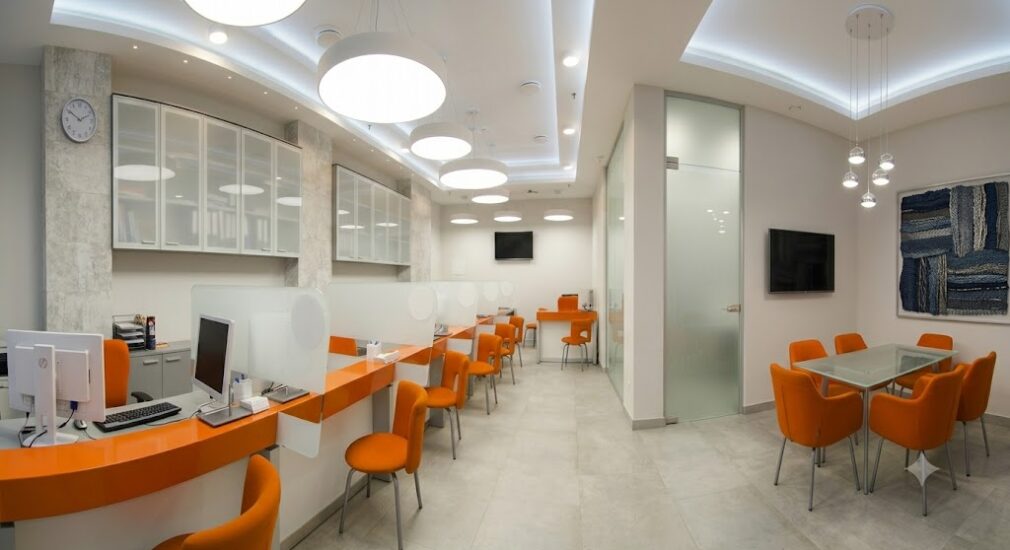
The central customer area generally requires clear and balanced illumination. Banking hall lighting should support customer movement, communication, document handling and interaction with service personnel.
Uniformity, glare management, colour quality and appropriate light distribution are important considerations. The architectural character of the ceiling can also influence the choice between recessed, surface-mounted or linear systems.
The reception area establishes the first impression.
Bank reception lighting can combine ambient illumination with controlled accent lighting to distinguish the reception desk from surrounding areas. A feature wall, branded element or architectural material can also be highlighted without making the environment excessively bright.
Customer-facing counters require sufficient illumination for documents, forms, screens and interpersonal communication.
A suitable bank counter lighting strategy should consider the position of luminaires relative to employees and customers. Poorly positioned fixtures can create reflections or uncomfortable brightness, particularly where computers and glossy surfaces are involved.
Private banking discussions, financial consultations and administrative work require a more controlled environment.
Bank office lighting can incorporate low-glare luminaires, adjustable scenes and appropriate colour rendering. Meeting rooms may also benefit from dimming so that the lighting can respond to presentations, discussions and screen-based activities.
ATMs operate beyond conventional banking hours, making their surrounding environment particularly important.
ATM lighting should provide clear visibility around the machine, approach route and immediate surroundings. Exterior installations also need to account for environmental exposure and appropriate protection.
The entrance is both a functional and architectural element.
Bank exterior lighting can combine façade illumination, entrance lighting, canopy lighting and landscape elements. The objective is to create clear visibility while maintaining a coherent relationship with the building’s architectural design.
One of the common mistakes in commercial lighting is evaluating a luminaire only by its lumen output.
A fixture producing more lumens is not automatically a better solution. The way those lumens are distributed can have a greater influence on the visual result.
For example, two luminaires may produce similar total output but create very different environments because of differences in beam angle, optical distribution, mounting height, glare control and spacing.
This is why LED lighting for banks should be evaluated as part of a complete lighting system rather than as individual products.
Important parameters can include:
The final selection should always reflect the actual application and project requirements.
Colour perception matters in environments where people interact with documents, identification materials, printed information, finishes and branded elements.
High CRI bank lighting can provide more natural colour representation than lower-quality light sources. This can be particularly useful in reception areas, customer service zones, premium interiors and spaces where materials and finishes are part of the architectural experience.
Colour rendering should, however, be selected according to the application rather than treated as an isolated specification.
The lighting designer should consider the relationship between the luminaire, interior materials and the intended visual appearance of the space.
Colour temperature influences the visual character of an interior.
A warmer appearance may create a more intimate or hospitality-oriented environment, while neutral white illumination can support a clean and contemporary commercial setting.
The appropriate bank lighting colour temperature depends on:
Rather than specifying one colour temperature throughout every area, a project can use a coordinated approach where different zones receive appropriate lighting characteristics.
Glare is an important consideration in modern banking environments because employees and customers frequently interact with digital screens.
Low glare bank lighting can help improve visual comfort when luminaires are positioned appropriately and optical control is properly considered.
Glare can originate from:
This is why bank lighting design should evaluate the complete relationship between luminaires, workstations, screens, ceilings and architectural surfaces.
For office and customer-service areas, glare should be addressed during the planning stage rather than attempting to correct it after installation.
Many contemporary bank branches use large glazed façades or windows to introduce natural daylight. While daylight can reduce dependence on artificial illumination during suitable periods, uncontrolled daylight can also create reflections and significant variations in brightness.
A professional lighting strategy therefore considers daylight as part of the overall system.
Energy efficient bank lighting can combine efficient LED luminaires with appropriate controls, daylight response and occupancy-based operation where suitable.
The result can be a more responsive environment in which artificial illumination complements available daylight rather than competing with it.
A bank is experienced as a sequence of spaces rather than a collection of isolated rooms.
The customer may approach the building, enter through the main entrance, move toward reception, wait in a designated area, interact with a service counter and potentially move into a consultation room.
Lighting can reinforce this journey.
A brighter architectural entrance can establish the arrival point. Balanced illumination can then guide customers toward reception, while accent or feature lighting can identify important architectural elements. Consultation spaces may transition into a calmer and more controlled visual environment.
This makes commercial bank lighting an important part of spatial planning rather than simply an electrical specification.
The strongest lighting schemes are often those where the luminaires themselves do not dominate the space.
Concealed linear systems, recessed fixtures, carefully positioned wall washers and integrated architectural details can allow light to become part of the building rather than appearing as an independent layer.
For architects and lighting designers, this creates opportunities to coordinate:
Architecture + Interior Design + Lighting + Technology + Customer Experience
A well-integrated system can highlight materials, establish hierarchy and create a sophisticated environment without unnecessary visual clutter.
A professional project should move beyond visual references and product selection.
DIALux bank lighting design can help designers evaluate fixture placement, illumination levels, uniformity and other photometric considerations before installation.
A typical workflow may involve:
Architectural Plan → Lighting Concept → Luminaire Selection → Photometric Data → Lighting Calculation → Layout Optimisation → Technical Review → Final Specification
This process can help identify areas that require additional illumination, different optics or changes in luminaire spacing before products reach the installation stage.
For large banking networks, the same methodology can also help establish consistent lighting principles across multiple branches while allowing individual locations to respond to their architectural conditions.
A bank rarely functions as a single visual environment. Customers move between public and private areas, employees work across different task zones, and the building may remain partially active outside conventional operating hours. For this reason, a successful lighting strategy should respond to the purpose, occupancy and architectural character of each space.
The selection of bank lighting solutions should therefore be based on a coordinated application strategy rather than simply installing identical fixtures throughout a branch. Recessed luminaires, linear systems, wall washers, accent fixtures and exterior products can each serve a different role within the same project.
For architects, developers, lighting consultants and MEP professionals, this approach also makes it easier to coordinate illumination with ceilings, furniture, branding, electrical layouts and building services.
The banking hall is usually the primary customer-facing environment and often occupies the largest area within a branch. It needs to feel open, organised and comfortable while providing sufficient visibility for everyday transactions.
A well-planned banking hall lighting scheme should address general illumination, customer movement, service counters, waiting areas and architectural features.
Rather than relying entirely on uniform overhead lighting, designers can establish several visual layers:
Bank branch lighting should also take ceiling height into consideration. A high ceiling may require different optics and mounting arrangements from a compact neighbourhood branch.
In open banking halls, controlled light distribution can help minimise distracting variations between brightly illuminated areas and darker circulation zones.
The interior of a financial institution combines customer service, administration, technology and branding. Consequently, bank interior lighting needs to work across multiple activities without creating a visually inconsistent environment.
Ceiling architecture is an important consideration. Recessed fixtures can maintain a clean appearance in minimalist interiors, while suspended or continuous linear systems may complement contemporary architectural concepts.
Where decorative elements are used, accent lighting can create hierarchy without compromising the functional illumination required throughout the room.
Customer-facing areas should feel welcoming while maintaining a professional appearance. Balanced illumination across faces, counters and surrounding surfaces can contribute to a comfortable environment.
Waiting zones can use a combination of ambient and accent illumination. Architectural features, artwork, branded walls or furniture can receive controlled emphasis.
Private consultation spaces may benefit from adjustable lighting scenes. A single fixed lighting level may not be appropriate for every activity, particularly where presentations or digital screens are involved.
The reception area is often one of the first elements a customer encounters.
Bank reception lighting can create a visual focal point while helping customers understand where to approach for assistance. The lighting should work with the reception desk, branding, signage and surrounding architecture.
A combination of soft ambient illumination and controlled accent lighting can distinguish the reception zone without producing excessive contrast.
Where corporate colours or premium materials form part of the interior design, suitable colour rendering can help preserve the intended appearance.
Service counters require careful consideration because customers and staff interact at close range.
Bank counter lighting should provide appropriate visibility for paperwork, identification documents, computer interfaces and face-to-face communication.
The position of the luminaire is particularly important. A fixture located directly above a glossy counter surface can create unwanted reflections, while a poorly positioned source may produce shadows across documents.
For this reason, bank lighting design should consider:
This is an area where a calculated lighting layout can provide more reliable results than simply selecting a high-output fixture.
Administrative and executive areas have different requirements from public banking halls.
Bank office lighting should support prolonged computer use, reading, meetings and other desk-based activities.
Low-glare luminaires can be particularly appropriate where employees work with digital screens. The relationship between the light source and monitor position should be considered during the layout stage.
Modern offices may combine direct and indirect illumination to create a balanced environment. Linear systems can also be integrated into ceiling grids or architectural features to create visual continuity.
For executive offices and private banking environments, accent lighting can introduce a more refined character while maintaining appropriate task illumination.
Financial consultations often involve documents, computer displays and face-to-face conversations.
A suitable lighting arrangement should provide adequate visibility without making the environment excessively bright.
Adjustable commercial lighting can be beneficial in meeting rooms because different activities may require different lighting scenes.
For example:
Dimming and scene control can allow the same room to support multiple functions.
ATMs create a unique lighting requirement because they may operate throughout the day and night.
ATM lighting solutions should provide clear visibility around the machine, approach route and immediate surroundings. Lighting should also be coordinated with the architecture of the ATM enclosure or lobby.
For an internal ATM lobby, controlled general illumination combined with focused illumination around the machine can create a comfortable and easily navigable environment.
External installations require greater attention to environmental exposure. The selection of outdoor bank lighting should take account of moisture, dust, temperature variation and potential mechanical impact.
Where an ATM is positioned below a canopy, integrated or surface-mounted luminaires can provide useful illumination without unnecessarily illuminating the entire façade.
The objective is clear visibility with controlled light distribution.
The entrance acts as the transition between the external environment and the interior.
Bank entrance lighting should make the entry point easy to identify while complementing the architectural façade.
Possible techniques include:
At night, the entrance should remain visually connected to the overall building. Excessive brightness at the doorway can create a harsh transition from outside to inside, so balanced illumination is preferable.
Exterior lighting can strengthen the identity of a branch after sunset while improving visibility around important access areas.
Bank exterior lighting may include:
The objective is not to illuminate every surface equally. A carefully designed hierarchy can make the building easier to recognise while controlling unnecessary light spill.
The building façade is an important opportunity to express architectural identity.
Bank facade lighting can highlight structural elements, textures, entrances, columns and distinctive architectural forms.
Several techniques can be combined depending on the building:
Broad illumination can reveal large vertical surfaces.
Closer positioning can emphasise stone, brick, concrete and textured materials.
Continuous LED systems can follow architectural lines, edges and horizontal or vertical details.
Fixtures positioned at ground level can direct light toward columns, walls or architectural features.
Narrower optical distributions can highlight specific details rather than the entire façade.
The right technique depends on the distance between the luminaire and surface, material reflectance, building geometry and desired visual effect.
Contemporary financial institutions often use clean geometric forms, suspended ceilings and integrated architectural details.
Bank linear lighting can complement these designs by creating continuous illumination with minimal visual interruption.
Applications include:
Linear lighting for banks can also help create a consistent design language across multiple branches.
For customised projects, dimensions, output, colour temperature, diffuser type and mounting method can be developed according to architectural requirements.
Vertical surfaces often represent a large proportion of a bank’s interior and exterior architecture. Illuminating them can make spaces feel more open and visually balanced.
Bank wall washer lighting can be used on:
A wall washer should be selected based on the required distribution and mounting distance rather than simply its lumen output.
Poorly positioned fixtures can create scalloping, excessive brightness or uneven illumination. Photometric planning can help determine appropriate spacing and aiming.
Large branches, corporate headquarters and financial campuses may include gardens, pedestrian approaches and landscaped external areas.
Bank landscape lighting can connect these outdoor spaces with the architecture.
Applications may include:
The landscape should not compete visually with the building. Instead, a coordinated hierarchy can guide visitors while maintaining the architectural focus.
Parking areas need practical illumination for vehicle movement and pedestrian circulation.
The lighting approach can include appropriate pole-mounted, bollard or architectural fixtures depending on the scale of the site.
For a bank, the exterior lighting strategy should consider the relationship between parking, entrance routes and the main building.
Uniform visibility is generally more useful than creating isolated pools of excessive brightness.
A corporate banking headquarters typically has a broader architectural programme than a standard branch.
It may include:
This creates an opportunity for a comprehensive architectural lighting solution that establishes a consistent visual language across the entire development.
The lighting can change subtly between public, private and ceremonial areas while maintaining consistent colour quality and design intent.
Private banking environments often use materials and interiors associated with luxury hospitality.
In these settings, luxury bank lighting should be discreet and refined rather than excessively bright.
Lighting may be integrated into:
Warm architectural accents can coexist with functional illumination, provided that the overall lighting composition remains visually comfortable.
Modern branches increasingly contain areas that are used differently throughout the day.
Smart lighting for banks can allow lighting operation to respond to schedules, occupancy or predefined scenes.
Potential applications include:
For example, public areas can follow scheduled operating hours while selected security or circulation zones remain illuminated outside those hours.
The control strategy should be planned alongside the electrical and architectural design rather than treated as an afterthought.
Banks can operate across large networks of branches, making operational efficiency an important consideration.
Energy efficient bank lighting can combine efficient LED luminaires with suitable optics, intelligent controls and appropriate lighting levels.
Energy performance can be improved through:
Simply replacing older lamps with LEDs does not automatically guarantee an optimised lighting system. The entire installation should be reviewed to determine whether the number, position and output of luminaires remain appropriate.
Financial institutions often operate branches across different cities or regions. Maintaining a consistent visual identity can therefore become a design and procurement challenge.
A centralised lighting specification can establish common parameters for:
At the same time, individual branches may have different ceiling heights, floor areas and architectural conditions.
A flexible bank lighting manufacturer can therefore provide a standard product family while supporting project-specific configurations.
The application determines the lighting requirement, while technical analysis determines how that requirement can be achieved.
For example, a banking hall may require broad and comfortable illumination, while a façade may require controlled directional optics. An ATM zone may require clear local visibility, while a landscaped pathway may need a lower-level guiding effect.
This is why bank lighting design should connect:
Application → Architecture → Luminaire → Optics → Positioning → Photometric Calculation → Controls → Installation
A bank lighting project should be evaluated as a complete lighting system rather than as a collection of individual fixtures. Luminaire efficiency, optical distribution, colour quality, glare control, mounting position, control strategy and environmental conditions all influence the final result.
For architects, lighting designers, MEP consultants and contractors, technical specification becomes particularly important when a project includes multiple branches or a large corporate facility. Consistent performance can help maintain the intended visual character while simplifying procurement, installation and future maintenance.
A professional bank lighting design therefore connects architectural intent with measurable lighting performance.
The appropriate luminaire depends on where and how it will be used. A fixture selected for a banking hall may not be appropriate for an ATM entrance or external façade.
Important parameters can include:
These characteristics should be evaluated together rather than independently.
For example, increasing lumen output without considering beam distribution can create excessive brightness in one location while leaving another area insufficiently illuminated.
The following table provides a practical framework for evaluating luminaires during a project.
| Parameter | What It Indicates | Project Consideration |
|---|---|---|
| Illuminance | Amount of light reaching a surface | Should correspond to the activity and applicable project requirements |
| Uniformity | Consistency of illumination | Important across customer and work areas |
| CRI | Quality of colour rendering | Useful where accurate colour perception is important |
| CCT | Apparent colour of white light | Should complement the architecture and intended atmosphere |
| UGR | Glare evaluation | Important in screen-based and customer-facing areas |
| Lumen Output | Light produced by the luminaire | Should be matched to mounting height and application |
| Beam Angle | Width of light distribution | Selected according to target area and distance |
| IP Rating | Protection against ingress | Important for outdoor and exposed installations |
| IK Rating | Resistance to mechanical impact | Relevant where fixtures may be exposed to impact |
| Dimming | Ability to regulate output | Useful for scenes, schedules and energy management |
| Control Protocol | Communication/control method | Can include DALI, DMX or other systems |
| Power Consumption | Electrical energy used | Important for lifecycle efficiency |
| Thermal Management | Heat dissipation capability | Influences performance and product longevity |
Exact lighting levels should be established according to the specific application, applicable standards, local regulations and project brief rather than applying one universal value to every banking environment.
Illuminance describes the amount of light reaching a surface and is generally expressed in lux.
In a banking environment, different activities naturally require different lighting considerations. A reception desk, customer counter, corridor and external pathway do not have the same visual function.
For this reason, bank lighting solutions should be designed on a zone-by-zone basis.
A lighting calculation can help determine:
This approach can prevent the common mistake of selecting luminaires based only on wattage.
Uniformity is particularly important in large customer areas.
A banking hall with significant differences between bright and dark zones may feel visually uncomfortable even if its average illumination appears acceptable.
Good bank branch lighting should therefore consider the distribution of light across the usable area.
Uniformity can be influenced by:
Photometric modelling allows designers to review these relationships before installation.
High CRI bank lighting can be valuable in customer-facing areas where documents, finishes, corporate colours and human skin tones need to appear naturally.
Colour rendering becomes especially relevant in:
However, CRI should not be considered in isolation. A luminaire with strong colour rendering still needs suitable optics, glare control, thermal performance and output for the application.
CCT describes the visual warmth or coolness of white light.
Different areas can require different visual characteristics depending on the architectural concept and activities performed there.
A modern commercial branch may favour a neutral appearance, while a private banking environment may use a warmer visual character in selected zones.
The choice should consider:
Architecture + Materials + Daylight + Brand Identity + Function + Customer Experience
Using different colour temperatures within one project should also be done carefully. Excessive variation can make the interior appear inconsistent.
Glare can become a significant issue in banking environments because staff and customers frequently interact with computers, digital displays and reflective surfaces.
Low glare bank lighting should therefore be considered for workstations, customer counters and other screen-oriented spaces.
UGR is one recognised method of evaluating discomfort glare in interior environments. The appropriate target depends on the application, layout, luminaire characteristics and applicable lighting requirements.
Glare can be influenced by:
The practical solution is not simply to choose a fixture labelled “low glare.” The complete installation needs to be assessed.
Beam angle determines how concentrated or dispersed light appears.
A narrow beam may be suitable for accentuating a particular architectural feature, while a wider distribution can be more appropriate for general illumination.
For architectural lighting for banks, optics can be selected according to the target:
Suitable for broad areas where relatively even coverage is required.
Useful where a balance between coverage and control is needed.
Appropriate for selected accent or feature applications.
Can be valuable for vertical surfaces, wall washing or specific architectural conditions.
Choosing the right optical distribution can improve visual performance without simply increasing luminaire output.
Computer-based photometric analysis can help translate a conceptual lighting layout into a measurable design.
DIALux bank lighting design can be used to model spaces and assess the expected behaviour of selected luminaires.
A typical process can involve:
For large banking projects, this can make coordination more systematic.
Lighting calculations depend on reliable photometric information.
Manufacturers may provide photometric files such as IES or LDT data for compatible design software. These files can allow lighting professionals to evaluate how a luminaire is expected to perform within a particular environment.
A product specification should therefore provide sufficient technical information for professional evaluation.
For bank LED lighting solutions, useful documentation can include:
This documentation supports more transparent specification and procurement.
Banks often operate numerous branches, offices and support facilities. Even relatively small differences in lighting energy consumption can become significant when multiplied across a large property portfolio.
Energy efficient bank lighting can combine high-efficiency LED sources with appropriate optical distribution and intelligent operation.
Energy reduction strategies can include:
A lower wattage fixture is not automatically the most efficient solution if it requires more fixtures to achieve the desired performance.
The better metric is the performance of the complete installation.
Modern banking facilities can benefit from intelligent control systems that allow lighting to respond to occupancy, schedules and operational requirements.
Smart lighting for banks may include:
For example, a branch may operate at full programmed levels during customer hours while selected circulation or security areas operate under different schedules.
This approach can support both operational efficiency and user comfort.
DALI lighting for banks can provide digitally addressable control for individual or grouped luminaires, depending on the system configuration.
Potential applications include:
DALI-based control can support dimming and scene management while providing greater flexibility than simple on/off switching.
The final system should be coordinated with the project’s electrical design and control requirements.
DMX lighting is more commonly associated with applications requiring detailed dynamic control.
For banks, it may have a role in architectural façades, feature installations or buildings where programmed exterior lighting forms part of the visual identity.
A façade can potentially use programmed scenes for:
Dynamic lighting should remain consistent with local regulations and responsible exterior-lighting practices.
Outdoor environments expose luminaires to moisture, dust and other environmental conditions.
An appropriate IP rating should therefore be selected based on the actual installation environment.
Applications such as:
may have different exposure conditions.
The required protection should be determined from the installation environment and applicable specifications rather than assuming that one rating suits every outdoor application.
IK rating indicates resistance to mechanical impact.
It may be relevant for fixtures installed in locations where accidental impact, vandalism or physical exposure is a concern.
Potential applications can include:
The appropriate rating depends on the physical risk associated with the location.
LED performance is influenced by temperature. Efficient heat dissipation is therefore an important consideration in luminaire engineering.
This can become especially relevant for exterior installations in hot climates.
For projects in regions such as the UAE, Saudi Arabia, Qatar, Kuwait, Oman and Bahrain, outdoor bank lighting should be evaluated for the environmental conditions in which it will operate.
Thermal design can involve:
A robust product specification should consider the complete thermal environment rather than focusing solely on LED efficiency.
The following table connects typical bank areas with the technical factors that deserve attention.
| Bank Area | Lighting Approach | Primary Technical Considerations |
|---|---|---|
| Banking Hall | General + architectural illumination | Uniformity, glare, colour quality |
| Customer Counter | Task-focused illumination | Glare, facial visibility, reflections |
| Reception | Ambient + accent | Visual hierarchy, colour rendering |
| ATM Zone | Functional illumination | Visibility, glare, security, environmental exposure |
| Office | General + task illumination | Low glare, screen comfort, efficiency |
| Meeting Room | Adjustable lighting | Dimming, scenes, screen reflections |
| Corridor | Linear/general lighting | Uniformity, wayfinding, efficiency |
| Entrance | Architectural + functional | Visual transition, façade integration |
| Façade | Wall wash/grazing/accent | Optics, spill control, IP protection |
| Landscape | Accent/pathway illumination | Outdoor durability, beam control |
| Parking | Functional outdoor lighting | Uniformity, visibility, environmental protection |
Large financial facilities may benefit from connecting lighting controls with wider building systems.
Depending on the project, lighting can potentially integrate with:
The degree of integration should reflect the project’s operational requirements. A small branch may require a straightforward control strategy, while a major banking headquarters may benefit from more sophisticated central management.
Bank lighting design should also account for emergency and life-safety requirements where applicable.
Emergency illumination is distinct from decorative or architectural lighting and should be designed according to relevant local regulations and project specifications.
Coordination between normal lighting, emergency systems, electrical infrastructure and escape routes is important during project development.
Standard products are not always sufficient for every architectural condition.
A project may require:
This is where custom bank lighting and project-specific product development can provide additional flexibility.
A manufacturer with design and engineering capabilities can coordinate the physical luminaire with the architectural requirement rather than forcing the architecture to adapt around a standard fixture.
Before approving a lighting product for a banking project, the project team should review more than the product photograph.
Key questions include:
This technical review can reduce problems during installation and commissioning.
Once the lighting requirements are established, the next stage is translating the specification into reliable products.
For a project requiring bank lighting solutions manufacturer support, the process can include:
Design Brief → Technical Specification → Product Selection → Photometric Review → Sample/Prototype → Approval → Manufacturing → Quality Inspection → Documentation → Supply
Where customised products are involved, additional engineering and prototype stages may be necessary.
This connection between bank lighting design and manufacturing can be particularly useful for large projects where product consistency is essential.
High-quality banking illumination depends on the relationship between lighting design, architecture and luminaire engineering.
CRI, CCT, UGR, optics, uniformity, thermal management, IP/IK protection and control systems each address a different aspect of performance. When these parameters are considered together, the resulting environment can be both visually refined and technically appropriate.
A successful banking project depends not only on the appearance of the luminaires but also on how effectively the lighting system can be specified, manufactured, coordinated and delivered. This becomes particularly important when a financial institution operates multiple branches or when a project includes customised architectural elements.
A capable bank lighting manufacturer should be able to work across the complete project cycle—from interpreting architectural drawings and lighting requirements to supplying technical documentation and coordinating production. For international projects, this capability becomes even more important because specifications, environmental conditions, installation practices and procurement requirements can vary between markets.
Standard luminaires can satisfy many applications, but complex banking environments may require products adapted to a particular ceiling, façade, furniture element or architectural detail.
Custom bank lighting can involve modifications such as:
The purpose of customisation should be functional as well as aesthetic. A luminaire should fit the architectural concept while maintaining the required optical and electrical performance.
For architects and lighting designers, early coordination with the manufacturer can help determine whether a standard product, modified product or fully bespoke solution is most appropriate.
Manufacturing quality has a direct influence on consistency across a lighting project.
A structured production process can typically include:
Architectural drawings, lighting layouts, technical specifications and project requirements are reviewed before production.
Product dimensions, optics, thermal requirements, drivers, mounting systems and electrical configurations are evaluated.
For customised products, a sample may be produced so the project team can assess physical appearance, finish and lighting performance.
The approved configuration becomes the reference for production.
Components are processed, assembled and finished according to the approved specification.
Products are checked for dimensional accuracy, finish, electrical characteristics and other applicable requirements.
Technical documents, installation instructions, product information and applicable certificates can be prepared for project use.
This structured approach is particularly useful for large banking developments where product consistency is critical.
The role of a manufacturer extends beyond producing a luminaire.
For a professional bank lighting solutions manufacturer, the ability to understand architectural drawings, photometric requirements and project coordination can simplify communication between different stakeholders.
A typical project may involve:
Architect → Lighting Designer → Developer → MEP Consultant → Contractor → Procurement Team → Manufacturer
Each party may have different requirements.
The architect may focus on aesthetics and integration.
The lighting designer may focus on photometric performance.
The MEP consultant may review electrical compatibility.
The contractor may require installation information.
The procurement team may require documentation, lead times and commercial clarity.
A manufacturer capable of coordinating these requirements can contribute to a smoother project workflow.
Banking architecture differs from one region to another, but the underlying need for comfortable, reliable and well-controlled illumination remains consistent.
For international projects, bank lighting solutions may need to respond to local architecture, climate, energy requirements, project specifications and procurement standards.
Luzion can position its architectural lighting capabilities for projects across India, the UAE, Saudi Arabia, Qatar, Kuwait, Oman, Bahrain, the UK, USA, Europe, Asia, Australia and selected international markets.
Rather than applying an identical lighting package everywhere, project-specific conditions should determine the final specification.
India has a broad range of banking environments, from compact urban branches to large corporate headquarters.
Bank lighting India projects can involve architectural interiors, customer service areas, ATMs, offices, façades and external landscapes.
For Indian projects, manufacturers may need to support different architectural styles, regional climatic conditions and project scales.
Luzion’s manufacturing base in Ahmedabad, Gujarat can support architectural lighting requirements for projects originating in India and international markets.
Potential commercial applications include:
These geographic terms should be supported through relevant project, service and location content rather than being unnecessarily repeated within a single page.
The UAE has a strong demand for sophisticated commercial architecture, particularly across banking, finance, hospitality and mixed-use developments.
Bank lighting UAE projects can require a combination of interior architectural illumination, façade lighting, entrance features and intelligent controls.
In high-end financial environments, visual quality and architectural integration are often particularly important.
Major commercial locations include:
For external installations, designers should also consider high ambient temperatures, dust exposure and the environmental conditions of the specific site.
Large-scale financial developments in Saudi Arabia can involve substantial branches, headquarters and mixed-use environments.
Bank lighting Saudi Arabia can encompass interior architectural systems, customer areas, offices, ATM zones, façades and external environments.
Important markets include:
For major developments, consistent product specifications can help maintain a coherent visual identity across different locations.
The wider GCC represents another important market for professional architectural illumination.
bank lighting Qatar can include branches, headquarters, customer areas, façades and commercial offices.
Key location:
bank lighting Doha
bank lighting Kuwait can address both interior and exterior financial environments.
Key location:
bank lighting Kuwait City
For Omani projects, bank lighting Oman may cover branches, offices, entrances and external architectural elements.
Key location:
bank lighting Muscat
bank lighting Bahrain can support banking branches, commercial buildings and financial facilities.
Key location:
bank lighting Manama
Across GCC projects, outdoor product selection should take the actual climatic and installation conditions into consideration rather than relying on a generic specification.
Financial institutions in established global markets often operate within highly developed architectural and technical environments.
bank lighting UK can encompass contemporary branches, financial offices, heritage buildings, headquarters and commercial interiors.
Key markets include:
bank lighting USA can cover retail banking branches, corporate offices, financial centres and regional facilities.
Potential markets include:
European markets can include:
Major urban financial centres such as Frankfurt, Paris, Milan, Madrid, Amsterdam, Zurich and London can present opportunities for architectural lighting manufacturers supplying international projects.
Asia contains highly diverse banking environments, ranging from compact urban branches to technologically advanced financial headquarters.
Potential markets include:
Other international markets can include:
For each market, project specifications should take account of local requirements, environmental conditions and the intended architectural application.
Professional procurement teams often require more than product images and basic specifications.
A complete technical package may include:
For international projects, clear documentation can help architects, consultants and contractors evaluate products before approval.
A structured project workflow can reduce technical misunderstandings and improve coordination.
Understand the building, application, architectural intent and performance requirements.
Establish the overall lighting hierarchy and visual direction.
Select suitable luminaires based on application, optics, dimensions and performance.
Use appropriate lighting software and photometric data to evaluate the proposed arrangement.
Coordinate lighting with ceiling plans, electrical layouts, HVAC, furniture, signage and architectural details.
Where required, provide samples or prototypes for review.
Produce the approved products according to the agreed specification.
Inspect products before dispatch.
Provide relevant project documentation and coordinate supply.
Installation information and technical clarification can help contractors achieve the intended result.
For architects, developers and procurement teams, selecting a manufacturer should involve more than comparing unit prices.
Important evaluation criteria can include:
Technical Capability
Can the manufacturer support photometric requirements, customised configurations and project-specific engineering?
Product Consistency
Can the same specification be maintained across multiple batches or branches?
Documentation
Are technical drawings, photometric data, installation instructions and applicable certificates available?
Customisation
Can dimensions, finishes, optics or mounting details be adapted when architecture demands it?
Project Coordination
Can the manufacturer communicate effectively with architects, consultants and contractors?
International Supply
Can products be prepared and supplied for projects across different countries?
These factors can have a greater impact on project success than product appearance alone.
Luzion Lighting is an architectural lighting manufacturer and lighting solutions provider based in Ahmedabad, India, supporting architectural and commercial lighting requirements for domestic and international projects.
Its capabilities can be applied across applications including:
For banking projects, the emphasis can be placed on matching the luminaire to the architectural and technical requirement rather than treating every project as a standard catalogue installation.
Where required, project discussions can cover product selection, customisation, technical documentation, photometric requirements and manufacturing coordination.
There is no single luminaire that is suitable for every banking environment. A professional bank lighting design normally combines general, task, accent and architectural illumination according to the function of each area.
Banking hall lighting should provide comfortable and appropriately distributed illumination while considering uniformity, glare, colour quality, ceiling height and customer movement. Recessed, linear and other architectural systems can be selected according to the space.
Bank employees and customers frequently use computers and digital screens. Low glare bank lighting can help reduce visual discomfort and reflections when luminaires are correctly selected and positioned.
Yes. LED lighting for banks can provide efficient illumination, long operating life, flexible optical options and compatibility with dimming and intelligent control systems when appropriately specified.
Yes. Custom bank lighting can be developed or adapted for dimensions, finishes, mounting arrangements, optical requirements and architectural integration where standard products do not meet the project requirement.
Yes. A central lighting specification can establish consistent product characteristics across a branch network while allowing individual layouts to adapt to different architectural conditions.
DIALux bank lighting design can help evaluate luminaire placement, illumination, distribution and uniformity before installation using appropriate photometric data.
Yes. Depending on the project, bank facade lighting can incorporate dimming, scheduled operation or dynamic control systems. The appropriate control method depends on the architectural concept and technical requirements.
Architects and procurement teams should review technical capability, product documentation, photometric data, customisation options, quality processes, relevant certifications, delivery capability and project coordination support.
A successful banking environment brings together architecture, technology and human experience. The lighting should help customers navigate the space, allow employees to work comfortably, reinforce the institution’s identity and provide appropriate illumination after dark.
From a small branch to an international financial headquarters, the most effective approach begins with understanding the application and then selecting the appropriate optical, electrical and architectural solution.
For developers, architects, lighting designers, MEP consultants, contractors and procurement teams, working with an experienced bank lighting manufacturer can simplify the transition from concept to specification, manufacturing and delivery.
The result should not simply be a brighter building. It should be a lighting environment that is comfortable, efficient, technically considered, architecturally integrated and appropriate to the identity of the financial institution.


Global Architectural Lighting Design for High-Performance Built Environments Lighting is no longer treated as a secondary element added after architecture…


Modern shopping destinations are no longer defined only by architecture, retail brands and interiors. The way visitors enter, navigate and…


Introduction to Mall Lighting Solutions Modern shopping malls are no longer designed simply as places where people visit stores and…


Hospitality signage is more than a way to identify a hotel, resort or hospitality destination. In a well-designed property, signage…


Lighting is one of the most influential design elements in a hospitality environment. It shapes the first impression of a…
Luzion is a leading manufacturer and exporter of high-quality LED lighting solutions. With a focus on design, research, and innovation, we offer a wide range of products for commercial, industrial, residential, and outdoor spaces.
© 2026 Luzion Specialised Heavy Lighting. All rights reserved.