
Search
Category
- Bollard Light
- Commercial Lighting
- Energy-Efficient Lighting
- LAMPS
- LED Lights
- LED Uplighter
- Light and Colour Theory
- Lighting Design and Facade Lighting
- Lighting Design Consultancy UAE
- lighting design principles
- Lighting Fundamentals and Design Principles
- Lighting Solutions
- Nature of Light in Lighting Design
- Panel Lights vs. Spot Lights
- Portable Lights
- Signage Solutions
- Smart Controllers for Streetlights
- Solar Lights
- Tree Lighter
- Uncategorized
Recent Posts


Commercial Signage Solutions UAE & GCC

Canadian Bespoke Lights
Tags
- Architectural Lighting
- Architectural Lighting Design
- Architectural Lighting Design UAE
- automation
- Best Lighting Design Consultancy in UAE
- COB LED Technology
- COB Spotlights
- Color Temperature in Lighting
- Commercial Lighting Design
- Commercial Lighting Fixtures
- Commercial Lighting Innovations
- Commercial Lighting UAE
- Cylinder COB Lights
- Dialux Lighting Design
- Dialux Lighting Design UAE
- Energy Efficient Lighting
- Energy-Efficient Lighting USA
- Exterior Lighting Solutions
- Facade & Exterior Lighting
- Facade Lighting
- Facade Lighting Design
- Facade Lighting Design UAE
- Facade lighting ideas
- Facade Lighting UAE
- Facade Uplighting
- Green Building Design
- Indoor & Exterior Lighting Solutions
- Interior Lighting Design
- Lamps
- LED Lighting Solutions
- LED lights
- LED Panel
- LED Uplighters
- LED vs Halogen
- Light and Color Theory
- Lighting Basics
- Lighting Consultancy UAE
- Lighting Design
- Lighting Design Consultancy in UAE
- Lighting Design Principles
- Lighting Design UAE
- Lighting Fundamentals Guide
- Lighting Layers
- Lumen Output in Lighting
- Modern Building Lighting Ideas
- Modern Lighting Ideas
- Office Lighting Solutions
- Outdoor Lighting Consultants UAE
- Panel Lights vs. Spot Lights
- Portable Lights
- smart light
- Smart Lighting Systems
- Sustainable Architecture
- Sustainable Lighting UAE
- Villa Lighting UAE
21Aug 2026
- Lighting Solutions


Hospitality Lighting Solutions Worldwide for Hotels, Resorts & Luxury Hospitality Projects
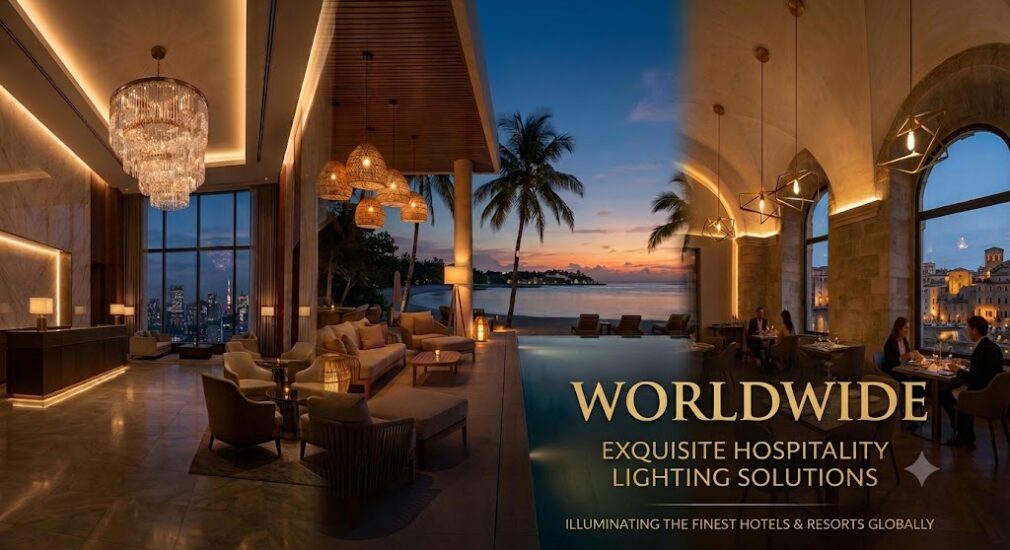
Lighting is one of the most influential design elements in a hospitality environment. It shapes the first impression of a hotel, influences how guests experience a restaurant or lounge, supports comfort in guest rooms and suites, and can transform an architectural façade after sunset. Well-planned Hospitality Lighting Solutions therefore go far beyond simply providing illumination. They combine architectural design, visual comfort, energy efficiency, technology and atmosphere to create memorable spaces.
From luxury hotels in Dubai and Riyadh to resorts in Goa, boutique properties in London, hospitality developments across Europe, and premium hotels in New York, Singapore and Sydney, professional lighting has become an essential part of contemporary hospitality design.
For architects, interior designers, lighting designers, MEP consultants, developers, contractors and procurement teams, the objective is to create a lighting environment that complements the architecture while delivering reliable performance and operational efficiency. This is where Hospitality Lighting Design, architectural LED systems, decorative illumination, façade lighting, smart controls and bespoke fixtures work together.
What Are Hospitality Lighting Solutions?
Hospitality Lighting Solutions are integrated lighting systems designed specifically for hotels, resorts, restaurants, cafés, bars, spas, wellness destinations, clubs, lounges, serviced apartments and other guest-focused environments.
Unlike standard commercial illumination, hospitality projects require a carefully controlled relationship between light, architecture and human experience. Different zones demand different lighting characteristics. A hotel lobby may require dramatic architectural lighting and decorative pendants, while a guest room needs comfortable ambient illumination, functional reading light and flexible scene control.
A comprehensive hospitality lighting strategy may include:
- Hospitality Lighting Design
- Hotel Lighting Solutions
- Resort Lighting Solutions
- Luxury Hospitality Lighting
- Hospitality LED Lighting Solutions
- Architectural and façade lighting
- Lobby and reception lighting
- Guest room and suite lighting
- Restaurant and dining lighting
- Spa and wellness lighting
- Landscape and outdoor lighting
- Smart lighting and lighting control systems
- Decorative and bespoke luminaires
- Emergency and functional lighting
- Energy-efficient lighting systems
The strongest projects do not treat these elements independently. Instead, they develop a coordinated lighting hierarchy that guides guests naturally through the property.
Why Lighting Matters in Modern Hospitality
Hospitality is fundamentally an experience-driven industry. Guests interact with a property through architecture, interiors, materials, sound, landscape and light. Among these elements, lighting has the unique ability to alter the perception of colour, scale, texture and atmosphere throughout the day.
A well-designed lighting environment can make a reception area feel welcoming, a restaurant feel intimate, a wellness space feel tranquil and a façade appear visually distinctive at night.
Professional Hotel Lighting Design also considers how people actually use each space. A guest reading in a suite has different visual requirements from a visitor relaxing beside a pool. Similarly, a restaurant table requires a different lighting approach from a corridor, staircase or service area.
For this reason, lighting designers typically consider:
- Visual comfort
- Colour rendering
- Colour temperature
- Glare control
- Beam distribution
- Illuminance levels
- Vertical illumination
- Accent lighting
- Architectural proportions
- Energy consumption
- Maintenance access
- Lighting controls
- Daylight integration
- Safety requirements
The result should feel effortless to the guest, even though significant technical planning takes place behind the scenes.
Hotel Lighting Solutions for Different Areas
A successful hotel does not rely on one lighting type throughout the building. Each zone should have its own lighting strategy while remaining visually connected to the overall design language.
Hotel Lobby and Reception Lighting
The lobby is often the first major interior space guests experience. It establishes the visual identity of the property and provides an opportunity to combine architectural illumination with decorative elements.
Hotel Lobby Lighting can incorporate recessed downlights, linear lighting, indirect illumination, wall washers, accent spotlights, decorative pendants and feature lighting.
Architectural details such as stone walls, timber panels, textured surfaces, artwork and reception counters can be highlighted using carefully positioned accent lighting.
For luxury properties, Luxury Hotel Lighting should create a sophisticated atmosphere without excessive brightness. Layered lighting is generally more effective than uniform illumination because it creates depth and visual hierarchy.
Guest Room and Suite Lighting
Guest rooms require a balance between comfort, functionality and flexibility.
A typical lighting strategy may include ambient illumination, bedside reading lights, wardrobe lighting, vanity illumination, decorative lighting and concealed indirect light.
LED Lighting for Hotels is particularly effective when luminaires provide high colour quality, low glare and reliable dimming. Guests should be able to create different lighting scenes depending on whether they are working, relaxing, reading or preparing for sleep.
In premium suites, Custom Hospitality Lighting can be developed around furniture, architectural details and interior finishes, creating a more integrated appearance.
Hotel Corridors and Circulation Areas
Corridors connect different hospitality spaces and require consistent visual guidance. Lighting should support wayfinding while avoiding excessive brightness or uncomfortable glare.
Linear fixtures, recessed luminaires, wall washers and concealed lighting can be combined to create rhythm along long circulation spaces.
In high-end projects, Architectural Hospitality Lighting can also highlight artwork, wall textures, niches and architectural transitions without overwhelming the space.
Hotel Restaurant and Dining Lighting
Restaurant lighting requires particularly careful control because light affects the perception of food, materials and ambience.
Restaurant Lighting Solutions commonly combine ambient, accent and decorative lighting. Pendant fixtures may define dining tables, while directional spotlights can emphasise architectural features or artwork.
The lighting designer must also consider the colour rendering performance of the LED source. High-quality light helps food, fabrics, timber, stone and skin tones appear natural.
Fine-dining environments may use lower-level ambient illumination with carefully controlled table lighting, while casual restaurants may require a brighter and more energetic atmosphere.
Resort Lighting Solutions for Destination Properties
Resorts have a broader lighting requirement than conventional hotels because they often combine accommodation, restaurants, pools, gardens, pathways, recreational areas and extensive outdoor architecture.
Resort Lighting Solutions should therefore connect indoor and outdoor environments while maintaining a consistent visual identity.
A comprehensive resort lighting strategy may include:
- Resort entrance lighting
- Arrival and drop-off lighting
- Landscape lighting
- Pool and water-feature lighting
- Pathway lighting
- Villa lighting
- Restaurant lighting
- Spa lighting
- Façade illumination
- Garden accent lighting
- Outdoor architectural lighting
- Signage and wayfinding illumination
In destinations such as Goa, Dubai, Bali, Phuket, the Maldives, the Red Sea region and the Mediterranean, the relationship between architecture and landscape becomes particularly important after sunset.
Luxury Resort Lighting
Luxury Resort Lighting requires a restrained approach. High-end environments generally benefit from carefully concealed sources, precise beam control and subtle contrasts rather than excessive fixture visibility.
Landscape elements can be softly illuminated to create depth, while architectural surfaces can receive grazing or washing effects. Pools and water features may use underwater illumination, while pathways can be lit for both safety and visual continuity.
The objective is not to make every surface equally bright. Instead, the lighting composition should guide attention toward important architectural and landscape elements.
Luxury Hospitality Lighting and Brand Identity
Lighting can become part of a hospitality brand’s identity.
A luxury hotel may use a distinctive lighting language across its lobby, restaurants, guest rooms, corridors and exterior architecture. Consistent colour temperature, fixture geometry, illumination levels and control scenes can reinforce the character established by the interior and architectural design.
Luxury Hospitality Lighting is particularly important for five-star hotels, branded residences, boutique properties and premium resorts where guests expect a carefully curated environment.
Bespoke fixtures can also become architectural features in their own right. Large chandeliers, sculptural pendants, illuminated ceilings and custom linear systems can provide visual focal points while supporting the broader lighting concept.
Architectural Hospitality Lighting
Modern hospitality architecture increasingly relies on integrated illumination rather than conventional surface-mounted fixtures.
Architectural Hospitality Lighting can be incorporated into ceilings, walls, joinery, furniture, façades, stairs, landscape elements and architectural details.
Linear LED systems are particularly versatile because they can be customised for different lengths, profiles, outputs and installation conditions.
Applications include:
- Cove lighting
- Recessed linear lighting
- Concealed ceiling illumination
- Wall grazing
- Wall washing
- Shelf and joinery illumination
- Step lighting
- Handrail lighting
- Feature lighting
- Façade accent lighting
The right approach depends on the architecture, material palette, viewing distance and desired visual effect.
Hospitality LED Lighting Solutions
LED technology has transformed hospitality lighting because it provides designers with greater flexibility in output, colour temperature, optical distribution, dimming and control.
Hospitality LED Lighting Solutions can deliver high efficiency while supporting sophisticated lighting scenes across guest areas and back-of-house spaces.
Important considerations include:
- LED efficiency
- Colour rendering index (CRI)
- Colour consistency
- CCT selection
- Beam angle
- Optical performance
- Dimming compatibility
- Driver quality
- Thermal management
- IP protection
- Product lifetime
- Maintenance requirements
For hospitality projects, product quality is especially important because many luminaires operate for long periods and can be difficult or expensive to replace once a property is operational.
Creating the Right Lighting Atmosphere
Good hospitality lighting is rarely about maximum brightness. It is about creating the right visual balance.
A successful scheme may combine ambient illumination for general visibility, accent lighting for focal points, decorative fixtures for identity and indirect lighting for softness.
This layered approach allows one space to support different moods and activities.
For example, a hotel restaurant might operate with a brighter scene during breakfast, a balanced scene during lunch and a warmer, more intimate scene during dinner. In a luxury lobby, architectural lighting may remain active throughout the evening while decorative fixtures create a changing visual atmosphere.
This flexibility is one of the key reasons why modern Smart Lighting Solutions for Hotels are becoming increasingly valuable.
Hospitality Lighting Worldwide
Hospitality lighting requirements vary according to architecture, climate, cultural expectations, operating conditions and project standards.
In India, hospitality developments range from urban business hotels in Mumbai and Bengaluru to luxury resorts in Goa, Rajasthan and Kerala.
Across the GCC, major destinations such as Dubai, Abu Dhabi, Riyadh, Doha, Muscat, Kuwait City and Manama are seeing continued investment in luxury hotels, resorts, mixed-use developments and destination hospitality.
In the USA, hospitality projects in New York, Miami, Los Angeles, Las Vegas, Chicago and Orlando often combine sophisticated interiors with technologically advanced lighting systems.
The UK and European markets place strong emphasis on architectural integration, energy performance, heritage considerations and refined interior environments, particularly in London, Paris, Milan, Berlin, Barcelona and Amsterdam.
Across Asia-Pacific, cities such as Singapore, Tokyo, Seoul, Sydney and Melbourne continue to develop premium hotels, resorts and mixed-use hospitality destinations where architectural lighting plays an important role in creating distinctive guest experiences.
Hospitality Lighting Applications for Hotels, Resorts, Restaurants & Wellness Spaces
The most effective hospitality environments use lighting as part of the architectural experience rather than treating it as a final technical requirement. Every area of a hotel, resort or hospitality destination has a different visual purpose, and the lighting strategy should respond to that purpose.
From the welcoming glow of a hotel entrance to the intimate atmosphere of a fine-dining restaurant, professional Hospitality Lighting Design creates visual hierarchy, supports guest comfort and strengthens the identity of the property.
Hotel Entrance and Arrival Lighting
The arrival experience begins before a guest enters the building. Driveways, drop-off areas, entrances, canopies, landscape elements and architectural features all contribute to the first impression.
Hotel Entrance Lighting should provide sufficient visibility while maintaining an elegant transition between exterior and interior spaces.
Architectural façade lighting, concealed linear fixtures, recessed uplighters, landscape luminaires and carefully positioned accent lights can be combined to create a distinctive arrival sequence.
For luxury properties, excessive brightness can reduce the sense of exclusivity. A controlled composition of light and shadow often produces a more sophisticated result.
Hotel Lobby Lighting Design
The lobby is one of the most important areas for Hotel Lighting Solutions because it combines architecture, hospitality, circulation and brand identity.
A successful lobby scheme often uses several layers:
- Ambient lighting for general illumination
- Accent lighting for artwork and architectural details
- Decorative lighting for visual identity
- Indirect lighting for softness
- Task lighting at reception and concierge areas
- Feature lighting for ceilings, columns and statement surfaces
Large decorative pendants or chandeliers can become focal points, while concealed linear systems can provide architectural continuity.
Wall washers are useful for highlighting stone, timber, textured walls and artwork. Narrow-beam spotlights can create controlled accents without flooding the entire space with light.
Guest Room and Suite Lighting
Guest rooms require a more personal lighting environment. Guests should be able to adjust the atmosphere according to their activities and preferences.
A complete Hotel Guest Room Lighting strategy may include:
- General ambient illumination
- Bedside reading lights
- Headboard lighting
- Wardrobe illumination
- Desk lighting
- Mirror and vanity lighting
- Bathroom lighting
- Decorative bedside fixtures
- Cove and indirect lighting
- Night lighting
The placement of controls is equally important. Guests should be able to operate essential lighting from convenient locations without searching for multiple switches.
Premium hotels increasingly use scene-based controls that allow guests to select predefined settings such as Welcome, Relax, Reading, Night and All Off.
Hotel Bathroom and Vanity Lighting
Bathrooms require a combination of functional and atmospheric illumination.
Hotel Bathroom Lighting should provide adequate light around mirrors and vanity areas while avoiding harsh shadows on the face.
Vertical illumination is particularly important around mirrors. Lighting from the sides or from integrated mirror systems can provide a more balanced appearance than a single overhead source.
Wet areas also require appropriate product selection, including suitable IP protection and materials capable of handling the environmental conditions.
Hotel Corridor Lighting
Corridors often occupy significant areas of a hotel and can strongly influence the perceived quality of the property.
Rather than creating an evenly illuminated corridor, designers can use architectural rhythm and controlled contrast.
Recessed downlights, linear lighting, wall grazing, artwork illumination and concealed ceiling systems can help create a calm and directional environment.
In contemporary properties, Linear Lighting for Hospitality can be integrated into ceiling details or wall junctions to create a continuous architectural line.
Restaurant Lighting Solutions
Restaurants require a careful balance between functional visibility and atmosphere.
Restaurant Lighting Solutions should support the dining experience while complementing the interior design, furniture, finishes and food presentation.
Different restaurant concepts require different approaches.
A fine-dining restaurant may use:
- Warm ambient illumination
- Focused table lighting
- Decorative pendants
- Artwork accent lighting
- Wall washing
- Dimmable architectural lighting
A casual restaurant may require brighter general illumination, stronger circulation lighting and more visible architectural features.
The lighting design should also avoid direct glare into diners’ eyes or uncontrolled reflections from glossy tables, glassware and polished surfaces.
Café, Bar and Lounge Lighting
Cafés, bars and lounges often depend heavily on atmosphere and visual identity.
Hospitality Lighting Solutions for these spaces can use decorative pendants, wall lights, concealed LED strips, shelf illumination, backlighting and accent spotlights.
Bars may benefit from concentrated lighting over counters and bottle displays, while lounge areas can use lower-level ambient illumination with selected highlights.
Integrated lighting can also make architectural details such as textured walls, timber shelving, artwork and decorative objects more visually prominent.
Ballroom and Banquet Hall Lighting
Ballrooms and event spaces need flexibility because the same room may host weddings, conferences, dinners, exhibitions and corporate events.
A well-planned Banquet Hall Lighting system should therefore support multiple lighting scenes.
Typical requirements include:
- General ambient lighting
- Stage illumination
- Decorative feature lighting
- Architectural accent lighting
- Dimmable ceiling systems
- Flexible event scenes
- Emergency lighting
- Control integration
Lighting controls can allow operators to change the atmosphere quickly without physically adjusting individual fixtures.
Spa and Wellness Lighting Solutions
Wellness environments demand a fundamentally different lighting approach from energetic commercial spaces.
Spa Lighting Solutions should encourage relaxation and visual comfort. Harsh glare, excessive contrast and overly cool light can undermine the intended atmosphere.
Warm or tunable white lighting, indirect illumination, concealed sources and carefully controlled accent lighting are commonly suitable for spa environments.
Treatment rooms may require functional lighting when therapists need visibility, while relaxation areas can operate at lower illumination levels.
Wellness Lighting
Wellness Lighting can also support circadian considerations by allowing colour temperature and intensity to change according to the time of day.
In premium wellness resorts, lighting may be coordinated with natural materials, water features, landscape elements and acoustic design to create a more immersive environment.
Hotel Pool and Water Feature Lighting
Water can become a powerful architectural element when illuminated correctly.
Hotel Pool Lighting may include underwater luminaires, perimeter illumination, surrounding landscape lighting and reflected architectural light.
The objective should be to create visual depth without producing uncomfortable glare or excessive brightness.
Water features, fountains and reflective surfaces can also be used to create dynamic nighttime compositions.
Outdoor luminaires should be selected according to installation conditions, exposure to water and environmental requirements.
Hospitality Landscape Lighting
Large resorts frequently depend on landscape design to establish their nighttime identity.
Hospitality Landscape Lighting can highlight trees, planting, pathways, sculptures, water features, seating areas and architectural transitions.
A successful landscape scheme does not illuminate everything equally. Instead, designers typically create a hierarchy of visual focal points.
For example, a pathway may receive subtle guidance lighting while a mature tree or sculpture receives a stronger accent. This creates depth and prevents the landscape from appearing flat.
Hotel Façade Lighting
The building exterior becomes a major visual asset after sunset.
Hotel Façade Lighting can emphasise architectural geometry, materials, columns, fins, balconies, entrances and distinctive building elements.
Depending on the façade material and architectural concept, designers may use:
- Wall washers
- Grazing lights
- Linear LED systems
- Inground luminaires
- Floodlights
- Projector-style spotlights
- Concealed façade fixtures
- Tunable white systems
- Dynamic colour-changing systems
The choice between static white, tunable white and dynamic RGB/RGBW lighting should be based on the architecture and operational requirements rather than technology alone.
Architectural Lighting for Resorts
Resort architecture often includes multiple structures rather than one single building.
This makes Architectural Lighting Solutions for Hotels particularly important because the lighting needs to create visual continuity across villas, restaurants, reception buildings, spa facilities and landscape areas.
A coordinated lighting language can help the property feel like one destination rather than a collection of disconnected buildings.
Outdoor Hospitality Lighting
Outdoor spaces increasingly function as extensions of hospitality interiors.
Terraces, rooftop restaurants, outdoor lounges, courtyards and gardens require lighting that supports both usability and atmosphere.
Outdoor Hospitality Lighting should consider:
- Weather exposure
- IP rating
- Corrosion resistance
- Glare
- Maintenance
- Beam control
- Light spill
- Landscape integration
- Energy consumption
For coastal destinations, material selection becomes particularly important because salt-laden air can accelerate corrosion.
Custom and Bespoke Hospitality Lighting
Standard luminaires may not always achieve the design intent of a premium hospitality project.
Bespoke Hospitality Lighting allows architects and interior designers to develop luminaires around the dimensions, materials and architectural character of a specific space.
Custom solutions can include:
- Sculptural chandeliers
- Custom pendant systems
- Bespoke wall lights
- Integrated linear profiles
- Custom decorative fixtures
- Feature ceiling lighting
- Illuminated furniture
- Special architectural details
Custom Hotel Lighting is particularly valuable for luxury properties where lighting fixtures themselves form part of the interior design.
A bespoke fixture can be developed around a project’s material palette, ceiling height, colour scheme and spatial proportions rather than forcing the architecture to accommodate an off-the-shelf product.
Architectural LED Lighting for Hospitality
LED technology offers designers significant flexibility for hospitality applications.
Architectural LED Lighting for Hotels can be integrated into ceilings, walls, furniture, joinery, façades and landscape structures.
Linear LED systems are especially useful for concealed applications because they can provide continuous illumination with minimal visual interruption.
Applications include:
- Cove illumination
- Under-counter lighting
- Headboard lighting
- Wardrobe lighting
- Stair lighting
- Handrail lighting
- Shelf illumination
- Façade lines
- Ceiling details
- Landscape accents
The quality of the LED system remains critical. Colour consistency, thermal management, driver performance and long-term reliability should be evaluated alongside initial purchase cost.
Lighting for Boutique Hotels
Boutique properties often have a more individual architectural identity than large hotel chains.
Boutique Hotel Lighting can therefore use lighting to emphasise local materials, artwork, heritage features and distinctive interior details.
A boutique hotel in London may require a different lighting language from a resort in Bali or a contemporary property in Dubai. The lighting strategy should respond to the architecture and brand rather than following a generic hotel template.
Lighting for Luxury Hospitality Projects
Luxury hospitality environments require precision at every level.
Luxury Hospitality Lighting should consider the relationship between light source, luminaire, architecture, interior finishes and guest movement.
Premium lighting can be subtle. In many high-end environments, the best result is achieved when guests notice the architecture and atmosphere rather than the lighting equipment itself.
This requires careful fixture selection, optical control, dimming performance, colour quality and coordination between the architectural and interior design teams.
The Importance of Lighting Coordination
Hospitality projects involve many disciplines, including architecture, interior design, landscape design, electrical engineering, MEP services, branding and construction.
Lighting should therefore be coordinated early in the design process.
A professional lighting team can work with architects and consultants to determine:
- Luminaire locations
- Ceiling coordination
- Power requirements
- Driver positions
- Control systems
- Emergency lighting
- Access for maintenance
- Installation details
- DIALux or equivalent lighting calculations
- Photometric performance
- Mock-up requirements
Early coordination reduces the risk of visible fixtures, conflicting services, insufficient illumination or expensive changes during construction.
Lighting Design for Different Hospitality Markets
Hospitality lighting requirements can vary significantly between regions.
In the UAE, luxury hotels and resorts often combine architectural façades, premium interiors, landscape environments and advanced lighting controls.
In Saudi Arabia, large-scale hospitality developments and destination projects create demand for robust architectural, landscape and façade lighting systems.
In Qatar, Kuwait, Bahrain and Oman, hotel and resort developments often require lighting solutions adapted to demanding climatic conditions and premium architectural environments.
In India, hospitality lighting spans luxury urban hotels, business properties, heritage destinations, beach resorts and wellness retreats.
Across the USA, hotel lighting projects frequently integrate sophisticated controls, energy-efficient LED systems and highly differentiated interior concepts.
In the UK and Europe, lighting design often places strong emphasis on architectural integration, energy performance, heritage sensitivity and refined visual comfort.
Across Singapore, Japan, South Korea, China, Australia and New Zealand, hospitality lighting increasingly combines technology, energy efficiency, architectural minimalism and guest experience.
The best Global Hospitality Lighting Solutions therefore combine international technical expertise with an understanding of the project’s local architecture, climate, regulations and operational requirements.
Moving Beyond Illumination
Modern hospitality lighting is no longer simply about making a room visible. It is about creating an environment that guests remember.
The right combination of ambient, accent, decorative, architectural and indirect illumination can transform the perception of a property without changing its physical architecture.
For hotels, resorts, restaurants, spas and wellness destinations, lighting should be considered an integral part of the design concept from the earliest stages of the project.
The next stage is to connect these lighting applications with intelligent controls, energy management, DALI and KNX systems, human-centric lighting, maintenance planning and project-level lighting calculations.
Smart, Energy-Efficient & Intelligent Hospitality Lighting Solutions
Modern hospitality projects require more than visually attractive luminaires. Hotels, resorts, restaurants and wellness destinations operate for long hours, serve guests with different needs and often contain hundreds or thousands of individual lighting points. As a result, lighting performance, energy consumption, control, maintenance and flexibility have become essential parts of the design process.
A professional Hospitality Lighting Solution brings architectural intent and technical performance together. The goal is to create an environment that feels refined to guests while remaining efficient, controllable and practical for hotel operators.
Smart Lighting Solutions for Hotels
Smart technology is changing how hotels manage and experience light.
Smart Lighting Solutions for Hotels allow lighting scenes, intensity, colour temperature and operating schedules to be controlled according to occupancy, time of day, room function and operational requirements.
A smart hospitality lighting system can support:
- Automated lighting scenes
- Dimming
- Occupancy-based control
- Daylight-responsive lighting
- Centralised monitoring
- Guest-room controls
- Time-based scheduling
- Energy management
- Remote diagnostics
- Integration with building management systems
In a luxury hotel, different lighting scenes can be programmed for arrival, evening, night-time cleaning, events or maintenance.
The technology should remain intuitive. Guests should not need technical knowledge to operate the lighting in their room.
Hotel Lighting Control Systems
Hotel Lighting Control Systems provide a bridge between individual luminaires and the operational requirements of the property.
Depending on project scale and specifications, lighting controls may include dimmers, sensors, scene controllers, touch panels, room automation systems and central management platforms.
A properly designed control system can help reduce unnecessary energy consumption while improving the guest experience.
For example, corridor lighting can operate at different levels during daytime and nighttime, while back-of-house areas can respond to occupancy. Meeting rooms can use predefined scenes for presentations, conferences and cleaning.
DALI Hotel Lighting
DALI is widely used for digitally controlled lighting applications where individual addressability and flexible dimming are required.
DALI Hotel Lighting systems can allow luminaires or groups of luminaires to be controlled individually, making them suitable for hotels with multiple zones and changing operational requirements.
Potential applications include:
- Guest rooms
- Corridors
- Restaurants
- Conference rooms
- Ballrooms
- Lobbies
- Retail areas
- Back-of-house spaces
The benefit is greater control over lighting scenes and easier adjustment when the use of a space changes.
For large hospitality projects, DALI can also support more structured commissioning and maintenance compared with basic switching arrangements.
KNX and Hospitality Lighting Automation
KNX Hotel Lighting and building automation can connect lighting with other building systems.
Depending on the project specification, lighting may interact with:
- HVAC
- Shading systems
- Occupancy sensors
- Access control
- Room automation
- Building management systems
- Energy monitoring
This creates a more integrated environment in which lighting becomes part of the overall building automation strategy.
For example, when a guest enters a room, the system can activate a predefined Welcome scene. When the room becomes unoccupied, selected loads can automatically switch off or reduce their output.
Energy-Efficient Hospitality Lighting
Energy efficiency is increasingly important for hospitality operators because lighting can represent a significant part of a property’s electricity consumption.
Energy Efficient Hospitality Lighting starts with efficient LED technology but should not stop there.
Efficiency can be improved through:
- High-performance LED luminaires
- Appropriate lighting levels
- Efficient optical design
- Dimming
- Occupancy detection
- Daylight harvesting
- Automated scheduling
- Intelligent controls
- Correct luminaire positioning
- Regular system monitoring
Simply installing higher-output fixtures is not an efficient strategy. The better approach is to deliver the required visual performance with the appropriate amount of light.
LED Lighting for Hotels
LED Lighting for Hotels provides significant flexibility because LED luminaires can be developed in different form factors and optical configurations.
Applications range from compact recessed fixtures to high-output architectural luminaires, linear systems, wall washers and exterior projectors.
Hotel operators should evaluate more than wattage when selecting LED products.
Important parameters include:
- Lumens
- Lumens per watt
- CRI
- CCT
- Beam angle
- UGR or glare performance
- Driver quality
- Dimming compatibility
- Thermal management
- IP rating
- Expected lifetime
- Colour consistency
A lower purchase price does not necessarily mean a lower lifecycle cost. Product reliability, replacement access, energy use and maintenance requirements should all be considered.
Human-Centric Hospitality Lighting
Human experience is at the centre of hospitality design.
Human Centric Hospitality Lighting considers how changes in light intensity and colour temperature can support different activities and moods throughout the day.
Hotels can use different lighting scenes for morning, daytime, evening and nighttime environments.
For example:
- Brighter and more neutral light for daytime activities
- Balanced illumination for working and social interaction
- Warmer light for evening relaxation
- Lower-level illumination for nighttime circulation
This approach can be particularly relevant to wellness hotels, luxury resorts, healthcare hospitality environments and premium guest rooms.
Human-centric lighting should be designed responsibly and integrated with the property’s architecture, controls and operational requirements rather than treated as a decorative technology.
Tunable White Lighting for Hospitality
Tunable white technology allows the colour temperature of suitable luminaires to be adjusted across a defined range.
Tunable White Hospitality Lighting can help create different visual atmospheres without changing the luminaires.
It can be used in:
- Hotel lobbies
- Guest rooms
- Restaurants
- Wellness spaces
- Conference rooms
- Retail environments
- Multi-purpose hospitality spaces
The choice of colour temperature should always be based on the material palette, activity, time of day and desired atmosphere.
Colour Rendering and Hospitality Experience
Colour quality is particularly important in hospitality because guests interact with food, skin tones, fabrics, artwork, wood, stone and decorative finishes.
High-quality Architectural LED Lighting for Hotels should provide consistent colour rendering and stable performance.
CRI is one useful measure, but professional lighting specifications may also consider R9 performance, colour consistency and the visual characteristics of the specific LED source.
Restaurants and fine-dining environments can benefit significantly from carefully selected high-colour-quality light because food presentation is part of the overall guest experience.
Glare Control in Hotel Lighting
Excessive glare can make a sophisticated interior uncomfortable.
Hotel Lighting Solutions should therefore consider luminaire positioning, beam angle, shielding, mounting height and viewing direction.
Glare can be particularly problematic in:
- Hotel rooms
- Reception areas
- Restaurants
- Conference rooms
- Corridors
- Workspaces
- Spa environments
A well-designed scheme controls the light source so that guests see the intended illuminated surface rather than an unnecessarily bright LED or reflector.
UGR and Visual Comfort
In spaces where guests read, work or participate in meetings, visual comfort becomes increasingly important.
Hospitality Lighting Design should consider glare limitations according to the activity and relevant project standards.
For example, a guest-room desk may require focused task lighting while a conference room needs comfortable illumination for presentations, note-taking and screen viewing.
The appropriate solution is determined by the space rather than by applying one lighting value throughout the property.
IP Rating for Hospitality Lighting
Outdoor and wet-area applications require careful consideration of environmental protection.
IP Rated Hospitality Lighting may be required for:
- Swimming pools
- Outdoor terraces
- Gardens
- Façades
- Water features
- Bathrooms
- External walkways
- Coastal environments
The required IP level depends on the installation location and exposure conditions. Product selection should always be based on the actual environmental requirements and applicable project standards.
For coastal hospitality developments, material selection and corrosion resistance should also be evaluated alongside IP protection.
Façade and Architectural Lighting Controls
Large hotels and resorts often require coordinated exterior lighting.
Hotel Façade Lighting can be connected to timers, astronomical clocks, sensors or central control systems to ensure the building operates according to predefined schedules.
Dynamic lighting can also be used for special events or architectural programming, but it should be carefully controlled to prevent visual clutter and excessive light spill.
For premium developments, static warm or neutral architectural illumination is often more timeless than continuously changing colour effects.
Sustainable Hospitality Lighting
Sustainability is becoming increasingly important for hotel owners, developers and operators.
Sustainable Hospitality Lighting considers energy consumption, product lifetime, maintenance, material selection, controls and responsible use of exterior illumination.
An efficient lighting strategy can reduce operational energy demand while maintaining the required guest experience.
Design teams may also consider:
- Long-life LED systems
- Replaceable components
- Efficient drivers
- Dimming
- Automated controls
- Daylight integration
- Reduced light spill
- Appropriate exterior illumination
- Maintenance planning
- Product lifecycle
Sustainability should be incorporated at the design stage rather than added after the lighting specification has already been finalised.
Custom Hospitality Lighting Manufacturer
Luxury projects frequently require fixtures that are not available as standard catalogue products.
A Custom Hospitality Lighting Manufacturer can work with architects, lighting designers and interior designers to develop products around a project’s requirements.
Customisation may involve:
- Dimensions
- Finishes
- Colour
- Mounting method
- Optical distribution
- Light output
- Colour temperature
- Dimming
- Material
- Ceiling integration
For procurement teams, custom manufacturing can also provide greater consistency across multiple areas of a large hospitality project.
Hospitality Lighting Manufacturer
Selecting the right Hospitality Lighting Manufacturer is an important part of project delivery.
A professional manufacturer should be able to support more than product supply.
Architects and consultants may require photometric files, technical drawings, product specifications, samples and application guidance.
Contractors may require installation information, driver details, wiring requirements and coordinated delivery.
Procurement teams may require commercial documentation, lead times, certifications and production capabilities.
The ideal partner should therefore understand the entire project lifecycle.
Hospitality Lighting Consultant and Design Coordination
A Hospitality Lighting Consultant can help translate architectural concepts into measurable lighting requirements.
The design process may include:
Concept Development
Understanding the architecture, interior concept, brand identity and guest journey.
Lighting Strategy
Establishing lighting layers, colour temperature, hierarchy, accent locations and functional requirements.
Technical Design
Selecting luminaires, optics, drivers, controls and mounting arrangements.
Lighting Calculations
Using professional software such as DIALux or equivalent tools to evaluate illumination, uniformity and other relevant parameters.
Mock-Ups
Testing important areas before large-scale installation.
Coordination
Working with architecture, interiors, electrical, MEP, landscape and construction teams.
Commissioning
Adjusting scenes, aiming fixtures and verifying the final lighting environment.
This structured process can significantly reduce costly changes during construction.
DIALux Lighting Design for Hospitality Projects
Large hospitality projects often benefit from professional lighting calculations.
DIALux Lighting Design can help designers evaluate how luminaires perform within a space before installation.
Depending on project requirements, calculations may examine:
- Illuminance
- Uniformity
- Light distribution
- Glare-related considerations
- Surface illumination
- Daylight interaction
- Fixture positioning
For hotel corridors, restaurants, guest rooms, offices and outdoor spaces, digital modelling can help identify potential issues before construction.
However, calculations should complement—not replace—the design concept and real-world visual evaluation.
Hospitality Lighting Project Planning
Successful lighting projects depend on early planning.
A typical workflow can include:
Architectural Concept → Lighting Concept → Luminaire Selection → Technical Design → Photometric Evaluation → Controls → Mock-Up → Coordination → Procurement → Installation → Commissioning
Early involvement allows the lighting strategy to influence ceiling details, joinery, electrical provisions and architectural elements.
Late-stage lighting selection often results in compromises because ceiling layouts and services may already be fixed.
Lighting Maintenance for Hotels
Hospitality properties cannot afford frequent lighting failures in prominent guest areas.
Maintenance should therefore be considered during product selection.
Design teams should evaluate:
- Access to luminaires
- Driver replacement
- Cleaning requirements
- Product availability
- Spare components
- Environmental exposure
- Expected operating hours
- Warranty support
For difficult-to-access architectural installations, reliable products and appropriate maintenance planning are particularly important.
Why Integrated Hospitality Lighting Creates Better Projects
The most successful hospitality projects combine aesthetics, technology and operational performance.
A beautiful fixture is not enough if it creates glare. An efficient luminaire is not enough if its colour quality is unsuitable. A sophisticated control system is not valuable if guests cannot use it intuitively.
Professional Hospitality Lighting Solutions bring these considerations together.
The result is a lighting environment that supports architecture, guest experience, energy performance, operational efficiency and long-term value.
Hospitality Lighting Solutions Worldwide: Regional Expertise, Project Selection & Future Trends
Hospitality development is expanding across established luxury markets and emerging destinations worldwide. From five-star hotels and branded residences to resorts, wellness retreats, restaurants and mixed-use destinations, every market has its own architectural language, environmental conditions, project standards and guest expectations.
For this reason, Global Hospitality Lighting Solutions should never follow a one-size-fits-all approach. A successful lighting strategy combines international technical knowledge with a detailed understanding of the local project, architecture, climate, regulations, operating conditions and brand identity.
Hospitality Lighting Solutions in India
India has one of the world’s most diverse hospitality environments, ranging from luxury urban hotels and business properties to heritage hotels, destination resorts, wellness retreats and coastal resorts.
Hospitality Lighting Solutions India can be tailored for projects across Mumbai, Delhi, Bengaluru, Hyderabad, Chennai, Pune, Ahmedabad, Jaipur, Goa, Kolkata, Kochi, Chandigarh and other emerging hospitality destinations.
Luxury properties may require sophisticated lobby lighting, decorative fixtures, façade illumination and landscape lighting, while resort destinations often require integrated indoor and outdoor lighting.
Hotel Lighting Solutions India can include:
- Hotel lobby lighting
- Guest room lighting
- Restaurant lighting
- Resort lighting
- Façade lighting
- Landscape lighting
- Spa and wellness lighting
- Smart hotel lighting
- Custom architectural lighting
Hospitality Lighting Across the GCC
The GCC has become one of the world’s most important markets for luxury hospitality, destination resorts and large-scale tourism developments.
Hospitality Lighting GCC projects often combine dramatic architecture, premium interiors, extensive landscape environments and advanced lighting controls.
UAE Hospitality Lighting
Hospitality Lighting Solutions UAE are increasingly relevant to luxury hotels, resorts, branded residences and mixed-use developments.
In Dubai, Abu Dhabi, Sharjah and Ras Al Khaimah, projects may require a combination of Hotel Lighting Dubai, architectural façade lighting, landscape illumination, decorative interiors and smart controls.
Dubai’s hospitality environment particularly demands lighting that can differentiate a property while complementing sophisticated architectural design.
Saudi Arabia Hospitality Lighting
Saudi Arabia is developing major hospitality and tourism destinations across Riyadh, Jeddah, the Red Sea region, NEOM and other emerging locations.
Hospitality Lighting Solutions Saudi Arabia can support hotels, resorts, cultural destinations, entertainment venues and large mixed-use developments.
Hotel Lighting Riyadh and Hotel Lighting Jeddah projects may require high-performance architectural systems combined with energy-conscious controls and robust exterior products.
Large destination developments can also require integrated façade, landscape and wayfinding illumination.
Qatar Hospitality Lighting
Hospitality Lighting Qatar continues to support premium hotels, resorts, restaurants and tourism developments.
For projects in Doha, Hotel Lighting Doha can combine architectural illumination, lobby lighting, guest-room systems, restaurant lighting and exterior landscape solutions.
Lighting should also be selected with consideration for the region’s environmental conditions and long operating hours.
Kuwait, Bahrain and Oman
The hospitality sectors in Kuwait, Bahrain and Oman provide opportunities for refined architectural and hotel lighting.
Hospitality Lighting Kuwait, Hospitality Lighting Bahrain and Hospitality Lighting Oman can cover hotels, resorts, restaurants, wellness destinations and mixed-use developments.
In Kuwait City, Manama and Muscat, designers may require lighting systems that combine contemporary architecture with regional design characteristics.
For resort developments in Oman, landscape and exterior lighting can become particularly important because the relationship between architecture and natural surroundings forms an important part of the guest experience.
Hospitality Lighting Solutions in the USA
The United States has a highly diverse hospitality market, ranging from urban luxury hotels and boutique properties to resorts, casinos and destination entertainment developments.
Hospitality Lighting Solutions USA can support projects in New York, Los Angeles, Miami, Las Vegas, Chicago, Dallas, San Francisco and Orlando.
Luxury properties may place strong emphasis on:
- Architectural integration
- Energy-efficient LED systems
- Lighting controls
- Decorative lighting
- Guest-room automation
- Restaurant ambience
- Façade identity
- Landscape illumination
Hotel Lighting New York may require a sophisticated urban design approach, while Hospitality Lighting Las Vegas can involve more dynamic architectural and entertainment-oriented environments.
Resort destinations such as Miami and Orlando often require extensive outdoor, landscape and pool lighting in addition to interior systems.
Hospitality Lighting Solutions in the UK
The UK combines contemporary hotel development with heritage buildings, boutique properties and luxury hospitality destinations.
Hospitality Lighting Solutions UK should therefore respond to both modern architectural requirements and sensitive heritage environments.
London remains a major hospitality centre, with premium hotels, restaurants, serviced residences and boutique properties requiring refined lighting solutions.
Hotel Lighting London may involve integrated architectural illumination, decorative fixtures, restaurant lighting, guest-room lighting and façade enhancement.
Across Manchester, Birmingham, Edinburgh and Glasgow, hospitality projects can range from modern urban hotels to converted historic properties.
In heritage environments, discreet fixture integration and careful control of light levels are particularly important.
Hospitality Lighting Solutions Across Europe
Europe offers a wide range of architectural styles, from historic buildings and luxury resorts to contemporary urban hotels.
Italy
Hospitality Lighting Italy can support luxury hotels, restaurants and resorts where architecture, materials and craftsmanship play a major role.
Hotel Lighting Milan and Hospitality Lighting Rome may require refined architectural integration and high-quality decorative lighting.
France
In France, Hospitality Lighting France can support luxury hotels, restaurants, resorts and boutique properties.
Hotel Lighting Paris often requires a balance between elegance, architectural character and contemporary technology.
Germany
Hospitality Lighting Germany can place strong emphasis on technical performance, energy efficiency and precise architectural integration.
Hotel Lighting Berlin and Hotel Lighting Munich can require sophisticated lighting controls and highly coordinated technical solutions.
Spain and the Mediterranean
Hospitality Lighting Spain supports urban hotels, coastal resorts and destination properties.
Barcelona, Madrid and Mediterranean destinations can require a combination of façade, landscape, pool and architectural lighting.
The same principles apply to luxury resort environments where outdoor spaces form an important part of the guest journey.
Netherlands and Switzerland
In the Netherlands, Hospitality Lighting Netherlands can support contemporary hotels and sustainable hospitality developments, particularly in Amsterdam and other major cities.
Swiss hospitality projects may require high-quality architectural lighting for hotels and alpine resorts, with careful consideration of environmental exposure and landscape integration.
Hospitality Lighting in Asia-Pacific
Asia-Pacific includes some of the world’s most technologically advanced hospitality environments.
Singapore
Hospitality Lighting Singapore frequently combines architectural minimalism, energy efficiency, automation and premium interiors.
Hotel Lighting Singapore can involve integrated ceiling systems, smart controls, façade illumination and sophisticated public-area lighting.
Japan
Hospitality Lighting Japan requires sensitivity to architectural simplicity, materiality and visual balance.
In Tokyo and other major cities, Hotel Lighting Tokyo can combine advanced technology with discreet architectural integration.
South Korea
Hospitality Lighting South Korea can support contemporary hotels, retail-integrated developments and premium hospitality destinations.
Hotel Lighting Seoul may incorporate architectural LED systems, smart controls and decorative lighting.
China
China’s large hospitality market includes luxury hotels, resorts and mixed-use developments.
Hospitality Lighting China can cover major cities such as Shanghai, Beijing, Shenzhen, Guangzhou and other growing destinations.
Large projects may require scalable lighting systems, custom fixtures and centralised controls.
Hospitality Lighting Australia and New Zealand
Australia combines urban hotels, coastal resorts, luxury destinations and large outdoor hospitality environments.
Hospitality Lighting Australia can support hotels and resorts in Sydney, Melbourne, Brisbane, Perth and Gold Coast.
Hotel Lighting Sydney may involve contemporary architectural lighting, while resort environments often require landscape, façade and outdoor systems.
In New Zealand, Hospitality Lighting New Zealand can support hotels and resorts in Auckland, Queenstown and other tourism destinations.
Landscape integration and environmental durability can be particularly important in resort locations.
Choosing a Hospitality Lighting Partner
Selecting a lighting partner should go beyond comparing fixture prices.
A professional Hospitality Lighting Manufacturer should understand architectural design, technical performance, manufacturing quality and project delivery.
Before appointing a supplier, architects, developers and procurement teams should evaluate:
Product Quality
Review LED performance, optics, driver quality, thermal management, colour consistency and expected service life.
Technical Support
The lighting partner should be able to provide technical drawings, photometric files, specifications, samples and application guidance.
Custom Manufacturing
For premium projects, Custom Hospitality Lighting Manufacturer capabilities can be important when standard products cannot meet the architectural concept.
Project Experience
Experience with hotels, resorts, restaurants, spas and large-scale architectural projects can help identify potential design and installation issues early.
Lighting Design Support
A capable Hospitality Lighting Consultant or manufacturer should understand lighting calculations, fixture positioning, optical performance and control requirements.
International Supply
For international projects, procurement teams should consider manufacturing capacity, export experience, documentation, packaging, lead times and after-sales support.
Hospitality Lighting Project Workflow
A structured process helps maintain quality from concept to completion.
1. Understand the Project
Review architecture, interior design, landscape, brand identity, room functions and operational requirements.
2. Develop the Lighting Concept
Establish lighting layers, visual hierarchy, colour temperature and key architectural focal points.
3. Select the Technology
Choose appropriate LED luminaires, optics, drivers, controls and protection ratings.
4. Prepare Technical Design
Develop layouts, specifications, schedules and relevant lighting calculations.
5. Coordinate With Other Disciplines
Coordinate with architects, interior designers, MEP consultants, electrical engineers, landscape designers and contractors.
6. Test Important Areas
Mock-ups can help evaluate colour, beam distribution, glare, brightness and material interaction before mass installation.
7. Manufacture and Supply
Production should follow approved specifications and quality requirements.
8. Install and Commission
Final aiming, dimming levels, scene programming and lighting adjustments should be completed after installation.
Future of Hospitality Lighting
The future of hospitality lighting is moving toward greater integration.
Smart Hospitality Lighting will increasingly interact with building automation, occupancy systems, room controls and energy-management platforms.
At the same time, architects and designers are placing greater emphasis on:
- Human experience
- Energy efficiency
- Tunable white lighting
- Low-glare illumination
- Architectural integration
- Sustainable materials
- Custom lighting
- Connected controls
- Intelligent energy management
- Reduced light pollution
The industry is also moving away from excessive illumination toward more carefully composed environments.
In premium hospitality, the future is likely to favour lighting that is technologically advanced but visually discreet.
Frequently Asked Questions About Hospitality Lighting Solutions
What are hospitality lighting solutions?
Hospitality Lighting Solutions are integrated lighting systems designed for hotels, resorts, restaurants, spas, lounges, wellness centres and other guest-focused environments. They can include architectural, decorative, ambient, accent, façade, landscape, smart and energy-efficient lighting.
Why is lighting important in hotels?
Professional hotel lighting influences guest comfort, architectural perception, brand identity, wayfinding and ambience. It can also contribute to operational efficiency when combined with dimming, occupancy detection and intelligent controls.
What lighting is best for luxury hotels?
There is no single fixture type that is best for every luxury hotel. A layered approach combining ambient, accent, decorative and indirect illumination generally provides greater flexibility. High-quality LEDs, precise optics, low glare and reliable dimming are also important.
Is LED lighting suitable for hospitality projects?
Yes. Hospitality LED Lighting Solutions provide flexibility in output, colour temperature, beam distribution, dimming and integration. They can also offer strong energy performance when correctly specified and controlled.
What is DALI lighting for hotels?
DALI Hotel Lighting is a digitally controlled lighting approach that can provide individual or grouped control of compatible luminaires. It is useful for projects requiring flexible scenes, dimming and structured lighting control.
Can hospitality lighting be customised?
Yes. Custom Hotel Lighting and bespoke luminaires can be developed around architectural dimensions, finishes, mounting conditions, optical requirements and interior design concepts.
How can hotels reduce lighting energy consumption?
Hotels can improve lighting efficiency through high-performance LED luminaires, appropriate illumination levels, dimming, occupancy sensors, daylight-responsive controls, scheduling and centralised energy management.
What should architects consider when selecting hotel lighting?
Architects and lighting designers should consider the architectural concept, visual comfort, colour quality, optics, luminaire integration, maintenance, energy performance, controls, environmental conditions and long-term reliability.
Why work with an architectural lighting manufacturer?
An experienced Architectural Lighting Manufacturer for Hotels can provide product development, technical support, photometric data, customisation, manufacturing, project coordination and international supply capabilities alongside the lighting products themselves.
Conclusion
Hospitality lighting has evolved from a basic functional requirement into a strategic part of architectural and guest-experience design.
From Hotel Lighting Solutions in urban properties to Luxury Resort Lighting, wellness environments, restaurants, façades and landscaped destinations, every application requires its own balance of performance, comfort and atmosphere.
Whether the project is located in India, the GCC, UAE, Saudi Arabia, Qatar, Kuwait, Bahrain, Oman, the USA, UK, Europe, China, Japan, South Korea, Singapore, Australia or New Zealand, the fundamental objective remains the same: create an environment where architecture, technology and human experience work together.
For architects, developers, lighting designers, MEP consultants, contractors and procurement teams, the right Hospitality Lighting Solutions Provider should offer more than a catalogue of luminaires. The ideal partner combines architectural understanding, technical expertise, manufacturing capability, customisation, project support and dependable international delivery.
At Luzion Lighting, hospitality projects can be approached as complete lighting environments—from architectural and decorative luminaires to façade, landscape, linear, smart and bespoke lighting systems—helping design teams create distinctive hospitality spaces with a consistent visual language.
Related posts
21 Oct 2026
Channel Letter Signage in UAE: Types, Materials and Applications
Channel letter signage is widely used by retail stores, hotels, restaurants, shopping malls and commercial buildings to display business names,…
21 Oct 2026
3D Letter Signage in UAE: Materials, Finishes and Applications
In a competitive commercial environment, signage plays an important role in how customers recognise a brand, locate a business and…
21 Oct 2026
Types of Illuminated Signage: A Guide for UAE & GCC Projects
Illuminated signage plays an important role in how commercial buildings, hotels, retail developments and corporate spaces communicate their identity. In…
17 Oct 2026
Commercial Signage Solutions UAE & GCC
How to Choose Commercial Signage Solutions in the UAE & GCC Commercial signage plays an important role in how people…
02 Oct 2026
Canadian Bespoke Lights
Canadian Bespoke Lighting: Where Design Becomes a Signature Luxury architecture is rarely defined by one element alone. The character of…
subscribe for newsletter

Luzion is a leading manufacturer and exporter of high-quality LED lighting solutions. With a focus on design, research, and innovation, we offer a wide range of products for commercial, industrial, residential, and outdoor spaces.
